• Home
  • About
  • Defense Systems
  • Manufacturer
  • Comparisons
  • Compare 
  • Tools
TheDefenseWatch.com
  • Aerospace & Aviation
  • Military & Ordnance
  • Naval & Maritime
  • Cyber & Space Defense
  • Policy & Strategy
  • Global News
  • Tools Library
    • Smart Calculator
    • Drone Flight Time Calculator
    • Drone Range Calculator
    • Counter-Drone Jammer Effective Range Calculator
    • Counter-Battery Radar Detection Calculator
    • Artillery Fire Correction Calculator
    • Thermal Camera Detection Range Calculator
    • Missile Range & Time-of-Flight Calculator
    • Radar Detection Range Calculator
    • FPV Strike Drone Payload vs Range Calculator
    • Loitering Munition Endurance Calculator
    • Sniper Ballistic Drop & Windage Calculator
    • Bullet Drop Calculator
    • U.S. Army Combat Fitness Test (ACFT) Calculator
    • Military Pension Calculator
    • Military Retirement Calculator
    • Military Pension Calculator
    • Large Number Calculator
Font ResizerAa

TheDefenseWatch.com

The Defense Watch | U.S. & Global Defense News, Analysis & Military Updates

Search
  • Home
  • About
  • Defense Systems
  • Manufacturer
  • Comparisons
  • Compare 
  • Tools

Stay Updated

Get the latest update

Subscribe

Explore

  • Drone
  • Fighter Jets & Military Aircraft
  • Hypersonic Weapons
  • Aircraft Carriers
  • Strategic History & Missions
  • Tools Library
Home » FAA Investigates Marine One Flight Safety Incident After Airspace Separation Lapse Near Reagan National
Defense Budgets & PolicyPolicy & Strategy

FAA Investigates Marine One Flight Safety Incident After Airspace Separation Lapse Near Reagan National

Samuel Drake | Defense Analyst
Last updated: August 5, 2026 2:43 am
Samuel Drake | Defense Analyst
Share
2 Min Read
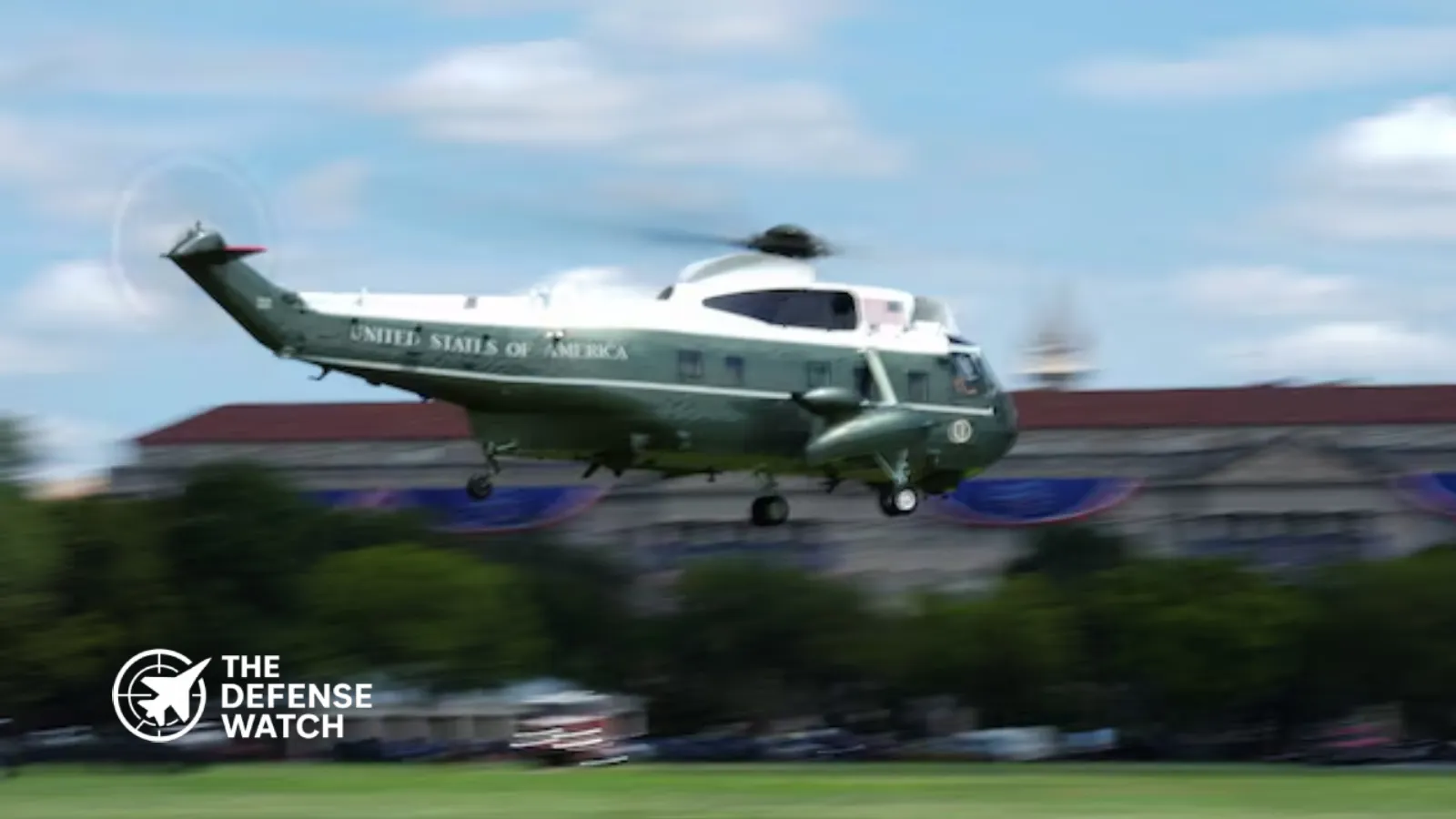
FAA Marine One safety incident
Image: REUTERS
SHARE

Executive Summary:

The Federal Aviation Administration is investigating a safety incident involving Marine One and a regional passenger aircraft operating near Ronald Reagan Washington National Airport. The review will determine whether established airspace separation procedures for presidential helicopter operations were correctly followed, even though both aircraft landed safely without coming into dangerous proximity.

FAA Investigates Marine One Safety Incident Near Reagan National

The FAA Marine One safety incident is under federal investigation after presidential helicopter operations near Washington, D.C., coincided with commercial airline departures from Ronald Reagan Washington National Airport.

Contents
  • FAA Investigates Marine One Safety Incident Near Reagan National
  • What Happened?
  • Why Marine One Flights Require Special Airspace Procedures
  • FAA Review Will Focus on Air Traffic Procedures
  • Defense and Aviation Perspective
  • What Happens Next?

According to the Federal Aviation Administration, the incident occurred Tuesday afternoon when Marine One, carrying President Donald Trump, departed from the White House while an Envoy Air regional flight departed Reagan National shortly afterward. Although both aircraft maintained safe flight paths and landed without incident, investigators are examining whether mandatory airspace separation requirements were properly observed.

The review comes as aviation authorities continue implementing stricter procedures around one of the nation’s busiest and most complex airspaces following the fatal January 2025 collision involving an Army helicopter and a regional passenger aircraft.

What Happened?

FAA officials said Marine One lifted off from the White House at approximately 2:33 p.m. local time. About one minute later, Envoy Air Flight 3742 departed Ronald Reagan Washington National Airport.

- Advertisement -

Federal regulations generally require aircraft to maintain at least 1.5 miles of horizontal separation and 500 feet of vertical separation. While preliminary information indicates the two aircraft were not converging and never reached a point considered a near midair collision, investigators believe the required minimum separation may not have been maintained throughout the operation.

A second regional aircraft was reportedly delayed as a precaution while controllers managed traffic in the area.

Why Marine One Flights Require Special Airspace Procedures

Marine One flights involve some of the most tightly controlled airspace management procedures in the United States.

Whenever the President travels by helicopter between the White House and Joint Base Andrews or other destinations, the FAA coordinates with the U.S. Secret Service, military flight crews, and air traffic controllers to temporarily restrict nearby civilian operations.

These procedures are designed to accomplish two objectives:

  • Maintain safe aircraft separation.
  • Protect presidential security through controlled airspace.

Following the January 2025 midair collision near Reagan National that killed 67 people, the FAA introduced additional restrictions that significantly reduced simultaneous helicopter and commercial jet operations around the airport. Those reforms were intended to minimize the risk of conflicting traffic in Washington’s highly congested airspace.

FAA Review Will Focus on Air Traffic Procedures

The FAA has confirmed that its Safety Review Team will evaluate the circumstances surrounding the event.

Investigators are expected to review:

- Advertisement -
  • Air traffic control communications.
  • Flight tracking and radar data.
  • Timing of aircraft departures.
  • Compliance with established presidential movement procedures.

FAA officials emphasized that the event does not currently appear to qualify as a near miss because the aircraft were never on converging flight paths. Nevertheless, any deviation from required separation standards triggers a formal safety review under federal procedures.

The White House had not publicly commented on the investigation at the time of reporting.

Defense and Aviation Perspective

While the incident does not indicate an operational failure aboard Marine One itself, it underscores the growing complexity of managing military, VIP, and civilian aviation in the Washington metropolitan area.

Marine One missions require seamless coordination among multiple federal agencies, including the U.S. Marine Corps, FAA air traffic controllers, the Secret Service, and airport operators. As commercial traffic continues to increase, maintaining procedural discipline becomes even more important around sensitive government flight operations.

The investigation also highlights the broader shift toward proactive aviation safety oversight following the extensive reforms introduced after the 2025 Washington air collision. Rather than waiting for accidents, regulators are increasingly examining procedural deviations that could reveal systemic weaknesses before they lead to more serious events.

From a defense aviation perspective, the review demonstrates that presidential airlift missions remain subject to rigorous civilian aviation safety standards despite their military and national security role. Such investigations are a normal part of aviation safety management and help refine coordination between military and civilian airspace users.

What Happens Next?

The FAA’s Safety Review Team will determine whether established procedures were correctly followed and whether additional operational changes or recommendations are necessary.

At present:

  • Both aircraft landed safely.
  • No injuries were reported.
  • Officials have stated the aircraft did not come dangerously close.
  • The investigation remains ongoing.

TAGGED:Aerospace & AviationGlobal NewsPolicy & Strategy
Share This Article
Facebook Copy Link Print
BySamuel Drake | Defense Analyst
Follow:
Samuel Drake is a defense analyst at TheDefenseWatch.com covering naval warfare, military ordnance, maritime technology, fleet modernization, and defense procurement. His reporting focuses on documented capabilities, procurement programs, and military technology.
Leave a Comment

Leave a Reply Cancel reply

Your email address will not be published. Required fields are marked *

Latest Defense Systems

  • RUTA B1 Cruise Missile RUTA B1 Cruise Missile
  • XQ-67A Drone XQ-67A Drone
  • B-25 Mitchell Bomber B-25 Mitchell Bomber
  • F-100 Super Sabre F-100 Super Sabre
  • North American F-86 Sabre North American F-86 Sabre
  • North American XB-70 Valkyrie North American XB-70 Valkyrie
  • Northrop YF-23 Fighter Northrop YF-23 Fighter
  • P-51 Mustang Fighter Aircraft P-51 Mustang Fighter Aircraft
  • Rafale F5 Fighter Rafale F5 Fighter

Recent Compares

  • J-10C vs JF-17 Thunder: Which Fighter Is More Capable? J-10C vs JF-17 Thunder: Which Fighter Is More Capable? View Comparison →
  • Tejas vs Gripen: Key Differences and Capabilities Tejas vs Gripen: Key Differences and Capabilities View Comparison →
  • Tejas vs MiG-21 Bison: How India Replaced Its Iconic Supersonic Fighter Tejas vs MiG-21 Bison: How India Replaced Its Iconic Supersonic Fighter View Comparison →
  • F-35 vs F-16: Stealth, Sensors and Combat Roles F-35 vs F-16: Stealth, Sensors and Combat Roles View Comparison →
  • Tejas Fighter Jet vs F-16 Fighting Falcon: Capability Compared Tejas Fighter Jet vs F-16 Fighting Falcon: Capability Compared View Comparison →
  • Rafale Fighter Jet vs F-16 Fighting Falcon : Which Fighter Has the Edge? Rafale Fighter Jet vs F-16 Fighting Falcon : Which Fighter Has the Edge? View Comparison →
  • Su-57 Fighter Jet vs J-20 Fighter Jet: Stealth and Air Combat Compared Su-57 Fighter Jet vs J-20 Fighter Jet: Stealth and Air Combat Compared View Comparison →
  • Mirage 2000 vs Tejas Mk1A: Legacy Combat Power vs Indigenous Modernization Mirage 2000 vs Tejas Mk1A: Legacy Combat Power vs Indigenous Modernization View Comparison →
  • Rafale Fighter Jet vs F-22 Raptor: Which Air Dominance Fighter Has the Edge? Rafale Fighter Jet vs F-22 Raptor: Which Air Dominance Fighter Has the Edge? View Comparison →
  • Tejas Fighter Jet vs. Rafale Fighter Jet: India’s Indigenous Fighter Meets France’s Proven Multirole Combat Aircraft Tejas Fighter Jet vs. Rafale Fighter Jet: India’s Indigenous Fighter Meets France’s Proven Multirole Combat Aircraft View Comparison →

Recent Posts

  • Iran Releases Footage of Underground Missile Tunnels Amid Rising US Military Tensions
  • China Says HQ Missile Systems Intercepted Two New Missile Types in PLA Drill
  • Phoenix Defense Ventures Wins $310.5 Million HH-60W Training Contract
  • Rolls-Royce Showcases Naval Engines and Automation Systems at Euronaval 2026
  • North Korea Tests Cruise Missile With Dispersal Warhead, KCNA Says

You Might Also Like

B-52 radar upgrade
Aerospace & AviationFighter Jets & Military Aircraft

US Air Force Faces Critical Test Fleet Loss As B-52 Bomber Crashes During Edwards Mission

September 7, 2026
U.S. shipbuilding budget 2027
Defense Budgets & PolicyPolicy & Strategy

U.S. Navy Races To Expand Fleet As $65.8 Billion Shipbuilding Plan Unveiled

April 5, 2026
Romanian and European Union flags displayed during discussions on joint military procurement and SAFE defense financing initiative
Defense Budgets & PolicyPolicy & Strategy

Romania Moves To Unlock $16B SAFE Defense Program As EU Pushes Joint Military Procurement

September 7, 2026
Türkiye S 400 sale
Alliances & DoctrinesPolicy & Strategy

Türkiye Moves To Explore S-400 Air Defense System Sale As Effort To Reopen Path To U.S. F-35 Program

September 7, 2026

Logo

Copyright © 2026 TheDefenseWatch.com

Helpful Links

  • Home
  • About Us
  • Privacy Policy
  • Terms of Use / Disclaimer
  • U.S. Privacy Notice – CCPA Compliance

Defense Systems

  • Defense Systems
  • Comparisons 
  • Manufacturer
  • Tactical Calculators

Popuplar

Which 5 Air Forces Possess the Costliest Fighter Jet Fleets in the World
Evolving Strategic Value: Carrier Strike Groups in the Indo-Pacific’s Future Security Architecture
Autonomous Weapon Systems Spark U.S. Ethics Debate Amid Rapid Military AI Integration

We report on developments involving military forces, governments, defense companies, research organizations, and security institutions around the world. 

Welcome Back!

Sign in to your account

Username or Email Address
Password

Lost your password?