Executive Summary:
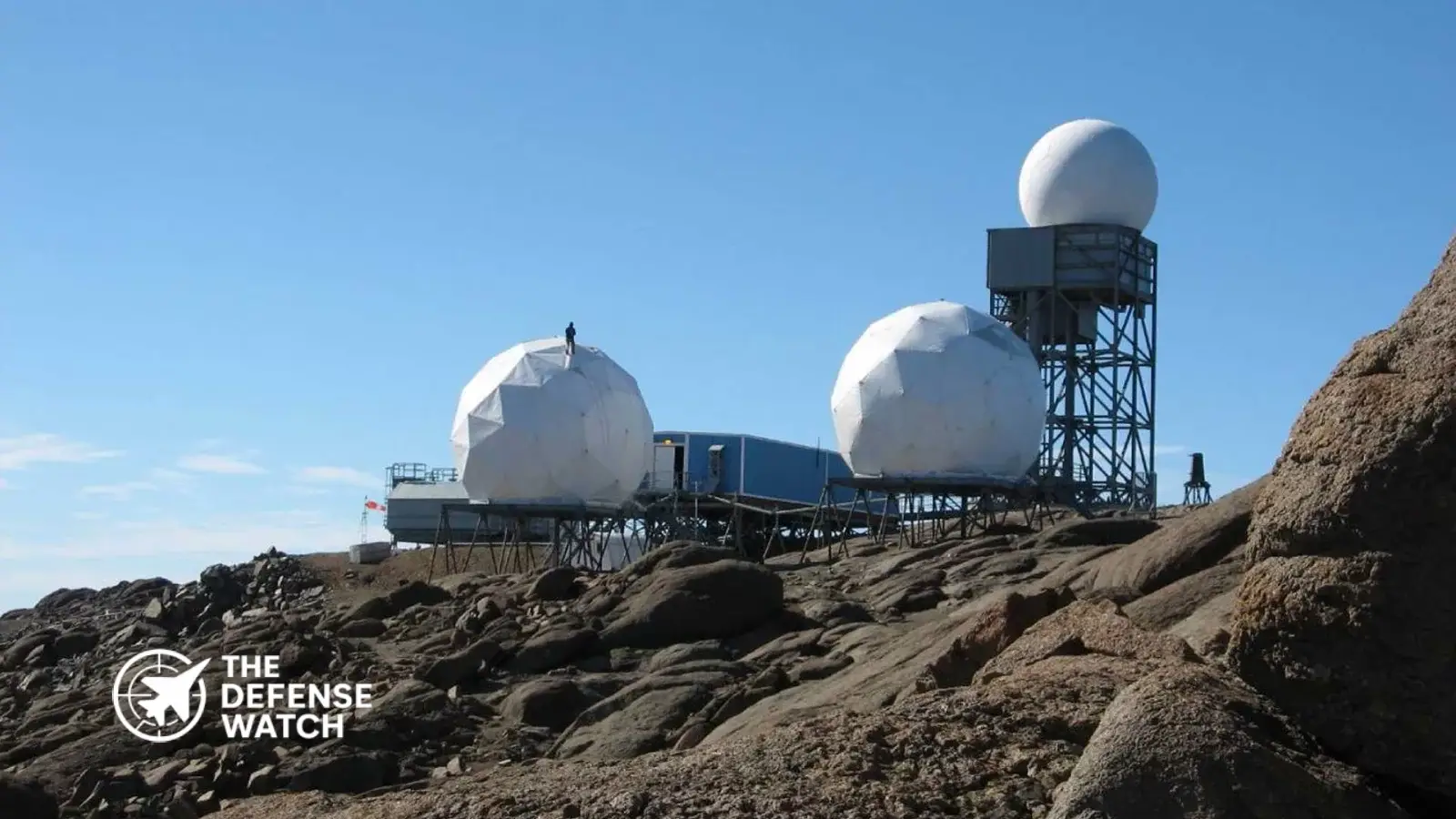
The U.S. Air Force awarded IAP World Services a $40 million indefinite-delivery/indefinite-quantity (IDIQ) contract on May 19, 2026, to replace deteriorating AN/FPS-124 radomes across northern Canada. The work sustains the North Warning System (NWS), a joint U.S.-Canadian NORAD network providing low-altitude surveillance against cruise missiles and aircraft in the Arctic. The effort extends the life of legacy infrastructure while longer-term next-generation systems remain in development.
The U.S. Air Force is investing $40 million to sustain critical Arctic radar infrastructure as part of ongoing efforts to maintain North American aerospace defense capabilities. This contract focuses on the replacement of protective radomes for the AN/FPS-124 short-range radars that form a key component of the binational North Warning System.
The award underscores the continued strategic importance of fixed radar sites in the high North amid growing concerns over Russian activity and potential polar-route threats.
Contract Details and Scope
Announced on May 19, 2026, the contract was awarded to IAP World Services of Melbourne, Florida. It is structured as a five-year base IDIQ with options extending through May 20, 2035. The Air Force Life Cycle Management Center’s Homeland Surveillance Branch at Hill Air Force Base oversees the program.
Work includes production, transportation, installation, removal, and disposal of 28-foot composite radome assemblies. These structures protect unattended AN/FPS-124 radars designed for low-altitude surveillance. Initial fiscal 2025 and 2026 obligations total approximately $4.576 million, with future task orders funding incremental replacements.
The procurement process started with a presolicitation in May 2025, followed by a formal RFP in August 2025. Four bidders participated. The final $40 million ceiling exceeds earlier planning estimates, reflecting the logistical challenges of Arctic operations.
North Warning System: Role and Condition
The North Warning System comprises roughly 15 long-range AN/FPS-117 radars and 36–39 short-range AN/FPS-124 sites stretching from Alaska across Yukon, Northwest Territories, Nunavut, and Labrador. The short-range radars serve as gap-fillers, detecting low-flying threats below the coverage of longer-range systems due to terrain and radar horizon limitations.
Most AN/FPS-124 radomes were installed between 1990 and 1992 when the Distant Early Warning (DEW) Line was upgraded. After more than three decades in one of the harshest environments on Earth, they face degradation from icing, corrosion, high winds, UV exposure, and thermal cycling.
Analysis: Sustaining these sites through targeted radome replacements represents a pragmatic bridge strategy. While ambitious programs for over-the-horizon (OTH) radars, space-based sensors, and distributed systems are underway, full deployment remains years away. Retiring the NWS prematurely would create exploitable gaps in low-altitude coverage precisely when adversaries are investing in advanced cruise missiles and Arctic operational concepts. This incremental approach balances fiscal reality with operational necessity in a theater where logistics costs are exceptionally high.
Strategic Context in the Arctic
The Arctic has become a region of renewed great-power competition. Russia has expanded its military presence, including submarine operations and reactivation of northern bases. China has declared itself a “near-Arctic state” and pursued dual-use infrastructure and research. These developments elevate the importance of reliable early warning for NORAD missions.
The AN/FPS-124 network specifically addresses the polar corridor—the shortest aviation and missile route between Russian strategic assets and North American targets. While long-range radars provide broad surveillance, the short-range units ensure detection of low-altitude penetrators.
This contract fits within broader U.S.-Canada defense cooperation under NORAD. Complementary efforts, such as Canadian contracts for NWS in-service support and U.S. investments in Alaska radar operations, demonstrate a coordinated approach to northern defense.
Operational Impact: Reliable radomes maintain radar uptime and accuracy in extreme conditions. Failures due to structural degradation could create temporary blind spots, complicating 24/7 monitoring of vast airspace. By prioritizing these “unattended” sites, the program preserves a proven, if legacy, layer of defense while newer technologies mature.
Path Forward and Broader Modernization
The radome replacement program does not replace the radars themselves but extends their viability. It signals that fixed infrastructure will remain relevant even as NORAD explores hybrid architectures combining terrestrial radars, airborne sensors, and space assets.
Future phases of Arctic defense modernization are expected to emphasize resilience, rapid deployability, and integration with emerging technologies such as AI-enhanced sensor fusion and autonomous systems. However, the immediate focus remains on keeping existing capabilities functional in a demanding environment.
Conclusion
The $40 million contract awarded to IAP World Services provides essential sustainment for NORAD’s Arctic radar architecture at a time when northern security demands steady investment. By addressing aging radomes, the U.S. Air Force and its Canadian partners ensure continuity of low-altitude surveillance across critical approaches to the continent. This pragmatic step reinforces the foundation for more advanced systems while addressing today’s operational requirements.