NASA Bolsters Flight Test Capabilities With Retired Air National Guard F-15s
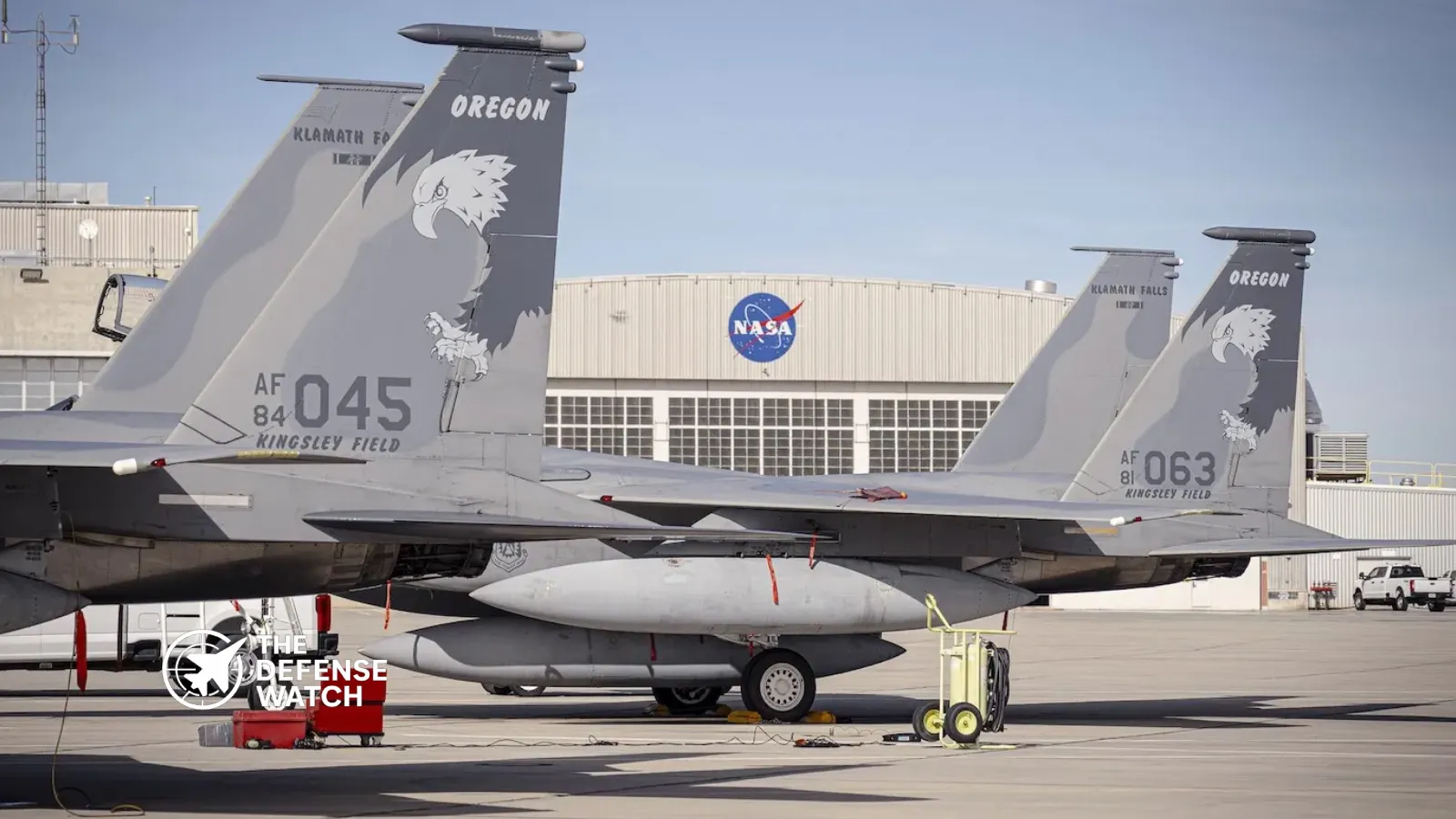
NASA’s Armstrong Flight Research Center has added two retired U.S. Air Force F-15D Eagles to its specialized test aircraft fleet, ensuring continued support for critical aerospace research programs including the groundbreaking X-59 quiet supersonic demonstrator. The twin-seat fighters, previously operated by the Oregon Air National Guard’s 173rd Fighter Wing, arrived at Edwards Air Force Base, California, in late December 2024.
The acquisition demonstrates how legacy military aircraft continue providing value beyond their operational service life. While the Air Force accelerates retirement of its F-15C/D fleet, NASA leverages the platform’s proven high-altitude, high-speed capabilities for missions commercial aircraft cannot perform.
Legacy Eagles Support Next-Generation Supersonic Research
NASA received F-15Ds with serial numbers 81-0063 and 84-0045 from Kingsley Field, the Air Force’s F-15C/D training center currently transitioning to F-35A Lightning II operations. Only one aircraft will enter active research service, with the second designated as a parts donor to maintain the maintenance-intensive Eagles.
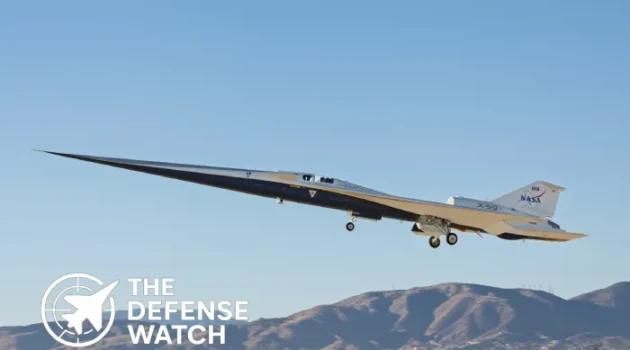
Troy Asher, director for flight operations at NASA Armstrong, confirmed the F-15Ds will primarily support the X-59 Low Boom Flight Demonstrator project. “These two aircraft will enable successful data collection and chase plane capabilities for the X-59 through the life of the Low Boom Flight Demonstrator project,” Asher stated in NASA’s official announcement.
The X-59 Quiet Supersonic Technology aircraft completed its maiden flight in October 2025 at Lockheed Martin’s Palmdale facility. The experimental jet aims to demonstrate technologies that reduce traditional sonic booms to quieter “sonic thumps,” potentially enabling future supersonic commercial flight over land—currently prohibited by federal regulations.
NASA’s F-15s will chase the X-59 during high-speed test flights, collecting critical acoustic and performance data as the demonstrator pushes toward its design speed of Mach 1.4 (approximately 925 mph) at altitudes up to 55,000 feet.
Five Decades of F-15 Contributions to Aerospace Science
NASA has operated F-15 variants since the early 1970s, accumulating an unmatched legacy of high-performance research missions. “NASA has been flying F-15s since some of the earliest models came out in the early 1970s,” Asher noted. “Dozens of scientific experiments have been flown over the decades on NASA’s F-15s and have made a significant contribution to aeronautics and high-speed flight research.”
The Eagle’s unique combination of thrust, altitude capability, and external load capacity makes it ideal for carrying experimental payloads. The aircraft’s generous fuselage ground clearance allows mounting test articles beneath the centerline or wings, while its 1970s-era avionics architecture permits straightforward integration of experimental systems and modified flight controls.
Recent NASA F-15 research programs include:
Advanced propulsion testing: NASA’s F-15B tested channeled center-body inlet designs in 2011, evaluating improved airflow and fuel efficiency across varied flight regimes. The subscale inlet mounted beneath the fighter demonstrated technologies intended for next-generation commercial engines.
(adsbygoogle = window.adsbygoogle || []).push({});Supersonic shockwave measurement: F-15 research aircraft supported Shock-Sensing Probe flight test series, with state-of-the-art nose-mounted instruments measuring shockwaves from supersonic aircraft. These tests advanced understanding of sonic boom formation and propagation.
Thrust vectoring systems: The F-15 Advanced Control Technology for Integrated Vehicles (ACTIVE) program, a joint NASA-Air Force-industry effort in the 1990s, demonstrated multi-axis thrust vectoring using Pratt & Whitney pitch-yaw balance beam nozzles. The heavily modified F-15 featured canard foreplanes and achieved supersonic yaw vectoring, pioneering technologies now standard on advanced fighters.
High-Altitude Upgrades Enable X-59 Chase Missions
To support X-59 testing requirements, NASA modified two earlier F-15s with upgraded life support systems borrowed from F-22 Raptor technology. The positive-pressure breathing system, installed in 2022, prevents hypoxia during high-altitude operations by providing additional oxygen pressure compared to the F-15’s original equipment.
New emergency oxygen bottles and regulators for both pilot and backseater enable safe operations up to 60,000 feet—matching the X-59’s maximum designed altitude of 60,000 feet and cruise altitude of 55,000 feet. The upgraded system shares components with the X-59 itself, including panel-mounted regulators and pressure-reducing devices from liquid oxygen tanks. Flight crews wear identical gear across both platforms, streamlining training and maintenance.
NASA is installing the same life support modifications in the newly acquired F-15D, ensuring standardized high-altitude capability across the research fleet.
Ongoing Laminar Flow Research With Veteran Eagles
NASA’s oldest F-15B research aircraft—NASA tail number 836, a 1974-vintage jet obtained from the Hawaii Air National Guard in 1993—recently commenced testing with a revolutionary wing design concept. In mid-January 2026, the F-15B completed high-speed taxi tests at 144 mph with a three-foot Crossflow Attenuated Natural Laminar Flow (CATNLF) wing model mounted vertically beneath its fuselage.
The CATNLF concept addresses a fundamental challenge in laminar flow aerodynamics: crossflow instabilities that disrupt smooth airflow over swept wings. Even large commercial aircraft like the Boeing 777 experience crossflow effects on their angled wing surfaces, increasing drag and fuel consumption.
According to NASA research, incorporating CATNLF design principles into long-range commercial aircraft could achieve fuel savings up to 10 percent annually—a transformative improvement for airline economics and environmental impact. First flight testing with the CATNLF wing model is scheduled for February 2026.
Air Force Extends Legacy F-15 Service Through 2030
While NASA expands its F-15 research capabilities, the Air Force has revised retirement timelines for operational Eagles. The service’s October 2025 Long-Term Fighter Force Structure report outlined plans to retain 42 combat-coded F-15C/Ds through 2028, contradicting earlier fiscal year 2024 budget documents targeting complete divestment by 2026.
The Air Force determined legacy Eagles remain necessary for homeland defense missions until sufficient F-15EX Eagle II and F-35A fighters become available. After 2028, the youngest 21 F-15C/Ds will continue serving with the California Air National Guard’s 144th Fighter Wing at Fresno until final retirement in 2030.
(adsbygoogle = window.adsbygoogle || []).push({});All active-duty F-15C/D squadrons have already inactivated. The last active-duty units at Kadena Air Base, Japan, transferred their Eagles to Air National Guard units in 2024. Remaining F-15C/Ds now serve exclusively with Guard units or in test roles.
The Air Force characterized its fighter force structure plan as “highly aspirational,” acknowledging budget realities and procurement challenges may alter timelines. However, current planning assumes F-15EX production and F-35A deliveries will fill capability gaps as legacy Eagles retire.
Enduring Value Beyond Military Service
NASA’s F-15 research fleet demonstrates how specialized aircraft can provide decades of service beyond typical operational lifespans. The platform’s robust airframe, powerful engines, and straightforward systems integration continue meeting requirements no other aircraft can fulfill.
Asher emphasized the broader research mission: “They will enable us to resume operations with various external partners, including the Department of Defense and commercial aviation companies.” This multi-mission capability ensures NASA’s F-15s will remain active well into the 2030s, potentially outlasting their military counterparts.
As the Air Force transitions to fifth-generation fighters and advanced F-15EX variants, NASA’s legacy Eagles carry forward a proud heritage—proving that even 50-year-old airframes can pioneer tomorrow’s aerospace breakthroughs when paired with cutting-edge research programs and dedicated engineering teams.