Executive Summary:
The Eurofighter Typhoon is Europe’s most operationally active multirole fighter, flown by nine air forces and now accumulating more than one million flying hours across combat, air policing, and NATO interoperability missions. With the Tranche 5 standard and ECRS Mk2 AESA radar in development, the platform is no longer a legacy 4th-gen holdout — it is being transformed into a 4.5+ generation electromagnetic warfare node with a service horizon extending past 2040. New orders placed in 2025 alone totalled over €15 billion across Germany, Italy, Spain, Turkey, and Bangladesh.
Forty-four Typhoons for Turkey. Twenty Tranche 5 jets for Germany approved at €3.75 billion. A Bangladesh letter of intent signed December 2025. An Italian order worth €7.5 billion finalized the same month. In a year when Europe’s defense procurement machine accelerated to a pace not seen since the Cold War, the Eurofighter Typhoon was the aircraft everyone wanted most.
That’s not a coincidence. The Typhoon has spent two decades quietly accumulating one of the most operationally diverse combat records of any Western fighter — and its upgrade roadmap is now threatening to make it more capable than several fifth-generation platforms in contested electromagnetic environments.
The Hard Numbers: What Makes the Typhoon Different
The Typhoon is a twin-engine, canard-delta multirole fighter designed from the start to be aerodynamically unstable — a deliberate engineering choice that gives it exceptional agility at the cost of requiring fly-by-wire computers to keep it airborne every millisecond. That instability is a feature.
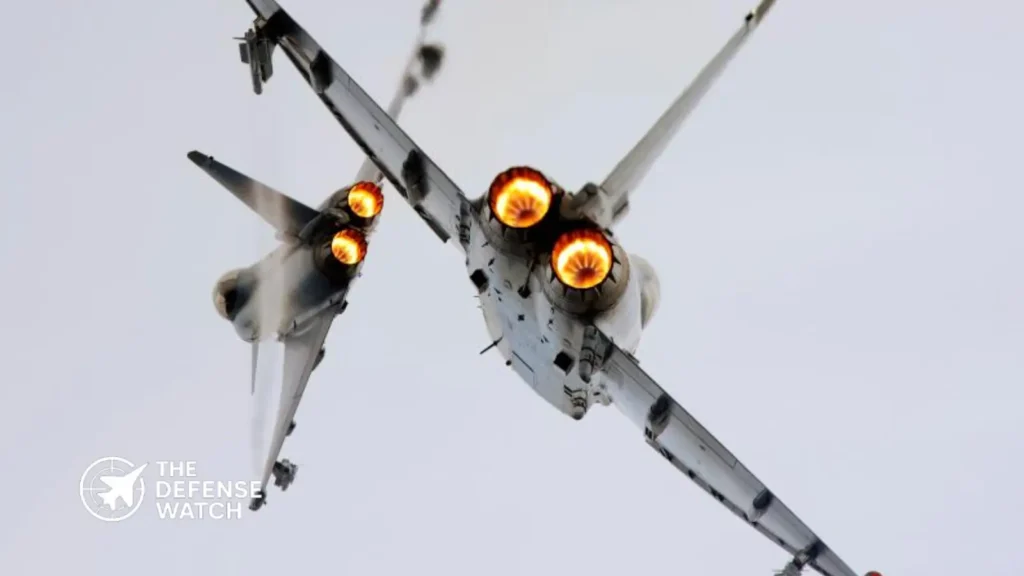
At maximum performance, the aircraft hits Mach 2.35 at altitude — faster than the F-35A (Mach 1.6) and the Dassault Rafale (Mach 1.8). Its EJ200 engines enable supercruise: sustained supersonic flight without afterburner, extending both range and survivability by reducing the aircraft’s infrared signature during cruise. Engine health monitoring is rated at 1,200 flying hours between unscheduled maintenance events.
The airframe uses composite materials for roughly 85% of its surface area, reducing radar cross-section compared to conventional metal construction while cutting structural weight by approximately 30%. Only 15% of the aircraft’s outer mold line is traditional metal. That’s a stealth-adjacent design philosophy built into the bones of a platform that predates the modern stealth era.

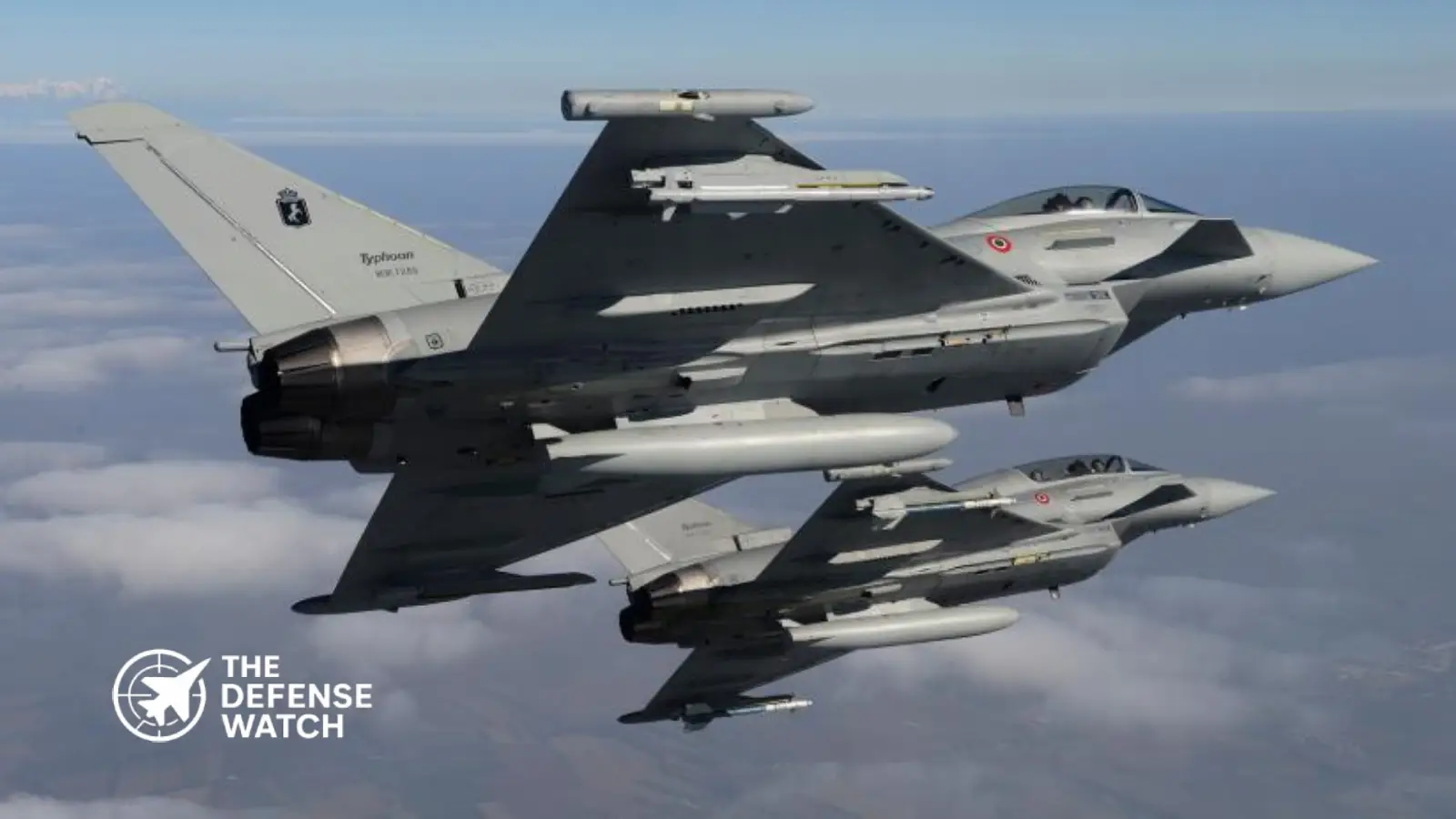
Weapons carriage is genuinely multi-role. The Typhoon fields up to 13 external hardpoints, capable of simultaneously carrying Meteor BVR missiles (the longest-ranged Western air-to-air missile in service), Brimstone 2 precision strike munitions, Storm Shadow/SCALP cruise missiles, and Paveway IV GPS/laser-guided bombs — all in a single sortie when configured for swing-role operations.
Technical Data: Eurofighter Typhoon vs. Primary Competitors
Metric Eurofighter Typhoon (T4/T5) Dassault Rafale F4 F-35A Lightning II Max Speed Mach 2.35 Mach 1.8 Mach 1.6 Unit Cost (approx.) ~€140M (T5) ~€120M (F4, French AF) ~$82M (FY2024 LRIP) Engine 2× EJ200 (20,000 lbf each) 2× M88-4E (16,900 lbf each) 1× F135 (43,000 lbf with AB) Radar (current/future) Captor-M → ECRS Mk0/Mk1/Mk2 RBE2-AA AESA APG-81 AESA Supercruise Yes (Mach ~1.2–1.3) Limited No SEAD/EW Role Yes (EK/ECRS Mk2) Limited No dedicated variant Operators (2026) 9 nations, 700+ aircraft 9 nations, ~220 on order 20+ nations, ~1,000+ delivered Service Horizon 2040s+ (with upgrades) 2040s (Rafale F5 planned) 2070s (platform lifecycle) Combat Debut 2011 Libya 2015 Syria 2019 USAF Cost data: Germany Tranche 5 contract (Breaking Defense, Oct 2025); Rafale French AF estimate (2025 French parliamentary review); F-35 FY2024 Selected Acquisition Report.
The ECRS Mk2: Why This Radar Changes the Calculus
Radar defines the modern air combat kill chain. The Typhoon’s long-standing weakness — its legacy mechanical Captor-M radar — is being corrected in the most aggressive terms possible.
The ECRS Mk2 (European Common Radar System Mark 2), developed by Leonardo UK and integrated by BAE Systems, is not simply a better radar. It is a multi-function active electronically scanned array that combines air-to-air search, ground targeting, and offensive electronic jamming into a single aperture. Its field of regard extends to approximately 200 degrees — about 50% wider than a conventional fixed-plate AESA — enabled by a mechanical steering pivot behind the array.
The radar uses gallium nitride (GaN) transmitter/receiver modules rather than the older gallium arsenide (GaAs) technology. GaN delivers higher power density, wider bandwidth, and better thermal efficiency. In practical terms, this allows the Mk2 to simultaneously track multiple targets, jam enemy radar emitters, and conduct SEAD (Suppression of Enemy Air Defenses) missions — all in one weapon system integration.
The ECRS Mk2 completed its first flight on a UK test and evaluation Typhoon at BAE Systems’ Warton facility in late 2024. The RAF’s Tranche 5 aircraft will receive Mk2 as standard. For Germany and Spain, the ECRS Mk1 from Hensoldt/Indra fills the same generation slot with GaN modules and enhanced signal processing.
When fully fielded, a Mk2-equipped Typhoon will be able to enter contested airspace, blind enemy integrated air defense systems, designate targets for follow-on forces, and egress — without a dedicated electronic attack aircraft in the flight package. That is a capability currently unique to the EA-18G Growler in the Western inventory.
Combat Record: What the Typhoon Has Actually Done
The Typhoon’s combat history is longer than most people realize, and more varied.
In 2011, RAF Typhoons conducted their combat debut over Libya, dropping Paveway IV bombs on armored targets — a mission that required rapid capability integration to even happen. In January 2024, four RAF Typhoons struck Houthi military facilities in Yemen with Paveway IVs during Operation Shader’s Red Sea operations. In April 2024, RAF Typhoons based in Cyprus and Romania intercepted Iranian UAVs during the 2024 Iranian drone strikes on Israel, engaging targets in Iraqi and Syrian airspace — a live ADIZ defense mission over a third-party state.
Most recently, in March 2026, an RAF Typhoon from 12 Squadron operating out of Qatar shot down an Iranian UAV approaching Qatari airspace. That engagement is not a footnote. It is proof that the Typhoon is the primary Western fighter conducting live air defense intercepts in the Persian Gulf theater right now.
During NATO Steadfast Dart 26 in February 2026, German Typhoons conducted manned-unmanned teaming (MUM-T) exercises with Turkish Bayraktar TB3 drones — the UAV provided ISTAR data to Typhoon pilots who then prosecuted precision strikes. It was the first public validation of the Typhoon’s MUM-T architecture in a NATO exercise context.
The Strategic Insight: Adaptability as the Core Doctrine
Here’s the angle that separates Typhoon operators from operators of most other fourth-generation platforms: the aircraft was designed to be upgraded in layers, not replaced in blocks.
In competitive gaming, the teams that win championships over consecutive seasons rarely do so on mechanical skill alone. They win on meta-adaptation — reading the evolving threat environment faster than opponents and restructuring their composition before the enemy can counter. Organizations like Team Liquid or FaZe Clan maintain longevity not by sticking to a single playstyle, but by systematically expanding their toolkit while preserving core strengths.
The Typhoon operates on exactly this doctrine. Its Tranche upgrade system — from Tranche 1’s basic air defense configuration through Tranche 3’s full swing-role capability to Tranche 5’s open software architecture and MUM-T integration — has kept a single airframe relevant across three decades of threat evolution. The avionics computing power in the Tranche 5/ECRS Mk2 configuration is reported to represent a 200-fold increase over Tranche 1 standard. Same aircraft. Completely different brain.
Germany’s decision in October 2025 to approve 20 Tranche 5 Typhoons at €3.75 billion — with deliveries running 2031 to 2034 — and simultaneously fund a €1.13 billion electronic warfare upgrade for 15 existing Typhoon EK aircraft illustrates this doctrine in budget form. The platform is not being retired. It is being restructured as an electromagnetic warfare node while the sixth-generation GCAP/Tempest program matures.
“The Eurofighter Typhoon is predestined to become a bridge for the next generation combat air system.” — Eurofighter GmbH Programme Directorate
That statement is no longer aspirational. With GCAP (the UK-Italy-Japan sixth-generation program) unlikely to reach initial operational capability before the mid-2030s, the Typhoon will carry NATO’s European air superiority burden for at least another 15 years. Every upgrade invested now — ECRS Mk2, Meteor integration, Striker II helmet, AREXIS EW suite — extends that bridge.
The Export Story: Why Nine Nations Have Said Yes
The Typhoon’s export trajectory tells a story that pure capability numbers cannot. Austria, Saudi Arabia, Oman, Qatar, and Kuwait all operate the platform. Turkey signed a £5.4 billion deal with the UK in October 2025 for 20 aircraft — Britain’s largest fighter export deal in nearly two decades, and Turkey’s first combat aircraft purchase from a non-American supplier.
Bangladesh signed a letter of intent with Leonardo in December 2025. The Philippines is evaluating a 32-aircraft Tranche 5 package. Egypt and Italy are negotiating 24 aircraft for approximately $3 billion.
The common thread across these customers is not price — at roughly €140 million per Tranche 5 unit, the Typhoon is not cheap. The common thread is industrial partnership. Every Typhoon sale comes with technology transfer agreements, local maintenance training, national workshare arrangements, and access to a supply chain that supports over 100,000 skilled jobs across Europe. For nations building sovereign defense industries, that package is worth the premium.
Conclusion: The Typhoon in 2026
The Eurofighter Typhoon arrived at its 2026 position through a combination of genuine capability and relentless adaptation. Its combat record spans Libya, Syria, Iraq, Yemen, and the Persian Gulf. Its order books are fuller now than they were five years ago. Its radar is being rebuilt from first principles with GaN AESA technology that puts it ahead of most competitors in the electromagnetic domain.
The narrative that the Typhoon is a transitional platform waiting to be replaced by GCAP or F-35 misses the operational reality. NATO’s European air forces cannot wait for sixth-generation fighters. The Typhoon is what they have, and the Tranche 5 program is ensuring it remains worth having.
One million flying hours logged. Hundreds of live intercepts completed. More than €15 billion in new orders signed in a single calendar year.
The storm isn’t passing. It’s intensifying.
Frequently Asked Questions
How much does a Eurofighter Typhoon cost in 2026?A Tranche 5 Eurofighter Typhoon costs approximately €140 million per unit, based on reported figures from late 2025 program reviews. Germany’s October 2025 contract for 20 Tranche 5 jets was valued at €3.75 billion (~€187 million per aircraft when including associated simulators and support equipment). Export unit pricing varies significantly by contract structure and offset agreements.
How fast is the Eurofighter Typhoon?The Typhoon reaches a maximum speed of Mach 2.35 at altitude. It also has supercruise capability — sustained supersonic flight without afterburner — which reduces the aircraft’s infrared signature during transit and extends operational range compared to non-supercruising platforms.
Has the Eurofighter Typhoon been used in combat?Yes. The Typhoon has a confirmed combat record spanning Libya (2011), Syria and Iraq (2015–present), Yemen (2024), and the Persian Gulf (2024–2026). RAF Typhoons conducted live intercepts of Iranian drones during the April 2024 Israeli strikes and shot down an Iranian UAV over Qatar in March 2026.
What is the ECRS Mk2 radar on the Typhoon?The ECRS Mk2 (European Common Radar System Mark 2) is a next-generation AESA radar developed by Leonardo UK and integrated by BAE Systems. It combines air-to-air targeting, air-to-surface modes, and offensive electronic jamming in a single system. The radar uses gallium nitride modules and has a 200-degree field of regard, making it one of the most capable radar/EW systems fitted to any 4th or 4.5th generation fighter.
How many countries operate the Eurofighter Typhoon?As of 2026, nine countries operate the Typhoon: the United Kingdom, Germany, Italy, Spain, Saudi Arabia, Oman, Qatar, Kuwait, and Austria. Turkey, Bangladesh, and the Philippines are in various stages of procurement discussions or signed agreements.
Will the Eurofighter Typhoon be replaced by GCAP?The UK and Italy plan to replace their Typhoons with the sixth-generation GCAP (Global Combat Air Programme), developed jointly with Japan. However, GCAP is not expected to reach operational service before the mid-2030s at the earliest. Tranche 5 Typhoons being ordered now will bridge that gap, with a projected service life extending into the 2040s.