
T-150 Drone

Defense Systems Full Specifications
1. General Information
| Name | T-150 (TRV-150) |
| Manufacturer | Malloy Aeronautics (BAE Systems) |
| Country of Origin | United Kingdom |
| Type / Role | Heavy Lift Logistics / Cargo UAS |
| First Flight / Introduced | ~2020s (operational trials from 2020) |
| Status | In Service |
| Unit Cost | Not publicly specified (procurement-dependent) |
2. Performance
| Maximum Speed | 108 km/h (30 m/s) |
| Cruise Speed | ~90-108 km/h |
| Operational Range | 13-70 km (payload dependent) |
| Endurance | 36-40 minutes |
| Service Ceiling | Not publicly detailed (tactical altitudes) |
| Rate of Climb | Not publicly detailed |
3. Dimensions
| Length | 2.65 m |
| Wingspan | 2.05 m |
| Height | 0.71 m |
| Maximum Takeoff Weight (MTOW) | ~123 kg (approx., including payload) |
4. Payload & Armament
| Payload Capacity | 68 kg (150 lb) |
| Hardpoints | Cargo mount with remote release |
| Weapons | Primarily cargo; limited adaptations reported |
| Sensors | Basic navigation; autonomous flight systems |
| Avionics | Redundant systems, GPS/INS, waypoint navigation |
5. Propulsion
| Engine Type | 8 x Electric Motors (coaxial rotors) |
| Engine Power | Not publicly detailed |
| Propeller Type | 8 x Rotors |
6. Communication & Control
| Control Type | Remote / Autonomous |
| Data Link Range | Line-of-sight with beyond options |
| Navigation | GPS / INS with anti-jam features |
| Ground Control Station | Laptop-based or portable |
7. Operational Use
| Primary Users | US Marine Corps, UK Royal Navy/Marines, allies |
| Combat Proven | Yes (logistics and reported adaptations) |
| Notable Operations | Arctic resupply, ship-to-shore, tactical trials |
PROS
- Rapid deployment and quick battery swaps enable high operational tempo
- Redundant electric propulsion enhances safety and reliability in harsh conditions
- Compact, foldable design for easy transport by small teams or vehicles
- Proven in real-world military trials with USMC, Royal Navy, and allies
- Autonomous features reduce operator workload and personnel risk
CONS
- Limited endurance (around 36-40 minutes) restricts use to shorter tactical distances
- Payload and range decrease significantly when operating at maximum capacity
- Dependent on battery technology, with potential performance degradation in extreme cold without mitigation
- Primarily logistics-focused, requiring adaptations for non-cargo missions
- Electronic systems may face vulnerabilities in heavily jammed electromagnetic environments
T-150 Heavy Lift Drone: Tactical Resupply UAS
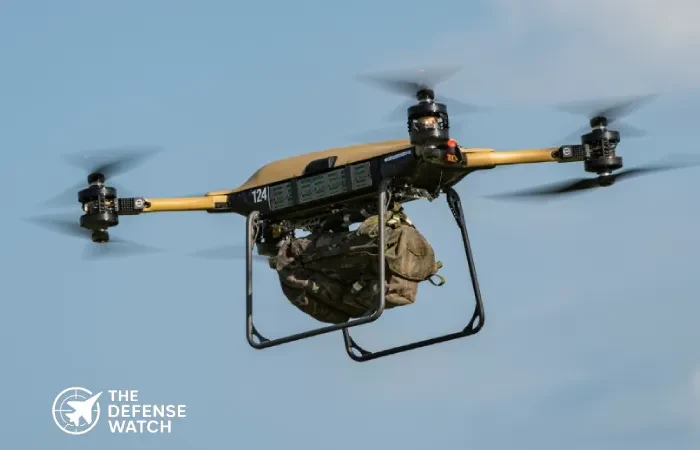
The T-150 represents a practical advancement in military unmanned logistics, addressing the persistent challenge of delivering time-sensitive supplies to dispersed or isolated forces without relying on manned helicopters or ground convoys. This all-electric vertical takeoff and landing (eVTOL) unmanned aircraft system (UAS) enables rapid, autonomous cargo delivery in demanding operational settings, from Arctic conditions to maritime environments.
Manufacturer and Origin
Developed by Malloy Aeronautics in the United Kingdom, the T-150 is now supported through BAE Systems following the acquisition. It has gained traction with U.S. forces, including the U.S. Marine Corps (under the TRV-150 designation), and has seen operational use with the UK Royal Navy and other allies. The platform originated from efforts to create compact, heavy-lift cargo drones for tactical resupply.
Capabilities
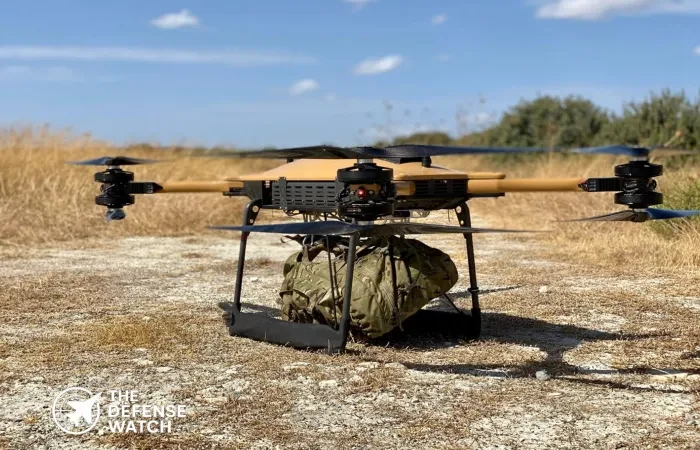
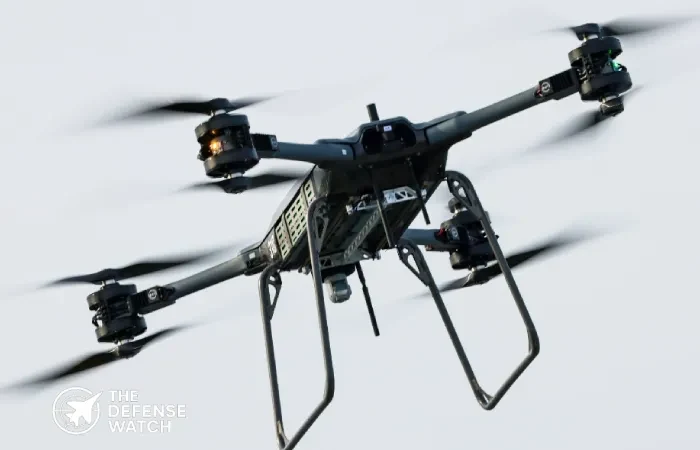
Designed primarily for logistics, the T-150 features eight electric motors driving coaxial rotors for redundancy and reliability. It offers a maximum payload of 68 kg (150 lb), making it suitable for transporting ammunition, medical supplies, food, water, spare parts, or other essential cargo directly to forward positions. Maximum speed reaches approximately 108 km/h (67 mph / 30 m/s), with endurance up to 36-40 minutes depending on payload and conditions. Operational range varies from about 13-37 km with full payload to over 70 km with lighter or zero payload. The system includes hot-swappable batteries for quick turnaround, foldable arms for compact transport, and autonomous waypoint navigation with remote payload release. It has demonstrated performance in extreme environments, including Arctic trials at -28°C and ship-to-shore operations.
For U.S. and NATO forces, the T-150 reduces risk to personnel and platforms by minimizing exposure during resupply missions in contested areas. While optimized for cargo, reports indicate adaptations for other roles in certain conflict zones, highlighting its versatility in modern hybrid warfare. Deployment takes under five minutes with a two-person team, and the rugged design supports all-weather operations.
Cost
Exact unit pricing is not publicly disclosed in detail due to military procurement sensitivities, but heavy-lift tactical UAS in this class typically range in the low hundreds of thousands of dollars per unit, offering a cost-effective alternative to traditional helicopter resupply.
Disclaimer Note
The information provided on TheDefenseWatch.com is for general informational purposes only. While we strive to ensure the accuracy, completeness, and timeliness of our content regarding defense and aerospace products, technologies, and specifications, we cannot guarantee that all information is 100% accurate or up-to-date due to the evolving nature of military technology and classified data.TheDefenseWatch.com does not warrant the reliability, suitability, or availability of the information for any specific purpose. Users are advised to consult official sources, such as manufacturers, government publications, or defense agencies, for precise and verified data before making decisions based on our content.We are not affiliated with any defense manufacturers, governments, or military organizations mentioned. Opinions, reviews, and ratings reflect expert analysis but are subjective and should not be considered endorsements. TheDefenseWatch.com is not responsible for any errors, omissions, or consequences arising from the use of this website’s content.External links are provided for convenience and do not imply endorsement. TheDefenseWatch.com reserves the right to update or modify content without prior notice. By using this website, you agree to our Privacy & Cookies Policy.

New Arrivals


Popular Comparisons
-
 J-10C vs JF-17 Thunder: Which Fighter Is More Capable?
View Comparison →
J-10C vs JF-17 Thunder: Which Fighter Is More Capable?
View Comparison → -
Tejas vs Gripen: Key Differences and Capabilities
View Comparison →
-
Tejas vs MiG-21 Bison: How India Replaced Its Iconic Supersonic Fighter
View Comparison →
-
F-35 vs F-16: Stealth, Sensors and Combat Roles
View Comparison →
-
Tejas Fighter Jet vs F-16 Fighting Falcon: Capability Compared
View Comparison →
-
Rafale Fighter Jet vs F-16 Fighting Falcon : Which Fighter Has the Edge?
View Comparison →
-
Su-57 Fighter Jet vs J-20 Fighter Jet: Stealth and Air Combat Compared
View Comparison →
-
Mirage 2000 vs Tejas Mk1A: Legacy Combat Power vs Indigenous Modernization
View Comparison →
-
Rafale Fighter Jet vs F-22 Raptor: Which Air Dominance Fighter Has the Edge?
View Comparison →
-
Tejas Fighter Jet vs. Rafale Fighter Jet: India’s Indigenous Fighter Meets France’s Proven Multirole Combat Aircraft
View Comparison →


- Ukrainian F-16 vs. Russian Su-35: What Happened, How the Engagement Unfolded and Why It Matters

- Canada’s Fighter Jet Fleet Faces a Critical Transition as F-35 Review Continues
- New Zealand Signs Deal for Five MH-60R Seahawk Helicopters
- U.S. Air Force Test Pilot School Adds Water Landings to Training
- F-22 Takes Control of YFQ-44A as U.S. Air Force Advances Collaborative Combat Aircraft Testing
- U.S. Army Tests Humanoid Robots for Military Missions
- Pentagon and BAE Systems Agree to Expand APKWS Production to 25,000 Kits a Year
- Saab Launches Cloud-Based Mission System for Space Operations
- Lockheed Martin Scales Up Production for Long-Range ER GMLRS Rockets
- L3Harris Delivers 1,000th Shipset of Key F-35 TR-3 Avionics Components



Fighter Jets
-
 SU-57 Felon Stealth Fighter
-
Boeing F/A-XX Fighter
-
JF-17 Thunder Fighter Jet
-
F-47 Fighter Jet
-
MIG-31 Fighter Jet
-
J-10CE Fighter Jet
-
Chengdu J-10 Fighter Jet
-
Chengdu J-10C Fighter Jet
-
Gripen E Fighter Jet
-
Tejas Mk1A Fighter Jet
-
Tejas Mk‑2 Fighter Jet
-
F-16V Viper Block 70 Fighter Jet
-
F-15EX Eagle II Fighter
-
F-15E Strike Eagle Fighter
-
F/A-18E/F Super Hornet Fighter Jet
-
Saab Gripen F Fighter Jet
-
JAS 39E/F Gripen Fighter Jet
-
JAS 39 Gripen Fighter Jet
-
F-35A Lightning II Fighter Jet
-
F/A-18F Super Hornet
-
J-50 Fighter Jet
-
Spanish EF-18 Hornet Fighter
-
F-35i Adir Fighter Jet
-
F-16 Fighting Falcon






Recent Compares
-
J-10C vs JF-17 Thunder: Which Fighter Is More Capable?
View Comparison →
-
Tejas vs Gripen: Key Differences and Capabilities
View Comparison →
-
Tejas vs MiG-21 Bison: How India Replaced Its Iconic Supersonic Fighter
View Comparison →
-
F-35 vs F-16: Stealth, Sensors and Combat Roles
View Comparison →
-
Tejas Fighter Jet vs F-16 Fighting Falcon: Capability Compared
View Comparison →
Latest Defense Systems
10 Compares Defense Systems
-
J-10C vs JF-17 Thunder: Which Fighter Is More Capable?
View Comparison →
-
Tejas vs Gripen: Key Differences and Capabilities
View Comparison →
-
Tejas vs MiG-21 Bison: How India Replaced Its Iconic Supersonic Fighter
View Comparison →
-
F-35 vs F-16: Stealth, Sensors and Combat Roles
View Comparison →
-
Tejas Fighter Jet vs F-16 Fighting Falcon: Capability Compared
View Comparison →
-
Rafale Fighter Jet vs F-16 Fighting Falcon : Which Fighter Has the Edge?
View Comparison →
-
Su-57 Fighter Jet vs J-20 Fighter Jet: Stealth and Air Combat Compared
View Comparison →
-
Mirage 2000 vs Tejas Mk1A: Legacy Combat Power vs Indigenous Modernization
View Comparison →
-
Rafale Fighter Jet vs F-22 Raptor: Which Air Dominance Fighter Has the Edge?
View Comparison →
-
Tejas Fighter Jet vs. Rafale Fighter Jet: India’s Indigenous Fighter Meets France’s Proven Multirole Combat Aircraft
View Comparison →
- Ukrainian F-16 vs. Russian Su-35: What Happened, How the Engagement Unfolded and Why It Matters
- Canada’s Fighter Jet Fleet Faces a Critical Transition as F-35 Review Continues
- New Zealand Signs Deal for Five MH-60R Seahawk Helicopters
- U.S. Air Force Test Pilot School Adds Water Landings to Training
- F-22 Takes Control of YFQ-44A as U.S. Air Force Advances Collaborative Combat Aircraft Testing