Executive Summary:
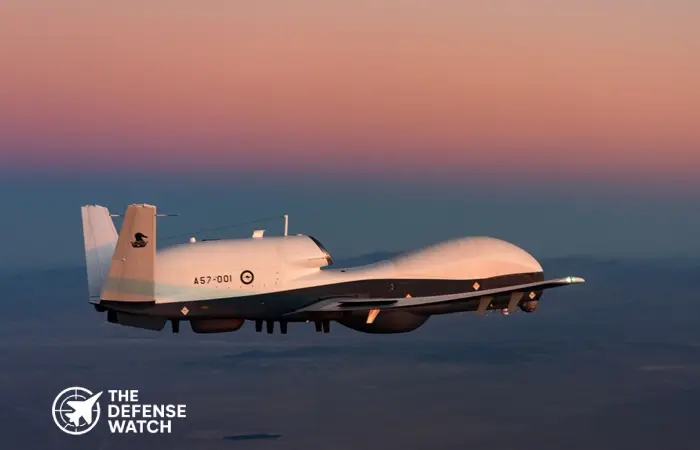
The U.S. Navy has awarded Northrop Grumman a $196 million contract modification to sustain the MQ-4C Triton unmanned maritime surveillance fleet through May 2027. Issued by Naval Air Systems Command, the award supports operational readiness for both the U.S. Navy and the Royal Australian Air Force as Indo-Pacific ISR demands continue to expand.
The Pentagon announced that Northrop Grumman has secured a $196,066,981 modification to an existing cost-plus-fixed-fee contract supporting the MQ-4C Triton unmanned aircraft system. The award extends logistics, testing, engineering, and field support services critical to keeping the Navy’s high-altitude maritime ISR fleet operational.
According to Naval Air Systems Command in Patuxent River, Maryland, the modification exercises additional contract options under agreement N0001924C0005 and includes support for the Royal Australian Air Force (RAAF), one of the platform’s primary international operators.
MQ-4C Triton’s Strategic Role In Indo-Pacific Surveillance
The MQ-4C Triton has become one of the U.S. Navy’s most important long-endurance intelligence, surveillance, and reconnaissance platforms for monitoring contested maritime regions. Derived from the RQ-4 Global Hawk airframe but extensively modified for naval operations, Triton is optimized for persistent oceanic surveillance, wide-area maritime tracking, and real-time intelligence collection.
Operating at altitudes exceeding 50,000 feet with endurance approaching 24 hours, the aircraft provides continuous ISR coverage across vast maritime areas that would otherwise require multiple crewed aircraft sorties. Its sensor suite integrates active electronically scanned array radar, electro-optical and infrared systems, electronic support measures, and automatic identification system receivers for tracking both military and civilian vessels.
The contract’s emphasis on logistics and reach-back engineering support reflects the growing operational tempo of the Triton fleet, particularly across the Indo-Pacific theater. U.S. Navy Tritons have increasingly supported maritime domain awareness missions near critical sea lanes and contested waters, including areas surrounding the South China Sea and Western Pacific approaches.
Australia’s participation is strategically significant because the RAAF is integrating Triton into its broader maritime surveillance architecture alongside the P-8A Poseidon fleet. The combined U.S.-Australian ISR framework is intended to strengthen allied monitoring capabilities across the Indo-Pacific, where long-range maritime reconnaissance has become central to deterrence operations.
Why Sustainment Contracts Matter For Modern ISR Fleets
While procurement contracts often receive greater attention, sustainment agreements like this one are critical for maintaining operational availability in high-demand ISR fleets.
The Pentagon identified several support categories under the modification, including:
- Logistics support for deployed aircraft and mission systems
- Test support services for fleet readiness and upgrades
- Field service representative support for operational locations
- Reach-back engineering support, allowing deployed operators to access stateside technical expertise for troubleshooting and rapid maintenance analysis
In operational terms, reach-back engineering enables frontline units operating in remote locations such as Guam or Okinawa to connect directly with engineering teams in the United States. This reduces aircraft downtime and improves mission availability during sustained operations.
The contract structure itself is also notable. A cost-plus-fixed-fee arrangement is commonly used in technically demanding defense sustainment programs where operational variables and maintenance requirements can fluctuate significantly. Under this model, the government reimburses allowable contractor costs while providing a fixed profit fee, reducing financial risk for complex support efforts that may involve unpredictable engineering demands.
Funding Breakdown And Operational Locations
The Pentagon stated that funding obligated at the time of award includes:
- $51.1 million in Fiscal Year 2026 Navy operations and maintenance funding
- $21.1 million in Fiscal Year 2026 Navy aircraft procurement funding
- $1 million in Navy research, development, test, and evaluation funding
- $7.5 million in RAAF cooperative partner funding
Workshare Distribution
Work will be conducted across multiple U.S. and overseas operating locations:
- San Diego, California: 37.1%
- Patuxent River, Maryland: 14.8%
- Jacksonville, Florida: 10.7%
- Okinawa, Japan: 7.2%
- Mayport, Florida: 6.9%
- Whidbey Island, Washington: 4.4%
- Baltimore, Maryland: 3.5%
- Chantilly, Virginia: 3.1%
- Yigo, Guam: 1.3%
- Various CONUS locations: 2.4%
- Various OCONUS locations: 8.6%
The contract is expected to continue through May 2027.
Broader Maritime ISR Expansion
The latest award comes as the U.S. Navy continues expanding distributed maritime ISR capabilities to support carrier strike groups, submarine operations, and long-range maritime targeting networks.
The Triton platform is increasingly viewed as a core component of the Navy’s future sensor architecture, particularly as the service shifts toward more networked and distributed operations across the Pacific. Persistent unmanned ISR coverage allows commanders to maintain situational awareness over large maritime areas while reducing reliance on crewed surveillance aircraft for routine monitoring missions.
For Australia, continued Triton integration also reinforces Canberra’s growing role in allied Indo-Pacific surveillance and maritime security operations.