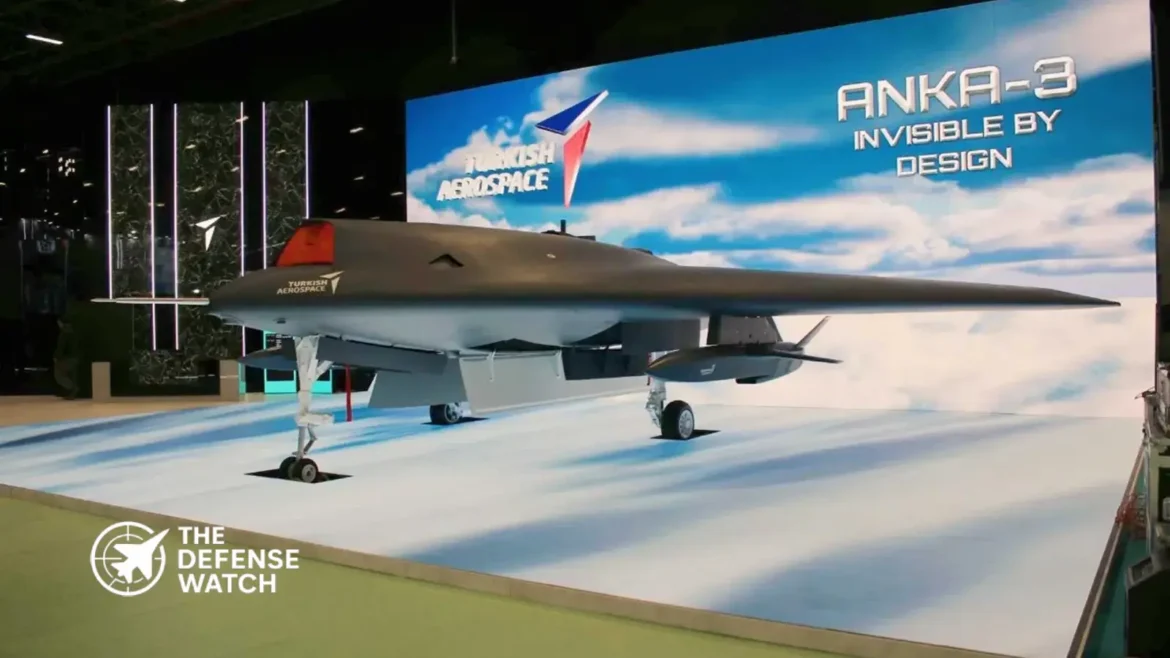
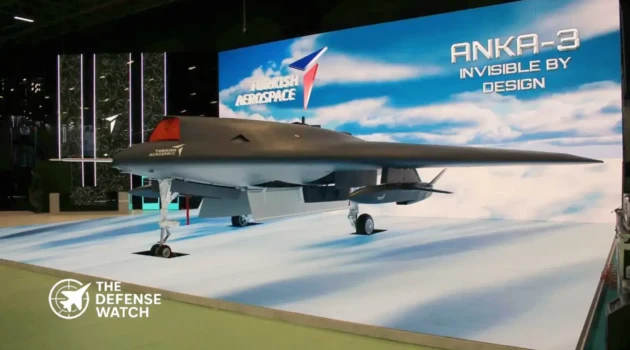
Executive Summary: Türkiye has presented the Anka-3 stealth unmanned combat aerial vehicle (UCAV) carrying two Süper Şimşek strike UAVs at SAHA Expo 2026. Turkish Aerospace Industries (TUSAŞ) showcased the configuration to demonstrate distributed strike capabilities in contested airspace. The system enables the stealthy mothership to remain outside high-threat zones while deploying expendable forward effectors for decoying, jamming, electronic warfare, and precision strikes.
Development and Exhibition Context
Turkish Aerospace Industries displayed a full-scale Anka-3 equipped with two Süper Şimşek UAVs under its wings during SAHA Expo 2026. This presentation highlights Türkiye’s shift toward low-observable, distributed unmanned operations designed for heavily defended airspace.
The Anka-3, a tailless flying-wing UCAV, serves as a mothership capable of launching smaller, expendable effectors. These forward-deployed UAVs can trigger enemy radars, conduct jamming, act as decoys, or execute kinetic strikes, preserving the higher-value Anka-3 platform at safer standoff distances.
This configuration aligns with Türkiye’s broader “Sadık Kanat” (loyal wingman) or OKU (Autonomous Wingman) concept, integrating with platforms such as the TF Kaan fighter and other Turkish UAVs like the Aksungur.
Anka-3 Technical Specifications and Capabilities
The Anka-3 features a low-observable flying-wing design with no vertical stabilizers, reducing radar cross-section while providing internal volume for fuel and weapons. Key specifications include:
- Dimensions: Approximately 7.9–8.9 m length, 12.5–13.1 m wingspan
- Maximum Takeoff Weight (MTOW): 6,500–7,250 kg
- Payload Capacity: 1,200–1,600 kg (internal bays plus external hardpoints)
- Propulsion: Single Ivchenko-Progress AI-322 turbofan (with indigenous TF6000/TF10000 development ongoing)
- Performance: Max speed Mach 0.7, cruise ~250 knots, endurance ~10 hours, service ceiling 40,000 ft (12,000 m)
The platform includes two internal weapon bays and five external hardpoints, allowing operators to balance stealth and payload. It supports ISR, electronic warfare, and strike missions, with satellite communications and autonomous teaming capabilities.
Süper Şimşek Strike UAV Characteristics
The Süper Şimşek evolved from the earlier Şimşek target drone into a multi-role tactical UAV. It is designed for high-subsonic operations as a decoy, jammer, or strike asset.
- Dimensions: ~4 m length, 1.75 m wingspan, 0.75 m height
- MTOW: 200 kg
- Payload: Up to 50 kg (warhead, jammers, signature enhancers, EO/IR sensors)
- Performance: Max speed ~Mach 0.85–0.9, service ceiling 35,000 ft, endurance ~80 minutes, range up to 700–900 km (air-launched)
Payload options include RF/IR signature augmentation to simulate larger aircraft (e.g., fighters), electronic attack modules, and precision seekers for air-to-surface or air-to-air engagements.
Comparison Table
System Range Payload Status Key Technology Anka-3 (with Süper Şimşek) ~700–900 km (effectors); carrier standoff 1,200–1,600 kg (carrier); 50 kg per effector Presented 2026 (prototype/advanced testing) Stealth flying-wing, loyal wingman teaming, distributed EW/strike Legacy Anka/Aksungur (MALE) Limited to permissive airspace Lower per platform, direct carriage Operational Conventional ISR/strike, non-stealth Typical Competitor MALE (e.g., MQ-9 class) Medium-altitude persistence ~1,000+ kg direct Operational Propeller-driven, vulnerable in contested airspace Technical Advantages
- Survivability: Anka-3 remains outside dense SAM engagement zones while effectors penetrate forward.
- Force Multiplication: Two (or more) expendable Süper Şimşek UAVs enable saturation, deception, and suppression of enemy air defenses (SEAD/DEAD).
- Mission Flexibility: Rapid reconfiguration of effector payloads for decoy, jamming, ISR, or kinetic roles.
- Autonomy and Teaming: Supports manned-unmanned teaming (MUM-T) with TF Kaan and other platforms; autonomous release and coordinated operations demonstrated.
- Attritable Cost: Lower-cost effectors preserve high-value stealth UCAV and manned assets.
Strategic Context
The Anka-3/Süper Şimşek combination addresses modern air defense challenges, including integrated air defense systems (IADS) with long-range SAMs, radars, and electronic warfare assets. By emphasizing distributed, attritable effects, Türkiye aligns with broader NATO and global trends toward massed unmanned systems that exhaust expensive interceptor inventories and complicate enemy targeting.
This development enhances Türkiye’s indigenous defense capabilities, reduces reliance on foreign systems, and positions it as a contributor to allied concepts in high-intensity conflict scenarios. Integration with future indigenous engines and advanced sensors will further strengthen operational effectiveness in regional security dynamics.

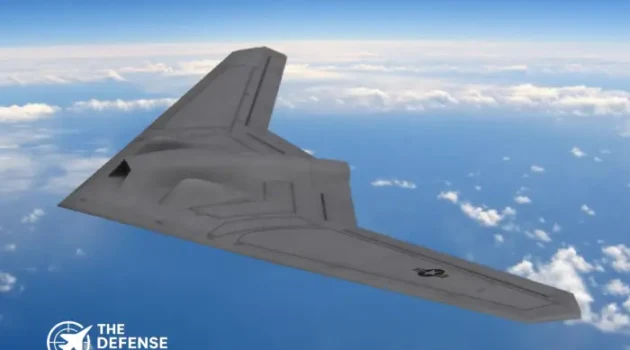
Reports link the US RQ-170 stealth drone to a recent Venezuela operation involving strikes and the capture of President Nicolás Maduro, according to open-source imagery and defense analysts.
rarely seen US Air Force RQ-170 Sentinel stealth unmanned aircraft has been tied by analysts to recent military activity connected with events in Venezuela.
Open-source images and video circulating on social platforms show a flying-wing drone consistent with the classified RQ-170 returning to Roosevelt Roads in Puerto Rico after reported US actions in Venezuelan airspace.
The UK Defence Journal reported that the low-observable UAV was spotted in the wider Caribbean region and analysts suggest it may have supported intelligence, surveillance and reconnaissance tasks linked to the operation.
Independently, AviationWeek-linked reporting noted the RQ-170’s activity aligns with the timeline of a US mission that led to the capture of Venezuela’s president, dubbed Operation Absolute Resolve, though the Pentagon has not confirmed its use.
The RQ-170 Sentinel is a classified platform designed for ISR in contested environments, operated by the US Air Force with a history of deployments over denied airspace.
US officials have not publicly acknowledged the drone’s operational role in Venezuela. Observers say RQ-170 activity in the region is rare and could reflect an increased reliance on stealth UAVs for intelligence ahead of complex missions.
This reporting comes amid broader US military and intelligence operations in and around Venezuela that have included precision strikes, deployment of aircraft and special operations forces. Independent news outlets have noted the operation involved a wide range of air assets.
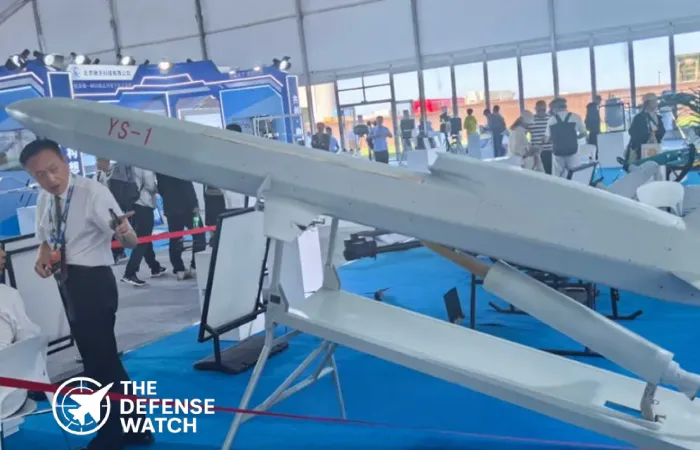
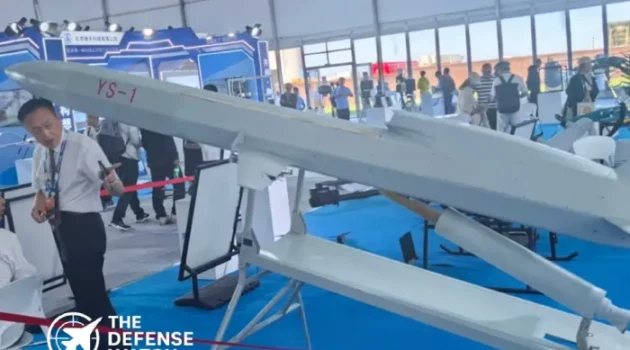
China Unveils YS-1 Stealth Drone for Reconnaissance and Attack
China’s defense industry has unveiled a new stealth unmanned aerial vehicle dubbed the YS-1, designed for reconnaissance and precision attack missions, marking another step in the country’s rapid expansion of advanced UAV platforms. The YS-1 stealth drone was publicly presented in early December 2025 by Shenyang Aircraft Corporation, a major Chinese aerospace manufacturer, during what Chinese sources said was an industry or military exposition. The platform’s debut adds to a growing list of Chinese unmanned systems intended to operate in contested or denied airspace.
The YS-1 stealth drone represents China’s push to field low-observable unmanned aircraft that can conduct multi-role missions, including intelligence, surveillance, reconnaissance (ISR), precision strike, electronic warfare, and decoy tasks. It reflects broader efforts by Beijing to modernize its air combat and UAV capabilities, a trend seen across several recent programs and prototype systems.
Background
Chinese defense research and industrial groups have invested heavily in unmanned platforms over the past decade, pursuing a wide range of designs from small tactical drones to large, long-endurance UAVs and combat aircraft. Programs such as the GJ-11 Sharp Sword stealth UCAV and other flying wing designs have drawn attention for their potential to operate in complex air defense environments and integrate with manned aircraft.
The YS-1 emerges as part of this expanding UAV portfolio, and comes as China continues to field newer models with advanced sensor suites and strike capabilities. Its unveiling follows other high-profile Chinese drone developments, including heavy drone carriers and stealth UCAVs intended for reconnaissance and strike roles in high-threat regions.
Design and Capabilities
Detailed official specifications for the YS-1 stealth drone are limited, but open-source reporting suggests the platform emphasizes a low radar cross section and high cruise speed to reduce detectability in enemy airspace. The drone is intended to perform reconnaissance and attack missions, and state-linked observers have suggested it may also be equipped or adaptable for electronic warfare or decoy functions, broadening its utility across mission sets.
Shenyang Aircraft Corporation, the developer, is better known for crewed combat aircraft and UAV prototypes, underscoring the strategic value Beijing places on UAV development as a complement to traditional aviation and missile forces.
Industry and open reporting describe the YS-1 as a high-speed platform with a stealthy airframe, geared to operate where radar and air defense threats are significant. Its reconnaissance systems could include advanced optics and signals-intelligence payloads, though specific sensor packages have not been disclosed publicly.
Context Within Chinese UAV Expansion
The YS-1’s unveiling comes amid a broad expansion of Chinese UAV capabilities. Other notable systems include the GJ-11 Sharp Sword, a flying-wing stealth combat drone that China has shown in formation with crewed fighters, signaling integration efforts for manned-unmanned teaming.
China has also developed large UAVs like the Jiutian heavy drone carrier, capable of deploying multiple smaller drones on long-range missions, and other stealth UAV efforts such as the CH-7 long-endurance stealth platform.
These programs are part of a layered approach to unmanned systems, combining platforms optimized for ISR, strike, electronic combat, and swarming operations. The trend mirrors developments in other major militaries seeking to exploit UAVs for both tactical and strategic effects. China’s investments reflect a growing belief that unmanned systems will be central to future combat operations, particularly in contested airspace and littoral environments.
Expert and Policy Perspective
Analysts say the introduction of the YS-1 stealth drone fits within Beijing’s broader military modernization agenda, which prioritizes unmanned capabilities alongside advanced fighter jets, long-range missiles, and naval assets. By fielding a range of drones with low observability, China seeks operational flexibility against sophisticated air defense systems and contested environments in potential future conflicts.
Observers note that while the United States and allied partners have similarly prioritized unmanned systems—illustrated by programs such as collaborative combat aircraft and loyal wingmen drones—the pace and diversity of China’s UAV developments underscore Beijing’s intent to close gaps and challenge air power dominance in regional theaters such as the Western Pacific.
What to Watch
The operational status and deployment plans for the YS-1 will be key indicators of its relevance to the People’s Liberation Army Air Force and other branches. China’s military aviation developments often move from prototype displays to fielding over several years, and follow-on information about flight tests, sensor performance, and combat integration will help clarify its role. Army Recognition
Further developments in related Chinese UAV programs, including integration with manned aircraft and networked warfare systems, are also likely to shape regional defense strategies and influence allied planning in the Indo-Pacific.