

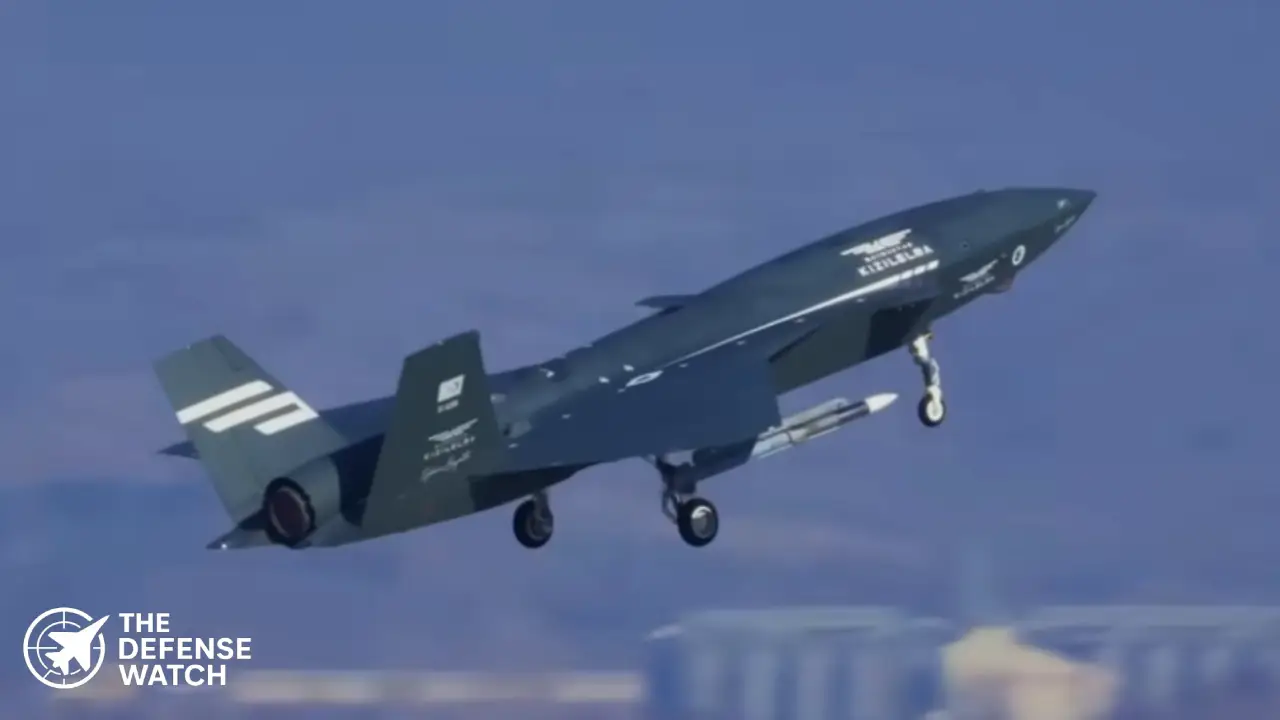
Executive Summary:
Indonesia is preparing to receive up to 60 Baykar Kizilelma unmanned combat aircraft from Türkiye in what could become the platform’s first export sale. The proposed deal reflects Jakarta’s growing focus on advanced unmanned warfare capabilities and highlights Türkiye’s expanding role in the global defense export market.
Indonesia Kizilelma Drone Deal Signals Major Shift In Regional Airpower
Indonesia’s planned acquisition of up to 60 Kizilelma unmanned combat aerial vehicles (UCAVs) from Türkiye represents one of Southeast Asia’s most ambitious drone modernization efforts to date. The agreement, reported by multiple defense outlets, would mark the first export success for the Turkish-developed unmanned fighter platform.
Developed by Turkish defense company Baykar, the Kizilelma is designed as a high-performance stealth-capable UCAV intended for air-to-air and strike missions. The aircraft has drawn international attention because of its jet-powered configuration, autonomous flight features, and compatibility with modern network-centric warfare concepts.
The potential Indonesia Kizilelma drone deal comes as regional militaries increasingly prioritize unmanned systems capable of operating in contested environments while reducing pilot risk.
Indonesia could receive as many as 60 aircraft under the arrangement, although detailed delivery timelines and financial terms have not yet been publicly disclosed.
What Is The Kizilelma UCAV?
Baykar Kizilelma is part of Türkiye’s broader effort to establish an indigenous high-end defense manufacturing base capable of competing in global aerospace markets.
Unlike many traditional medium-altitude drones optimized mainly for surveillance or precision strike missions, Kizilelma has been designed to operate in more contested airspace. The aircraft incorporates reduced radar signature features, high-speed maneuverability, and artificial intelligence-assisted flight control systems.
Baykar has stated previously that the UCAV is intended to support missions including:
- Air superiority support
- Deep strike operations
- Suppression of enemy air defenses
- Maritime strike missions
- Intelligence and reconnaissance operations
The aircraft is also expected to operate from short-deck carriers and expeditionary platforms, including Türkiye’s TCG Anadolu amphibious assault ship.
Analysts have noted that Kizilelma reflects a broader shift toward loyal wingman and unmanned combat concepts being pursued by several major powers, including the United States, China, and Russia.
Why Indonesia Is Expanding Its Drone Capabilities
Indonesia has steadily increased defense modernization spending in recent years amid evolving security concerns across the Indo-Pacific region. The country faces complex maritime security requirements due to its vast archipelagic geography and strategic position near key sea lanes.
The addition of Kizilelma UCAVs could significantly expand Indonesia’s ability to conduct long-range surveillance and strike operations across maritime zones and remote island chains.
Jakarta has also sought to diversify defense procurement sources beyond traditional Western suppliers. Türkiye has emerged as an increasingly important defense partner for several Asian and Middle Eastern states because of its competitive pricing, rapid production capability, and fewer export restrictions compared to some Western systems.
Indonesia and Türkiye have already cooperated in multiple defense sectors, including armored vehicles, aerospace programs, and drone technology.
The potential acquisition also aligns with broader trends in Southeast Asia, where regional powers are accelerating investments in unmanned systems, electronic warfare capabilities, and long-range precision strike assets.
Türkiye’s Defense Export Ambitions Continue To Grow
Türkiye’s defense industry has expanded rapidly over the past decade, particularly in the unmanned systems sector. Baykar gained international prominence after the operational success of the Bayraktar TB2 in several conflict zones, including Libya, Nagorno-Karabakh, and Ukraine.
The Kizilelma program represents the next phase of Türkiye’s ambition to move beyond tactical drones into advanced combat aviation technologies traditionally dominated by a small number of aerospace powers.
A successful Indonesia Kizilelma drone deal would provide Türkiye with a major export breakthrough for a next-generation combat UAV platform. It could also strengthen Ankara’s defense ties across Southeast Asia and reinforce its position as a growing global arms supplier.
Defense observers also view the deal as evidence of increasing international demand for lower-cost alternatives to Western stealth aircraft and advanced manned combat systems.
Strategic Implications For Southeast Asia
The introduction of stealth-capable unmanned fighters into Southeast Asia could influence regional military planning, particularly in maritime security and airpower competition.
Several countries in the Indo-Pacific are now integrating drones into operational doctrine for surveillance, strike, and electronic warfare missions. Indonesia’s planned acquisition may encourage neighboring states to accelerate similar procurement programs.
While Kizilelma is not a direct replacement for conventional fighter aircraft, it offers an additional layer of operational flexibility. UCAVs can perform high-risk missions with reduced personnel exposure and potentially lower operational costs compared to manned fighter fleets.
The platform’s autonomous capabilities may also support future integration with manned aircraft in coordinated combat operations.


