Executive Summary:
The U.S. Navy has awarded Bath Iron Works a contract for construction of the future USS Robert R. Ingram, the 21st Flight III Arleigh Burke-class destroyer. The deal reinforces the Navy’s long-term surface fleet modernization strategy centered on advanced air and missile defense capabilities.
U.S. Navy Awards Contract For USS Robert R. Ingram Flight III Destroyer
The U.S. Navy has awarded a new construction contract to Bath Iron Works for the future USS Robert R. Ingram (DDG-140), marking the 21st Flight III Arleigh Burke-class destroyer ordered under the Navy’s ongoing modernization effort.
The contract continues production of the Navy’s most advanced destroyer configuration, designed to enhance ballistic missile defense, integrated air defense, and long-range maritime operations.
Bath Iron Works, a major U.S. naval shipbuilder owned by General Dynamics, remains one of the two primary producers of the Arleigh Burke-class alongside HII Ingalls Shipbuilding.
The future USS Robert R. Ingram is named after Medal of Honor recipient Master Chief Special Warfare Operator Robert R. Ingram, recognizing his actions during the Vietnam War.
Flight III Destroyers Expand U.S. Naval Air Defense Capability
The Flight III Arleigh Burke destroyer represents the latest and most capable evolution of the long-running DDG-51 program. The design introduces major improvements over earlier variants, particularly in radar performance, power generation, and combat systems integration.
At the center of the upgrade is the AN/SPY-6(V)1 Air and Missile Defense Radar developed by RTX Corporation. The radar significantly improves the Navy’s ability to detect and track ballistic missiles, hypersonic threats, advanced cruise missiles, and low-observable targets at extended ranges.
The Flight III configuration also incorporates upgraded electrical power systems and cooling capacity to support future weapons and sensors, including potential directed-energy systems and advanced electronic warfare packages.
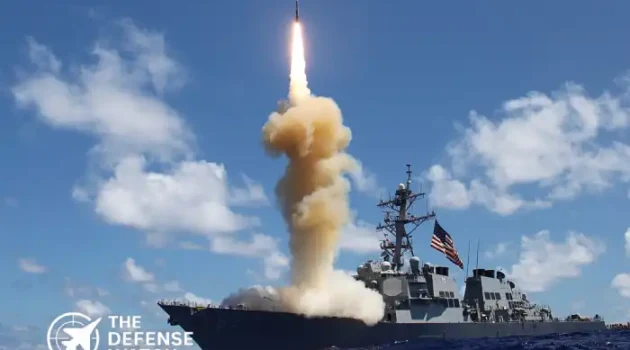
The USS Robert R. Ingram will be equipped with the Aegis Combat System and vertical launch capabilities supporting a wide range of interceptors and strike weapons, including Standard Missile variants, Tomahawk land-attack missiles, and anti-submarine warfare systems.
Why The New Destroyer Matters
The latest Flight III destroyer contract highlights the Navy’s continued reliance on the Arleigh Burke platform as the backbone of its surface combatant fleet despite ongoing development of future large surface combatants.
The Navy has increasingly prioritized integrated air and missile defense in response to expanding Chinese naval capabilities in the Indo-Pacific and continued missile proliferation among near-peer competitors.
While the DDG(X) next-generation destroyer remains in development, Flight III ships are expected to carry a substantial operational burden through the 2030s and beyond. Their combination of mature systems and upgraded sensors provides a lower-risk path for maintaining fleet readiness while future programs mature.
The growing importance of naval ballistic missile defense has also elevated the role of destroyers in regional deterrence missions. Arleigh Burke-class ships are routinely deployed to the Pacific, Middle East, and European theaters to support carrier strike groups and allied missile defense architectures.
Bath Iron Works Maintains Strategic Role In U.S. Shipbuilding
The award further strengthens Bath Iron Works’ role in sustaining the U.S. industrial base for major naval surface combatants.
Located in Maine, the shipyard has produced numerous Arleigh Burke destroyers over the past decades and remains a critical component of the Navy’s shipbuilding strategy. Maintaining stable destroyer production is viewed as essential for preserving workforce expertise, supplier networks, and fleet delivery timelines.
The Navy continues balancing production between Bath Iron Works and Ingalls Shipbuilding to ensure capacity and reduce industrial risk amid increasing demand for advanced warships.
The USS Robert R. Ingram contract also reflects broader Pentagon efforts to accelerate naval modernization while addressing concerns over fleet size and global operational commitments.
Broader Strategic Context
The Flight III Arleigh Burke destroyer program remains one of the Pentagon’s most important naval modernization initiatives due to the ship’s multi-role flexibility and survivability.
As maritime competition intensifies, especially in the Indo-Pacific, the Navy is investing heavily in platforms capable of integrated air defense, anti-submarine warfare, long-range strike operations, and distributed maritime operations.
The continued procurement of Flight III destroyers demonstrates that the Navy still sees large surface combatants as central to future high-end naval warfare despite growing interest in unmanned systems and distributed fleets.
Analysts also note that the SPY-6 radar family will become a foundational sensor architecture across multiple Navy platforms, improving interoperability and battlespace awareness across carrier strike groups and joint operations.