Type 10 Hitomaru: Japan’s Agile 4th-Gen MBT
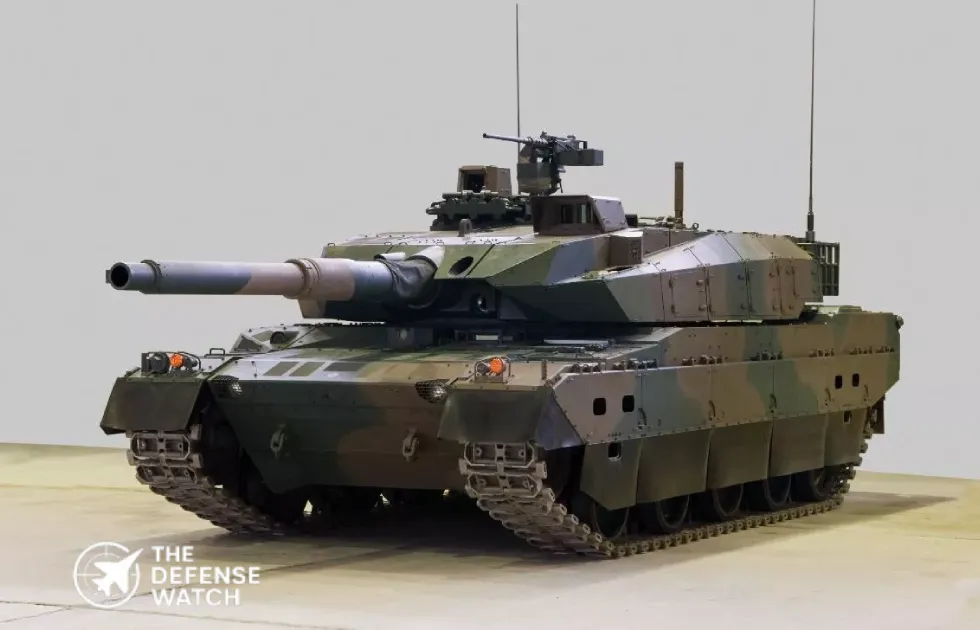
The Type 10, known as Hitomaru, is Japan’s fourth-generation main battle tank designed for the Japan Ground Self-Defense Force. Introduced to address the limitations of the Type 74 and Type 90, it prioritizes mobility across Japan’s constrained road and bridge networks while delivering modern firepower and networked battlefield awareness. Its compact size and adjustable weight make it one of the lightest modern MBTs, optimized for rapid deployment in mountainous and island terrain.
Manufacturer
Mitsubishi Heavy Industries produces the Type 10, with the 120 mm main gun supplied by Japan Steel Works. Development began in the late 1990s under the TK-X program; the tank formally entered service in January 2012. Over 100 units have been built, with low-rate production continuing to sustain industrial capacity.
Speed and Range
A 1,200 hp Mitsubishi 8VA34WTK V8 diesel engine paired with a continuously variable transmission (CVT) enables a top speed of 70 km/h in both forward and reverse. Operational range is approximately 440–500 km. Hydropneumatic suspension allows the hull to raise, lower, or tilt for better gun elevation, improved off-road performance, and reduced silhouette.
Cost/Price
Unit cost has varied with production volume. Early estimates were around $6.5–8.4 million; more recent figures place it near $11.3 million (2022), reflecting low annual production rates. Development costs totaled roughly ¥48.4 billion.
The Type 10 carries a Japan Steel Works 120 mm L/44 smoothbore gun with an autoloader (14 rounds ready), firing NATO-standard and Japanese Type 10 APFSDS ammunition. Secondary armament includes a coaxial 7.62 mm Type 74 machine gun and a roof-mounted 12.7 mm M2HB. Modular ceramic composite armor can be configured for basic (≈40 t), standard (≈44 t), or full (≈48 t) protection. Advanced C4I systems, 360-degree day/night sensors, and laser warning receivers support networked operations. No major combat success stories exist, as the Type 10 has not been deployed in overseas conflicts; its design success lies in meeting Japan’s specific mobility and infrastructure requirements.