

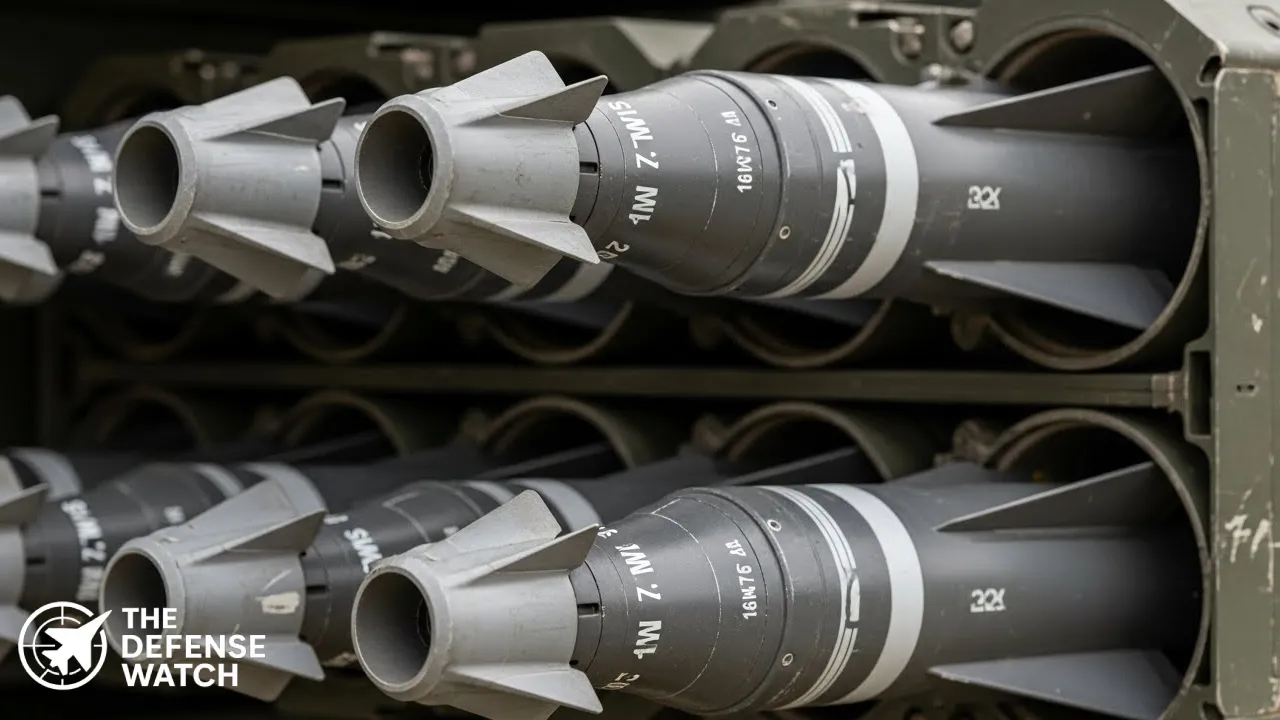
F-16 Jets Spotted With Laser-Guided Rockets
New imagery circulating on social media and defense forums suggests that Ukrainian Air Force F-16AM jets are now carrying laser-guided 70 mm rockets — specifically the Advanced Precision Kill Weapon System II (APKWS II).
According to the report, the photos — first shared by the Telegram channel Avia OFN on December 4, 2025 — show an F-16AM from the 107th Separate Aviation Wing fitted with two LAU-131/A 7-shot rocket pods, each apparently loaded with APKWS II rounds.
Context: Why This Matters Now
Since receiving Western-supplied F-16s from Denmark, the Netherlands, Belgium, and Norway, Ukraine has heavily relied on the jets for a mix of air defense and ground-attack missions.
Traditionally armed with air-to-air missiles like the AIM-120 AMRAAM and AIM-9 Sidewinder, and precision guided bombs for strike missions, the Ukrainian Air Force jets now appear to be adding a lower-cost but high-volume air-to-air capability.
The emergence of mass Russian drone attacks — slow-flying loitering munitions and cruise missiles — has put enormous strain on Ukraine’s air defenses. Against such threats, guided rockets like APKWS II provide a cost-effective complement to expensive missiles.
What the Numbers and Hardware Show
- Weapon System: APKWS II is a laser-guided upgrade kit based on the 70 mm Hydra rocket. When paired with proper rocket pods (e.g., LAU-131/A) and a targeting/laser designator pod, it can transform an otherwise unguided rocket into a precision munition.
- Cost Effectiveness: Compared with air-to-air missiles — typically costing hundreds of thousands to over a million dollars per round — a guided rocket like APKWS II costs roughly US$20,000–25,000 per unit.
- Expanded Loadout Potential: By employing two 7-shot rocket pods, a single F-16 sortie could field up to 14 guided rockets, offering multiple engagement chances with each mission. This “magazine depth” advantage becomes valuable when facing waves of low-cost drones or incoming missiles.
The photos reportedly also show the jets carrying a targeting pod — likely the AN/AAQ-33 Sniper Advanced Targeting Pod — necessary to lase targets for the rocket guidance.
Limitations and Considerations
While the development is significant, there are important caveats:
- Laser-Dependence: APKWS II rockets require continuous laser designation during flight (semi-active laser guidance). That limits their use primarily to targets that are slower-moving or non-evasive — such as drones, kamikaze UAVs, or cruise missiles — rather than high-performance fighter aircraft.
- Not Fire-and-Forget: Unlike radar-guided or infrared-guided missiles, these rockets are not fire-and-forget; a designating pod must keep the laser locked on target until impact, potentially exposing the launching aircraft or designator to risk.
- Unclear Variant Supply: Although a variant of APKWS II optimized for air-to-air use — called AGR-20F FALCO (Fixed-Wing Air-Launched Counter-UAS Ordnance) — exists, it remains unconfirmed whether Ukraine has received that specific version, or is using standard ground-oriented APKWS II kits.
What This Suggests Strategically
For Ukraine, employing APKWS II on F-16s represents a pragmatic adaptation to the evolving nature of aerial threats — especially the prevalence of low-cost drones and cruise missiles. The ability to fire guided rockets may allow more sorties with higher engagement capacity while conserving its limited stock of expensive air-to-air missiles.
This shift also demonstrates flexibility: by using existing hardware (Hydra rocket pods) and attaching guidance kits, Ukraine can rapidly field an affordable and effective counter-UAS solution without waiting for delivery of new types of missiles.
What’s Next: Implications and Open Questions
- Operational Impact: Will Ukrainian F-16s begin conducting more anti-drone patrols with rocket pods? Will these deployments reduce reliance on high-value missiles for threats like loitering drones and cruise missiles?
- Supply and Sustainability: Can Ukraine sustain enough ammunition supply of APKWS II rockets for prolonged use? Are there enough targeting pods and crews trained in laser designation?
- Escalation Risk: If Russian forces adapt — for example by deploying faster, more maneuverable UAVs — the limitations of semi-active laser rockets may become more apparent.

13 comments
[…] Temple — saw the first combat deployment of RTAF fighter jets of the year. At that time, a Thai F-16 struck Cambodian military targets, prompting condemnation from Phnom […]
[…] systems. Its purpose is to detect, track, and intercept ballistic, hypersonic, and other missile threats – potentially during their boost phase or in long-range […]
[…] State Secretary for Defense Gijs Tuinman previously informed the Dutch parliament that the government planned to acquire 22 units under an earlier budget outline. While the final contract value and configurations differ from those initial estimates, the core aim remains to fill a capability gap in countering drones and other low-altitude threats. […]
[…] FMV’s acquisition aligns with Sweden’s broader push to modernize its ground and littoral forces under initiatives like the Amphibious Battalion 2030 effort. The program aims to enhance the operational effectiveness and flexibility of amphibious units within the Swedish Armed Forces. […]
[…] efforts. This includes oversight of training missions, logistics synchronization, and long term force development planning for Ukrainian armed […]
[…] analysts shows a loitering munition impacting a full scale F 16 decoy positioned on the apron. Ukrainian Air Force officials later acknowledged the strike and stated no operational aircraft were […]
[…] with Qatar, aimed at strengthening the country’s airspace sovereignty and its ability to counter evolving airborne threats including drones and low-signature […]
[…] The announcement was made during the biennial airshow, one of Asia’s most important defense and aerospace exhibitions, where Singapore routinely outlines key modernization priorities for the Singapore Armed Forces. […]
[…] The Surface Electronic Warfare Improvement Program is the U.S. Navy’s primary effort to modernize shipboard electronic warfare capabilities. Block Two focuses on enhanced electronic support measures designed to detect, identify, and classify enemy emitters, with a specific emphasis on countering Anti Ship Missile threats. […]
[…] position, balancing relations within NATO, managing tensions in the Eastern Mediterranean, and modernizing its armed forces with new aircraft, naval platforms, and surveillance […]
[…] from MiG-31K aircraft operating from the Savasleyka airfield in Russia’s Nizhny Novgorod region. Ukrainian Air Force authorities said a range of countermeasures was implemented to stop the incoming hypersonic weapons […]
[…] targeting data, and respond quickly to Ukrainian maneuvers. In contested sectors of Zaporizhzhia, Ukrainian forces were able to exploit delays and confusion among Russian formations that suddenly lost reliable […]
[…] China’s latest laser systems reflect a broader shift toward scalable, cost effective defenses that can operate in high threat environments without relying solely on missiles. […]