

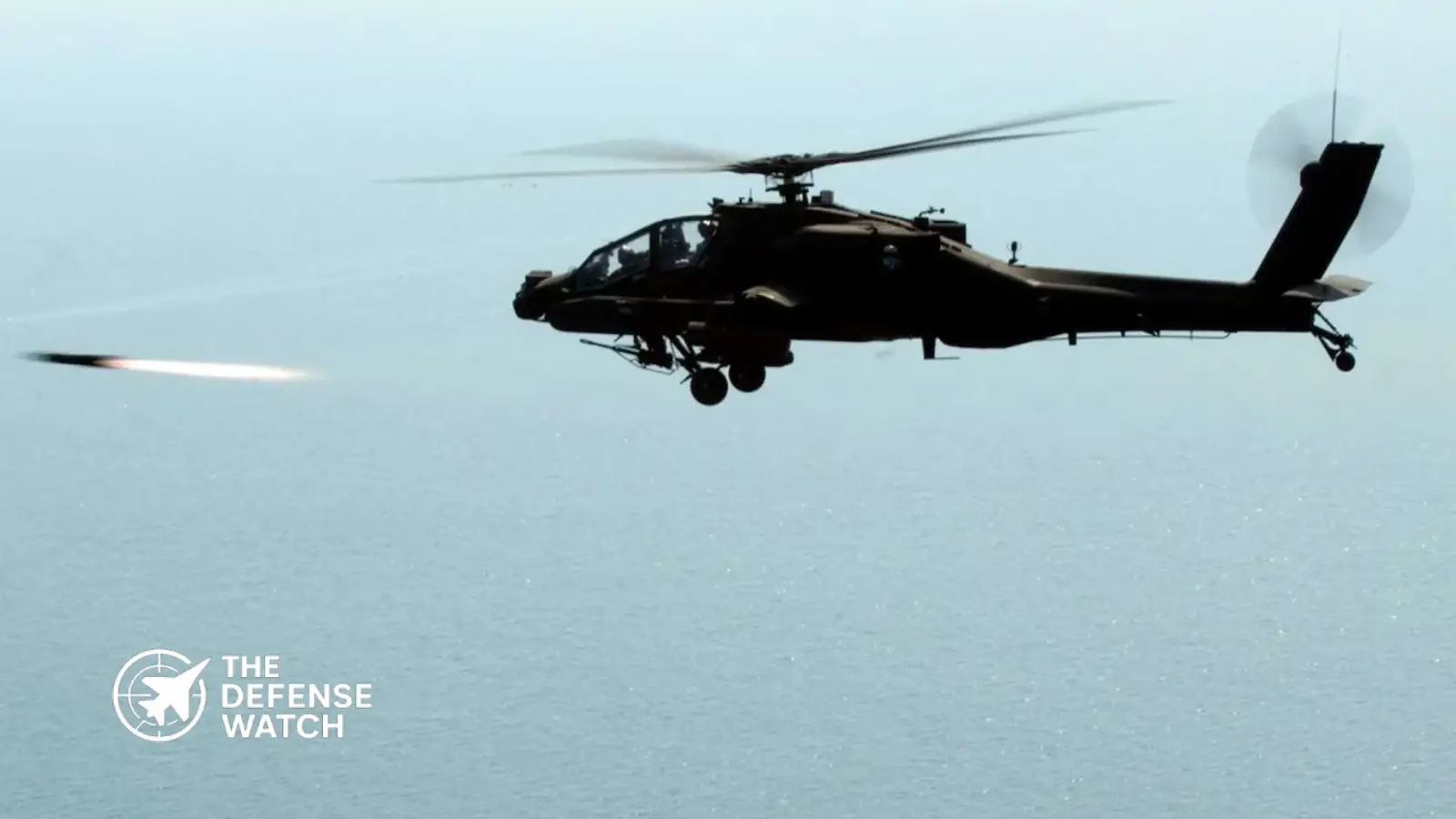
Executive Summary: In a significant escalation of maritime tensions, U.S. Army AH-64E Apache Guardians and Navy MH-60R Seahawks engaged and destroyed six Iranian Revolutionary Guard Corps Navy (IRGCN) fast attack craft in the Strait of Hormuz. The joint strike followed repeated Iranian attempts to harass and board commercial vessels, marking a decisive application of U.S. “joint-air” maritime defense doctrine.
U.S. Apache and Seahawk Teams Neutralize IRGCN Threat in Strait of Hormuz
The security architecture of the Persian Gulf faced a critical test this week as U.S. Army and Navy aviation assets conducted a joint strike to neutralize six Iranian Revolutionary Guard Corps Navy (IRGCN) fast attack craft (FAC) within the Strait of Hormuz. The engagement, characterized by high-precision munitions and integrated sensor-to-shooter links, underscores a shift in how U.S. Central Command (CENTCOM) intends to police one of the world’s most vital maritime chokepoints.
The incident began when a swarm of Iranian fast boats attempted to intercept a Liberian-flagged tanker. Despite repeated warnings from a nearby U.S. Navy destroyer, the IRGCN vessels continued aggressive maneuvers, prompting the deployment of an “Air Combat Element” consisting of Army AH-64E Apache Guardians and Navy MH-60R Seahawks.
The Anatomy of the Engagement: Joint-Air Integration
The destruction of the six vessels highlights the increasing maturity of the U.S. military’s Joint All-Domain Command and Control (JADC2) initiatives in a maritime environment. While the MH-60R Seahawk typically serves as the “eyes” of the fleet with its advanced AN/APS-153(V)1 multi-mode radar, the AH-64E Apache provides the heavy “fist” required to dismantle swarm threats.
During the engagement, the Seahawks utilized their Multi-Spectral Targeting Systems to designate targets for the Apaches. The Army helicopters, operating from sea-based platforms, deployed AGM-114 Hellfire missiles and 30mm M230 chain guns to systematically disable the Iranian craft. This “hunter-killer” pairing is specifically designed to counter the “swarm” tactics favored by the IRGCN, which rely on overwhelming a single ship’s defenses through volume and speed.
Strategic Shift: Army Aviation at Sea
The presence of U.S. Army Apaches in the Strait of Hormuz is not a coincidence but a deliberate strategic choice. Since the 2020 “Great Prophet 14” exercise by Iran, the U.S. 5th Fleet has frequently integrated Army aviation into maritime surface warfare (SUW) drills.
The AH-64E Guardian is particularly suited for this role due to its Longbow fire-control radar, which can track up to 128 targets simultaneously and engage 16 in a single minute. In the confined waters of the Strait, where the distance between Iranian territorial waters and international shipping lanes is a matter of miles, the Apache’s ability to discriminate between civilian traffic and hostile combatants is paramount.
Geopolitical Implications and Regional Security
This kinetic response comes at a time of heightened friction between Washington and Tehran. The Strait of Hormuz sees approximately 20% of the world’s total oil consumption pass through its waters daily. Any disruption to this flow has immediate global economic consequences.
By utilizing helicopters rather than fixed-wing carrier-based aircraft or surface-to-surface missiles, the U.S. Navy 5th Fleet demonstrated a “proportional yet decisive” response. Helicopter engagements allow for closer visual identification, reducing the risk of collateral damage while ensuring that the hostile intent of the IRGCN boats is documented and neutralized with surgical precision.
Expert analysts at The Defense Watch suggest that this engagement serves as a deterrent signal. It proves that the “securitization” of the Strait is no longer reliant solely on large surface combatants like destroyers, which are vulnerable to asymmetric swarm attacks, but on a layered defense that includes agile, lethal aviation assets.
Technological Edge: Countering the Swarm
The IRGCN’s fast boats—often armed with rocket launchers, heavy machine guns, and sometimes short-range anti-ship missiles—rely on “hit-and-run” maneuvers. However, the 2026 engagement proved that digital integration outpaces manual maneuvering. The Link-16 data exchange between the Navy’s Aegis Combat System and the Army’s Apache cockpits allowed for a shared tactical picture that rendered the Iranian “stealth” maneuvers ineffective.
As the U.S. continues to pivot toward littoral (near-shore) combat capabilities, the success of this joint operation will likely lead to increased funding for marinized Army assets and specialized training for Army pilots operating in corrosive salt-water environments.
Conclusion
The neutralization of the IRGCN fast boats represents more than a tactical victory; it is a validation of the U.S. Department of Defense’s move toward integrated, multi-branch operations. For the shipping industry, the message is clear: the U.S. remains committed to the principle of “Freedom of Navigation,” backed by the combined firebox of the world’s most advanced attack helicopters.
