• Home
  • About
  • Defense Systems
  • Manufacturer
  • Comparisons
  • Compare 
  • Tools
TheDefenseWatch.com
  • Aerospace & Aviation
  • Military & Ordnance
  • Naval & Maritime
  • Cyber & Space Defense
  • Policy & Strategy
  • Global News
  • Tools Library
    • Smart Calculator
    • Drone Flight Time Calculator
    • Drone Range Calculator
    • Counter-Drone Jammer Effective Range Calculator
    • Counter-Battery Radar Detection Calculator
    • Artillery Fire Correction Calculator
    • Thermal Camera Detection Range Calculator
    • Missile Range & Time-of-Flight Calculator
    • Radar Detection Range Calculator
    • FPV Strike Drone Payload vs Range Calculator
    • Loitering Munition Endurance Calculator
    • Sniper Ballistic Drop & Windage Calculator
    • Bullet Drop Calculator
    • U.S. Army Combat Fitness Test (ACFT) Calculator
    • Military Pension Calculator
    • Military Retirement Calculator
    • Military Pension Calculator
    • Large Number Calculator
Font ResizerAa

TheDefenseWatch.com

The Defense Watch | U.S. & Global Defense News, Analysis & Military Updates

Search
  • Home
  • About
  • Defense Systems
  • Manufacturer
  • Comparisons
  • Compare 
  • Tools

Stay Updated

Get the latest update

Subscribe

Explore

  • Drone
  • Fighter Jets & Military Aircraft
  • Hypersonic Weapons
  • Aircraft Carriers
  • Strategic History & Missions
  • Tools Library
Home » Royal Navy Takes Command Of NATO Maritime Task Group As Alliance Boosts Atlantic Security
Naval & MaritimeNaval Strategy & Maritime Security

Royal Navy Takes Command Of NATO Maritime Task Group As Alliance Boosts Atlantic Security

Samuel Drake | Defense Analyst
Last updated: April 13, 2026 5:18 am
Samuel Drake | Defense Analyst
Share
6 Min Read
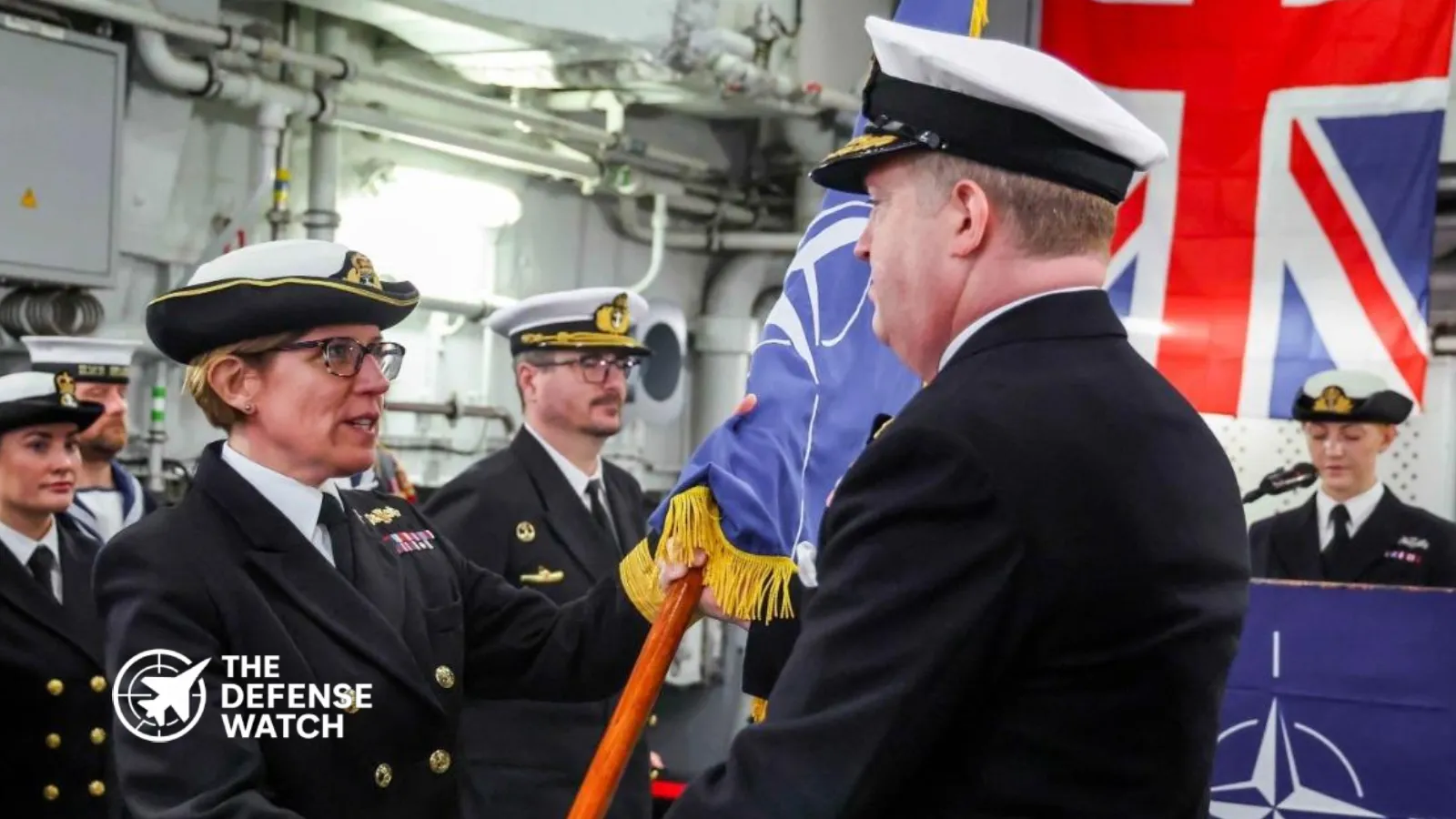
Royal Navy NATO task group
SHARE

Royal Navy NATO Task Group Command Strengthens Alliance Maritime Posture

The Royal Navy NATO task group leadership has shifted to the United Kingdom, marking a significant step in reinforcing alliance naval coordination and readiness in the Atlantic and surrounding waters.

Contents
  • Royal Navy NATO Task Group Command Strengthens Alliance Maritime Posture
  • Strategic Role Of NATO Maritime Task Groups
  • Why The Atlantic Theater Matters Now
  • Operational Impact And Capability Integration
  • Analysis: NATO’s Shift Toward Persistent Maritime Presence
  • Geopolitical Context And Alliance Signaling

The Royal Navy has formally taken command of a NATO maritime task group, placing British naval leadership at the center of ongoing multinational operations. The deployment includes multiple allied vessels operating under NATO’s standing maritime framework, designed to ensure rapid response and sustained presence in key strategic areas.

This transition comes at a time when NATO is placing renewed emphasis on maritime security, particularly across the North Atlantic, where undersea infrastructure protection, sea lane security, and deterrence operations have become increasingly critical.

¦ KEY FACTS AT A GLANCE
  • The Royal Navy has assumed command of a NATO maritime task group, reinforcing alliance naval coordination.
  • The deployment focuses on Atlantic and European waters, a key region for transatlantic security.
  • The task group includes multiple allied warships operating under NATO’s integrated command structure.
  • The mission supports deterrence, maritime security, and freedom of navigation operations.
  • The move reflects NATO’s increased emphasis on naval readiness amid evolving geopolitical tensions.

Strategic Role Of NATO Maritime Task Groups

NATO’s standing maritime groups serve as one of the alliance’s most flexible and responsive military tools. These formations are multinational by design, allowing participating navies to integrate seamlessly under a unified command structure.

- Advertisement -

The Royal Navy NATO task group now under UK leadership is expected to conduct a range of operations, including:

  • Maritime security patrols
  • Joint training and interoperability exercises
  • Presence missions in contested or sensitive regions
  • Support for broader NATO deterrence objectives

Such task groups are typically composed of frigates, destroyers, and support vessels contributed by member states, ensuring both capability diversity and operational depth.

From an operational standpoint, rotating command among allied nations strengthens cohesion while allowing each navy to demonstrate leadership within NATO’s integrated force model.

Why The Atlantic Theater Matters Now

The decision to place the Royal Navy NATO task group under UK command carries broader strategic implications. The Atlantic remains a vital artery for transatlantic reinforcement, logistics, and trade. Any disruption in this region would have immediate consequences for NATO’s ability to mobilize forces between North America and Europe.

Recent years have seen increased attention to:

  • Subsea cable security
  • Monitoring of naval activity in the North Atlantic
  • Protection of critical maritime infrastructure

The UK, with its geographic position and long-standing naval capabilities, plays a central role in this environment. By leading the task group, the Royal Navy reinforces its position as a key pillar of NATO’s maritime strategy.

Operational Impact And Capability Integration

The Royal Navy NATO task group command is not just symbolic. It directly affects how multinational naval forces are coordinated and deployed.

British command enables:

- Advertisement -
  • Centralized operational planning aligned with NATO objectives
  • Enhanced interoperability across allied fleets
  • Faster decision-making in dynamic maritime environments

In practical terms, this means improved readiness for real-world contingencies, from crisis response to high-end naval warfare scenarios.

The Royal Navy’s experience in carrier strike operations, anti-submarine warfare, and expeditionary missions adds further depth to the task group’s capabilities.

Analysis: NATO’s Shift Toward Persistent Maritime Presence

This leadership transition reflects a broader shift within NATO toward maintaining a more persistent and visible maritime presence.

Unlike previous decades, where naval deployments were often episodic, the alliance is now emphasizing continuous operations. This approach aims to deter adversaries through presence rather than reaction.

The Royal Navy NATO task group plays a central role in this model. By maintaining a steady operational footprint, NATO can:

  • Monitor emerging threats in real time
  • Reassure member states along critical maritime corridors
  • Demonstrate unity and readiness to potential adversaries

Additionally, the integration of multiple allied navies under a single command enhances collective defense credibility. It signals that any maritime challenge would be met with a coordinated multinational response.

Geopolitical Context And Alliance Signaling

The timing of the UK assuming command is notable. NATO continues to adapt to a complex security environment marked by increased competition in both the Atlantic and adjacent regions.

Maritime forces are often the first line of presence and deterrence. As such, leadership of a NATO task group carries both operational and political significance.

By taking command of the Royal Navy NATO task group, the UK reinforces its commitment to NATO’s collective defense mission, particularly in the maritime domain. It also underscores the alliance’s focus on unity and burden-sharing among member states.


TAGGED:Atlantic defenseMaritime SecurityNATONaval OperationsRoyal Navy
Share This Article
Facebook Copy Link Print
BySamuel Drake | Defense Analyst
Follow:
Samuel Drake is a defense analyst at TheDefenseWatch.com covering naval warfare, military ordnance, maritime technology, fleet modernization, and defense procurement. His reporting focuses on documented capabilities, procurement programs, and military technology.
Leave a Comment

Leave a Reply Cancel reply

Your email address will not be published. Required fields are marked *

New Arrivals

  • Boeing VC-25B Presidential Aircraft Boeing VC-25B Presidential Aircraft
  • SM-3 Block IB Missile SM-3 Block IB Missile
  • USS Abraham Lincoln Aircraft Carrier USS Abraham Lincoln Aircraft Carrier
  • M142 HIMARS M142 HIMARS
  • Terrex S5 Infantry Vehicle Terrex S5 Infantry Vehicle
  • A-29 Super Tucano Aircraft A-29 Super Tucano Aircraft
  • DSAR 15 Rifle DSAR 15 Rifle

Recent Compares

  • Tejas vs Gripen: Key Differences and Capabilities Tejas vs Gripen: Key Differences and Capabilities View Comparison →
  • Tejas vs MiG-21 Bison: How India Replaced Its Iconic Supersonic Fighter Tejas vs MiG-21 Bison: How India Replaced Its Iconic Supersonic Fighter View Comparison →
  • F-35 vs F-16: Stealth, Sensors and Combat Roles F-35 vs F-16: Stealth, Sensors and Combat Roles View Comparison →
  • Tejas Fighter Jet vs F-16 Fighting Falcon: Capability Compared Tejas Fighter Jet vs F-16 Fighting Falcon: Capability Compared View Comparison →
  • Rafale Fighter Jet vs F-16 Fighting Falcon : Which Fighter Has the Edge? Rafale Fighter Jet vs F-16 Fighting Falcon : Which Fighter Has the Edge? View Comparison →
  • Su-57 Fighter Jet vs J-20 Fighter Jet: Stealth and Air Combat Compared Su-57 Fighter Jet vs J-20 Fighter Jet: Stealth and Air Combat Compared View Comparison →
  • Mirage 2000 vs Tejas Mk1A: Legacy Combat Power vs Indigenous Modernization Mirage 2000 vs Tejas Mk1A: Legacy Combat Power vs Indigenous Modernization View Comparison →
  • Rafale Fighter Jet vs F-22 Raptor: Which Air Dominance Fighter Has the Edge? Rafale Fighter Jet vs F-22 Raptor: Which Air Dominance Fighter Has the Edge? View Comparison →
  • Tejas Fighter Jet vs. Rafale Fighter Jet: India’s Indigenous Fighter Meets France’s Proven Multirole Combat Aircraft Tejas Fighter Jet vs. Rafale Fighter Jet: India’s Indigenous Fighter Meets France’s Proven Multirole Combat Aircraft View Comparison →
  • F-22 Raptor vs. F-35 Joint Strike Fighter: Which Fifth Generation Fighter Has the Edge? F-22 Raptor vs. F-35 Joint Strike Fighter: Which Fifth Generation Fighter Has the Edge? View Comparison →

Recent Posts

  • USS Oregon Visits Norway as U.S. Navy Maintains High North Presence
  • Lockheed Martin Unveils PAC-3 Edge Interceptor for U.S. Army
  • Northrop Grumman Completes B-2 Spirit of Kitty Hawk Overhaul
  • Army Report Finds Systemic Failures Behind Fatal 2025 Midair Collision
  • Lockheed Martin to Supply Black Hawk Training Systems to Philippine Air Force

You Might Also Like

North Korean destroyer cruise missiles
Naval & MaritimeNaval Strategy & Maritime Security

North Korean Destroyer Conducts Repeat Ripple Launch Of Strategic Cruise Missiles

March 11, 2026
U.S. Air Force F-35A Lightning II fighter jet during flight operations at a military airbase
Defense Budgets & PolicyPolicy & Strategy

US Moves To Expand Poland Defense Financing As Warsaw Accelerates F-35 Fleet Growth

September 7, 2026
NSA Stirling Australia
Naval & MaritimeSubmarines

US Navy Expands Submarine Capability In Australia With New NSA Stirling Support Hub

June 9, 2026
HMS Queen Elizabeth back at sea
Aircraft CarriersNaval & Maritime

Royal Navy Moves HMS Queen Elizabeth Back To Sea As Britain Sharpens Carrier Readiness

April 20, 2026

Logo

Copyright © 2026 TheDefenseWatch.com

Helpful Links

  • Home
  • About Us
  • Privacy Policy
  • Terms of Use / Disclaimer
  • U.S. Privacy Notice – CCPA Compliance

Defense Systems

  • Defense Systems
  • Comparisons 
  • Manufacturer
  • Tactical Calculators

Popuplar

Which 5 Air Forces Possess the Costliest Fighter Jet Fleets in the World
Evolving Strategic Value: Carrier Strike Groups in the Indo-Pacific’s Future Security Architecture
Autonomous Weapon Systems Spark U.S. Ethics Debate Amid Rapid Military AI Integration

We report on developments involving military forces, governments, defense companies, research organizations, and security institutions around the world. 

Welcome Back!

Sign in to your account

Username or Email Address
Password

Lost your password?