• Home
  • About
  • Defense Systems
  • Manufacturer
  • Comparisons
  • Compare 
  • Tools
TheDefenseWatch.com
  • Aerospace & Aviation
  • Military & Ordnance
  • Naval & Maritime
  • Cyber & Space Defense
  • Policy & Strategy
  • Global News
  • Tools Library
    • Smart Calculator
    • Drone Flight Time Calculator
    • Drone Range Calculator
    • Counter-Drone Jammer Effective Range Calculator
    • Counter-Battery Radar Detection Calculator
    • Artillery Fire Correction Calculator
    • Thermal Camera Detection Range Calculator
    • Missile Range & Time-of-Flight Calculator
    • Radar Detection Range Calculator
    • FPV Strike Drone Payload vs Range Calculator
    • Loitering Munition Endurance Calculator
    • Sniper Ballistic Drop & Windage Calculator
    • Bullet Drop Calculator
    • U.S. Army Combat Fitness Test (ACFT) Calculator
    • Military Pension Calculator
    • Military Retirement Calculator
    • Military Pension Calculator
    • Large Number Calculator
Font ResizerAa

TheDefenseWatch.com

The Defense Watch | U.S. & Global Defense News, Analysis & Military Updates

Search
  • Home
  • About
  • Defense Systems
  • Manufacturer
  • Comparisons
  • Compare 
  • Tools

Stay Updated

Get the latest update

Subscribe

Explore

  • Drone
  • Fighter Jets & Military Aircraft
  • Hypersonic Weapons
  • Aircraft Carriers
  • Strategic History & Missions
  • Tools Library
Home » China Tests Autonomous Maritime Drone Swarm To Counter Future US Naval Operations
Naval & MaritimeNaval Strategy & Maritime Security

China Tests Autonomous Maritime Drone Swarm To Counter Future US Naval Operations

Kaleem Sheikh | Regional Defense Correspondent
Last updated: September 7, 2026 4:00 pm
Kaleem Sheikh | Regional Defense Correspondent
Share
2 Min Read
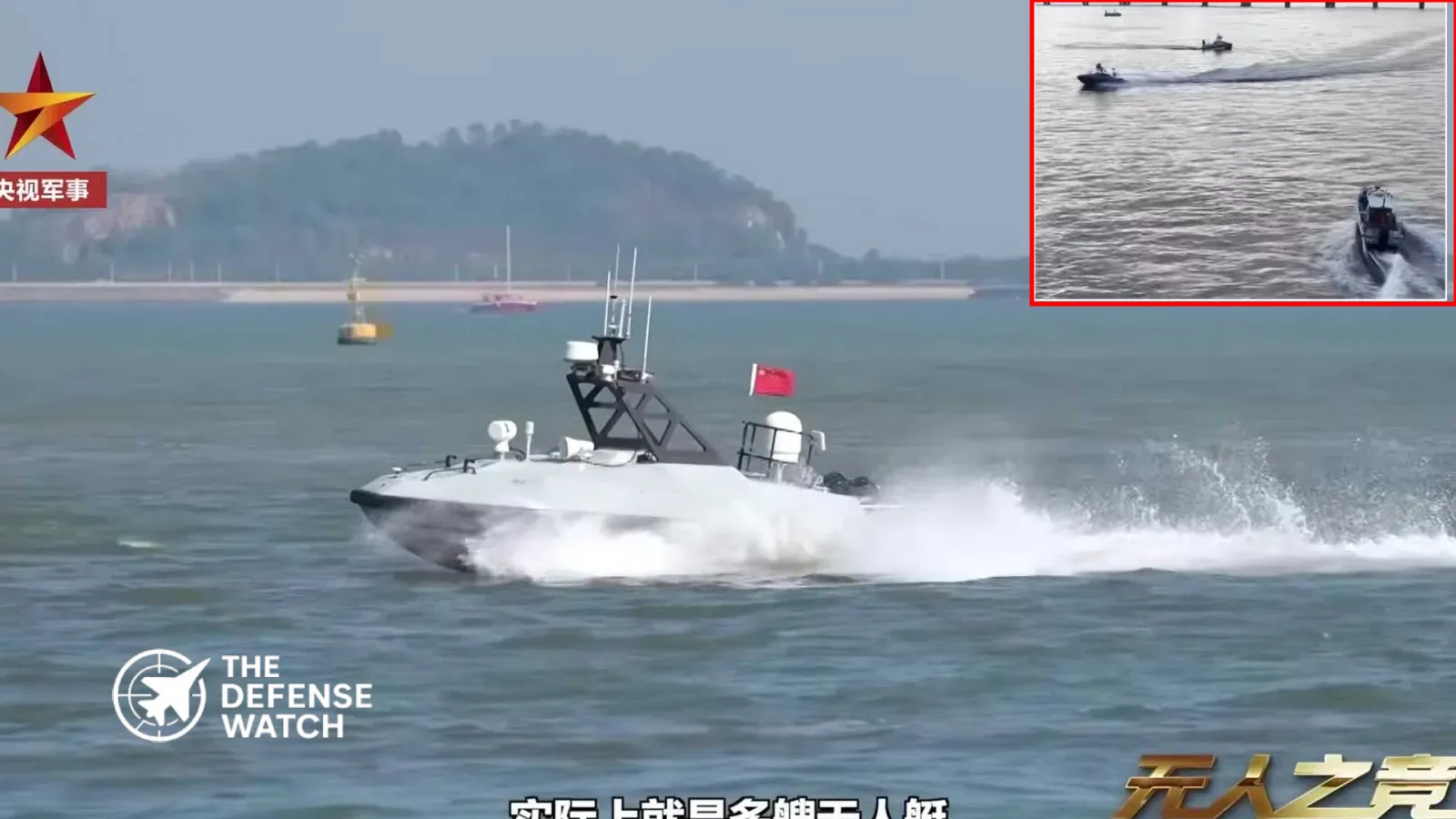
china maritime drone swarm
Image: China/CCTV
SHARE
Follow The Defense Watch on Google:
¦ KEY FACTS AT A GLANCE
  • China has tested an autonomous maritime drone swarm designed for coordinated naval operations.
  • The system features multiple unmanned surface vessels operating with AI-driven coordination.
  • The drone swarm is intended to counter advanced naval forces, including US carrier strike groups.
  • The test reflects China’s growing focus on asymmetric maritime warfare capabilities.
  • Analysts see swarm systems as a cost-effective way to challenge high-value naval assets.

China Advances Autonomous Maritime Drone Swarm Capabilities

China’s autonomous maritime drone swarm program is gaining momentum, with recent tests demonstrating coordinated unmanned surface operations aimed at countering future U.S. naval deployments.

Contents
China Advances Autonomous Maritime Drone Swarm CapabilitiesA New Layer Of Naval WarfareStrategic Focus On Countering US Naval PowerOperational Advantages And LimitationsBroader Implications For Naval StrategyAnalysis: Shifting The Balance At Sea

The system involves multiple unmanned surface vessels operating together using artificial intelligence, allowing them to coordinate movement, share targeting data, and execute missions with limited human input. This approach reflects a broader shift in naval warfare toward distributed and autonomous systems.

Unlike traditional naval platforms, the drone swarm is designed to overwhelm defenses through numbers and coordination rather than relying on a single high-value platform.

A New Layer Of Naval Warfare

The tested autonomous maritime drone swarm represents a significant evolution in how naval engagements could unfold. Instead of relying solely on large warships, China appears to be investing in scalable, lower-cost unmanned systems capable of operating in contested environments.

- Advertisement -

According to reporting, the swarm can perform reconnaissance, surveillance, and potentially strike missions. These drones can disperse across a wide area, making detection and targeting more difficult for adversaries.

This model aligns with modern naval doctrine trends, where distributed lethality and networked systems are becoming central concepts. The ability to deploy dozens or even hundreds of small autonomous vessels creates a new operational challenge for traditional fleets.

Strategic Focus On Countering US Naval Power

The development of the autonomous maritime drone swarm is widely viewed as part of China’s broader effort to counter the technological and operational advantages of the U.S. Navy.

Carrier strike groups, long considered the backbone of U.S. naval power, are designed to project force globally. However, swarm systems could complicate their operations by introducing saturation attacks that strain defensive systems.

In a potential conflict scenario, even a relatively low-cost swarm could force high-value assets to expend expensive interceptors or reposition defensively. This dynamic shifts the cost equation, favoring the attacker.

Operational Advantages And Limitations

From an operational standpoint, autonomous maritime drone swarm systems offer several advantages:

  • Reduced risk to personnel
  • Lower production and deployment costs
  • Scalability for mass operations
  • Flexibility across mission types

However, limitations remain. Communication links, electronic warfare vulnerabilities, and environmental conditions can affect performance. Maintaining reliable coordination among multiple autonomous units in contested electromagnetic environments is still a technical challenge.

Despite these constraints, continued testing suggests that China is making steady progress in refining these systems.

- Advertisement -

Broader Implications For Naval Strategy

The emergence of autonomous maritime drone swarm technology signals a broader transformation in naval strategy. Traditional dominance based on large, heavily armed vessels is increasingly being supplemented by distributed, unmanned systems.

For the United States and its allies, this trend underscores the need to invest in counter-swarm technologies, including:

  • Advanced electronic warfare systems
  • Directed energy weapons
  • Improved detection and tracking capabilities

The U.S. Navy has already begun exploring similar concepts, but China’s recent testing highlights the accelerating pace of development in this domain.

Analysis: Shifting The Balance At Sea

The autonomous maritime drone swarm concept reflects a clear strategic calculation. Rather than matching the U.S. Navy ship for ship, China is focusing on asymmetric capabilities that exploit cost and scale advantages.

This approach mirrors trends seen in other domains, including aerial drone warfare, where relatively inexpensive systems have proven effective against more advanced platforms.

If successfully operationalized, swarm systems could complicate U.S. naval planning, particularly in regions like the South China Sea and Western Pacific, where geography already favors distributed operations.

At the same time, the effectiveness of such systems in high-intensity conflict remains unproven. Real-world conditions, including electronic warfare and countermeasures, will ultimately determine their impact.

Enjoying our coverage?

Make The Defense Watch a preferred source on Google to see more of our geopolitical and defense insights when relevant to you.


TAGGED:autonomous warfareChina NavyDrone SwarmNaval TechnologyUS Navy
Share This Article
Facebook Copy Link Print
ByKaleem Sheikh | Regional Defense Correspondent
Follow:
Kaleem Sheikh is a regional defense correspondent at TheDefenseWatch.com covering defense and security developments across Asia and the Middle East, including military operations, procurement, and regional security issues.
Leave a Comment

Leave a Reply Cancel reply

Your email address will not be published. Required fields are marked *

Search Defense Systems

Latest Defense Systems

  • F-15J Eagle Fighter Jet F-15J Eagle Fighter Jet
  • China’s GJ-21 Stealth Drone China’s GJ-21 Stealth Drone
  • China’s GJ-11 Stealth Drone China’s GJ-11 Stealth Drone
  • F-15EX Eagle Fighter Jet F-15EX Eagle Fighter Jet
  • TRML-4D Radar TRML-4D Radar
  • F-47A Fighter Jet F-47A Fighter Jet
  • China DF-61 Missile China DF-61 Missile
  • B61 Nuclear Bomb B61 Nuclear Bomb
  • Japan E-767 Airborne Japan E-767 Airborne

Recent Compares

  • J-10C vs JF-17 Thunder: Which Fighter Is More Capable? J-10C vs JF-17 Thunder: Which Fighter Is More Capable? View Comparison →
  • Tejas vs Gripen: Key Differences and Capabilities Tejas vs Gripen: Key Differences and Capabilities View Comparison →
  • Tejas vs MiG-21 Bison: How India Replaced Its Iconic Supersonic Fighter Tejas vs MiG-21 Bison: How India Replaced Its Iconic Supersonic Fighter View Comparison →
  • F-35 vs F-16: Stealth, Sensors and Combat Roles F-35 vs F-16: Stealth, Sensors and Combat Roles View Comparison →
  • Tejas Fighter Jet vs F-16 Fighting Falcon: Capability Compared Tejas Fighter Jet vs F-16 Fighting Falcon: Capability Compared View Comparison →
  • Rafale Fighter Jet vs F-16 Fighting Falcon : Which Fighter Has the Edge? Rafale Fighter Jet vs F-16 Fighting Falcon : Which Fighter Has the Edge? View Comparison →
  • Su-57 Fighter Jet vs J-20 Fighter Jet: Stealth and Air Combat Compared Su-57 Fighter Jet vs J-20 Fighter Jet: Stealth and Air Combat Compared View Comparison →
  • Mirage 2000 vs Tejas Mk1A: Legacy Combat Power vs Indigenous Modernization Mirage 2000 vs Tejas Mk1A: Legacy Combat Power vs Indigenous Modernization View Comparison →
  • Rafale Fighter Jet vs F-22 Raptor: Which Air Dominance Fighter Has the Edge? Rafale Fighter Jet vs F-22 Raptor: Which Air Dominance Fighter Has the Edge? View Comparison →
  • Tejas Fighter Jet vs. Rafale Fighter Jet: India’s Indigenous Fighter Meets France’s Proven Multirole Combat Aircraft Tejas Fighter Jet vs. Rafale Fighter Jet: India’s Indigenous Fighter Meets France’s Proven Multirole Combat Aircraft View Comparison →

Recent Posts

  • Boeing B-1B LAM Pylon Clears Design Review, Advancing Hypersonic Weapons Integration
  • Pakistan, Türkiye Explore Deeper Air Force Cooperation in Drones and Electronic Warfare
  • Meta Muse AI Agent Faces Privacy Concerns After Reports of Unauthorized Data Access
  • Trump Nominates Christopher LaNeve for Permanent U.S. Army Chief of Staff
  • Sweden and UK Plan Meteor Missile Support for Ukraine’s Gripen Fighters

You Might Also Like

Directed energy weapons
Naval & MaritimeNaval Strategy & Maritime Security

U.S. Navy Advances Directed Energy Weapons on Surface Ships — HELIOS Hits Drone, Songbow Project Launched

October 3, 2026
U.S. SOUTHCOM autonomous warfare
Geopolitical & Strategic DoctrinesPolicy & Strategy

U.S. SOUTHCOM Unveils Autonomous Warfare Command To Counter Narcotics Networks With Drones

April 22, 2026
North Korean destroyer Kang Kon sails during a naval exercise as Pyongyang expands its maritime modernization program.
Naval & MaritimeNaval Strategy & Maritime Security

North Korea Moves To Build 10,000-Ton Destroyer As Xi Jinping Visit Nears

September 7, 2026
Upgraded Aegis destroyer combat
Naval & MaritimeNaval Strategy & Maritime Security

US Navy Destroyer With Upgraded Aegis Enters Combat Against Iran, Pentagon Urges Extended Testing

September 8, 2026

Logo

Copyright © 2026 TheDefenseWatch.com

Helpful Links

  • Home
  • About Us
  • Privacy Policy
  • Terms of Use / Disclaimer
  • U.S. Privacy Notice – CCPA Compliance

Defense Systems

  • Defense Systems
  • Comparisons 
  • Manufacturer
  • Tactical Calculators

Popuplar

Which 5 Air Forces Possess the Costliest Fighter Jet Fleets in the World
Evolving Strategic Value: Carrier Strike Groups in the Indo-Pacific’s Future Security Architecture
Autonomous Weapon Systems Spark U.S. Ethics Debate Amid Rapid Military AI Integration

We report on developments involving military forces, governments, defense companies, research organizations, and security institutions around the world. 

Welcome Back!

Sign in to your account

Username or Email Address
Password

Lost your password?

Enjoying our coverage?

Make The Defense Watch a preferred source on Google to see more insights.