- Home
- Catalog
- Attack & Multirole Drones (UAVs)
- MQ-1B Predator UAV
MQ-1B Predator UAV
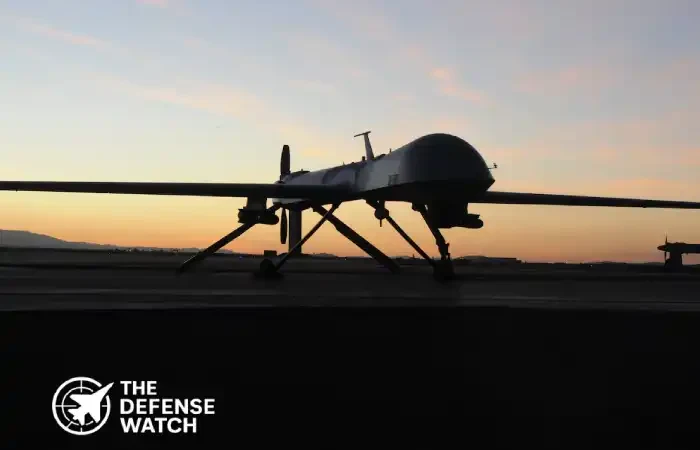
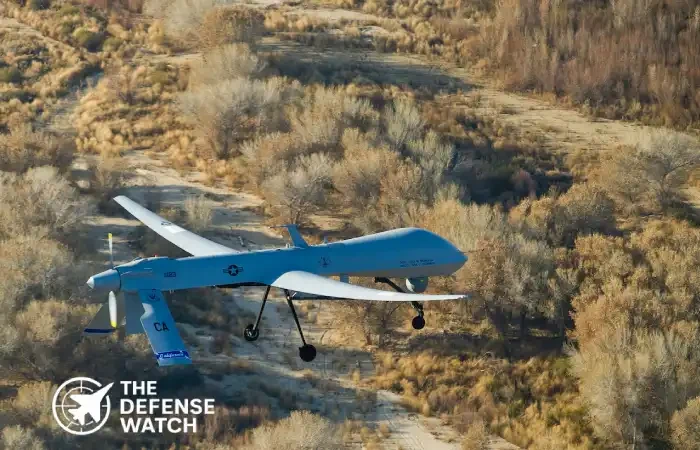
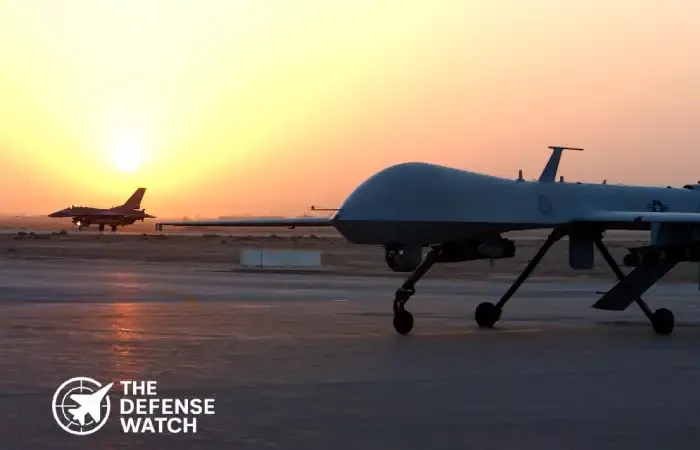
Full Specifications
1. General Information
| Name | MQ-1B Predator |
| Manufacturer | General Atomics Aeronautical Systems |
| Country of Origin | United States |
| Type / Role | Unmanned Reconnaissance and Strike UAV |
| First Flight / Introduced | 1994 / Early 2000s operational use |
| Status | Retired from USAF, limited global use |
| Unit Cost | USD 4–5 Million (Approx.) |
2. Performance
| Maximum Speed | 480 km/h (diving max) |
| Cruise Speed | 135 knots (~250 km/h) |
| Operational Range | 1,850 km |
| Endurance | 24 hours |
| Service Ceiling | 25,000 ft |
| Rate of Climb | 12 m/s |
3. Dimensions
| Length | 8.22 m |
| Wingspan | 16.8 m |
| Height | 2.1 m |
| Maximum Takeoff Weight (MTOW) | 1,020 kg |
4. Payload & Armament
| Payload Capacity | 204 kg |
| Hardpoints | 2 |
| Weapons | AGM-114 Hellfire missiles |
| Sensors | EO/IR camera, laser designator, SAR radar |
| Avionics | Satellite link, GPS/INS navigation |
5. Propulsion
| Engine Type | Rotax 914 piston engine |
| Engine Power | ~115 hp |
| Propeller Type | Two-blade pusher propeller |
6. Communication & Control
| Control Type | Remote / Semi-autonomous |
| Data Link Range | ~200 km LOS / Satellite beyond LOS |
| Navigation | GPS / INS |
| Ground Control Station | Fixed or deployable control unit |
7. Operational Use
| Primary Users | USAF, CIA, NATO partners |
| Combat Proven | Yes |
| Notable Operations | Afghanistan, Iraq, Libya, Syria |
PROS
- Long endurance allows extended surveillance missions
- Proven combat record across multiple operational theaters
- Equipped with precision strike capability using Hellfire missiles
- Advanced ISR sensors for real-time intelligence gathering
- Remote operation reduces risk to personnel
CONS
- Limited speed compared to manned aircraft
- Vulnerable to advanced air defense systems
- Requires satellite or line-of-sight communication links
- Payload capacity is relatively constrained
- Dependent on ground infrastructure and trained operators
MQ-1B Predator Drone
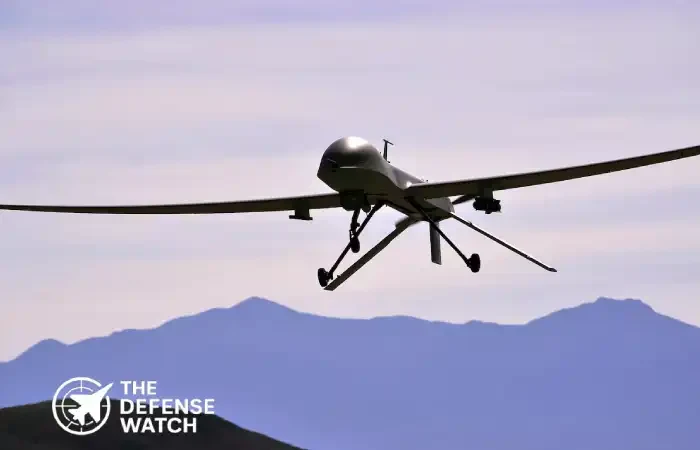
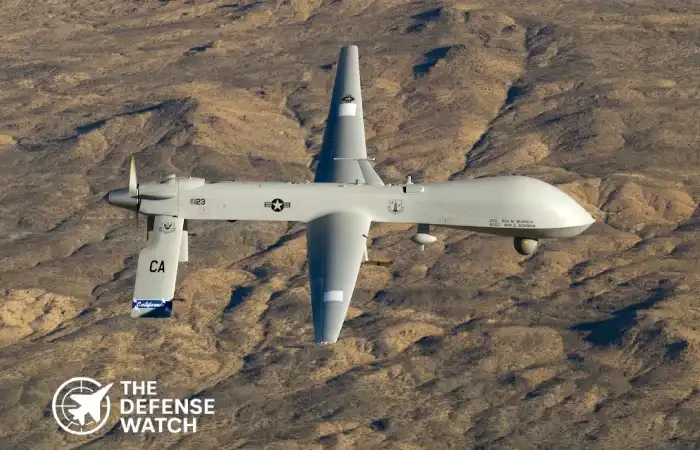
The MQ-1B Predator is a medium-altitude, long-endurance unmanned aerial vehicle developed for intelligence, surveillance, reconnaissance, and precision strike missions. Designed to operate without an onboard pilot, it became one of the earliest armed drones used by the United States Air Force and intelligence agencies. The platform played a key role in modernizing remote warfare by enabling persistent monitoring and targeted engagement in high-risk environments.
Manufacturer
The system is produced by General Atomics Aeronautical Systems, a leading U.S. defense contractor specializing in unmanned aircraft systems. The Predator program marked a major milestone in the company’s expansion into advanced UAV technologies, integrating sensor suites, satellite communications, and precision weapons.
Capabilities and Performance
The MQ-1B Predator is powered by a turboprop engine that allows a cruising speed of around 135 knots. It can remain airborne for up to 24 hours, providing continuous coverage over extended operational areas. With a line-of-sight range of approximately 200 kilometers and satellite communication links for beyond-line-of-sight missions, the drone can be operated globally. It is equipped with electro-optical and infrared sensors, synthetic aperture radar, and laser designation systems for target acquisition and tracking.
Armament and Technology
The platform is capable of carrying AGM-114 Hellfire missiles for precision strikes. Its integrated avionics include GPS and inertial navigation systems, secure data links, and real-time video transmission to ground control stations. These features enable operators to conduct both reconnaissance and combat missions with high situational awareness.
Cost
The unit cost of the MQ-1B Predator is estimated at approximately 4 million to 5 million USD, depending on configuration and support systems. Additional infrastructure such as ground control stations and satellite links contributes to overall program costs.
Get real time update about this post category directly on your device, subscribe now.
Reviews
Disclaimer Note
The information provided on TheDefenseWatch.com is for general informational purposes only. While we strive to ensure the accuracy, completeness, and timeliness of our content regarding defense and aerospace products, technologies, and specifications, we cannot guarantee that all information is 100% accurate or up-to-date due to the evolving nature of military technology and classified data.TheDefenseWatch.com does not warrant the reliability, suitability, or availability of the information for any specific purpose. Users are advised to consult official sources, such as manufacturers, government publications, or defense agencies, for precise and verified data before making decisions based on our content.We are not affiliated with any defense manufacturers, governments, or military organizations mentioned. Opinions, reviews, and ratings reflect expert analysis but are subjective and should not be considered endorsements. TheDefenseWatch.com is not responsible for any errors, omissions, or consequences arising from the use of this website’s content.External links are provided for convenience and do not imply endorsement. TheDefenseWatch.com reserves the right to update or modify content without prior notice. By using this website, you agree to our Privacy & Cookies Policy.


New Arrivals



Popular Comparisons
-
 GCAP vs FCAS, Europe Sixth Generation Fighter Race
View Comparison →
GCAP vs FCAS, Europe Sixth Generation Fighter Race
View Comparison → -
Su-57 vs F-35 Cost Analysis: Price, Maintenance, and Export Availability
View Comparison →
-
SIG XM7 Rifle vs M4: Key Differences and Performance Comparison
View Comparison →
-
Eurofighter Typhoon vs Rafale vs F-35: Fighter Jet Comparison
View Comparison →
-
J-20 vs F-22: Stealth Fighter Showdown Explained
View Comparison →
-
F-14 Tomcat vs Su-57: Can a Legend Challenge Russia’s Stealth Fighter?
View Comparison →
-
Su-35 vs Su-57: Russia’s Top Fighter Jets Compared
View Comparison →
-
Eurofighter Typhoon vs Su-57: Ultimate Fighter Jet Comparison
View Comparison →
-
Rafale vs Su-57: 4.5 Gen vs 5th Gen Fighter Jet Comparison
View Comparison →
-
Su-57 vs F-16 Fighting Falcon: Stealth vs Speed
View Comparison →


- Breaking the Sound Barrier Without Breaking the Peace: How the U.S. Military and NASA Are Redefining Sonic Boom Science in 2026

- U.S. Navy Races To Expand Fleet As $65.8 Billion Shipbuilding Plan Unveiled
- US Rescues Downed F-15 Pilot After Aircraft Shot Down Over Iran
- UK Races To Expand Munitions Production As Stockpile Pressures Mount
- Portugal Deploys F-16s To Expand NATO Baltic Air Policing Mission
- UK Typhoon And Wildcat Operations Expand Air Defense Capability Across Middle East
- BAE Systems Expands Cyber Capabilities To Strengthen AUKUS Defense Integration
- Pentagon Moves To Fund 38 F-35A Fighters As Air Force Battles Its Worst Fighter Shortfall In History
- Iran Moves To Keep Peace Talks Open As Search For Missing US Pilot Intensifies
- U.S. Navy Expands Undersea Readiness As USS New Jersey Attack Submarine Returns To Service