- Home
- Catalog
- Bombs & Aerial Munitions
- GBU-15 Bomb
GBU-15 Bomb
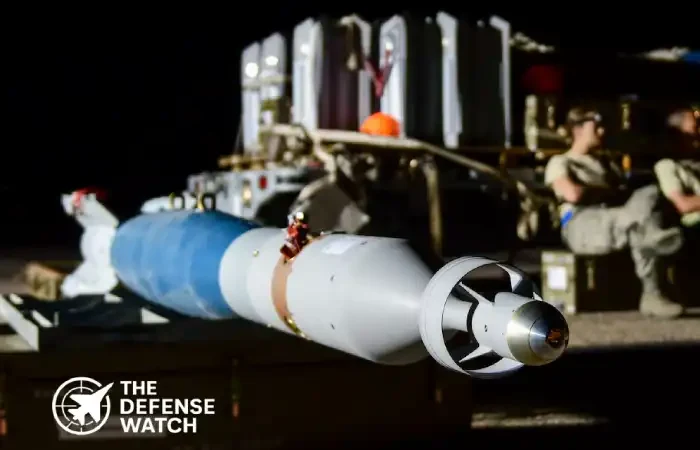

Full Specifications
1. General Information
| Name / Designation | GBU-15 |
| Type | Precision Guided Bomb |
| Manufacturer | Texas Instruments, later Raytheon |
| Country of Origin | United States |
| Year Introduced | Late 1970s |
| Operational Status | In service with upgrades |
2. Physical Characteristics
| Weight | Approximately 2,000 pounds class |
| Length | Varies by bomb body configuration |
| Diameter | Standard 2,000 pound bomb diameter |
| Casing Type | Steel conventional bomb casing |
3. Performance
| Yield | Conventional explosive charge |
| Guidance | Electro optical or infrared with data link |
| Accuracy (CEP) | Typically within a few meters under optimal conditions |
| Delivery Platforms | F-15, F-111 and compatible strike aircraft |
| Penetration Capability | Limited, depends on bomb body and fuse configuration |
4. Warhead / Explosive Details
| Warhead Type | High explosive conventional |
| Fuzing Options | Impact and delayed fuze options |
| Explosive Composition | Standard military high explosive compositions |
5. Operational Use
| Primary Mission | Precision strike against fixed and relocatable targets |
| Operators | United States Air Force |
| Notable Deployments / History | Used in multiple conflicts since the late Cold War era |
6. Variants
| Variants | Different guidance packages including electro optical and infrared seeker versions |
PROS
- High precision with man in the loop guidance
- Standoff capability reduces aircraft exposure to air defenses
- Flexible targeting with electro optical or infrared options
- Compatible with multiple aircraft platforms
- Modular design allows integration with different bomb bodies
CONS
- Requires line of sight or data link for guidance
- Limited effectiveness in heavily obscured environments like dense clouds or smoke
- Dependent on operator control during terminal phase
- No propulsion limits range compared to cruise missiles
- Susceptible to electronic warfare interference in contested environments
GBU-15 Precision Guided Glide Bomb
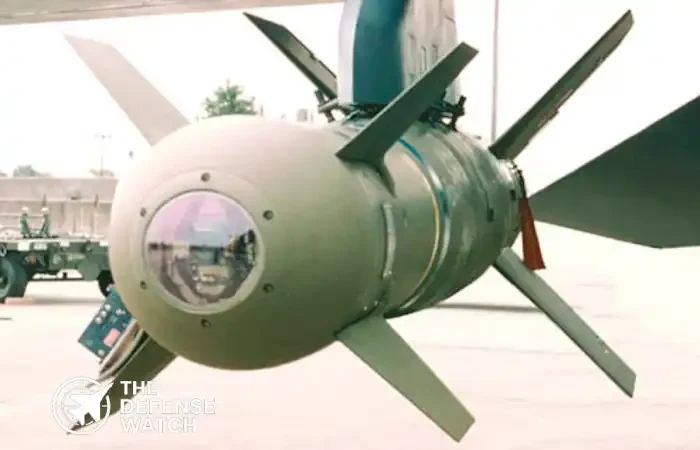
The GBU-15 is a U.S. precision guided glide bomb designed to deliver accurate, standoff strike capability against high value and hardened targets. Developed during the Cold War era, it combines a conventional bomb body with advanced guidance and control systems, allowing operators to guide it to a target after release. This capability gives aircraft the ability to engage threats from outside heavily defended airspace while maintaining high accuracy.
Manufacturer
The weapon was originally developed by Texas Instruments, with later production and support associated with Raytheon, a major U.S. defense contractor. It was introduced into service in the late 1970s and has since been integrated with multiple U.S. Air Force platforms.
Capabilities and Guidance
The GBU-15 uses electro optical or infrared guidance depending on the variant. It supports man in the loop control via a data link, allowing a weapons systems operator to steer the bomb during flight. This enables real time target selection, retargeting, and improved accuracy against moving or time sensitive targets. The modular guidance package can be paired with different bomb bodies, typically in the 2,000 pound class.
Speed and Range
As an unpowered glide weapon, the GBU-15 does not have its own propulsion system. Its speed depends on the release aircraft and altitude, typically descending at high subsonic speeds. Operational range varies significantly based on launch conditions, altitude, and platform, generally extending from around 15 kilometers to over 40 kilometers in optimal release scenarios.
Cost
Publicly available cost estimates vary, but the GBU-15 system is generally considered a cost effective precision strike solution compared to more complex powered munitions. Individual unit costs are influenced by guidance kit configuration and modernization upgrades.
FAQs
It has been integrated with aircraft such as the F-15 Strike Eagle and legacy platforms like the F-111.
No, it primarily relies on electro optical or infrared guidance with a man in the loop data link.
Its ability to be guided after release allows high accuracy and standoff engagement from outside defended airspace.
Yes, it remains in service with the U.S. Air Force, although newer precision weapons have supplemented its role.
Yes, operator guidance allows adjustment during flight, enabling engagement of moving or relocatable targets under suitable conditions.
Get real time update about this post category directly on your device, subscribe now.
Reviews
Disclaimer Note
The information provided on TheDefenseWatch.com is for general informational purposes only. While we strive to ensure the accuracy, completeness, and timeliness of our content regarding defense and aerospace products, technologies, and specifications, we cannot guarantee that all information is 100% accurate or up-to-date due to the evolving nature of military technology and classified data.TheDefenseWatch.com does not warrant the reliability, suitability, or availability of the information for any specific purpose. Users are advised to consult official sources, such as manufacturers, government publications, or defense agencies, for precise and verified data before making decisions based on our content.We are not affiliated with any defense manufacturers, governments, or military organizations mentioned. Opinions, reviews, and ratings reflect expert analysis but are subjective and should not be considered endorsements. TheDefenseWatch.com is not responsible for any errors, omissions, or consequences arising from the use of this website’s content.External links are provided for convenience and do not imply endorsement. TheDefenseWatch.com reserves the right to update or modify content without prior notice. By using this website, you agree to our Privacy & Cookies Policy.




New Arrivals










Popular Comparisons
-
 GCAP vs FCAS, Europe Sixth Generation Fighter Race
View Comparison →
GCAP vs FCAS, Europe Sixth Generation Fighter Race
View Comparison → -
Su-57 vs F-35 Cost Analysis: Price, Maintenance, and Export Availability
View Comparison →
-
SIG XM7 Rifle vs M4: Key Differences and Performance Comparison
View Comparison →
-
Eurofighter Typhoon vs Rafale vs F-35: Fighter Jet Comparison
View Comparison →
-
J-20 vs F-22: Stealth Fighter Showdown Explained
View Comparison →
-
F-14 Tomcat vs Su-57: Can a Legend Challenge Russia’s Stealth Fighter?
View Comparison →
-
Su-35 vs Su-57: Russia’s Top Fighter Jets Compared
View Comparison →
-
Eurofighter Typhoon vs Su-57: Ultimate Fighter Jet Comparison
View Comparison →
-
Rafale vs Su-57: 4.5 Gen vs 5th Gen Fighter Jet Comparison
View Comparison →
-
Su-57 vs F-16 Fighting Falcon: Stealth vs Speed
View Comparison →


- Breaking the Sound Barrier Without Breaking the Peace: How the U.S. Military and NASA Are Redefining Sonic Boom Science in 2026

- U.S. Navy Races To Expand Fleet As $65.8 Billion Shipbuilding Plan Unveiled
- US Rescues Downed F-15 Pilot After Aircraft Shot Down Over Iran
- UK Races To Expand Munitions Production As Stockpile Pressures Mount
- Portugal Deploys F-16s To Expand NATO Baltic Air Policing Mission
- UK Typhoon And Wildcat Operations Expand Air Defense Capability Across Middle East
- BAE Systems Expands Cyber Capabilities To Strengthen AUKUS Defense Integration
- Pentagon Moves To Fund 38 F-35A Fighters As Air Force Battles Its Worst Fighter Shortfall In History
- Iran Moves To Keep Peace Talks Open As Search For Missing US Pilot Intensifies
- U.S. Navy Expands Undersea Readiness As USS New Jersey Attack Submarine Returns To Service