Germany Lays Out Roadmap To Field Europe’s Most Powerful Conventional Military by 2039
Germany’s military strategy, unveiled April 22 in Berlin, sets the most ambitious defense transformation target in the country’s postwar history — becoming the strongest conventional fighting force in Europe within 13 years. Defense Minister Boris Pistorius presented the package of foundational documents at a press conference, framing the strategy as an unavoidable response to a changed security environment driven primarily by Russia.
- Germany released its first-ever standalone military strategy on April 22, 2026 — the most comprehensive Bundeswehr planning overhaul in decades.
- The plan targets expansion from 185,420 active-duty soldiers today to 260,000 by the mid-2030s, with reserves growing from ~60,000 to 200,000 — a combined 460,000 combat-ready troops.
- Russia is formally identified as the primary threat; the strategy introduces a “one theater approach” linking NATO territory, the Middle East, and the Indo-Pacific as interconnected security spaces.
- Priority capability gaps include deep precision strike, hypersonic missile defense, and drone warfare — areas where Germany acknowledges it is essentially starting from scratch on long-range strike.
- A three-phase buildup runs through 2039: rapid force growth by 2029, capability expansion by 2035, and technology-driven modernization beyond 2039.
The Big Picture
European NATO members have spent the better part of two years responding to pressure — from Russia’s continued war in Ukraine, from Washington’s increasingly conditional security guarantees, and from the recognition that the Cold War-era model of a small, U.S.-backstopped force structure is no longer adequate.
Germany, long criticized for chronic underinvestment and institutional sluggishness, has emerged as the alliance member making the most structurally ambitious commitments. The €100 billion special defense fund announced in 2022 began reversing years of budgetary neglect, but hardware spending alone cannot rebuild a military culture or a force structure. The April 22 documents attempt to address the doctrine, personnel, and organizational questions that funding alone cannot answer.
For the United States, a more capable German military carries direct strategic value. A Bundeswehr able to serve as a logistics hub and leading conventional deterrent reduces the operational burden on U.S. forces in Europe and strengthens the eastern flank without requiring additional American deployments.
What’s Happening
Berlin released four interconnected strategic documents on April 22, 2026. The package includes Germany’s first standalone military strategy, titled Verantwortung für Europa (Responsibility for Europe); a new capability profile; a personnel growth plan; and a redesigned reserve strategy. Defense Minister Pistorius and military Deputy Inspector-General Nicole Schilling presented unclassified summaries to lawmakers and the press in Berlin.
The documents are classified “living documents” subject to ongoing revision, and Pistorius declined to detail classified threat assessments, noting that publishing them would be equivalent to “adding Vladimir Putin to our email distribution list.”
The strategy formally identifies Russia as the primary threat and outlines scenarios for potential attacks on NATO territory. It also introduces a “one theater approach” — a doctrinal shift that treats NATO territory, the Middle East, and the Indo-Pacific as interconnected security spaces rather than separate operational theaters.
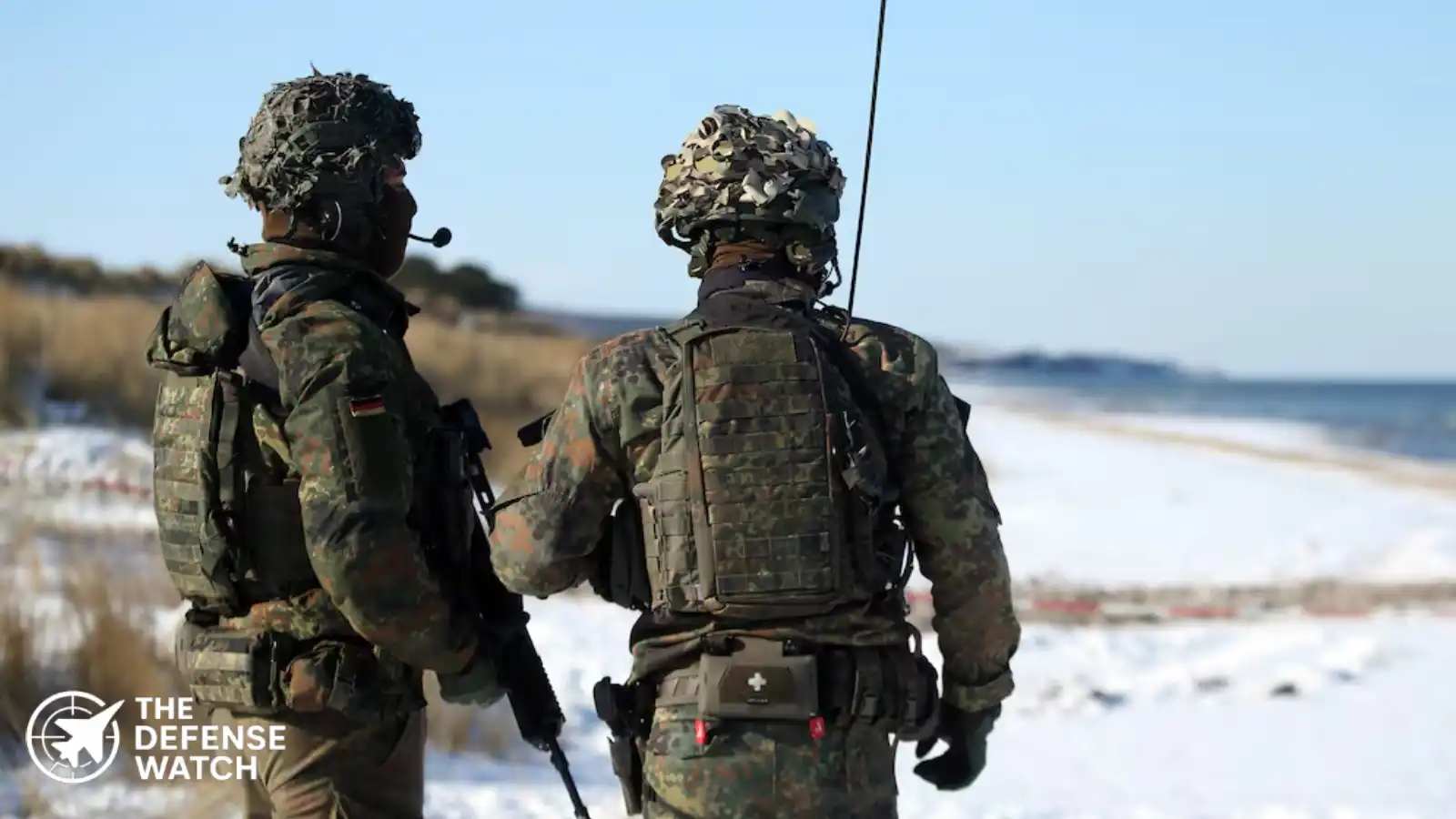
The Bundeswehr currently fields 185,420 active-duty soldiers. The personnel plan foresees growth to 260,000 by the mid-2030s. Reserve forces, currently sitting at approximately 60,000 assigned reservists, would expand to at least 200,000. Combined, the goal is 460,000 combat-ready troops — a force level Germany has not approached since reunification.
A three-phase timeline governs the expansion: rapid buildup through 2029, capability-focused growth through 2035, and a technology-driven phase extending through 2039 and beyond. New legislation enacted in January 2026 codifies these milestones in law, with conscription embedded as a fallback option if voluntary recruitment targets are not met.
Why It Matters
The release of Germany’s first standalone military strategy is not procedural housekeeping. It signals a fundamental shift in how Germany conceptualizes its security role — from a country that participated in NATO while depending on American deterrence as a backstop, to one actively designing itself for high-end warfighting at continental scale.
The capability profile accompanying the strategy marks a particularly significant doctrinal evolution. Rather than specifying hardware inventories — a set number of tanks, aircraft, or ships — the new model is effects-based. The question Pistorius posed publicly: not how many battalions does Germany need, but what battlefield effects must Germany be able to produce?
That framing has direct implications for procurement. Priority capability areas identified include deep precision strike, air defense against hypersonic missiles, and drone systems. Pistorius acknowledged that Germany is “essentially starting from scratch on long-range strike” — a candid admission that reflects how completely postwar restraint, both political and doctrinal, constrained German military development for decades.
The reserve strategy carries equal significance. Germany’s reserve force has historically been an afterthought — a pool of former service members available for emergencies but not integrated into operational planning. The new strategy places reserves “on par with the active force,” explicitly tasking them with homeland defense and positioning Germany as a logistics and transit hub for allied forces moving east in a crisis. Pistorius described the reserve as “the hinge between the military and civil society.”
Strategic Implications
A Germany fielding 460,000 combat-ready troops with a high-end precision strike capability and an integrated reserve structure would represent a qualitative shift in NATO’s European deterrence posture — not merely an incremental improvement.
The “one theater approach” embedded in the strategy is analytically significant. By framing NATO territory, the Middle East, and the Indo-Pacific as interconnected rather than discrete security spaces, Germany is signaling awareness that future conflicts may not be geographically isolated. This aligns with broader NATO and U.S. strategic thinking about multi-domain and multi-theater contingencies, but it also obligates Germany to develop force planning that accounts for simultaneous demands across different regions.
The codification of milestones in law — a step taken in January 2026 — creates accountability mechanisms that previous German defense plans lacked. It means that if recruitment targets slip, conscription is not merely a political option to be debated: it is already embedded in existing law as a fallback. That legal structure increases the credibility of the timeline in a way that voluntary planning documents cannot match.
The bureaucratic modernization agenda — EMA26, with 153 concrete measures and 580 implementation steps — addresses one of the Bundeswehr’s most persistent structural problems. Germany’s military has long suffered from procurement delays, administrative bottlenecks, and a regulatory environment that slowed everything from ammunition purchases to officer promotions. The automatic expiry dates assigned to all internal regulations represent a genuine institutional reform rather than a cosmetic gesture.
Competitor View
Moscow will track the German buildup with particular attention. Russia’s military planning has long operated on assessments of NATO’s eastern and central European posture, and a Germany capable of functioning as a high-capacity logistics hub and fielding a conventional force of 460,000 directly complicates Russian operational calculus in any scenario involving NATO territory.
The “one theater approach” may register differently in Beijing. China has closely monitored European defense developments for indications of how far European NATO members are willing to extend their strategic focus toward the Indo-Pacific. Germany naming the Indo-Pacific as part of its connected security space — even in a foundational strategy document — contributes to the pattern of European defense engagement with the region that China has sought to discourage.
What To Watch Next
Recruitment figures will be the first leading indicator of whether the personnel plan is realistic. Schilling noted that recruitment in 2026 is running 10% above last year’s pace, with applications up 20% — encouraging data, but the distance between current numbers and the 2029 targets remains large.
Procurement decisions in the deep strike and hypersonic defense domains will be the next major test. Pistorius acknowledged that global production capacity for air defense systems has tightened due to Middle Eastern demand, and Germany does not control all procurement variables. The gap between strategic ambition and industrial capacity is where ambitious defense plans most commonly fail.
The reserve expansion timeline will also require close monitoring. Building an integrated reserve force of 200,000 requires not just recruiting numbers but organizational infrastructure, equipment allocation, training cycles, and legal frameworks for activation — all of which take time that hardware procurement timelines cannot compress.
Capability Gap
The German military strategy addresses three distinct gaps simultaneously. The first is structural: Germany’s force was too small, too lightly equipped, and too poorly integrated with its reserve component to credibly fulfill NATO’s collective defense commitments.
The second is doctrinal: without a standalone military strategy, Germany lacked a coherent framework connecting political objectives to military tasks. The strategy document fills that gap, even if its classified threat assessments remain unavailable to public analysis.
The third is industrial and technological: Germany’s procurement apparatus was too slow and too bureaucratically constrained to translate available funding into actual capability at speed. EMA26 is the institutional response to this problem — though 153 measures and 580 implementation steps represent a substantial execution risk in their own right.
Realistic limitations remain. The timeline runs to 2039, which means full capability will not be available for over a decade. Conscription as a backstop acknowledges that voluntary recruitment alone may not deliver the required numbers. And global competition for air defense systems and precision munitions means that Germany’s ability to acquire the hardware it needs depends partly on factors outside its control.
The Bottom Line
Germany’s 2039 military strategy represents the most consequential structural commitment to European defense self-reliance since the end of the Cold War — and whether Berlin can execute at the pace the documents demand will determine whether that commitment translates into actual deterrence.