The USAFE Headquarters Bombing and Its Enduring Security Lessons
The USAFE Headquarters bombing at Ramstein Air Base on August 31, 1981, was a terrorist attack that exposed vulnerabilities in the physical security of a major U.S. military installation during the Cold War. Forty-five years later, the attack remains relevant because many of the principles developed in its aftermath are reflected in the layered security, threat awareness and force-protection practices used by U.S. Air Forces in Europe-Air Forces Africa today.
- The USAFE Headquarters Bombing and Its Enduring Security Lessons
- Key Takeaways
- What Happened in the 1981 Ramstein Attack?
- Why the Ramstein Bombing Was a Major Force-Protection Lesson
- Access Control Is Only One Layer
- Critical Facilities Need Physical Protection
- Emergency Response Is Part of Force Protection
- From Cold War Terrorism to Multi-Domain Installation Defense
- Modern USAFE Force Protection and Counter-UAS
- The Strategic Role of Ramstein Has Also Changed
- USAFE Headquarters Bombing vs. Modern Installation Security
- Lessons From the 1981 Attack for Modern Military Bases
- 1. Threats Adapt to Security Measures
- 2. Security Must Protect the Mission
- 3. Human Awareness Still Matters
- 4. Resilience Matters as Much as Prevention
- 5. Security Must Evolve With the Threat
- USAFE-AFAFRICA’s Future Force-Protection Challenge
- Why the 1981 Ramstein Attack Still Matters
- Conclusion
The bombing occurred during a period of intense terrorist activity across Western Europe. The Red Army Faction, also known as the Baader-Meinhof Gang, targeted U.S. military personnel and facilities as part of its broader campaign against Western institutions.
At Ramstein, attackers exploited security practices that were significantly different from those used at U.S. military installations today. The result was a major explosion outside Building 201, the USAFE headquarters facility, with extensive damage to the building and vehicles nearby.
Fourteen people, including 12 Americans and two Germans, were injured according to the current USAFE historical account. No one was killed.
The significance of the event extends beyond the physical damage. It demonstrated that installation security could not depend on a single access-control measure. The threat could exploit weaknesses in vehicle access, perimeter security, personnel awareness and facility protection simultaneously.
Key Takeaways
The 1981 Ramstein attack became an important force-protection lesson for USAFE, while modern threats have expanded the security challenge to include drones, cyber threats, sabotage and other forms of attack.
What Happened in the 1981 Ramstein Attack?
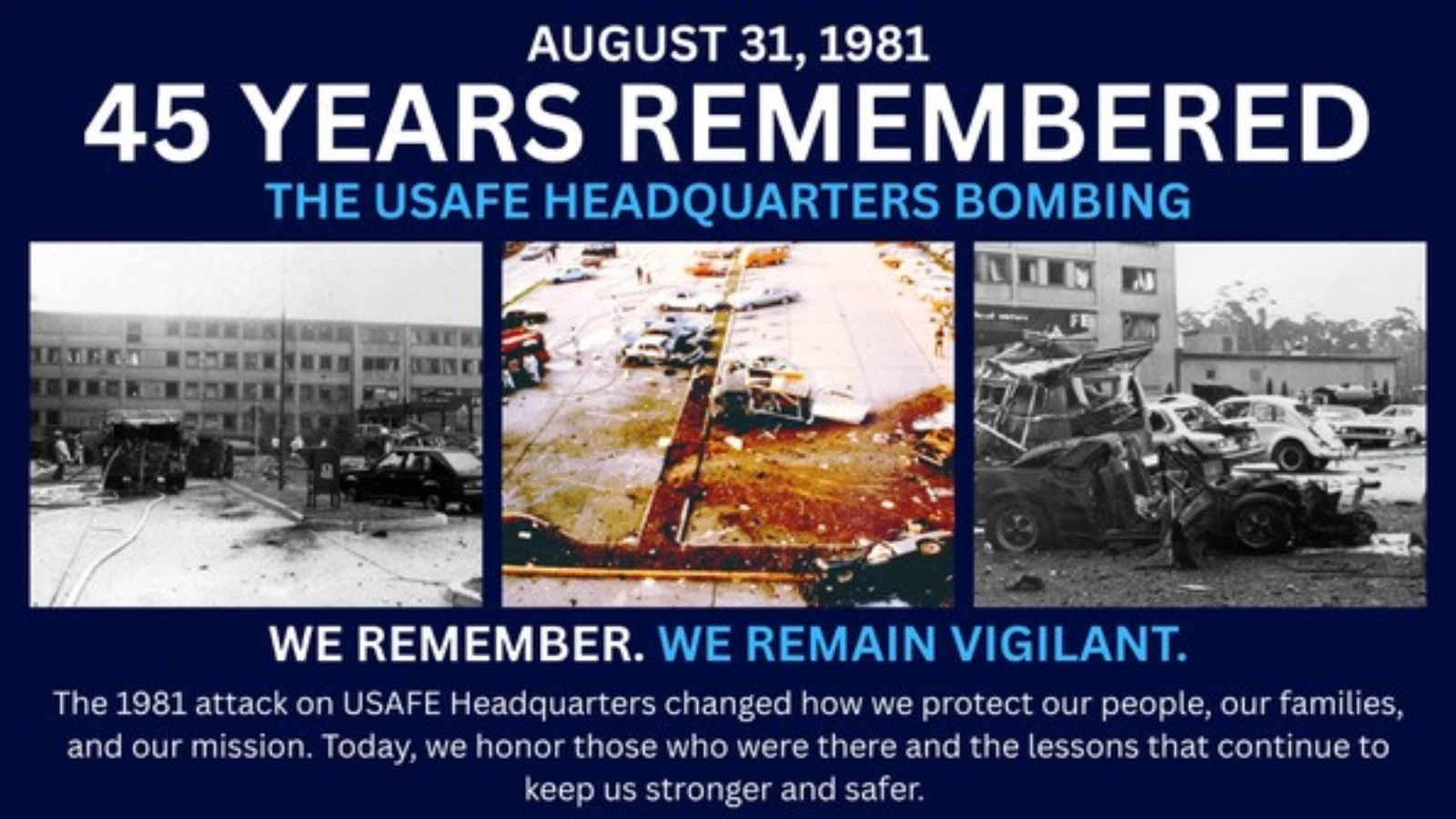
The USAFE Headquarters bombing occurred early on August 31, 1981, at Ramstein Air Base in then-West Germany.
According to USAFE’s 2026 historical account, a vehicle carrying explosives was brought onto the installation using stolen U.S. Army Europe license plates. The vehicle was positioned near the entrance to Building 201, where USAFE Headquarters was located. Two explosive devices detonated at approximately 7:21 a.m.
The explosion damaged the headquarters building and approximately 50 vehicles. Windows across portions of the building were shattered, while interior walls, equipment and furniture were damaged.
A third explosive device failed to detonate and was subsequently made safe. Fourteen people were injured, including U.S. Air Force Brig. Gen. Joseph D. Moore, USAFE’s deputy chief of staff for operations.
The attack was later attributed to the Red Army Faction, a West German left-wing extremist organization that had conducted a campaign of violence against government institutions, businesses and U.S. interests.
Historical reporting from Stars and Stripes states that the attack prompted significant security changes around the headquarters, including physical barriers and a permanent security ring.
Why the Ramstein Bombing Was a Major Force-Protection Lesson
The most important consequence of the bombing was not simply the damage to Building 201. It was the realization that an installation could be vulnerable even when conventional security procedures were functioning as designed.
The attack demonstrated several important force-protection principles.
Access Control Is Only One Layer
A secure military installation requires more than an entry gate. Vehicle screening, identification procedures, standoff distances, barriers, surveillance, patrols and personnel awareness must work together.
The security environment at Ramstein in 1981 was substantially different from today’s installation-security model. The use of U.S. military license plates as an access mechanism provided an opportunity that attackers were able to exploit.
Critical Facilities Need Physical Protection
Headquarters buildings are high-value targets because they contain personnel, command functions, communications infrastructure and decision-making capabilities.
The Ramstein attack showed that protecting a facility requires consideration of the area surrounding the building as well as the structure itself.
Increasing distance between potential threats and critical facilities can reduce the effects of an explosion, while physical barriers and controlled vehicle movement can reduce opportunities for hostile actors to approach sensitive locations.
Emergency Response Is Part of Force Protection
The response to the bombing also demonstrated the importance of medical preparedness.
Personnel from the nearby dental clinic moved toward the scene immediately after the explosion. Air Force Medical Service historical records describe how dental personnel helped evacuate casualties and established an improvised triage and treatment area.
The episode illustrates a broader principle that remains relevant to military installations today: force protection includes not only preventing attacks but also maintaining the ability to respond when prevention fails.
From Cold War Terrorism to Multi-Domain Installation Defense
The security environment surrounding Ramstein has changed dramatically since 1981.
USAFE-AFAFRICA is now the air component for U.S. European Command and U.S. Africa Command. Its operational area spans three continents and includes 104 countries. The command maintains forward-based airpower and infrastructure that support U.S. and allied operations.
That mission creates a security problem far broader than traditional perimeter defense.
A modern air base must protect:
- Aircraft and aviation infrastructure
- Command and control facilities
- Fuel and energy infrastructure
- Communications networks
- Maintenance facilities
- Personnel and families
- Weapons and sensitive equipment
- Transportation networks
- Information systems
- Critical logistics nodes
The threat can also arrive through multiple domains.
Terrorist groups remain a concern, but military planners must additionally account for unmanned aircraft, cyber operations, electronic warfare, sabotage, intelligence collection and long-range weapons.
This has transformed force protection from a primarily physical-security function into a broader operational requirement.
Modern USAFE Force Protection and Counter-UAS
The evolution is particularly visible in the U.S. Air Force’s response to unmanned aircraft.
In July 2026, USAFE-AFAFRICA announced that it was strengthening its defensive posture against unmanned aircraft systems through new equipment, testing and additional training. The command described the effort as a layered and integrated Counter-UAS approach designed to protect installations and personnel.
This represents a major change from the threat environment of 1981.
An attacker no longer necessarily needs physical access to an installation. A relatively small unmanned aircraft can potentially create a security problem without crossing a traditional gate.
Consequently, modern installation defense can involve multiple elements, including:
- Detection and tracking systems
- Electronic warfare
- Counter-UAS interceptors
- Directed-energy technologies
- Physical security
- Air-defense systems
- Intelligence and surveillance
- Human reporting and threat awareness
The objective is not to rely on one technology. It is to build enough overlapping protection that the failure of one layer does not automatically compromise the installation.
The Strategic Role of Ramstein Has Also Changed
Ramstein is no longer simply a Cold War-era air base supporting a fixed forward force.
USAFE-AFAFRICA has evolved into a mobile and expeditionary command capable of operating across multiple locations. Its current mission includes projecting combat-ready airpower, supporting allies and partners, and deterring aggression.
The command’s role makes installation protection strategically important.
A damaged runway, command facility, communications node or logistics center can have effects that extend well beyond the installation itself.
For a forward-based air force, infrastructure is part of combat power.
Protecting the base therefore helps preserve:
Command and control: Leaders must remain able to plan and direct operations.
Air operations: Aircraft require secure runways, maintenance, fuel and weapons support.
Logistics: Forward operations depend on predictable movement of personnel, fuel, spare parts and equipment.
Allied interoperability: U.S. forces operate through a network of European bases and partner nations.
Deterrence: A force that can continue operating under attack is harder for an adversary to disrupt.
The 603rd Air Operations Center at Ramstein illustrates this modern command-and-control requirement. It provides operational-level command and control for integrated air, space and cyber power in support of U.S. European Command and U.S. Africa Command requirements.
USAFE Headquarters Bombing vs. Modern Installation Security
| Area | 1981 Environment | Modern Approach |
|---|---|---|
| Primary concern | Terrorist infiltration and physical attack | Multi-domain threats |
| Vehicle access | Significantly less restrictive | Layered access control and screening |
| Perimeter defense | Less developed than today’s model | Multiple physical and procedural layers |
| Building protection | Limited standoff and protective measures | Greater emphasis on standoff and hardened security |
| Air threats | Conventional aircraft and missiles | Aircraft, missiles and unmanned systems |
| Counter-UAS | Not applicable | Detection, tracking and defeat capabilities |
| Command protection | Primarily physical security | Physical, cyber and communications protection |
| Medical response | Base medical capabilities and local responders | Integrated emergency response and casualty care |
| Threat awareness | Focused largely on known terrorist activity | Continuous monitoring across multiple threat domains |
| Security model | Primarily physical | Layered and integrated |
The comparison shows that the most important change is not the introduction of any individual security technology.
It is the shift from point protection to layered defense.
Lessons From the 1981 Attack for Modern Military Bases
The Ramstein bombing offers several enduring lessons for military planners.
1. Threats Adapt to Security Measures
Once one route into an installation becomes difficult to exploit, adversaries look for another.
Modern security planning therefore has to account for adaptation rather than assuming that a single security improvement permanently solves a vulnerability.
2. Security Must Protect the Mission
Force protection cannot become detached from operational requirements.
A base must remain secure while continuing to generate sorties, move supplies, maintain aircraft and support command functions.
3. Human Awareness Still Matters
Technology can detect threats, but personnel remain critical to identifying unusual behavior, reporting suspicious activity and responding to emergencies.
USAFE’s current approach continues to emphasize training and awareness alongside equipment.
4. Resilience Matters as Much as Prevention
No defensive system can guarantee that an installation will never be attacked.
The more practical objective is to reduce the probability of successful attacks, limit their effects and restore operations quickly if an incident occurs.
5. Security Must Evolve With the Threat
The 1981 attack involved a physical vehicle-borne threat.
Today’s military installations face a much wider spectrum that includes drones and cyber operations. Future threats may combine several methods simultaneously.
That requires continuous modernization rather than a one-time security overhaul.
USAFE-AFAFRICA’s Future Force-Protection Challenge
USAFE-AFAFRICA operates in a security environment shaped by renewed great-power competition, NATO’s eastern flank, long-range precision weapons, unmanned systems and increasingly contested communications.
The command’s ability to operate from distributed locations is becoming more important as adversaries develop capabilities designed to locate and strike fixed military infrastructure.
This is one reason modern force protection is increasingly linked to distributed operations, resilient command and control, mobility and rapid recovery.
USAFE-AFAFRICA’s own planning documents emphasize the need for distributed command and control and resilient systems capable of supporting joint all-domain operations in contested environments.
The lesson from Ramstein therefore extends beyond fences and gates.
A modern air base must be able to detect threats, protect personnel, preserve command functions, defend aircraft and infrastructure, maintain communications and continue operations even when portions of the installation are disrupted.
That is a much broader definition of force protection than existed in 1981.
Why the 1981 Ramstein Attack Still Matters
The USAFE Headquarters bombing is now 45 years in the past, but its strategic lesson remains relevant.
The attack demonstrated that a sophisticated military organization could possess substantial combat capability while still being vulnerable to a relatively localized security breach.
That lesson helped drive changes in installation protection and contributed to a broader understanding that military readiness begins with protecting the force itself.
Today, USAFE-AFAFRICA operates a far larger and more complex mission than the USAFE of the Cold War era. It supports U.S. European Command and U.S. Africa Command, works with NATO allies and partners, and projects airpower across a vast geographic area.
That mission depends on secure bases.
The modern answer to the vulnerabilities exposed at Ramstein is not simply more barriers or more technology. It is a layered security architecture combining physical protection, access control, surveillance, counter-UAS capabilities, emergency response, cyber resilience, intelligence and trained personnel.
Forty-five years after the attack, the central lesson remains clear: force protection is not separate from military power. It is one of the conditions that makes military power possible.
Conclusion
The 1981 bombing of USAFE Headquarters at Ramstein Air Base was a defining force-protection event for U.S. Air Forces in Europe. Fourteen people were injured, the headquarters building sustained major damage and the incident exposed vulnerabilities in installation security that demanded a new approach.
The security environment has changed considerably since then.
USAFE-AFAFRICA now operates across multiple theaters and relies on a network of bases, command centers, aircraft, personnel and infrastructure to project airpower with U.S. and allied forces. Protecting those assets requires a layered defense against threats that extend well beyond the vehicle-borne terrorism of the Cold War.
The history of Ramstein demonstrates why force protection must remain a continuous process.
The objective is not simply to stop the next attack. It is to ensure that when an adversary attempts to disrupt military operations, the force can absorb the shock, protect its people, preserve its command structure and continue the mission.
That is the enduring strategic value of the lessons learned 45 years ago.