ABSTRACT
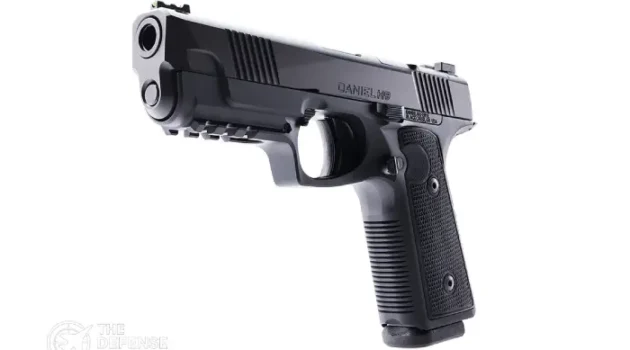
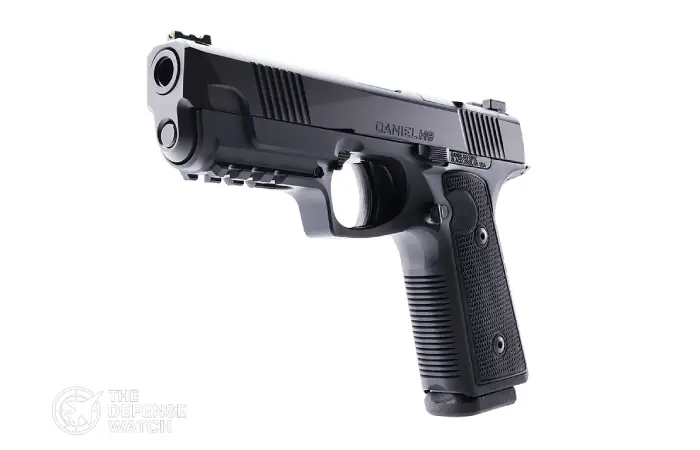
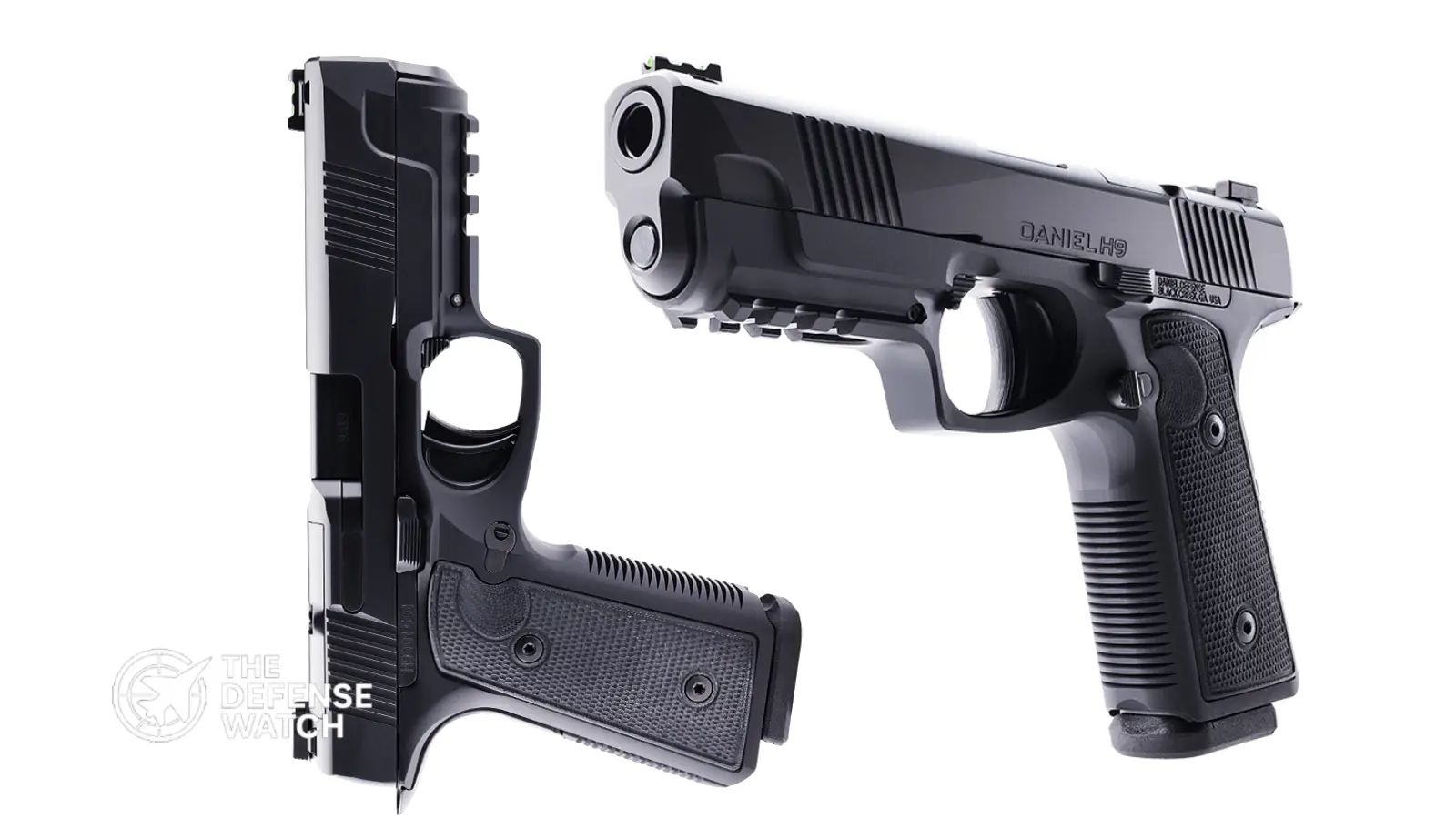
The Daniel Defense H9 represents a calculated resurrection of one of the most mechanically ambitious striker-fired pistol concepts of the modern era. Originally engineered by Hudson Manufacturing, the H9’s foundational architecture — a low bore axis, inline recoil system, and 1911-inspired ergonomics — was functionally ahead of its production infrastructure. Daniel Defense, a manufacturer with an established track record in military-contract rifle systems, has applied its precision fabrication capabilities to the platform, addressing the original’s manufacturing vulnerabilities while preserving its operational geometry. The result is a mission-capable sidearm that warrants serious evaluation by defense professionals, executive protection specialists, and those structuring residential defense architecture around reduced-recoil, high-control ballistic systems.
I. THE HUDSON LEGACY: A DESIGN THAT OUTLIVED ITS MANUFACTURER
To understand what Daniel Defense has built, one must first account for what Hudson Manufacturing attempted. Founded with the singular objective of producing the H9, Hudson’s design team pursued an unconventional engineering brief: create a striker-fired pistol that felt and shot like a tuned 1911, without the platform’s weight, single-action limitations, or manual safety requirement.
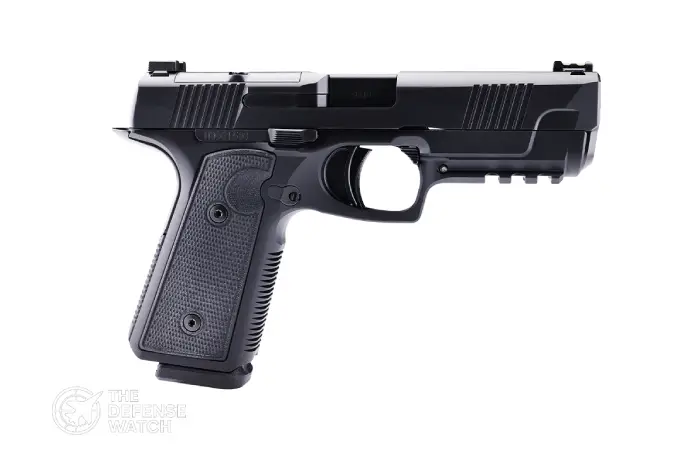
The Hudson H9, introduced at SHOT Show 2017, was immediately recognized within the firearms engineering community as structurally novel. Its bore axis — the vertical distance between the shooter’s hand and the barrel centerline — was dramatically lower than any production striker-fired pistol on the market. This was not an aesthetic choice. It was a calculated mechanical intervention designed to reduce muzzle flip by shortening the lever arm through which recoil force acts on the shooter’s wrist.
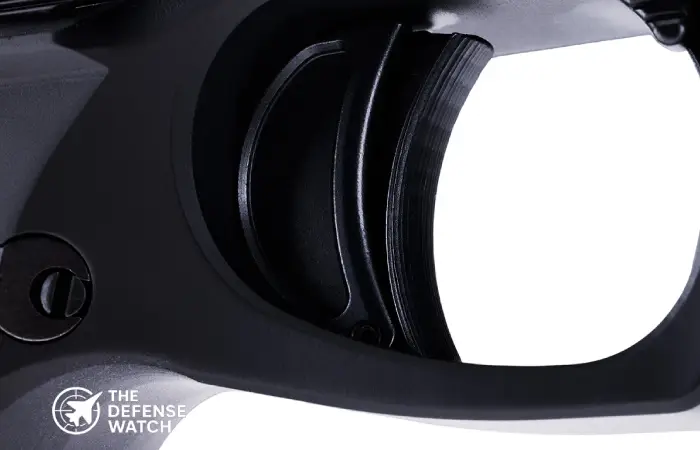
The trigger system compounded this advantage. Rather than the curved, hinged trigger geometry standard to Glock-pattern pistols, the H9 employed a straight-pull trigger with a flat face and a short, tactile reset — characteristics borrowed directly from competition 1911 architecture. For operators accustomed to single-action platforms, the H9 offered a viable transition path without the training overhead of hammer management.
Hudson Manufacturing ceased operations in 2019, a casualty of production scaling failures rather than design deficiencies. The intellectual property sat dormant — a viable ballistic tool without a viable manufacturer. Daniel Defense’s acquisition of that IP and subsequent engineering commitment to the H9 platform is, operationally, the more significant story.
II. DANIEL DEFENSE: MANUFACTURING CREDIBILITY AS A FORCE MULTIPLIER
Before assessing the H9 itself, the organizational context of Daniel Defense warrants acknowledgment. The company’s primary market identity is built on the MK18 and DDM4 series of AR-platform rifles — systems that have achieved adoption across U.S. military and law enforcement channels. Their manufacturing infrastructure is oriented around tight-tolerance CNC machining, cold hammer forging, and mil-spec material standards.

Image Source : Daniel Defense This is not a polymer-frame pistol manufacturer experimenting with a heritage acquisition. Daniel Defense brought a rifle-grade manufacturing philosophy to a pistol platform, and the material specification decisions in the H9 reflect that institutional orientation directly.
III. TECHNICAL BREAKDOWN: MATERIAL SCIENCE AND MECHANICAL ARCHITECTURE
3.1 Frame Construction: 7075-T6 Aluminum — A Deliberate Departure
The H9’s frame is CNC-machined from 7075-T6 aluminum alloy — the same material specification used in aircraft structural components and, notably, in Daniel Defense’s own AR-pattern lower receivers. This is a foundational differentiator from the dominant polymer-frame pistol market.
7075-T6 aluminum carries a tensile strength of approximately 83,000 psi, substantially exceeding the structural properties of the glass-filled nylon polymers used in Glock, SIG P320, and comparable platforms. The practical operational implications are dimensional stability under thermal load, resistance to frame flex during high-round-count strings of fire, and long-term retention of rail interface tolerances — relevant for operators who mount weapon lights or targeting systems on a consistent basis.
The CNC machining process ensures dimensional repeatability across production units, a manufacturing characteristic that directly affects fit between frame, slide, and internal components. Looser tolerances in machined metal components are a product of inadequate process control, not an inherent material limitation.
Weight is the acknowledged trade-off. The aluminum frame positions the H9 as a duty-oriented or residential defense platform rather than a deep-concealment carry solution. Operators should calibrate holster selection and carry configuration accordingly.
3.2 Barrel: 4.28-Inch Cold Hammer Forged
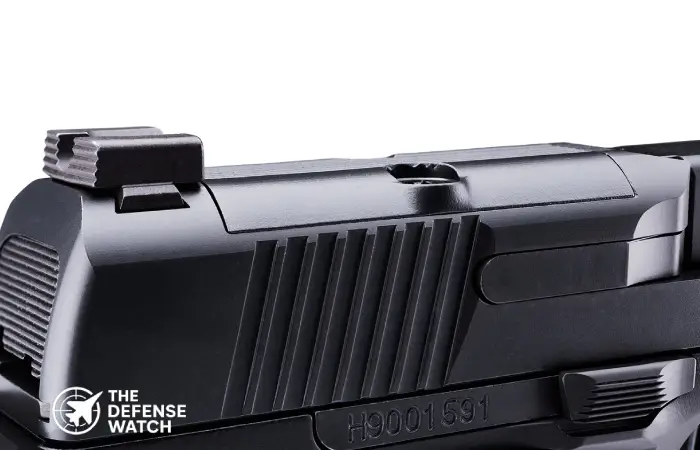
The H9’s 4.28-inch barrel is produced via cold hammer forging — a manufacturing process in which a steel mandrel is driven through a barrel blank under high-force rotary hammer strikes, compressing the steel and forming rifling simultaneously. The result is a barrel with a grain structure that follows the rifling geometry rather than being cut across it, producing measurably superior wear resistance and sustained accuracy over service-life round counts.
Cold hammer forging is the process standard for military-contract barrel production — M16 and M4 barrels are CHF-produced. Its application to a pistol barrel at this price point signals a manufacturing commitment to service-life durability rather than cost optimization.
Image Source : Daniel Defense The 4.28-inch length provides a meaningful ballistic advantage over compact carry platforms in the 3.5-to-3.9-inch range, producing higher muzzle velocity and more complete powder combustion — both relevant factors for terminal performance in close-quarters ballistic engagements.
3.3 Trigger System: Straight-Pull 1911 Architecture
The H9’s trigger is the platform’s most operationally distinctive feature and its primary ergonomic departure from the Glock-pattern market. The straight-pull, flat-faced trigger operates on a geometry that distributes finger contact load across a broader surface area, reducing the perception of trigger weight and improving consistency of pull angle across varying finger placements.
Travel is short. Reset is tactile and audible. The pull weight is factory-set in a range consistent with duty applications — not a competition-tuned hair trigger, but clean and consistent in a manner that supports accurate fire under elevated physiological stress conditions.
For operators with prior 1911 or 2011 trigger experience, adaptation time is minimal. For operators transitioning from Glock-pattern systems, the straight-pull geometry represents a training consideration but not an operational liability.
3.4 Low Bore Axis: Recoil Management as a System Feature
The H9’s defining mechanical characteristic — the low bore axis — functions as a passive recoil mitigation system embedded in the platform’s geometry. In conventional striker-fired pistols, the barrel sits above the bore of the shooter’s hand, creating a moment arm that converts rearward recoil force into rotational muzzle rise.
The H9 positions the barrel as close to the hand as mechanically feasible, compressing that moment arm. The inline recoil spring system, positioned below the barrel rather than around it, enables this geometry. The operational result is measurably faster return to target between shots, reduced visual disruption during rapid fire, and reduced cumulative wrist fatigue during extended training or operational deployment.
This is not a subjective comfort preference. It is a mechanical advantage with direct implications for split times in close-quarters engagements where follow-up shot speed and first-round accuracy determine outcomes.
IV. COMPETITIVE POSITIONING: H9 vs. GLOCK 19 vs. SIG P320
The H9 does not compete on price. Its positioning is premium, and a direct specification comparison against the two dominant standard-issue striker-fired platforms clarifies the operational rationale for that premium.
Parameter Daniel Defense H9 Glock 19 Gen5 SIG Sauer P320 Frame Material 7075-T6 Aluminum Polymer Polymer Barrel Length 4.28 in. (CHF) 4.02 in. 3.9 in. (Compact) Bore Axis Ultra-low (inline) Standard Standard Trigger Type Straight-pull, flat Curved, hinged Curved, hinged Weight (unloaded) ~34 oz. ~23.6 oz. ~25.5 oz. Capacity 15+1 (9mm) 15+1 17+1 MSRP Range ~$1,800–$2,000 ~$600–$650 ~$600–$700 Frame Flex Under Load Minimal (metal) Measurable Measurable Target Market Duty / Residential Defense Duty / Carry Duty / Modular The Glock 19 is the global benchmark for reliability and logistical simplicity. It is not the benchmark for trigger quality, bore axis geometry, or material specification. The SIG P320 introduced modularity as its primary value proposition — the ability to reconfigure grip module and caliber within a single serialized chassis. Neither platform was designed around the H9’s specific operational priorities.
The H9’s premium price point is justified for operators who place primary value on recoil management, trigger quality, and frame material durability. It is not the operationally correct choice for every application — it was not designed to be. It was designed to be the correct choice for operators who understand what they are purchasing and why.
V. OPERATIONAL APPLICATION: RESIDENTIAL DEFENSE ARCHITECTURE
The H9’s specification set is particularly well-suited to fixed-position residential defense deployment — a context in which concealment weight is not a primary constraint, but control, reliability, and rapid follow-up capability are mission-critical parameters.
Image Source : Daniel Defense In a residential defense scenario, the operator is not on patrol. They are responding to a threat that has already breached a defined perimeter, typically in low-light conditions, at distances ranging from across a room to across a hallway. The engagement geometry is inherently close-quarters. Shot placement under stress, with a potentially non-dominant hand, in a compromised physical position, against a moving target — these are the performance conditions the platform must be evaluated against.
The H9’s low bore axis reduces muzzle climb in those conditions. The straight-pull trigger reduces the risk of trigger-induced accuracy error under elevated stress. The aluminum frame’s dimensional stability ensures the mounted weapon light — a non-negotiable component of any professionally configured residential defense system — maintains zero under recoil. The 4.28-inch CHF barrel extracts maximum ballistic performance from the 9mm cartridge.
For operators structuring a residential defense system around a primary long-gun and a sidearm, the H9 functions as a high-performance secondary that does not require the user to accept capability trade-offs in the name of carry convenience.
VI. TECHNICAL SPECIFICATIONS
Specification Detail Platform Designation Daniel Defense H9 Action Type Striker-Fired, Semi-Automatic Caliber 9mm Luger Barrel Length 4.28 inches Barrel Manufacturing Cold Hammer Forged Frame Material CNC-Machined 7075-T6 Aluminum Slide Material Machined Steel Trigger Type Straight-Pull, Flat-Faced (1911-Style) Bore Axis Ultra-Low / Inline Recoil System Magazine Capacity 15+1 (9mm) Overall Length ~7.55 inches Height ~5.25 inches Width ~1.35 inches Unloaded Weight ~34 oz. Safety Systems Trigger Safety, Internal Passive Rail Interface Picatinny MIL-STD-1913 Finish Cerakote / Nitride Country of Origin United States MSRP ~$1,800–$2,000 VII. HOLSTER AND ACCESSORIES ECOSYSTEM
One practical operational consideration for H9 adopters: the platform’s return from discontinuation means the dedicated holster market is in active development rather than mature. The H9’s aluminum frame geometry — particularly its unique rail position and slide profile — does not conform to standard Glock 19 or SIG P320 holster dimensions.
Operators should source holsters from manufacturers with confirmed H9-specific mold production. Kydex custom shops and several established duty-holster manufacturers have introduced H9-compatible SKUs following the Daniel Defense relaunch. Confirm fit verification before operational deployment. A holster that retains inconsistently is a liability in any defensive application.
For weapon light mounting, the Picatinny rail interface accepts standard MIL-STD-1913 accessories. Streamlight TLR-1 HL and SureFire X300 series lights are confirmed compatible, though operators should verify fitment against current H9 production units as the accessories ecosystem continues to develop.
VIII. PRICING AND MARKET AVAILABILITY
The Daniel Defense H9 carries an MSRP in the $1,800–$2,000 range, positioning it in the upper tier of the production striker-fired pistol market — above the Glock 19, SIG P320, and Walther PDP, and in approximate parity with the HK VP9 or Wilson Combat-tuned variants of standard platforms.
Street pricing at authorized Daniel Defense dealers may reflect modest variation above or below MSRP depending on regional market conditions and distributor inventory levels. The platform’s recent return to production means inventory availability is not yet consistent across all retail channels. Operators seeking to acquire the H9 should contact authorized Daniel Defense dealers directly or monitor the manufacturer’s dealer locator for confirmed stock.
The price premium over Glock-pattern alternatives is not a market positioning error. It is a reflection of material costs (7075-T6 aluminum vs. polymer), manufacturing process costs (CNC machining and cold hammer forging vs. injection molding and button rifling), and the limited-production economics of a specialized platform. Operators evaluating the H9 should assess total cost against the operational capability delta, not against the acquisition cost of a mass-market baseline.
IX. OPERATIONAL VERDICT
The Daniel Defense H9 is a technically coherent answer to a specific operational question: what does a striker-fired pistol look like when it is designed without the cost constraints of mass-market production?
The answer is a platform with an aluminum frame that will not flex or deform under service conditions, a cold hammer forged barrel with a service life measured in tens of thousands of rounds, a trigger that supports accurate fire without requiring a gunsmith, and a bore axis geometry that produces measurably faster target reacquisition than any comparable production striker-fired pistol.
It is not the correct platform for every operator. It is heavier than polymer-frame alternatives. Its holster ecosystem is still developing. Its price point requires deliberate budget allocation. These are not design deficiencies — they are engineering trade-offs made in favor of performance over convenience.
For defense professionals, residential security architects, and operators who have moved past the question of “what can I afford” toward “what is the correct tool for this specific mission profile,” the Daniel Defense H9 is a mission-capable answer. It delivers on the promise Hudson Manufacturing could not fulfill — not because the design was flawed, but because the manufacturing infrastructure was. Daniel Defense has closed that gap.
The H9 is, by any objective material and mechanical assessment, the most technically ambitious production striker-fired pistol currently available to the civilian professional market. Whether that ambition is operationally relevant is a determination each operator must make within the context of their specific threat environment, training level, and deployment architecture.
For those for whom it is relevant, it is the correct choice.