Abstract
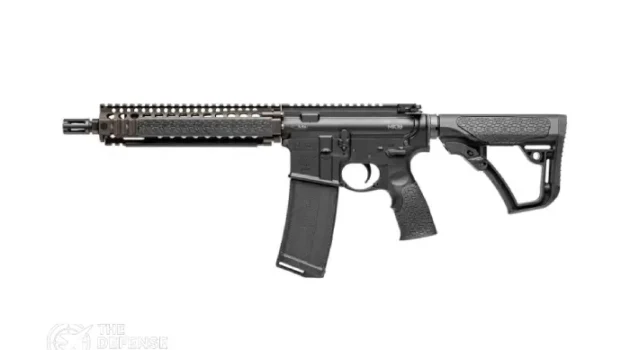
The Daniel Defense MK18 occupies a unique position in the tactical firearms market. Originally fielded as part of USSOCOM’s Close Quarters Battle Receiver (CQBR) program, the platform was engineered for confined environments where maneuverability and rapid target acquisition were mission-critical.
Today, the MK18 has transitioned into the civilian tactical sector as a premium short-barreled rifle optimized for residential defense architecture, low-profile operations, and close-quarters ballistic efficiency. Its military lineage continues to influence how the platform is evaluated among professional users and informed civilian owners alike.
Operational Highlights
- Military-grade 10.3-inch Cold Hammer Forged barrel
- USSOCOM-derived CQBR architecture
- RIS II free-float quad rail interface
- MPI and HP-tested bolt carrier group
- Optimized for confined-space maneuverability
- Suppressor-compatible close-quarters platform
- Designed for low-profile operational environments
Terms Worth Bolding Throughout the Article
These carry both technical weight and search relevance:
- Cold Hammer Forged
- 4150 Chrome Moly Vanadium
- Magnetic Particle Inspection (MPI)
- High-Pressure (HP) testing
- CQBR
- RIS II
- Carbine-length gas system
- Free-float rail
- 5.56 NATO
- Short-Barreled Rifle (SBR)
The SOCOM Legacy
The MK18’s operational roots trace back to USSOCOM requirements for a compact 5.56 NATO platform capable of maintaining reliability in confined maritime, urban, and vehicle-based environments. Standard M4 carbines, while effective, presented limitations in tight operational spaces due to barrel length and overall footprint.
The solution emerged through the CQBR program, centered around a 10.3-inch barrel assembly paired with the now-industry-standard RIS II rail system developed by Daniel Defense. The platform was heavily utilized by Naval Special Warfare units and other Tier One elements conducting direct action missions where compact weapon handling outweighed long-range engagement requirements.
A defining component of the MK18’s success was the RIS II free-float quad rail. Unlike earlier rail interfaces, the RIS II provided enhanced rigidity, laser zero retention, and modular accessory integration without compromising barrel harmonics. The system also enabled reliable mounting of infrared aiming devices, white lights, suppressors, and vertical foregrips, all considered mission-critical for night operations and CQB environments.
The 10.3-inch configuration ultimately became a benchmark for compact AR-pattern carbines, influencing both military procurement programs and commercial tactical rifle development.
Technical Specifications
Component Specification Manufacturer Daniel Defense Caliber 5.56x45mm NATO Barrel Length 10.3 inches Barrel Material 4150 Chrome Moly Vanadium Steel Barrel Process Cold Hammer Forged Gas System Carbine-Length Direct Impingement Rail System Daniel Defense RIS II Upper Receiver Mil-Spec 7075-T6 Aluminum Lower Receiver Mil-Spec 7075-T6 Aluminum Bolt Carrier Group MPI and HP Tested Twist Rate 1:7 Muzzle Thread 1/2×28 Weight Approx. 5.88 lbs Operating System Semi-Automatic Typical Use Case CQB, Residential Defense, Vehicle Operations Technical Breakdown
Barrel Construction and Metallurgy
At the core of the MK18 platform is a cold hammer forged 10.3-inch barrel manufactured from 4150 Chrome Moly Vanadium steel. This material selection prioritizes heat resistance, barrel longevity, and sustained firing durability under high-pressure operating conditions.

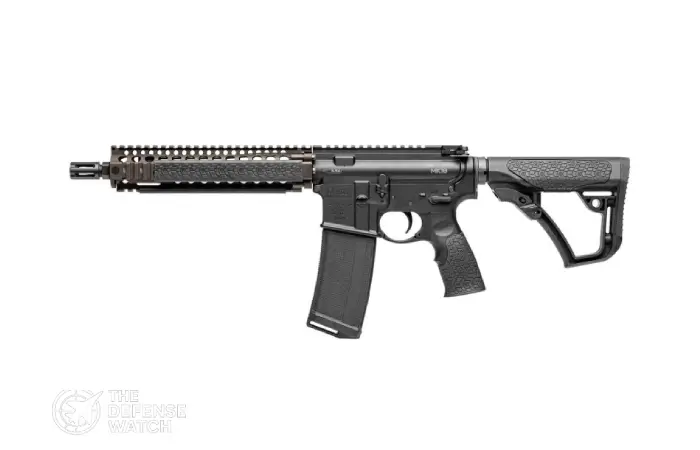
Image Source : Daniel Defense Cold hammer forging enhances structural consistency within the barrel while increasing wear resistance. For short-barreled systems that experience elevated heat and pressure cycles, this manufacturing method provides a measurable operational advantage over standard button-rifled barrels.
The 1:7 twist rate enables stabilization across a broad range of projectile weights, particularly heavier 62-grain to 77-grain loads commonly associated with duty-grade defensive ammunition.
Gas System Dynamics
The MK18 utilizes a carbine-length direct impingement gas system, a necessity given the reduced barrel length. While short gas systems inherently operate under higher pressures and cyclic rates, Daniel Defense has refined the platform through optimized gas port sizing and proven bolt carrier geometry.
Short-barreled rifles frequently encounter reliability challenges related to dwell time and extraction pressure. The MK18 mitigates these concerns through a properly staked gas key, heavy-duty extractor spring assembly, and rigorous bolt carrier group testing standards.
Each bolt undergoes both Magnetic Particle Inspection (MPI) and High-Pressure (HP) testing, procedures typically associated with military contract standards rather than entry-level commercial rifles.
RIS II Rail Interface
The RIS II rail remains one of the defining characteristics of the MK18 architecture. Unlike modern ultra-light M-LOK rails focused primarily on weight reduction, the RIS II prioritizes structural integrity and operational durability.
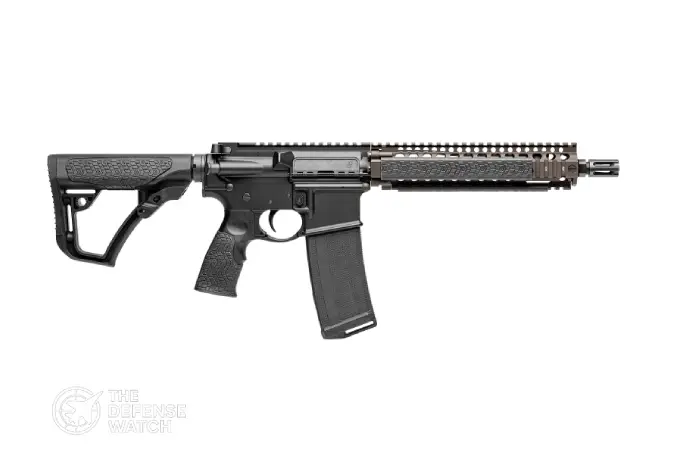
Image Source : Daniel Defense Its free-float design minimizes pressure shift on the barrel while preserving laser alignment under hard-use conditions. This remains particularly relevant for users employing night vision systems or infrared aiming modules within close-quarters operational environments.
The rail’s quad-interface configuration also continues to provide extensive compatibility with legacy military accessories and mission-specific loadouts.
Ballistic Performance in Close Quarters
The MK18’s 10.3-inch barrel significantly alters the ballistic profile of the 5.56 NATO cartridge when compared to standard 14.5-inch or 16-inch carbines.
Velocity reduction is the primary tradeoff. Depending on ammunition type, muzzle velocity losses can range between 400 and 700 feet per second compared to full-length rifle systems. This affects terminal fragmentation thresholds, particularly with legacy M193 and M855 ammunition.
However, modern bonded soft-point and barrier-blind defensive loads have substantially improved the effectiveness of short-barreled 5.56 platforms. Ammunition optimized for lower velocity expansion enables the MK18 to maintain credible terminal performance within realistic residential defense engagement distances.
From a tactical perspective, the shorter overall length delivers substantial maneuverability advantages inside confined spaces such as stairwells, hallways, and vehicle interiors. The compact form factor reduces snag hazards and improves target transitions during dynamic movement.
Suppressed configurations further enhance the MK18’s utility in close-quarters environments by mitigating flash signature and reducing auditory overpressure. This has contributed to the platform’s continued relevance among professional users conducting low-visibility operations.
Residential Defense Architecture
Within the civilian market, the MK18 has evolved beyond its military identity into a specialized defensive platform for users prioritizing compact dimensions and professional-grade reliability.
Its appeal is largely centered on controllability in confined structures. Compared to full-length carbines, the MK18 allows more efficient corner navigation and reduced weapon exposure around doorways and barricades.
The platform also supports extensive modularity through optics integration, white light placement, sling configuration, and suppressor compatibility. These characteristics align closely with modern residential defense doctrine emphasizing positive target identification and rapid response capability under low-light conditions.
While the MK18 requires greater attention to muzzle blast management and ammunition selection than longer rifles, its operational footprint remains one of the most refined within the short-barreled AR category.
Operational Verdict
The Daniel Defense MK18 remains one of the most recognizable compact carbines derived directly from USSOCOM operational requirements. Its continued relevance stems from a balance of compact dimensions, military-grade manufacturing standards, and close-quarters efficiency that few platforms have consistently replicated.
The 10.3-inch configuration, RIS II rail system, and rigorously tested internal components collectively position the MK18 as a mission-capable asset rather than a purely commercial sporting rifle.
For users focused on residential defense architecture, vehicle deployment, or confined operational environments, the MK18 continues to offer a credible combination of maneuverability, reliability, and modular adaptability rooted in decades of real-world combat application.