Executive Summary:
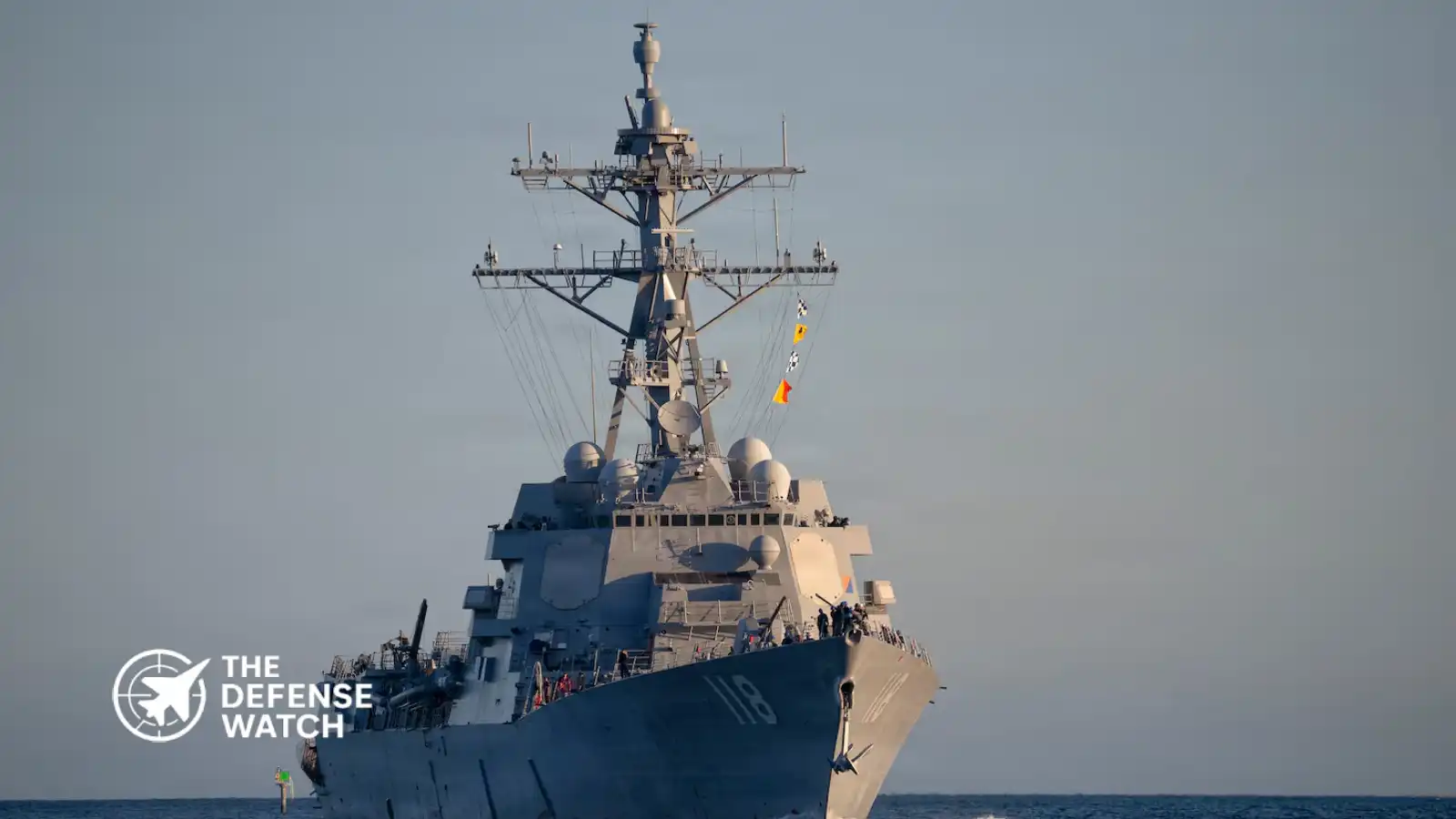
The US Navy has announced the early return of USS Daniel Inouye (DDG 118) following a successful maintenance period completed ahead of schedule. The Arleigh Burke class destroyer’s early delivery back to the fleet underscores improved shipyard efficiency and supports ongoing efforts to maintain high operational readiness across the surface force.
USS Daniel Inouye returns early from maintenance
The early return of USS Daniel Inouye (DDG 118) marks a notable milestone in US Navy fleet readiness planning. According to a US Navy news release, the Arleigh Burke class destroyer completed its maintenance availability ahead of schedule and has now rejoined the operational fleet.
The development reflects broader efforts within the US Navy to streamline maintenance cycles, reduce downtime, and ensure high-end surface combatants remain available for tasking across global theaters.
Fleet Readiness and Maintenance Efficiency Gains
The early completion of maintenance for USS Daniel Inouye (DDG 118) highlights a key priority for US naval forces, maximizing ship availability while sustaining long term platform performance.
Arleigh Burke class destroyers are central to US surface warfare capability, providing multi mission flexibility across air defense, anti submarine warfare, and surface strike roles. Keeping these vessels at peak readiness is essential given current global maritime demands.
The US Navy has increasingly focused on improving shipyard throughput, modernizing maintenance workflows, and reducing delays that have historically affected fleet availability. Early returns like this one indicate progress in that direction, although systemic pressures across the maintenance enterprise remain a challenge.
Operational Significance of Early Return
The return of this destroyer to active duty improves near term deployment flexibility for the US Navy surface fleet. Each Arleigh Burke class ship contributes to carrier strike group operations, independent patrol missions, and maritime security tasks.
By reducing time in maintenance, the Navy increases the number of ready ships available for global tasking. This is particularly important in an operational environment characterized by increased activity in both the Indo Pacific and European theaters.
The early completion also signals improved coordination between naval maintenance planners, shipyard personnel, and fleet scheduling commands. While individual milestones do not resolve broader capacity constraints, they contribute to incremental improvements in force readiness.
Platform Background: Arleigh Burke Class Capability
The USS Daniel Inouye (DDG 118) is part of the Arleigh Burke class destroyer family, one of the most capable and widely deployed surface combatant classes in the world.
These ships are equipped with the Aegis Combat System, advanced radar suites, and vertical launch systems capable of firing a wide range of missiles for air defense, land attack, and anti ship roles. The class is designed for sustained multi domain operations, often serving as the backbone of US Navy surface action groups and carrier strike formations.
Modern variants of the class continue to evolve with incremental upgrades in sensors, combat systems, and integration with networked warfare architectures.
Strategic Context and Fleet Pressure
The US Navy continues to operate under increasing demand for presence missions, deterrence operations, and joint exercises with allied navies. As a result, ship availability has become a central concern for force planners.
Maintenance optimization efforts, including early completion milestones such as this one, are part of a broader strategy to improve operational readiness without significantly expanding fleet size in the short term.
While the early return of USS Daniel Inouye (DDG 118) is a positive indicator, long term readiness will still depend on shipyard modernization, workforce stability, and supply chain performance.
Broader Implications for Naval Operations
Incremental improvements in maintenance timelines directly impact deployment cycles for surface combatants. Faster turnaround enables commanders to better manage rotational deployments and sustain presence in high priority regions.
For the US Navy, these gains contribute to maintaining deterrence posture, particularly in contested maritime environments where presence operations are a key element of strategy.
The ability to return high value assets to the fleet ahead of schedule also supports training cycles, joint exercises, and coalition operations with allied navies.
Analysis
This report is based on official US Navy communications and reflects verified maintenance outcomes for USS Daniel Inouye (DDG 118). The analysis focuses on operational readiness, fleet sustainment trends, and naval force structure implications.
No speculative assessments have been included. All conclusions are grounded in publicly released Navy information and established understanding of Arleigh Burke class destroyer operations.
Executive Summary:
The U.S. Navy has awarded Bath Iron Works a contract for construction of the future USS Robert R. Ingram, the 21st Flight III Arleigh Burke-class destroyer. The deal reinforces the Navy’s long-term surface fleet modernization strategy centered on advanced air and missile defense capabilities.
U.S. Navy Awards Contract For USS Robert R. Ingram Flight III Destroyer
The U.S. Navy has awarded a new construction contract to Bath Iron Works for the future USS Robert R. Ingram (DDG-140), marking the 21st Flight III Arleigh Burke-class destroyer ordered under the Navy’s ongoing modernization effort.
The contract continues production of the Navy’s most advanced destroyer configuration, designed to enhance ballistic missile defense, integrated air defense, and long-range maritime operations.
Bath Iron Works, a major U.S. naval shipbuilder owned by General Dynamics, remains one of the two primary producers of the Arleigh Burke-class alongside HII Ingalls Shipbuilding.
The future USS Robert R. Ingram is named after Medal of Honor recipient Master Chief Special Warfare Operator Robert R. Ingram, recognizing his actions during the Vietnam War.
Flight III Destroyers Expand U.S. Naval Air Defense Capability
The Flight III Arleigh Burke destroyer represents the latest and most capable evolution of the long-running DDG-51 program. The design introduces major improvements over earlier variants, particularly in radar performance, power generation, and combat systems integration.
At the center of the upgrade is the AN/SPY-6(V)1 Air and Missile Defense Radar developed by RTX Corporation. The radar significantly improves the Navy’s ability to detect and track ballistic missiles, hypersonic threats, advanced cruise missiles, and low-observable targets at extended ranges.
The Flight III configuration also incorporates upgraded electrical power systems and cooling capacity to support future weapons and sensors, including potential directed-energy systems and advanced electronic warfare packages.
The USS Robert R. Ingram will be equipped with the Aegis Combat System and vertical launch capabilities supporting a wide range of interceptors and strike weapons, including Standard Missile variants, Tomahawk land-attack missiles, and anti-submarine warfare systems.
Why The New Destroyer Matters
The latest Flight III destroyer contract highlights the Navy’s continued reliance on the Arleigh Burke platform as the backbone of its surface combatant fleet despite ongoing development of future large surface combatants.
The Navy has increasingly prioritized integrated air and missile defense in response to expanding Chinese naval capabilities in the Indo-Pacific and continued missile proliferation among near-peer competitors.
While the DDG(X) next-generation destroyer remains in development, Flight III ships are expected to carry a substantial operational burden through the 2030s and beyond. Their combination of mature systems and upgraded sensors provides a lower-risk path for maintaining fleet readiness while future programs mature.
The growing importance of naval ballistic missile defense has also elevated the role of destroyers in regional deterrence missions. Arleigh Burke-class ships are routinely deployed to the Pacific, Middle East, and European theaters to support carrier strike groups and allied missile defense architectures.
Bath Iron Works Maintains Strategic Role In U.S. Shipbuilding
The award further strengthens Bath Iron Works’ role in sustaining the U.S. industrial base for major naval surface combatants.
Located in Maine, the shipyard has produced numerous Arleigh Burke destroyers over the past decades and remains a critical component of the Navy’s shipbuilding strategy. Maintaining stable destroyer production is viewed as essential for preserving workforce expertise, supplier networks, and fleet delivery timelines.
The Navy continues balancing production between Bath Iron Works and Ingalls Shipbuilding to ensure capacity and reduce industrial risk amid increasing demand for advanced warships.
The USS Robert R. Ingram contract also reflects broader Pentagon efforts to accelerate naval modernization while addressing concerns over fleet size and global operational commitments.
Broader Strategic Context
The Flight III Arleigh Burke destroyer program remains one of the Pentagon’s most important naval modernization initiatives due to the ship’s multi-role flexibility and survivability.
As maritime competition intensifies, especially in the Indo-Pacific, the Navy is investing heavily in platforms capable of integrated air defense, anti-submarine warfare, long-range strike operations, and distributed maritime operations.
The continued procurement of Flight III destroyers demonstrates that the Navy still sees large surface combatants as central to future high-end naval warfare despite growing interest in unmanned systems and distributed fleets.
Analysts also note that the SPY-6 radar family will become a foundational sensor architecture across multiple Navy platforms, improving interoperability and battlespace awareness across carrier strike groups and joint operations.
U.S. Navy Expands Multi-Threat Defense With USS George M. Neal
The USS George M. Neal destroyer marks a significant expansion of U.S. Navy multi-threat defense capabilities as the service continues to modernize its surface fleet for high-end warfare.
The vessel, the 81st in the Arleigh Burke-class series, was recently launched by General Dynamics Bath Iron Works. As a Flight III configuration, the ship represents the most advanced evolution of the long-running destroyer program.
The Arleigh Burke-class has formed the backbone of U.S. surface combatant forces for decades. However, the introduction of Flight III variants signals a shift toward addressing increasingly complex aerial and missile threats, particularly in contested maritime environments.
- USS George M. Neal is the 81st Arleigh Burke-class destroyer launched by the U.S. Navy.
- The ship is a Flight III variant equipped with the AN/SPY-6(V)1 Air and Missile Defense Radar.
- Designed to counter simultaneous air, missile, and surface threats in high-intensity environments.
- Built by General Dynamics Bath Iron Works as part of ongoing U.S. Navy fleet modernization.
- Enhances integrated air and missile defense capability across carrier strike groups and global deployments.
Advanced Radar and Combat Systems
At the core of the USS George M. Neal destroyer is the AN/SPY-6(V)1 Air and Missile Defense Radar, a next-generation sensor designed to significantly outperform earlier systems.
Compared to the legacy SPY-1 radar, the SPY-6 provides greater sensitivity, improved target discrimination, and the ability to track a larger number of threats simultaneously. This is critical in modern conflict scenarios where adversaries deploy layered attacks involving cruise missiles, ballistic missiles, and unmanned systems.
The destroyer is also equipped with the Aegis Combat System, which integrates radar data with weapons systems to enable real-time threat detection and engagement. This allows the ship to respond to multiple incoming threats at once, a capability increasingly required in Indo-Pacific and Middle Eastern operational theaters.
Designed for High-Intensity Naval Warfare
The USS George M. Neal destroyer is optimized for multi-domain operations, including air defense, surface warfare, and ballistic missile defense.
Its vertical launch system supports a wide range of interceptors and strike weapons, enabling it to defend carrier strike groups, amphibious forces, and allied assets. The ship can also operate independently in forward-deployed roles, providing flexibility for U.S. naval commanders.
This reflects a broader U.S. Navy strategy to maintain distributed lethality, where multiple platforms can independently engage threats while contributing to a networked battlespace.
Strategic Context and Fleet Modernization
The launch of the USS George M. Neal comes amid rising global naval competition and increasing emphasis on integrated air and missile defense.
According to the U.S. Navy, Flight III destroyers are intended to address capability gaps created by evolving threats, including hypersonic weapons, advanced anti-ship missiles, and drone swarms.
The continued production of Arleigh Burke-class ships also highlights the Navy’s decision to extend the life of a proven platform rather than transition entirely to next-generation programs. This approach balances cost, risk, and operational readiness while maintaining a high-end combat capability.
Analysis: Why Flight III Matters Now
The introduction of the USS George M. Neal destroyer underscores a practical shift in U.S. naval procurement strategy. Instead of relying solely on future platforms like the DDG(X), the Navy is enhancing existing designs with advanced sensors and systems.
This approach offers several advantages.
First, it accelerates deployment timelines. Flight III ships can be fielded faster than entirely new classes, which often face delays and cost overruns.
Second, it ensures interoperability across the fleet. By building on the established Aegis architecture, the Navy maintains seamless integration with allied systems and joint force networks.
Third, it directly addresses the growing challenge of saturation attacks. Modern adversaries are increasingly capable of launching coordinated strikes involving multiple vectors. The SPY-6 radar and upgraded combat systems are specifically designed to handle these scenarios.
However, this strategy also reflects underlying constraints. The Navy must balance modernization with budget realities, while also preparing for future threats that may exceed the capabilities of current platforms.
Industrial Base and Production Outlook
The USS George M. Neal was constructed by General Dynamics Bath Iron Works, one of the primary shipbuilders for the Arleigh Burke program.
The continued production of these destroyers supports the U.S. defense industrial base while ensuring a steady pipeline of advanced surface combatants.
The Navy is expected to continue procuring Flight III destroyers in the near term, reinforcing fleet numbers while next-generation programs remain in development.
US Navy Tomahawk Strike in Nigeria
The United States Navy launched a precision Tomahawk cruise missile strike against Islamic State positions in northwest Nigeria on December 25, 2025, from an Arleigh Burke-class guided-missile destroyer, US Africa Command said. This operation marks a notable use of sea-launched strike capabilities in West Africa and was carried out at the request of the Nigerian government.
The attack targeted militants linked to Islamic State West Africa Province, an extremist group responsible for attacks on civilians, including religious communities in the region, US officials said. According to the Pentagon and the White House, multiple militant fighters were killed, though exact numbers and damage assessments have not been released.
Video released by the Department of War shows a missile launch from a Navy surface combatant operating offshore. Defense analysts say the visual profile is consistent with the long-range BGM-109 Tomahawk cruise missile fired from a Mk 41 Vertical Launching System aboard an Arleigh Burke destroyer. The US military has not publicly confirmed the specific vessel or weapon type used.
Coordination With Nigerian Authorities
US Africa Command said the operation was conducted in coordination with Nigerian authorities and under presidential direction. The coordinated nature of the strike reflects a partnership approach rather than unilateral action by US forces in the region.
Arleigh Burke Destroyers and Tomahawk Capability
Arleigh Burke-class destroyers serve as the backbone of the US Navy’s surface combat fleet. Equipped with the Aegis Combat System and up to 96 Mk 41 VLS cells, these ships can launch a variety of munitions, including Standard Missiles for air defense and Tomahawk cruise missiles for long-range land attack missions.
The Tomahawk is a subsonic, long-range cruise missile capable of striking fixed targets with high precision at ranges beyond 1,000 miles. It uses GPS, inertial guidance, and terrain contour matching for navigation and has been a key naval strike weapon since the 1991 Gulf War.
Strategic Implications
Using a maritime launch platform for strikes inland gives the US military flexibility to engage distant targets without relying on regional airfields. This approach reduces diplomatic friction and limits the need for a ground presence in politically sensitive areas.
The December 25 strike could signal a broader shift in how US forces support counterterrorism operations in West Africa, complementing existing drone and land-based air missions.