

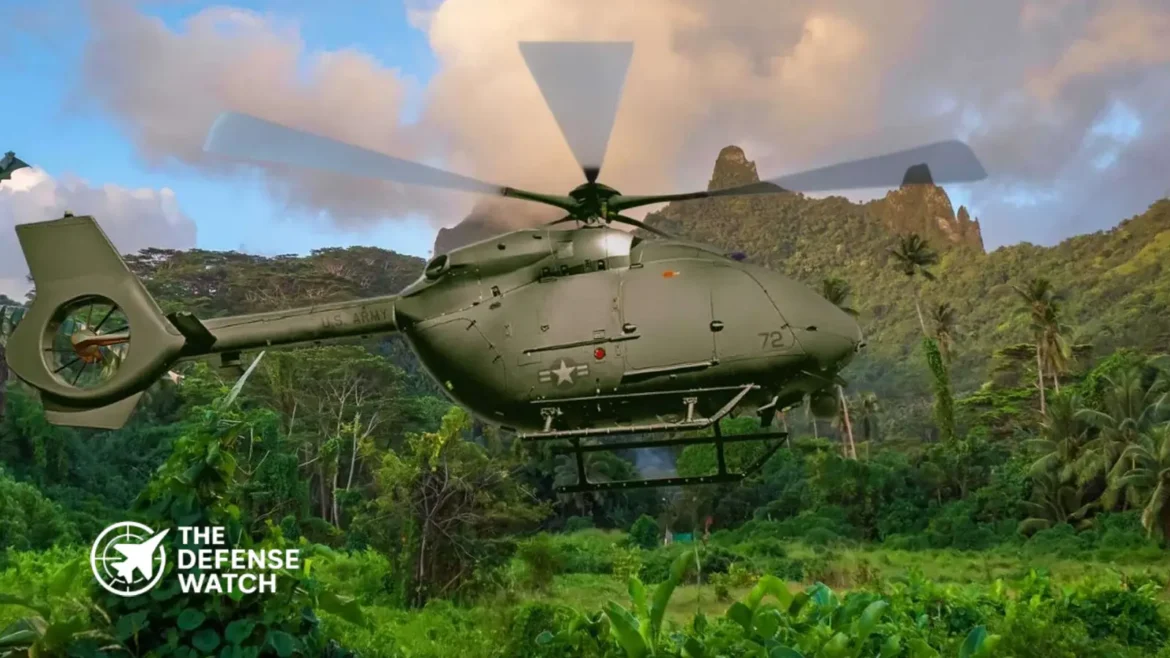
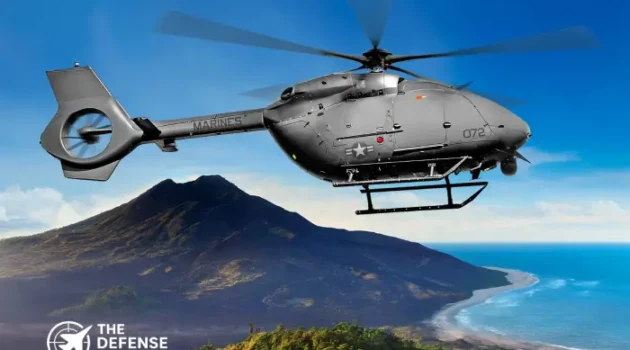
Executive Summary: The U.S. Marine Corps is rapidly advancing the MQ-72C Lakota Connector, an unmanned variant of the proven UH-72 platform, to solve “the last mile” of logistics in contested environments. By integrating Shield AI’s Hivemind autonomy, the MQ-72C is designed to deliver ammunition and supplies across the vast distances of the Pacific without risking aircrews.
The Evolution of the Lakota: From Utility to Autonomous Logistics
The MQ-72C Lakota, developed by Airbus U.S. Space & Defense, represents a strategic pivot in the Marine Corps’ Aerial Logistics Connector (ALC) program. Unlike the legacy manned UH-72A/B used primarily for domestic utility and training, the MQ-72C is a “clean-nose” redesign. By removing the cockpit, flight controls, and life-support systems, engineers have maximized internal volume for fuel and cargo.
This platform leverages the existing H145/UH-72 global supply chain, ensuring that the USMC can field a “risk-worthy” asset with high operational availability. The aircraft’s digital backbone, built on a Modular Open Systems Approach (MOSA), allows for the rapid integration of third-party sensors and mission sets beyond simple transport.
Technical Comparison: MQ-72C vs. Legacy UH-72
Feature UH-72B Lakota (Manned) MQ-72C Lakota (Autonomous) Range ~330 nm +350 nm (Expanded via fuel tanks) Payload ~3,903 lbs (Total Useful Load) Optimized for JMIC & Ordnance Status In Service (US Army/Navy) Prototyping / Flight Testing (2025-2026) Key Technology Helionix Avionics Suite Shield AI Hivemind / L3Harris C2 Force Design 2030: Strategic Context
The acceleration of the MQ-72C is a direct response to the threat posed by Anti-Access/Area Denial (A2/AD) bubbles in the Indo-Pacific. Under the Force Design 2030 mandate, the Marine Corps requires “stand-in forces” that can operate within the range of enemy precision fires.
- Contested Logistics: Traditional resupply via large vessels or manned heavy-lift helicopters (like the CH-53K) is increasingly vulnerable to sophisticated missile threats.
- Mass and Attrition: The MQ-72C provides a relatively low-cost, “attritable” alternative that can operate in swarms or continuous shuttle runs to sustain small, dispersed units.
- Expeditionary Advanced Base Operations (EABO): The aircraft’s ability to land in austere, unprepared clearings makes it ideal for supporting mobile missile batteries and ISR nodes on remote islands.
Technological Advantages of the MQ-72C
The integration of the Shield AI Hivemind autonomy software is the primary differentiator for the Lakota Connector. This “AI pilot” enables:
- GPS-Denied Navigation: The system can navigate and execute missions even when electronic warfare (EW) environments sever satellite links.
- Obstacle Avoidance: Real-time processing allows the MQ-72C to detect and avoid terrain and obstacles in low-altitude flight.
- Operational Simplicity: A single operator can manage multiple MQ-72Cs, reducing the manpower footprint required for sustainment.
- Modular Growth: Airbus has indicated the platform may eventually support “Launched Effects”—deploying smaller drones or loitering munitions from the helicopter in flight.
As of May 2026, the USMC continues to refine the MQ-72C’s performance through iterative flight tests, focusing on high-speed transport and autonomous landing on moving naval platforms. The success of the Lakota Connector could signal a broader shift across the Department of Defense toward converting proven rotorcraft into autonomous logistics workhorses.
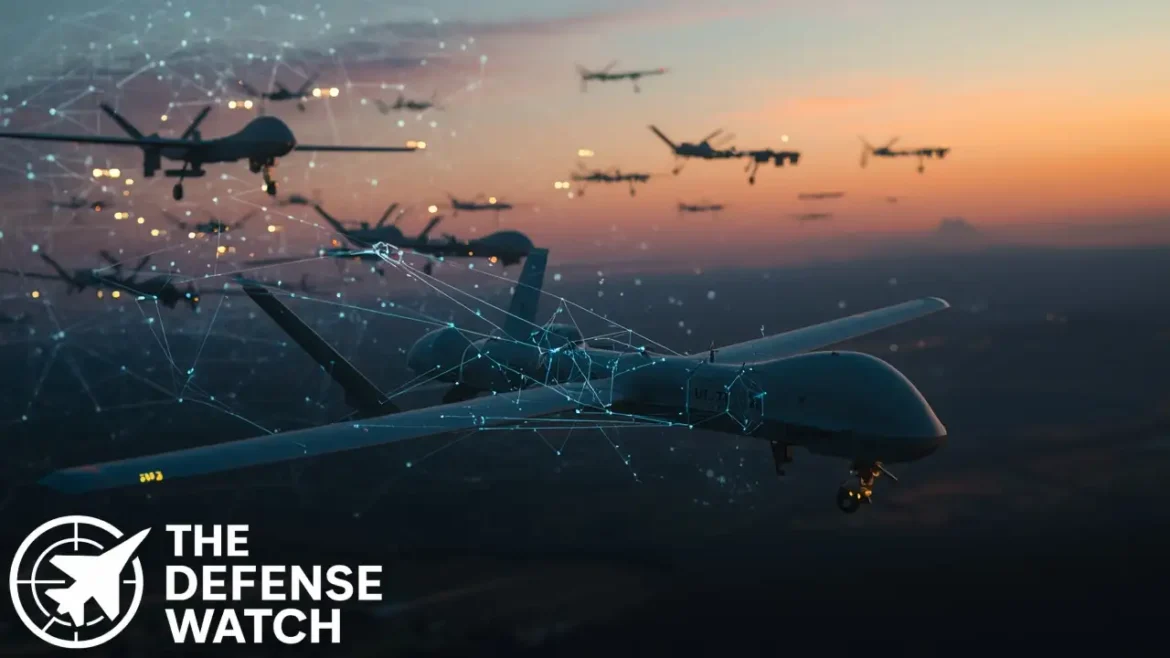
AI-enabled drones are increasingly central to U.S. military modernization efforts. By combining autonomy, machine learning, sensor fusion, and advanced communications, these unmanned aerial systems (UAS) are being used in multiple roles—from surveillance and reconnaissance (ISR) to autonomous target recognition and countering hostile drone threats. This article explores the leading use cases, ongoing programs, and strategic challenges involved in integrating AI-enabled drones into the U.S. armed forces.
Leading Use Cases of AI-Enabled Drones in U.S. Military
Intelligence, Surveillance, and Reconnaissance (ISR) with Autonomous Assistance
One of the foundational use cases for AI in UAS is enhancing ISR. Drones equipped with AI can process imagery, video, thermal, LiDAR, radar, and other sensor data in real time, identifying objects of interest or changes in terrain without needing constant human intervention. Systems like Shield AI’s V-BAT use autonomy software (e.g., Hivemind) to operate even in GPS- and communications-denied environments.
These capabilities help reduce human workload in high-volume ISR missions and enable faster responses to emerging threats.
Precision Targeting, Recognition & Decision Support
AI-enabled drones assist targeting via algorithms that help distinguish between different kinds of objects—friendly vs adversary, civilian infrastructure, etc.—and prioritize threats. One example is the Pentagon’s Project Maven, which uses machine learning, computer vision, and data fusion to help filter and identify targets from surveillance feeds. While humans still have to approve lethal force or strikes, the system accelerates the “find, fix, finish, exploit, analyze, and disseminate” chain.
Swarm Tactics and Coordinated Operations
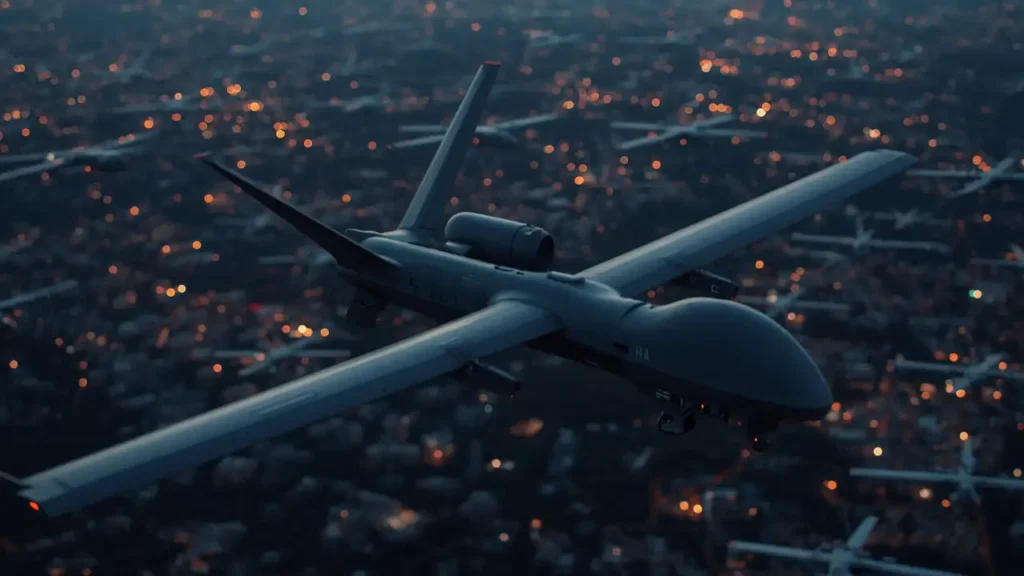
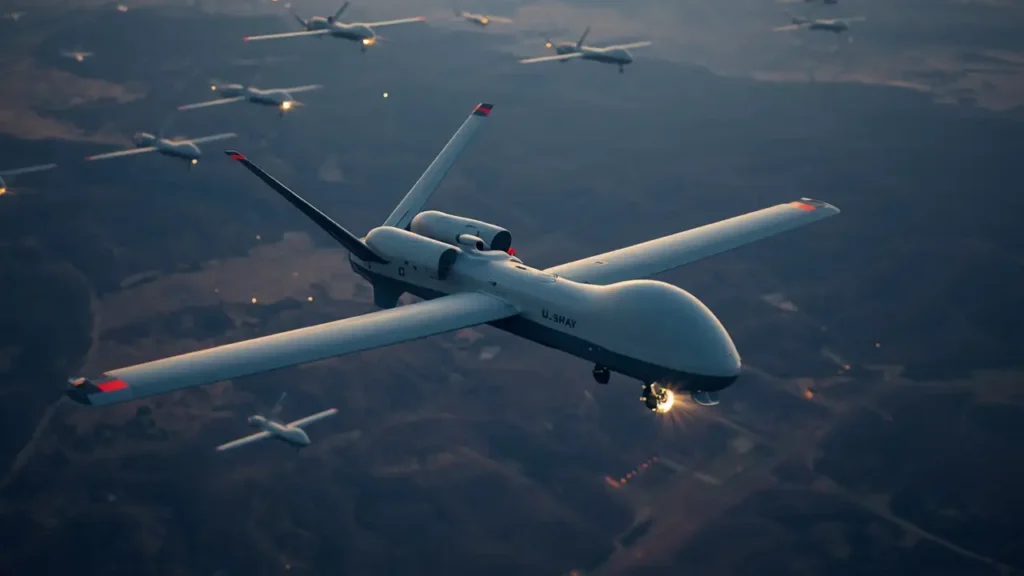
Swarming—multiple drones operating together in coordination—is an area receiving heavy investment. Swarm UAS can cover more ground, complicate adversary defenses, and enhance redundancy. U.S. programs such as Replicator are designed to deploy large numbers of low-cost, attritable autonomous systems. These may work collaboratively for surveillance, target saturation, or decoy missions.
Counter-Drone and Air Defense Systems
With proliferation of small drones as threats (for reconnaissance, loitering munitions, or kamikaze attacks), the U.S. military is pushing AI-based counter-drone systems. The Replicator initiative includes counter-drone technologies that detect, analyse, and neutralize hostile UAS threats.
Another example is from the Naval Postgraduate School, which is developing AI to automate ship-defensive high energy laser systems. These use AI to rapidly assess incoming drone threats, track them, and aim defensive lasers accordingly.
Operations in Degraded or Denied Environments
AI-enabled drones are particularly valuable when GPS, communications, or command-and-control links are compromised or jammed. Autonomous navigation, waypoints, obstacle avoidance, and on-board decision-making allow UAS to continue missions even under contested conditions. Shield AI’s V-BAT, for example, is built to function in GPS/beyond line-of-sight challenged environments.
Strategic Programs & Initiatives
- Replicator: A U.S. DoD program aiming to field thousands of low-cost autonomous systems in coming years, both for offensive use (attritable drones) and for defensive roles like counter-drone.
- Project Maven: Focused on target recognition from imagery/sensor data, helping human operators make faster and more accurate decisions.
Analysis & Context
The deployment of AI-enabled drones reflects a shift in how the U.S. military views unmanned systems—not merely as remote cameras or missiles, but as intelligent agents within a networked battlespace. Several factors are driving this:
- Pace of warfare: AI and automation compress decision cycles. Adversaries are fielding drones and EW (electronic warfare), so response times using AI assistance become critical.
- Cost & attritability: Using lower-cost autonomous drones that can be “lost” (attritable) in high risk zones makes operations more acceptable than risking expensive manned platforms.
- Resilience: In contested environments where satellites, GPS, or comms may be disrupted, UAS with autonomous capabilities ensure continuity of operations.
However, challenges remain: ethical issues around autonomous targeting; ensuring reliability and safety; adversarial counter-measures (jamming, spoofing, deception); legal and policy constraints; and scaling production while maintaining trust and interoperability.
What’s Next? Trends to Watch
- Greater autonomy with human oversight: Fully autonomous lethal systems remain controversial; likely future is supervised autonomy, where humans retain control of “kill decisions.”
- Improved sensor fusion & AI robustness: More resilient against spoofing, deception, and able to operate in adverse weather or complex terrain.
- Swarms & attritable mass production: More investment in systems that are inexpensive, disposable, networked.
- Regulatory, doctrine & ethical frameworks: Policies will need catching up to technology—defining acceptable levels of autonomy, rules of engagement, accountability.
Conclusion
AI-enabled drones are becoming a core component of U.S. military strategy, across ISR, precision targeting, swarm operations, and defense against drones. While the promise is immense, getting autonomy, ethics, policy, and industrial capacity in alignment will be essential for these technologies to deliver reliably and responsibly in future conflicts.
FAQs
As of now, most AI-enabled systems are semi-autonomous. Humans commonly retain control over critical decisions, especially lethal force. Fully autonomous lethal drones are constrained by legal, ethical, and policy limits.
An “attritable” drone is a system that is designed to be low-cost and expendable. If lost or damaged in contested zones, the loss is acceptable compared to losing high-value or manned platforms.
U.S. programs use radar, electronic warfare, AI for detection, tracking, classification, and then deploy effectors (jammers, kinetic interceptors, lasers) to neutralize hostile drones. Some systems can autonomously detect and classify threats and assist in real-time defensive decisions.
Key concerns include proper distinction between combatants and civilians; whether AI decision making meets legal standards; accountability if AI malfunctions; ensuring transparency and oversight; and international norms.
Note: The images are AI-generated.