
- Home
- Defense Systems
- Future / Concept Weapons
- Night Stalker MV-75 Tiltrotor Aircraft
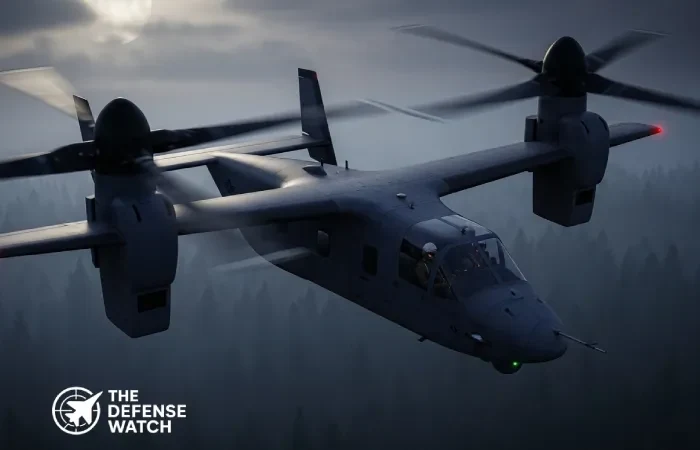
Night Stalker MV-75 Tiltrotor Aircraft
Defense Systems Full Specifications
1) Basic / Identification
| Name | Night Stalker MV-75 |
| Designation | MV-75 |
| Manufacturer / Developer | U.S. defense contractor (conceptual, Bell/Boeing class) |
| Country / Lead partner | United States |
| Type / Role | Tiltrotor Special Operations Aircraft |
| Status | Concept / Development |
| Program Start | Not publicly disclosed |
| Estimated unit cost | $85–110 million (est.) |
| Public Source / Reference | N/A (conceptual analysis) |
2) Performance & Capabilities
| Operational Concept | Long-range special operations, rapid insertion, ISR and strike |
| Effective Range / Engagement Envelope | 1,200–1,500 km |
| Speed / Response Time | ~520–555 km/h |
| Endurance / Sustained Operation | 5–7 hours (mission dependent) |
| Precision / Accuracy | High (guided munitions, sensor fusion) |
| Mobility / Basing | Ship-based and land-based VTOL |
3) Propulsion / Power / Energy
| Power Source | Twin turboshaft engines |
| Power Output | Not disclosed |
| Propulsion Type | Tiltrotor |
| Fuel / Energy Storage | Aviation fuel, extended tanks optional |
4) Payload / Kill Mechanism
| Primary Effect | Kinetic strike and troop deployment |
| Guidance / Targeting | GPS/INS, EO/IR targeting systems |
| Multi-mode Capability | ISR + strike + transport |
5) Sensors, Avionics & Autonomy
| Sensors | AESA radar, EO/IR, terrain-following radar |
| Autonomy Level | Supervised autonomy |
| AI Features | Target recognition, flight optimization |
| Communications & Datalinks | SATCOM, secure mesh networks |
6) Survivability & Countermeasures
| Signature Reduction | Reduced acoustic and IR signature |
| Defensive Systems | Electronic warfare, flares, DIRCM |
| Resilience | Redundant systems, cyber hardening |
7) Integration & Interoperability
| Integration | Network-centric warfare systems |
| Suitable Platforms | Amphibious ships, forward bases |
| Interoperability Standards | Link-16 compatible |
| Upgrade Path | Modular open architecture |
8) Legal / Ethical / Policy Notes
| Export Control | ITAR-controlled |
| Legal/Ethical Flags | Use in covert operations |
| Policy Implications | Enhances rapid global strike capability |
9) Operational / Program Notes
| Notable Tests / Milestones | Not disclosed |
| Expected IOC (if given) | Early 2030s (projected) |
| Partners / Contractors | U.S. defense primes |
| Remarks | Conceptual system based on evolving tiltrotor doctrine |
PROS
- High speed compared to traditional helicopters
- Long operational range with aerial refueling capability
- VTOL capability allows flexible deployment
- Advanced night operation and low-visibility systems
- Multi-role adaptability (transport, ISR, strike)
CONS
- High acquisition and maintenance cost
- Complex tiltrotor mechanics increase sustainment burden
- Larger radar and thermal signature than stealth helicopters
- Vulnerable during hover and transition phases
- Requires specialized pilot training
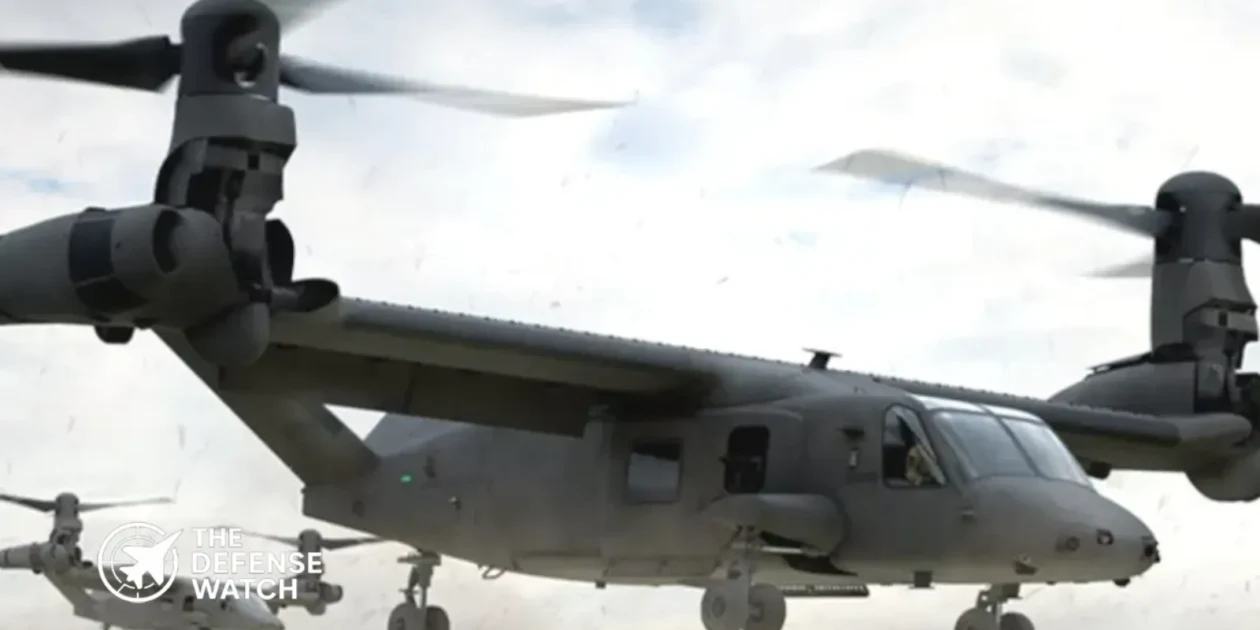
The Night Stalker MV-75 tiltrotor is a next-generation vertical lift platform designed for U.S. special operations and long-range assault missions. Combining the vertical takeoff capability of a helicopter with the speed and endurance of a turboprop aircraft, the MV-75 is optimized for rapid insertion, extraction, and precision strike in contested environments. Its design prioritizes night operations, low observability, and networked battlefield awareness.
Manufacturer
The MV-75 is conceptually aligned with advanced U.S. rotorcraft development programs, likely led by a major defense contractor such as Bell Textron or Boeing. It builds on lessons from earlier tiltrotor systems, integrating modern avionics, reduced acoustic signature, and enhanced survivability systems tailored for special operations forces.
Speed and Range
The MV-75 offers a projected cruise speed of approximately 280–300 knots (520–555 km/h), significantly faster than conventional helicopters. Its operational range is estimated at 1,200–1,500 km without refueling, extendable via aerial refueling. This range enables deep-penetration missions without forward basing, a key advantage in Indo-Pacific and Middle East theaters.
Cost/Price
Estimated unit cost ranges between $85 million and $110 million per aircraft, depending on mission configuration, sensors, and defensive systems. Costs reflect advanced avionics, survivability features, and multi-role flexibility.
The aircraft supports modular payloads, including door-mounted guns, precision-guided munitions, and ISR sensor suites. Integrated AI-assisted flight systems and terrain-following radar enhance low-level night operations. The MV-75 is expected to play a critical role in future distributed warfare concepts, supporting rapid response and special operations missions across large distances.
Disclaimer Note
The information provided on TheDefenseWatch.com is for general informational purposes only. While we strive to ensure the accuracy, completeness, and timeliness of our content regarding defense and aerospace products, technologies, and specifications, we cannot guarantee that all information is 100% accurate or up-to-date due to the evolving nature of military technology and classified data.TheDefenseWatch.com does not warrant the reliability, suitability, or availability of the information for any specific purpose. Users are advised to consult official sources, such as manufacturers, government publications, or defense agencies, for precise and verified data before making decisions based on our content.We are not affiliated with any defense manufacturers, governments, or military organizations mentioned. Opinions, reviews, and ratings reflect expert analysis but are subjective and should not be considered endorsements. TheDefenseWatch.com is not responsible for any errors, omissions, or consequences arising from the use of this website’s content.External links are provided for convenience and do not imply endorsement. TheDefenseWatch.com reserves the right to update or modify content without prior notice. By using this website, you agree to our Privacy & Cookies Policy.
More Defense Systems from (Originally U.S. defense contractor)
New Arrivals


Popular Comparisons
-
 J-10C vs JF-17 Thunder: Which Fighter Is More Capable?
View Comparison →
J-10C vs JF-17 Thunder: Which Fighter Is More Capable?
View Comparison → -
Tejas vs Gripen: Key Differences and Capabilities
View Comparison →
-
Tejas vs MiG-21 Bison: How India Replaced Its Iconic Supersonic Fighter
View Comparison →
-
F-35 vs F-16: Stealth, Sensors and Combat Roles
View Comparison →
-
Tejas Fighter Jet vs F-16 Fighting Falcon: Capability Compared
View Comparison →
-
Rafale Fighter Jet vs F-16 Fighting Falcon : Which Fighter Has the Edge?
View Comparison →
-
Su-57 Fighter Jet vs J-20 Fighter Jet: Stealth and Air Combat Compared
View Comparison →
-
Mirage 2000 vs Tejas Mk1A: Legacy Combat Power vs Indigenous Modernization
View Comparison →
-
Rafale Fighter Jet vs F-22 Raptor: Which Air Dominance Fighter Has the Edge?
View Comparison →
-
Tejas Fighter Jet vs. Rafale Fighter Jet: India’s Indigenous Fighter Meets France’s Proven Multirole Combat Aircraft
View Comparison →


- AVIC Chengdu Cuts Aircraft Tooling Costs With Modular Manufacturing System

- Saab, FMV Launch Large Uncrewed Underwater Vehicle Demonstrator
- Hegseth Meets UK Defence Secretary as Ukraine Support Tops US-UK Talks
- U.S. Navy Demonstrates GPS-Free Drone Landing on Ship
- US Counter-Drone Task Force Marks First Year With Faster Procurement Push
- L3Harris and Skydio Integrate Anti-Jam Communications With X10D Drone
- Saab Presents First GlobalEye AEW&C Aircraft for Sweden
- Israel Signs Deal for 12 AH-64E Apache Attack Helicopters
- Nepal Orders Robinson Unmanned SPIRIT Drones for Army Operations
- Draken Deploys Sting and Phantom Sky Training System Together for First Time


Fighter Jets
-
 MIG-31 Fighter Jet
-
J-10CE Fighter Jet
-
Chengdu J-10 Fighter Jet
-
Chengdu J-10C Fighter Jet
-
Gripen E Fighter Jet
-
Tejas Mk1A Fighter Jet
-
Tejas Mk‑2 Fighter Jet
-
F-16V Viper Block 70 Fighter Jet
-
F-15EX Eagle II Fighter
-
Boeing F/A-XX Fighter
-
F-15E Strike Eagle Fighter
-
F/A-18E/F Super Hornet Fighter Jet
-
Saab Gripen F Fighter Jet
-
JAS 39E/F Gripen Fighter Jet
-
JAS 39 Gripen Fighter Jet
-
F-35A Lightning II Fighter Jet
-
F/A-18F Super Hornet
-
J-50 Fighter Jet
-
Spanish EF-18 Hornet Fighter
-
F-47 Fighter Jet
-
F-35i Adir Fighter Jet
-
F-16 Fighting Falcon
-
AIDC T-5 Brave Eagle
-
F-CK-1 Ching-Kuo Fighter








Recent Compares
-
J-10C vs JF-17 Thunder: Which Fighter Is More Capable?
View Comparison →
-
Tejas vs Gripen: Key Differences and Capabilities
View Comparison →
-
Tejas vs MiG-21 Bison: How India Replaced Its Iconic Supersonic Fighter
View Comparison →
-
F-35 vs F-16: Stealth, Sensors and Combat Roles
View Comparison →
-
Tejas Fighter Jet vs F-16 Fighting Falcon: Capability Compared
View Comparison →
Latest Defense Systems
10 Compares Defense Systems
-
J-10C vs JF-17 Thunder: Which Fighter Is More Capable?
View Comparison →
-
Tejas vs Gripen: Key Differences and Capabilities
View Comparison →
-
Tejas vs MiG-21 Bison: How India Replaced Its Iconic Supersonic Fighter
View Comparison →
-
F-35 vs F-16: Stealth, Sensors and Combat Roles
View Comparison →
-
Tejas Fighter Jet vs F-16 Fighting Falcon: Capability Compared
View Comparison →
-
Rafale Fighter Jet vs F-16 Fighting Falcon : Which Fighter Has the Edge?
View Comparison →
-
Su-57 Fighter Jet vs J-20 Fighter Jet: Stealth and Air Combat Compared
View Comparison →
-
Mirage 2000 vs Tejas Mk1A: Legacy Combat Power vs Indigenous Modernization
View Comparison →
-
Rafale Fighter Jet vs F-22 Raptor: Which Air Dominance Fighter Has the Edge?
View Comparison →
-
Tejas Fighter Jet vs. Rafale Fighter Jet: India’s Indigenous Fighter Meets France’s Proven Multirole Combat Aircraft
View Comparison →
- AVIC Chengdu Cuts Aircraft Tooling Costs With Modular Manufacturing System
- Saab, FMV Launch Large Uncrewed Underwater Vehicle Demonstrator
- Hegseth Meets UK Defence Secretary as Ukraine Support Tops US-UK Talks
- U.S. Navy Demonstrates GPS-Free Drone Landing on Ship
- US Counter-Drone Task Force Marks First Year With Faster Procurement Push