Executive Summary: Huntington Ingalls Industries (HII), the U.S. Navy’s largest shipbuilder, reported $3.1 billion in first-quarter 2026 revenues on May 5 — a 13.4% year-over-year increase — driven by expanded output across aircraft carriers, submarines, and surface combatants. The company also confirmed completion of builder’s sea trials for the nuclear-powered aircraft carrier John F. Kennedy (CVN 79), marking a critical milestone on the path to Navy delivery. HII reaffirmed its full-year fiscal 2026 guidance, signaling continued confidence in its program execution and naval production pipeline.
HII Reports Strong Q1 2026 Earnings As CVN 79 Kennedy Completes Sea Trials
Huntington Ingalls Industries (HII) — America’s largest military shipbuilder — reported solid first-quarter 2026 earnings results on May 5, posting $3.1 billion in revenue and confirming a string of shipbuilding milestones that underscore the company’s central role in sustaining U.S. naval power.
First-quarter 2026 revenues of $3.1 billion were up 13.4% from the first quarter of 2025, driven by growth at Newport News Shipbuilding, Ingalls Shipbuilding, and Mission Technologies. The results reflect sustained momentum in a defense shipbuilding sector under pressure to accelerate production amid growing maritime competition with China and Russia.
CVN 79 Kennedy Clears Builder’s Sea Trials — Acceptance Trials Next
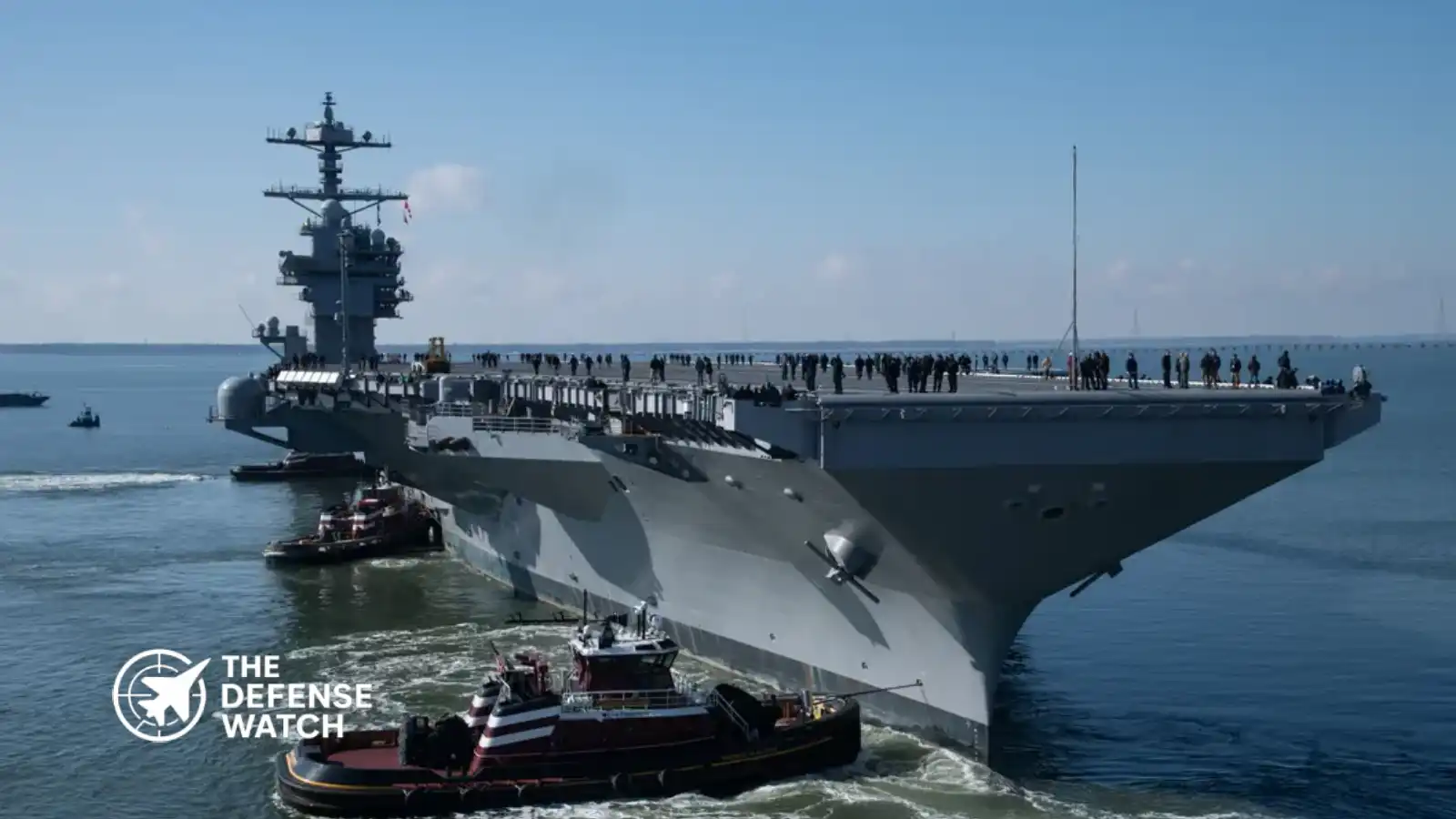
The quarter’s headline operational milestone was the completion of builder’s sea trials for the aircraft carrier John F. Kennedy (CVN 79), the second Gerald R. Ford-class nuclear-powered carrier.
HII’s Newport News Shipbuilding division and the U.S. Navy completed builder’s sea trials of CVN 79, with the pre-commissioning unit departing its Virginia shipyard on January 28, 2026, and returning on February 4 after eight days of at-sea testing — the ship’s first voyage and a key milestone toward fleet delivery.
During the trials, HII shipbuilders, industry and Navy partners, and sailors conducted intensive testing of propulsion, steering, navigation, weapons systems, anchors, and firefighting capabilities, working around the clock to evaluate performance across nearly 2,000 spaces using hundreds of sensors.
HII leadership confirmed the company remains focused on preparing for CVN 79 acceptance trials later this year. The carrier is currently slated to deliver to the Navy in March 2027, following delays attributed to completion of Advanced Arresting Gear (AAG) certification and Advanced Weapons Elevator (AWE) work — two technologies unique to the Ford class that have historically complicated the program’s schedule.
For the U.S. Navy, Kennedy’s progress matters strategically. The Ford class is designed to replace aging Nimitz-class carriers and incorporates electromagnetic launch systems and other next-generation capabilities. Getting CVN 79 delivered and operational addresses a critical force structure requirement as the Navy works to maintain its 11-carrier fleet posture.
Newport News Shipbuilding: Revenue Up 19.3%
Newport News Shipbuilding revenues for Q1 2026 reached $1.7 billion, an increase of $269 million — or 19.3% — from the same period in 2025, primarily driven by higher volumes in aircraft carriers, submarines, and naval nuclear support services.
Segment operating income was $88 million, up $3 million year-over-year, though operating margin dipped slightly to 5.3% from 6.1% in Q1 2025, reflecting contract adjustments on the Virginia-class submarine program and lower performance in aircraft carrier construction.
The Virginia-class submarine program remains one of the most strategically vital production lines in the U.S. defense industrial base. The Navy has long sought to boost Virginia-class output to two boats per year as part of its answer to China’s expanding submarine fleet — a goal that depends heavily on Newport News’s throughput capacity and workforce stability.
Ingalls Shipbuilding: Surface Combatants Drive 13.8% Revenue Growth
Ingalls Shipbuilding posted revenues of $725 million in Q1 2026, up $88 million — or 13.8% — from Q1 2025, primarily driven by higher volumes in surface combatants.
Segment operating income was $49 million, an increase of $3 million from the same period in 2025.
Key milestones at Ingalls during the quarter included completion of builder’s sea trials for the USS Zumwalt (DDG 1000) and the keel authentication of amphibious transport dock Philadelphia (LPD 32).
The Zumwalt-class destroyers, while built in limited numbers, have taken on new strategic relevance as candidates for hypersonic missile integration under the Navy’s Conventional Prompt Strike program — further elevating the importance of Ingalls’s destroyer production work.
Critically, new collective bargaining agreements were ratified at Ingalls Shipbuilding extending through 2031 — a development with significant strategic implications. Labor stability at Pascagoula reduces the risk of production disruptions at a time when the Pentagon and Congress are pressing for accelerated warship delivery timelines.
Mission Technologies: Steady Growth In Defense Tech
Mission Technologies revenues for Q1 2026 were $748 million, an increase of $13 million — or 1.8% — from Q1 2025.
While Mission Technologies’ growth rate was more modest compared to the shipbuilding divisions, the segment plays an increasingly important role in HII’s long-term strategy. The division covers cyber, ISR, AI/ML, and synthetic training capabilities — domains the Pentagon has identified as critical to multi-domain warfighting. As the Navy and broader joint force push for greater integration of autonomous and unmanned systems, Mission Technologies provides HII with a pathway beyond traditional hull construction into the software and systems integration space.
Full-Year 2026 Guidance Reaffirmed
HII’s full-year 2026 outlook projects shipbuilding revenue of $9.7 billion to $9.9 billion, with shipbuilding operating margin of 5.5% to 6.5%, alongside Mission Technologies revenue of $3.0 billion to $3.2 billion at an operating margin of approximately 5%.
The company’s decision to reaffirm guidance reflects management confidence in its program pipeline and workforce stability heading into the back half of the year. Upcoming milestones include preliminary acceptance of CVN 79, the keel laying of CVN 81, and redelivery of submarine SSN 796 — all of which will determine whether HII can sustain the margin trajectory investors and the Pentagon are closely watching.
Strategic Outlook: Industrial Capacity Under The Spotlight
HII’s Q1 results arrive at a pivotal moment for U.S. naval shipbuilding. The Department of Defense and Congress have both flagged the American defense industrial base — particularly submarine and surface combatant production — as a national security vulnerability relative to China’s shipbuilding capacity, which dwarfs U.S. output by volume.
HII’s revenue growth and operational milestones in Q1 2026 suggest the company is executing on its delivery commitments. But the slight margin compression at Newport News signals that cost and performance pressures on complex programs — particularly Ford-class carriers and Virginia-class submarines — remain real. Maintaining shipbuilding margins while scaling output will be the defining challenge for HII through the remainder of 2026 and beyond.
With CVN 79 Kennedy on track for acceptance trials later this year, new labor agreements locked in at Ingalls through 2031, and revenues accelerating across all three divisions, HII enters mid-2026 with its strongest quarterly performance in years — and significant delivery obligations still ahead.