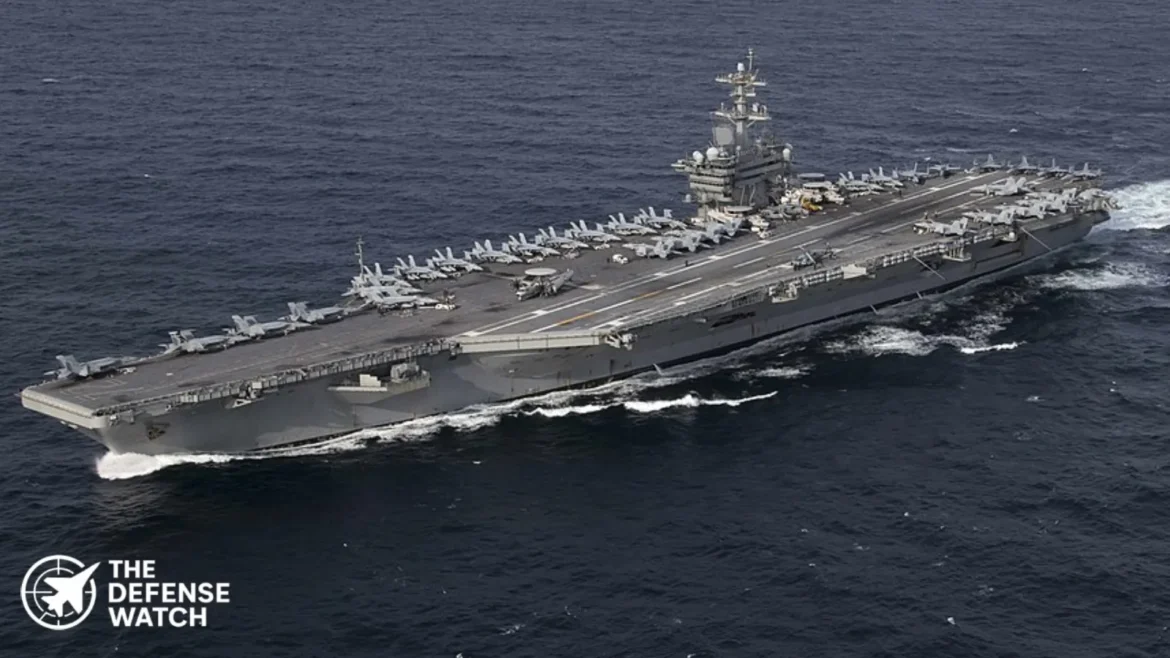
Growing Concerns Over Naval Vulnerability to Drone Swarms
The USS Abraham Lincoln aircraft carrier and other U.S. naval assets face a credible threat from Iranian drone swarm attacks, according to Cameron Chell, CEO of Canadian drone manufacturer Draganfly. The warning comes as the aircraft carrier operates in strategically sensitive waters near Iran’s sphere of influence.
(adsbygoogle = window.adsbygoogle || []).push({});Chell’s assessment highlights a critical vulnerability in modern naval warfare: the ability of low-cost unmanned aerial vehicles to potentially overwhelm sophisticated ship-based air defense systems through sheer numerical superiority.
Canadian Defense Executive Outlines Attack Scenario
Cameron Chell, who leads Draganfly—a publicly-traded drone technology company based in Canada—emphasized the mathematical challenge facing naval defenders. If hundreds are launched in a short time, some are almost certain to penetrate air defenses and reach their targets,” Chell stated in his warning about Iranian capabilities.
The Draganfly CEO’s comments reflect growing recognition within the defense industry that traditional layered air defense systems, designed primarily to counter aircraft and anti-ship missiles, may struggle against coordinated swarm attacks involving dozens or hundreds of small, low-cost drones.
This assessment aligns with observations from recent conflicts, including the ongoing war in Ukraine and various Middle East engagements, where drone swarms have demonstrated effectiveness against conventional military targets.
Iranian Drone Capabilities and Regional Tensions
Iran has developed an extensive unmanned aerial vehicle program over the past two decades, producing a range of platforms from small quadcopters to larger fixed-wing strike drones. The Islamic Revolutionary Guard Corps and Iranian military forces have showcased these capabilities through proxy forces in Yemen, Iraq, Syria, and Lebanon.
The Houthi movement in Yemen, backed by Iran, has repeatedly deployed drone and missile attacks against maritime targets in the Red Sea and Gulf of Aden, forcing U.S. and allied naval forces to maintain heightened defensive postures. These attacks have demonstrated Iran’s ability to project power through asymmetric means.
Iranian-designed drones, including the Shahed-136 and various reconnaissance platforms, have been deployed in multiple conflict zones. The relatively low cost of these systems—often thousands of dollars per unit compared to millions for interceptor missiles—creates a concerning cost-exchange ratio for defenders.
Aircraft Carrier Defense Systems Face New Challenges
The USS Abraham Lincoln Carrier Strike Group employs multiple layers of defense, including the Aegis Combat System, Rolling Airframe Missiles (RAM), Evolved Sea Sparrow Missiles (ESSM), and Close-In Weapon Systems (CIWS) like the Phalanx. However, these systems were primarily designed to counter traditional aerial threats.
Naval air defense doctrine has historically focused on defeating sophisticated anti-ship cruise missiles and aircraft rather than large numbers of small, slow-moving targets. The saturation point—where incoming threats exceed a ship’s ability to engage them—becomes a critical vulnerability in swarm scenarios.
Recent U.S. Navy exercises and assessments have acknowledged the drone swarm challenge, leading to increased investment in counter-drone technologies, including electronic warfare systems, directed energy weapons, and artificial intelligence-enabled targeting solutions.
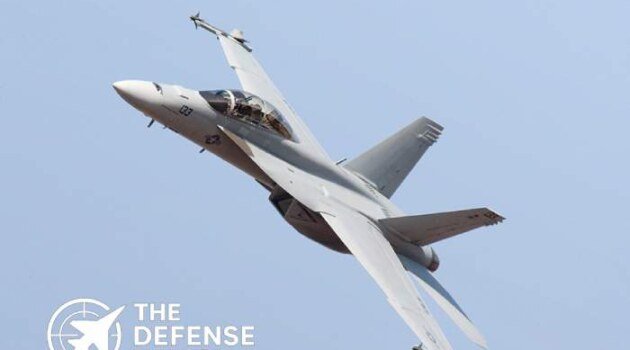
The carrier strike group’s defensive perimeter typically extends dozens of miles from the vessel, with E-2D Advanced Hawkeye aircraft providing airborne early warning and F/A-18 Super Hornets capable of intercepting threats. However, small drones flying at low altitudes can be difficult to detect and track using conventional radar systems.
Cost Asymmetry Favors Attackers
Defense analysts have long warned about the economic imbalance inherent in counter-drone operations. A small quadcopter costing $1,000 might require a $2 million missile to intercept, creating an unsustainable cost ratio for defenders facing mass attacks.
Chell’s warning underscores this mathematical reality: even with sophisticated defenses, a numerically superior attack has statistical advantages. The sheer volume problem is real,” noted one U.S. defense official speaking on background about counter-drone challenges, though not specifically addressing Chell’s comments.
(adsbygoogle = window.adsbygoogle || []).push({});The Pentagon has prioritized development of more cost-effective counter-drone solutions, including high-power microwave weapons, laser systems, and electronic warfare capabilities that can disable or redirect multiple drones simultaneously at a fraction of the cost of kinetic interceptors.
Regional Security Implications
The USS Abraham Lincoln has operated in U.S. Central Command’s area of responsibility, which includes the Persian Gulf, Arabian Sea, and surrounding waters where Iranian forces maintain significant presence. The carrier’s proximity to potential Iranian launch sites reduces warning time and complicates defensive operations.
Iran’s Islamic Revolutionary Guard Corps Navy operates numerous small, fast attack craft in addition to drone capabilities, creating multi-domain threats that could support coordinated swarm attacks. The convergence of unmanned aerial systems with traditional naval threats represents a evolving challenge for U.S. maritime forces.
Recent incidents in the region, including attacks on commercial shipping and oil infrastructure, have demonstrated Iran’s willingness to employ asymmetric tactics. While direct attacks on U.S. naval vessels remain unlikely given potential escalation risks, the technical capability exists and continues to develop.
U.S. Navy Counter-Drone Initiatives
The United States Navy has accelerated counter-unmanned aerial systems (C-UAS) programs in response to the evolving threat landscape. These initiatives include:
Directed Energy Weapons: The Navy has deployed laser weapon systems aboard several vessels, with plans for wider adoption. These systems can engage multiple targets at minimal cost per shot, addressing the economic asymmetry problem.
Electronic Warfare: Jamming and spoofing capabilities can disrupt drone navigation and control systems, potentially neutralizing multiple threats simultaneously without kinetic engagement.
AI-Enabled Detection: Advanced sensor fusion and artificial intelligence systems improve detection and tracking of small, low-radar-cross-section targets that might evade traditional systems.
Layered Defense Integration: The Navy continues refining integration between ship-based systems, aircraft, and land-based assets to create comprehensive defense networks.
Despite these investments, military analysts acknowledge that perfect defense against determined swarm attacks remains elusive. The fundamental challenge of defending high-value assets against numerous low-cost threats continues to drive doctrinal and technological evolution.
International Perspectives on Drone Warfare
Chell’s position as CEO of a Canadian drone technology company provides him with industry insight into unmanned systems capabilities and limitations. Draganfly specializes in commercial and public safety drone applications, though the company’s expertise in autonomous flight systems offers relevant perspective on military applications.
International defense cooperation on counter-drone technologies has intensified, with NATO allies sharing intelligence and developing coordinated responses to drone threats. The challenge transcends individual national concerns, affecting coalition naval operations worldwide.
(adsbygoogle = window.adsbygoogle || []).push({});Allied naval forces operating in Middle Eastern waters have coordinated defensive measures, sharing sensor data and intercept responsibilities to maximize coverage. However, the distributed nature of modern naval operations means individual vessels or small groups may face threats without immediate support.
Future of Naval Air Defense
The drone swarm threat represents a broader shift in military technology where quantity can challenge quality. Traditional naval superiority, built on platforms like aircraft carriers, faces new asymmetric challenges that demand innovative responses.
Military experts anticipate continued evolution in both offensive drone tactics and defensive countermeasures. The race between swarm capabilities and counter-swarm technologies will likely define naval warfare dynamics for the coming decades.
Chell’s warning, while focused on current Iranian capabilities, applies broadly to any adversary developing drone swarm technologies. China, Russia, and other nations have invested heavily in unmanned systems, creating global implications for naval operations.
The U.S. Navy’s response will likely include continued technological investment, tactical adaptation, and potentially doctrinal changes in how carrier strike groups operate in contested environments. The fundamental question remains whether traditional high-value platforms can be adequately defended against distributed, low-cost threats—or whether naval strategy must evolve to reduce vulnerability.

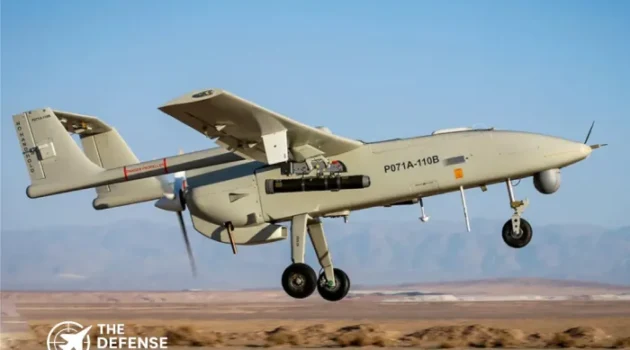

U.S. Carrier Live-Fire Drill in South China Sea
The U.S. Navy’s USS Abraham Lincoln conducted a live-fire drill in the South China Sea in early January, with the carrier’s defensive weapons systems firing during operations aimed at deterring aggression and supporting allied presence in the Indo-Pacific region, the Navy says.
(adsbygoogle = window.adsbygoogle || []).push({});Routine Patrols With Live-Fire Serial
According to U.S. Navy reporting and imagery, the Nimitz-class aircraft carrier USS Abraham Lincoln executed Close-In Weapon System live-fire serials on January 8 while underway with its Carrier Strike Group in the U.S. 7th Fleet area of operations.
The carrier’s embarked air wing and accompanying escorts, including destroyers USS Frank E. Petersen Jr., USS Spruance and USS Michael Murphy, are operating in the South China Sea and Philippine Sea as part of regular Indo-Pacific patrols.
The Navy frames such live-fire drills as part of routine readiness and deterrence posture to counter potential aggression, strengthen alliances and partnerships, and sustain forward naval presence.
Carrier Capabilities and Operational Context
USS Abraham Lincoln, commissioned in 1989, is equipped to carry about 90 fixed-wing aircraft and helicopters. Defensive systems aboard include the Phalanx CIWS, Rolling Airframe Missiles and Sea Sparrow missiles for layered protection against air and missile threats.
Images released by the service show sailors conducting post-exercise checks on the carrier deck following the live-fire drill in the region.
(adsbygoogle = window.adsbygoogle || []).push({});Indo-Pacific Presence and Strategic Messaging
The live-fire activity occurs amid sustained U.S. naval operations in the Indo-Pacific, where the 7th Fleet routinely patrols to demonstrate freedom of navigation and reassure regional allies. U.S. forces continue to operate alongside allied navies and conduct joint exercises across the region.
This activity also comes as China conducts its own live-fire drills and naval exercises near Taiwan and in the broader region, reflecting a broader pattern of military signaling by both sides.
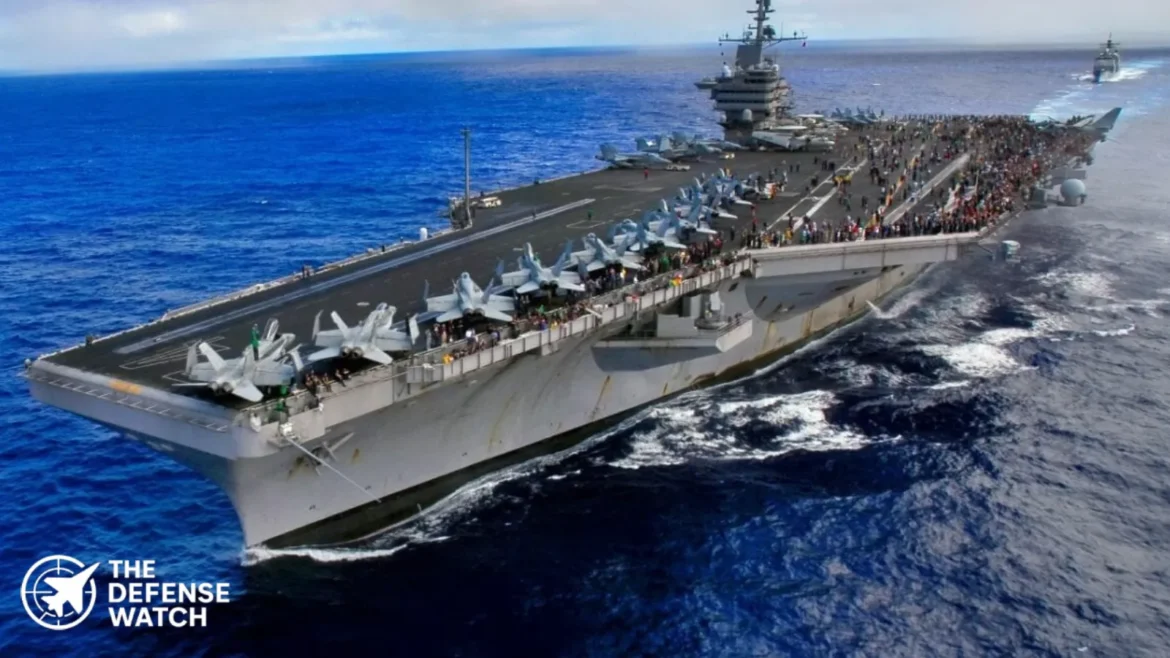
Best Aircraft Carriers in the World 2026, Why It Matters
The best aircraft carriers in the world in 2026 matter because they remain the clearest measure of global naval power. These ships project airpower far from home ports, support allies, deter rivals, and shape crisis response. As competition sharpens in the Indo Pacific, the Atlantic, and the Middle East, carrier capability is no longer about prestige. It is about who can sustain combat power at sea.
How the Ranking Assessment Was Made
The ranking assessment looks at how well each aircraft carrier can perform real world combat and sustained operations in 2026, not just how large or new the ship is. Key factors include the size and capability of the air wing, launch and recovery systems, power generation, survivability, and how often the carrier can generate sorties during high intensity operations. Operational experience also matters. Navies with decades of carrier deployments score higher because training, maintenance, and command integration are proven under stress. Finally, the assessment weighs how each carrier fits into its nation’s wider naval strategy, including escort ships, logistics support, and alliance interoperability. This approach gives a clearer picture of actual combat value rather than paper specifications alone.
What follows is a fresh analysis of the top aircraft carriers shaping naval balance in 2026, written for TheDefenseWatch.com audience.
1. Gerald R. Ford Class, United States
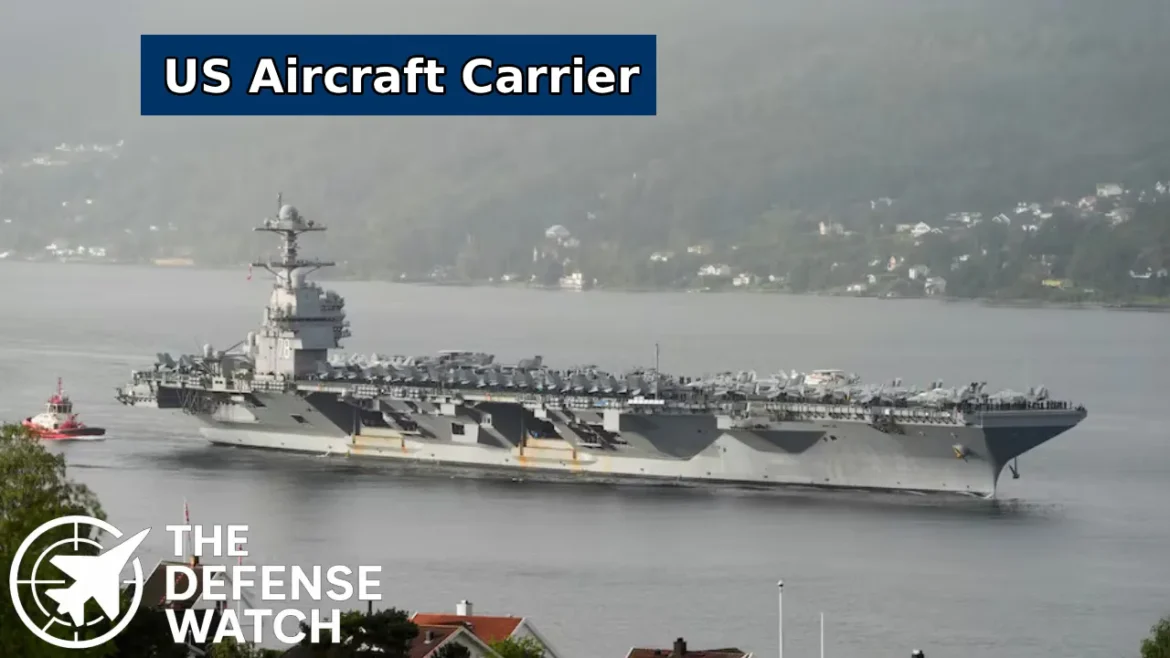
The Gerald R. Ford class remains the benchmark for modern aircraft carriers. These nuclear powered ships are the largest warships ever built and represent a generational leap over the older Nimitz class.
Why It Leads the Ranking
Ford class carriers introduce electromagnetic catapults, advanced arresting gear, and a redesigned flight deck. These changes increase sortie rates while reducing crew workload. The class is built to operate modern aircraft like the F 35C alongside legacy platforms.
Strategic Impact
In 2026, USS Gerald R. Ford and USS John F. Kennedy anchor U.S. carrier strike groups in the Atlantic and Pacific. Their ability to generate sustained air operations gives Washington unmatched reach. No other navy can deploy comparable power at similar scale or tempo.
2. Nimitz Class, United States
Even as newer ships enter service, the Nimitz class remains a core pillar of U.S. naval power. Several of these carriers will remain active into the 2030s.
Still Relevant in 2026
Despite their age, Nimitz class carriers have received major upgrades. Improved radars, combat systems, and air wings keep them combat credible. Their nuclear propulsion allows long deployments without refueling.
Operational Value
Nimitz class carriers continue to shoulder much of the U.S. Navy’s global presence mission. From freedom of navigation patrols to crisis response, these ships remain central to American maritime strategy.
3. Fujian, China
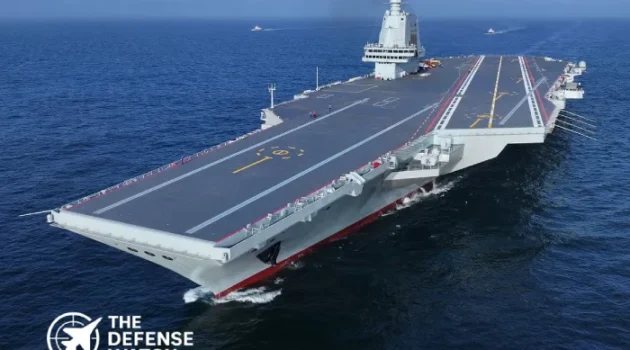
China’s Fujian aircraft carrier marks a turning point for the People’s Liberation Army Navy. It is Beijing’s first carrier designed from the start with electromagnetic catapults.
A Leap Forward for China
Unlike earlier Chinese carriers, Fujian is not based on Soviet era designs. It is larger, more capable, and better suited for high tempo flight operations. This allows China to operate heavier aircraft with greater range and payload.
Regional Consequences
While Fujian does not yet match U.S. carriers in experience or integration, its entry into service signals China’s intent to operate blue water carrier groups. In the Western Pacific, this adds pressure on U.S. and allied naval planners.
4. HMS Queen Elizabeth, United Kingdom
The United Kingdom’s Queen Elizabeth class focuses on flexibility rather than raw size. These carriers operate short takeoff and vertical landing aircraft, primarily the F 35B.
Strength Through Integration
HMS Queen Elizabeth and HMS Prince of Wales are designed to operate closely with NATO allies, especially the United States. U.S. Marine Corps F 35Bs routinely deploy aboard British carriers, creating combined air wings.
Strategic Role
In 2026, British carriers support NATO operations, reinforce presence in the Indo Pacific, and provide London with independent strike options. Their strength lies in coalition warfare rather than solo power projection.
5. Charles de Gaulle, France
France’s Charles de Gaulle remains Europe’s only nuclear powered aircraft carrier. Though smaller than U.S. carriers, it packs significant capability.
Compact but Capable
The ship operates CATOBAR systems, allowing it to launch heavier aircraft than STOVL carriers. Its air wing includes Rafale M fighters with nuclear strike capability.
Global Reach
Charles de Gaulle gives France an independent global strike option. Regular deployments to the Indo Pacific and Middle East underline Paris’s role as a global naval actor.
Comparing Carrier Capabilities in 2026
Size vs Effectiveness
Bigger is not always better, but size still matters. Larger decks allow more aircraft, higher sortie rates, and better sustainment. This remains a U.S. advantage.
Technology and Training
Catapult systems, aircraft integration, and crew experience often matter more than displacement. The U.S. Navy still leads in operational knowledge built over decades.
Numbers Matter
The United States operates more aircraft carriers than the rest of the world combined. Even as rivals improve individual ships, overall capacity remains uneven.
Analysis, What This Ranking Tells Us
The best aircraft carriers in the world in 2026 reflect a shifting but still U.S. led naval order. China’s progress is real and should not be dismissed. However, experience, integration, and logistics remain decisive advantages for the United States and its allies.
European carriers show a different model. They focus on alliance operations and crisis response rather than sustained high intensity conflict alone. This complements U.S. strategy and spreads risk across partners.
For Washington, the message is clear. Maintaining carrier readiness matters as much as building new hulls. For rivals, closing the gap will take more than hardware. It will require decades of training and operational learning.
FAQs
Which country has the best aircraft carriers in 2026?The United States operates the most capable and numerous aircraft carriers in the world in 2026.
Is China close to matching U.S. aircraft carriers?China is improving rapidly, but it still lacks the operational experience and global reach of the U.S. Navy.
Why are aircraft carriers still important?They provide mobile airpower, deterrence, and rapid response without relying on foreign bases.
Do smaller carriers still matter?Yes. British and French carriers play key roles in coalition operations and regional security.

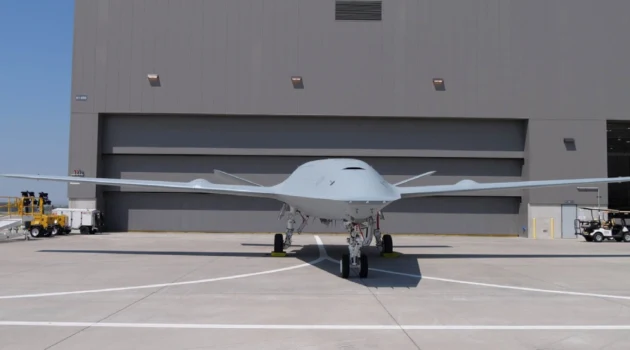
The U.S. Navy MQ 25A Stingray is set to play a central role in future carrier operations under the FY2026 budget plan, marking a major shift in how carrier air wings manage range and endurance. According to U.S. Navy budget documents and reporting by Army Recognition, the program is transitioning from development toward sustained operational integration.
The move reflects broader Navy efforts to modernize carrier aviation while reducing strain on crewed strike fighters used for aerial refueling.
(adsbygoogle = window.adsbygoogle || []).push({});MQ 25A Stingray and the FY2026 Plan
The FY2026 planning framework positions the MQ 25A Stingray as the Navy’s primary carrier based aerial refueling platform. Budget materials show continued funding for system maturation, carrier suitability testing, and early operational capability.
The Stingray is designed to operate from Nimitz and Ford class aircraft carriers using catapult launch and arrested recovery. It integrates with existing deck operations rather than requiring a separate unmanned infrastructure.
Why the MQ 25A Stingray Matters
Before the MQ 25A Stingray, the Navy relied heavily on F A 18 Super Hornets configured as buddy tankers. This practice reduced the number of aircraft available for strike missions and accelerated airframe fatigue.
By shifting the refueling mission to an unmanned platform, the Navy expects to preserve fighter service life while extending the combat radius of carrier air wings. This directly supports long range operations in contested maritime environments.
See also: U.S. Navy carrier air wing modernization programs
Operational Role and Capabilities
The MQ 25A Stingray is optimized for fuel offload rather than strike missions. It can deliver thousands of pounds of fuel to receiving aircraft at range, supporting fighters, electronic attack aircraft, and future platforms.
The aircraft uses autonomous flight control with human oversight, aligning with the Navy’s broader approach to unmanned systems integration rather than fully independent operations.
(adsbygoogle = window.adsbygoogle || []).push({});The Navy has emphasized incremental fielding, avoiding rapid capability expansion before operational lessons are learned.
Strategic Impact for Carrier Aviation
Placing the MQ 25A Stingray at the center of FY2026 carrier planning signals a long term commitment to unmanned aviation at sea. While the aircraft does not replace crewed fighters, it reshapes how those fighters are employed.
For potential competitors, extended carrier strike range complicates planning and increases uncertainty. For allies, it signals continued U.S. investment in carrier relevance despite growing anti access threats.
(adsbygoogle = window.adsbygoogle || []).push({});
Historic Commissioning Marks New Era for PLAN Carrier Aviation
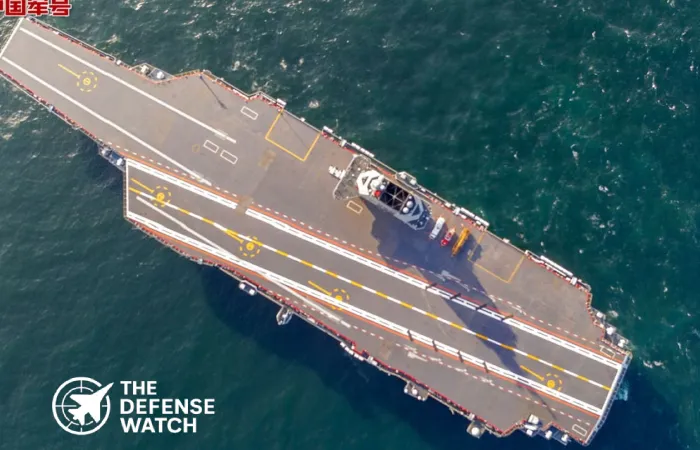
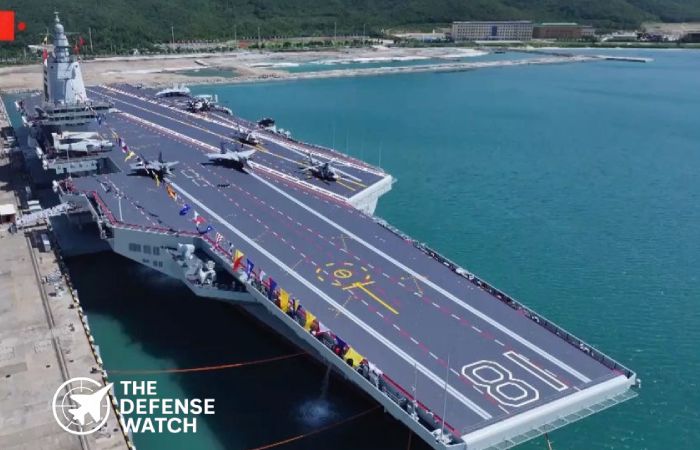
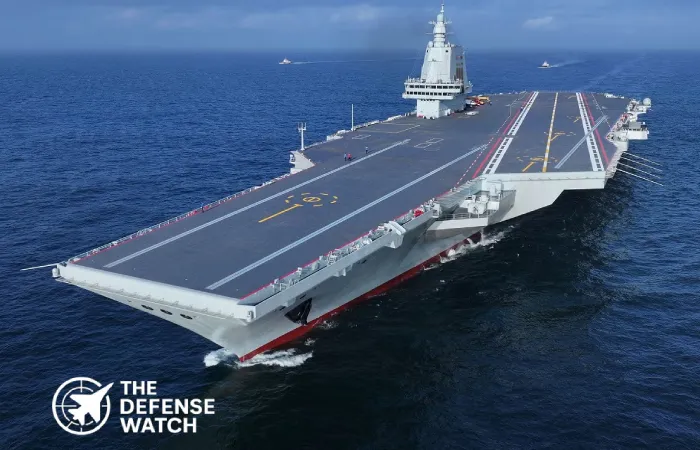
The People’s Liberation Army Navy reached a significant milestone with the commissioning of the Fujian, China’s third and most advanced aircraft carrier, at a ceremony in Sanya on November 5, 2025, attended by President Xi Jinping. The 80,000-ton flattop represents China’s first domestically designed carrier equipped with electromagnetic aircraft launch systems (EMALS), placing Beijing in an exclusive club alongside the United States in operating this cutting-edge technology.
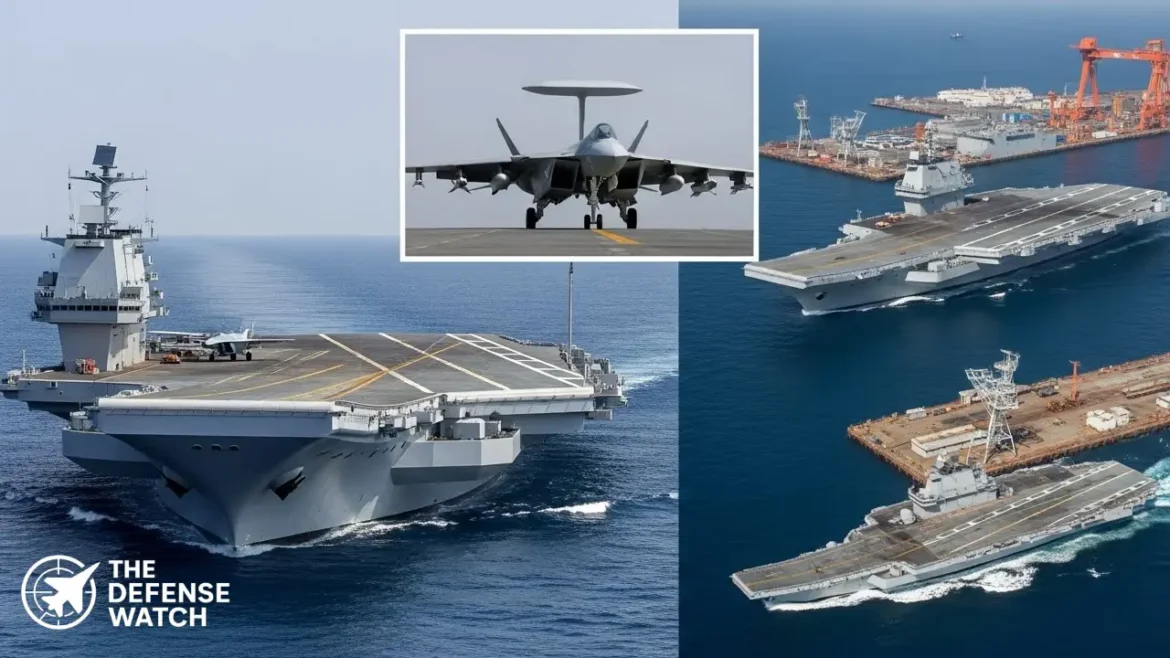
The Fujian successfully demonstrated electromagnetic catapult launches of the J-15T fighter, J-35 stealth fighter, and KJ-600 early warning aircraft during its ninth sea trial in September 2025, proving the carrier achieved initial full-deck operational capability. The vessel completed nine sea trials totaling over 100 days at sea since May 2024, testing propulsion systems, navigation equipment, and the revolutionary catapult technology that differentiates it from China’s ski-jump equipped carriers.

Electromagnetic Catapults: A Game-Changing Capability
The Fujian’s EMALS represents a quantum leap in Chinese carrier aviation capability. Unlike conventional steam catapults, electromagnetic systems cause less stress to aircraft and ships, allow more precise speed control, and can launch a wider range of aircraft. This technology enables the carrier to launch heavier aircraft with full fuel and weapons loads, dramatically extending operational range and combat effectiveness.
The electromagnetic launch system is found only on the latest U.S. Navy Ford-class carriers and now the Fujian, giving China the ability to launch heavier aircraft like the KJ-600 early warning and control plane. The ability to operate fixed-wing airborne early warning aircraft represents a critical capability gap closure for Chinese carrier operations, previously limited to helicopter-based early warning systems.
The carrier’s air wing will operate a diverse mix of platforms. Aircraft to be deployed include the J-15T catapult-compatible fighter, the J-15D electronic warfare variant, the J-35 fifth-generation stealth fighter, and the KJ-600 early warning aircraft. This combination provides the PLAN with capabilities approaching U.S. carrier air wings in terms of offensive strike, defensive counter-air, electronic warfare, and battle management.
Shandong Demonstrates Operational Maturity
While the Fujian represents China’s technological cutting edge, the conventionally powered carrier Shandong has been demonstrating impressive operational tempo and combat readiness. In 2024, the Shandong achieved all-weather combat capacity while significantly reducing aircraft launch preparation times and improving consecutive sortie readiness.
During a July 2024 deployment to the Philippine Sea, the Shandong Carrier Strike Group conducted 240 fighter aircraft launches and recoveries and 140 helicopter operations over a nine-day period. Japanese Maritime Self-Defense Force ships closely monitored these operations, which occurred approximately 300 miles east of the Luzon Strait.
Chinese official media revealed that the Shandong has ensured the safe takeoff and landing of nearly 10,000 sorties of various carrier-based aircraft since commissioning five years ago. Military analysts note this operational experience is crucial for developing the doctrinal expertise and crew proficiency necessary for effective carrier operations.
The Shandong played a prominent role in aggressive exercises near Taiwan. During the April 2025 Strait Thunder 2025A exercise, the Shandong entered Taiwan’s military response zone and maneuvered within 24 nautical miles of Taiwan’s coast, the closest approach yet. The drill involved J-15 carrier-borne fighters conducting simulated strike operations and air superiority missions east of Taiwan.
Dual-Carrier Operations Signal Growing Capability
In late October 2024, the Shandong conducted dual aircraft carrier formation exercises with the Liaoning for the first time in the South China Sea, alongside escort vessels including destroyers, frigates, and replenishment ships. These exercises rehearsed advanced tactics such as one carrier practicing surface attacks while the other seized air superiority and conducted air defense operations.
In June 2025, Chinese carriers achieved three major milestones: the first simultaneous deployment of two carrier strike groups beyond the First Island Chain, with operations extending roughly 3,000 kilometers from Midway Island, and 27 consecutive days of carrier group operations in the Western Pacific. The Liaoning remained active for 24 days while the Shandong operated for 16 days, setting new endurance records for PLAN carrier operations.

During June 14-18, the two carriers likely conducted carrier-versus-carrier training exercises, maintaining a distance of 500-600 kilometers with the Liaoning generating 90 sorties on June 14 and 80 on June 17. These high sortie counts suggest intensive operational training designed to develop coordinated multi-carrier strike capabilities.
Mystery Ship Raises Questions About Naval Aviation Expansion
Satellite imagery captured in October 2024 revealed a mysterious new vessel with a large open flight deck under construction at Guangzhou Shipyard International on Longxue Island. The approximately 200-meter vessel features three island structures and flight deck markings for vertical takeoff and landing operations.
Video footage from November 26, 2024, showed the vessel sailing under its own power, notably displaying the China State Shipbuilding Corporation logo rather than PLAN insignia or hull numbers. The lack of military markings suggests the ship may serve dual civilian-military purposes.
The vessel’s structure is similar to the PLAN’s Type 075 Amphibious Assault Ship, with spaces that could indicate hangars and sections appearing to lead to elevators for moving equipment and aircraft. Experts speculate the ship could function as a drone carrier, test platform, or scientific research vessel with inherent military utility.
The design appears to match an unconfirmed Chinese government tender calling for a 200-meter test platform with 15,000-ton displacement, 25-meter runway width, 16-knot maximum speed, and twin-island configuration for specialized large deck operations. The rapid construction timeline—from first appearance in May 2024 to sea trials by November—demonstrates China’s impressive shipbuilding capacity.
Nuclear-Powered Carrier Development Accelerates
Beyond the Fujian, China is rapidly advancing development of its fourth aircraft carrier, with strong evidence suggesting nuclear propulsion. Recent satellite imagery from Dalian shipyard shows a distinct structural feature resembling a reactor containment compartment within a rapidly growing hull module.
Research by the Middlebury Institute identified a prototype nuclear reactor at Base 909 near Leshan in Sichuan Province, with satellite images from 2020-2023 revealing extensive construction including water intake infrastructure and reactor housing aligned with naval propulsion requirements.
The Type 004 carrier will likely feature a 100,000-ton displacement rivaling U.S. Nimitz and Ford-class supercarriers, with four electromagnetic catapults compared to the Fujian’s three. Nuclear propulsion would provide unlimited range and abundant electrical power for advanced sensors, high-power radars, and future directed energy weapons.
Sources indicate the Type 004’s reactor module was laid down in Q3 2024, followed by bow and stern integration in Q1 2025, with 70 percent completion achieved by late 2025. If construction continues at this pace, commissioning by 2029 appears achievable.
Strategic Implications and Force Projection
The PLAN has grown from 255 battle force vessels in 2015 to over 370 ships in 2024, with projections reaching approximately 400 by 2025 and 435 by 2030. This represents a roughly 50 percent expansion in a decade while modernizing most inventory.
By the 2030s, China plans to operate six aircraft carriers, with the submarine force expected to reach 80 units by 2035 featuring China’s first credible sea-based nuclear deterrent. The six operational Jin-class ballistic missile submarines represent a significant strategic capability enhancement.
Japanese Defense officials expressed wariness, with Chief Cabinet Secretary stating the commissioning underscores that China is extensively and rapidly strengthening military power without transparency. Regional allies are closely monitoring how quickly the Fujian becomes combat-ready and how aggressively China employs its expanded carrier capabilities.
Analysis: Closing the Gap But Challenges Remain
China’s carrier program represents remarkable progress from zero operational carriers in 2012 to three commissioned platforms with a fourth under construction in 2025. The technological leap to EMALS-equipped carriers demonstrates impressive engineering capabilities and China’s commitment to matching or exceeding foreign naval technology.
However, significant challenges remain in translating hardware into operational capability. Two former U.S. carrier officers indicated that despite incorporating EMALS technology, the Fujian’s air operations may run at only about 60 percent the rate of a 50-year-old U.S. Navy carrier due to flight deck configuration. Sortie generation rates depend not just on catapults but on aircraft handling, maintenance practices, crew training, and deck choreography refined over decades of U.S. carrier operations.
Analysts noted that sophisticated new equipment does not necessarily translate to military readiness, as China hasn’t fought a war since 1979, and carefully choreographed parades are effective at amplifying perceptions of strength. Real-world operational readiness may lag behind showcased capabilities.
The Fujian’s conventional propulsion limits global deployment compared to nuclear-powered U.S. carriers. Nuclear power gives U.S. carriers ability to remain at sea for as long as crew provisions last, while the Fujian must either make port calls or be met by tankers at sea to refuel. This constrains sustained operations far from Chinese ports and support infrastructure.
China’s carrier-based aviation lacks combat experience. While PLAN aviators have accumulated thousands of training sorties, they have never conducted carrier operations under combat conditions. The U.S. Navy’s carrier aviation community draws on continuous combat experience from decades of power projection operations worldwide.
The addition of nuclear-powered carriers in the 2030s will fundamentally transform PLAN global reach. Unlimited range, combined with advanced EMALS catapults and fifth-generation fighters, would enable China to sustain carrier operations anywhere in the Indo-Pacific and beyond without the logistical constraints that currently limit deployments.
China’s carrier development reflects broader strategic objectives extending well beyond Taiwan scenarios. The ability to conduct extended operations beyond the First and Second Island Chains, demonstrated by dual-carrier operations reaching toward Midway, signals intent to challenge U.S. naval dominance across the Pacific. Future nuclear carriers would enable presence operations in the Indian Ocean, supporting China’s Belt and Road Initiative and protecting maritime trade routes to the Middle East and Africa.
The mystery ship development and rapid expansion of amphibious capabilities suggest China is pursuing diverse platforms for power projection beyond traditional carrier strike groups. A distributed fleet architecture incorporating conventional carriers, nuclear supercarriers, amphibious assault ships, drone carriers, and unmanned surface vessels would provide operational flexibility and complicate adversary planning.
Conclusion
China’s aircraft carrier fleet expansion represents one of the most significant shifts in Indo-Pacific naval balance in decades. The Fujian’s commissioning with EMALS technology, the Shandong’s demonstrated operational maturity, emerging mystery platforms, and nuclear carrier development collectively signal China’s determination to field a true blue-water navy capable of global power projection by mid-century.
While quantitative growth is impressive—from zero to potentially six carriers within two decades—qualitative gaps in operational experience, crew proficiency, and combat-proven tactics remain. The PLAN is investing heavily in closing these gaps through intensive training, dual-carrier exercises, and far-seas deployments.
For the United States and regional allies, China’s carrier expansion necessitates sustained investment in capabilities to maintain technological edges, enhanced intelligence surveillance and reconnaissance to track PLAN operations, strengthened alliances and interoperability with partners, and development of new operational concepts optimized for distributed maritime operations in contested environments.
The commissioning of the Fujian marks not an endpoint but an inflection point in China’s naval modernization. The next decade will reveal whether China can translate hardware advantages into the operational proficiency, strategic acumen, and combat effectiveness necessary to truly rival the U.S. Navy as a global maritime power.
FAQs
How does China’s Fujian carrier compare to U.S. carriers?The Fujian at 80,000 tons is smaller than U.S. supercarriers (100,000+ tons) and conventionally powered rather than nuclear. However, it features EMALS catapults matching the latest U.S. Ford-class technology. The Fujian can carry an estimated 50-60 aircraft compared to 75+ on U.S. carriers, and its flight deck configuration may limit sortie generation rates to about 60 percent of U.S. capabilities.
What is the significance of EMALS technology on the Fujian?Electromagnetic Aircraft Launch Systems represent a generational leap over ski-jump ramps on China’s earlier carriers. EMALS enables launching heavier aircraft with full fuel and weapons loads, supports operation of critical fixed-wing early warning aircraft like the KJ-600, reduces stress on aircraft and ship structures, and allows precise control over launch speeds for different aircraft types.
How many aircraft carriers does China plan to operate?China currently operates three carriers: Liaoning, Shandong, and the newly commissioned Fujian. A fourth nuclear-powered Type 004 carrier is under construction at Dalian shipyard. Pentagon assessments project China will operate five to six carriers by the 2030s as part of its goal to field a “world-class” navy by 2049.
What is the mysterious ship spotted at Guangzhou Shipyard?Satellite imagery revealed a 200-meter vessel with a flight deck and three island structures under construction at Guangzhou Shipyard International. The ship displays China State Shipbuilding Corporation markings rather than military insignia, suggesting potential dual civilian-military use. Experts speculate it could serve as a drone carrier, test platform for VTOL operations, or scientific research vessel with inherent military utility.
How does the Shandong’s operational tempo compare to U.S. carriers?The Shandong has demonstrated impressive operational improvement, conducting 240 fighter sorties and 140 helicopter operations over nine days during 2024 deployments—averaging about 54 sorties per day. However, this still significantly trails U.S. Navy Nimitz-class carriers, which conduct approximately 120 sorties per day during sustained operations. The Shandong has accumulated nearly 10,000 aircraft sorties since commissioning in 2019.
U.S. Navy Aircraft Carriers Dominate Global Sea Power in 2025
The U.S. Navy maintains a fleet of 11 aircraft carriers in 2025, fulfilling its statutory requirement under the National Defense Authorization Act. These nuclear-powered supercarriers represent the most potent projection of American military power, capable of deploying air wings that rival entire nations’ air forces. As the service transitions from the venerable Nimitz class to the technologically advanced Gerald R. Ford class, u.s. navy aircraft carriers 2025 remain the cornerstone of maritime dominance in an increasingly contested global environment.
As of November 2025, carrier strike groups are deployed globally, with USS Gerald R. Ford operating in the Caribbean Sea, USS George Washington underway in the Philippine Sea, and USS Nimitz conducting operations in the South China Sea. This forward presence demonstrates the Navy’s ability to respond rapidly to crises while maintaining deterrent posture in critical regions.
The Ford-Class Revolution: Next-Generation Carrier Technology
The Fiscal Year 2025 Budget Request allocates continued funding for three Gerald R. Ford-class carriers: USS John F. Kennedy (CVN-79), USS Enterprise (CVN-80), and USS Doris Miller (CVN-81). These vessels incorporate technologies that fundamentally transform carrier operations.
Electromagnetic Launch and Recovery Systems
The Ford class features the Electromagnetic Aircraft Launch System (EMALS), which replaces traditional steam catapults with electromagnetic induction to smoothly accelerate aircraft during takeoff. This innovation reduces stress on airframes while enabling the launch of a broader range of aircraft weights, from lightweight unmanned aerial vehicles to heavy strike fighters.
The Advanced Arresting Gear (AAG) uses digital controls for more precise braking and energy absorption during aircraft recovery. Together, EMALS and AAG increase sortie generation rates by approximately 30 percent compared to Nimitz-class carriers, dramatically enhancing combat tempo.
Enhanced Power Generation and Automation
Ford-class carriers employ an all-electric power system, eliminating steam service lines used on previous Nimitz-class carriers. The new Bechtel A1B reactor generates at least 25 percent greater power capacity than Nimitz-class A4W reactors, with electrical generation capacity tripled.
Despite being massive warships, Ford-class carriers operate with approximately 2,600 sailors—nearly 700 fewer than Nimitz-class vessels—made possible by automation technologies handling munitions transport, aircraft handling, and maintenance tracking. This reduced crew requirement translates to lower operational costs and improved quality of life for personnel.
Advanced Sensors and Combat Systems
The Dual Band Radar (DBR) system provides comprehensive detection and tracking capabilities, significantly improving radar performance in hostile and contested environments. The DBR integrates S-band Multi-Function Radar and X-band Volume Search Radar into a single cohesive unit, enabling simultaneous tracking of multiple targets while providing enhanced situational awareness.
Current Fleet Status and Deployments
USS Gerald R. Ford (CVN-78): The Flagship
USS Gerald R. Ford, commissioned in July 2017, replaced the aging USS Enterprise (CVN-65) and is now an active part of the fleet with enhanced power projection capabilities. The Ford carries twin-engine F/A-18E/F Super Hornets with a maximum combat range of 1,250 miles, along with electronic-jamming aircraft, airborne early warning and control planes, cargo and passenger planes, and helicopters.
In November 2025, the USS Gerald R. Ford Carrier Strike Group entered the Caribbean Sea, with 4,000 sailors and dozens of military aircraft aboard the lead ship, as part of Operation Southern Spear. The strike group includes nine carrier air wing squadrons, two Arleigh Burke-class guided-missile destroyers, and an integrated air and missile defense command ship.
Nimitz-Class: Enduring Workhorses
USS George Washington (CVN-73) operates as the forward-deployed carrier in Yokosuka, Japan, while USS Nimitz (CVN-68) conducts operations in the South China Sea. The Nimitz class continues to shoulder the burden of global presence operations while Ford-class vessels complete their transition to full operational capability.
The USS Nimitz, commissioned in 1975, is scheduled for deactivation in May 2026, marking the beginning of the Nimitz-class retirement process. However, the USS Dwight D. Eisenhower (CVN-69), originally scheduled to retire in 2026, will remain in service until 2030 due to delays in Ford-class construction.
The Transition Challenge: Managing Fleet Size During Modernization
The Navy faces a delicate balancing act maintaining its 11-carrier force requirement while retiring aging Nimitz-class vessels and introducing Ford-class replacements. USS John F. Kennedy (CVN-79), initially scheduled for commissioning in 2025, is now expected to enter service in 2027. USS Enterprise (CVN-80) is under construction with a scheduled launch in 2025 and commissioning in 2029, while USS Doris Miller (CVN-81) is slated for construction in 2026 with projected delivery in 2032.
In January 2025, the Navy announced that two additional Ford-class carriers will be named USS William J. Clinton (CVN-82) and USS George W. Bush (CVN-83). The service ultimately plans to acquire 10 Ford-class carriers to completely replace the Nimitz class on a one-for-one basis.
Budget Realities and Construction Economics
According to Congressional Budget Office estimates, the Navy’s 2025 shipbuilding plan would cost an average of $40.1 billion per year over the 2025-2054 period—46 percent more than the average annual funding received over the past five years. This funding gap presents significant challenges for maintaining the carrier fleet at required strength levels.
The dual-carrier procurement contract for CVN-80 and CVN-81, awarded in FY 2019, is expected to yield approximately $4.0 billion in savings through economies of scale achieved by constructing both ships under a single contract. Navy officials have indicated that buying the fifth and sixth Ford-class carriers together could shave billions compared to serial purchases.
Operational Demands and Strategic Competition
Carrier strike group deployments have been extended multiple times over the past three years, initially for deterrence patrols in the Mediterranean Sea, then for operations in U.S. Central Command following Hamas attacks in southern Israel and Houthi attacks in the Red Sea. This persistent demand underscores the enduring relevance of aircraft carriers in modern conflict.
The Navy has only 11 aircraft carriers, and in general, only three are at sea at any one time because of the need for maintenance and training. Regional combatant commanders consistently request carrier presence, with U.S. Indo-Pacific Command requiring coverage to counter China’s growing naval capabilities, Central Command needing support for operations against Iran and the Houthis, and European Command seeking deterrence against Russia.
The China Factor
China has been rapidly expanding and modernizing its naval capabilities, with the People’s Liberation Army Navy now operating the Liaoning and Shandong carriers, while a third, Fujian, has recently been launched. China’s Fujian carrier has advanced to choreographed deck movement and catapult launches, though the U.S. maintains advantages in carrier aviation culture, magazines afloat and ashore, and allied intelligence-surveillance-reconnaissance infrastructure.
The U.S. response centers on continued investment in Ford-class carriers, which provide superior operational capabilities through technologies like EMALS and AAG, enhanced sortie generation rates, and increased power projection that allows the Navy to maintain maritime dominance in contested regions.
Air Wing Composition and Future Integration
Ford-class carriers can accommodate more than 75 aircraft, including F/A-18E/F Super Hornet strike fighters, E-2D Advanced Hawkeye early warning aircraft, EA-18G Growler electronic warfare jets, and MH-60 Seahawk helicopters. Future integration will include the F-35C Lightning II stealth fighter and the MQ-25 Stingray unmanned refueling aircraft.
The Ford does not currently carry the Navy’s newest stealth fighter jet, the F-35C, as modifications needed to support the fifth-generation aircraft are not expected until a future maintenance period. Once integrated, the F-35C will provide unprecedented stealth strike capabilities from the carrier deck.
The service plans to buy 76 MQ-25 Stingrays at an estimated cost of about $13 billion. These carrier-based unmanned tankers will extend the combat radius of manned strike fighters, effectively increasing the carrier’s power projection envelope without risking additional aircrew.
Analysis: Carriers Remain Central to Naval Strategy Despite Challenges
The U.S. Navy’s commitment to maintaining 11 aircraft carriers reflects strategic calculations that extend beyond pure military capability. Carriers serve as floating symbols of American power and commitment, providing visible deterrence that no other platform can match. As Vice Admiral Daniel Cheever noted, aircraft carriers are symbolic of America and serve as a visible deterrent around the globe, with everyone knowing when a carrier is near or approaching.
The transition from Nimitz to Ford class, while necessary, presents timing challenges that could temporarily reduce fleet availability. Extended service lives for Nimitz-class carriers like USS Eisenhower demonstrate the Navy’s pragmatic approach to maintaining force structure during this critical transition period. These extensions carry costs—older ships require more maintenance and operate less efficiently—but the alternative of falling below the 11-carrier threshold would create unacceptable capability gaps.
The Ford class has overcome its troubled early development period. By 2025, reliability issues have been largely resolved, and the carrier is settling into routine operations after a long shakedown. Recent imagery shows USS Gerald R. Ford conducting full flight operations across European waters, demonstrating that the Navy’s investment in next-generation systems is paying dividends.
Budget pressures remain the most significant long-term threat to carrier force structure. The 46 percent funding increase required to execute the Navy’s shipbuilding plan appears unrealistic in the current fiscal environment. This gap may force difficult choices between carrier numbers and other naval priorities, including submarines, surface combatants, and unmanned systems.
China’s carrier development, while impressive, still lags American capabilities in critical areas including operational experience, logistics support, and integration with allied forces. However, the pace of Chinese naval expansion cannot be ignored. The Ford-class technological edge provides a buffer, but maintaining that advantage requires continued investment in both ships and air wing modernization.
Looking ahead, the carrier’s role may evolve as unmanned systems, directed-energy weapons, and advanced missiles reshape naval warfare. The Ford class’s expanded electrical generation capacity positions these ships to integrate future technologies, ensuring relevance through mid-century. Whether 11 carriers remain sufficient in future high-intensity conflicts against peer competitors remains an open question that doctrine, budget, and geopolitics will ultimately answer.
FAQs
How many aircraft carriers does the U.S. Navy have in 2025?The U.S. Navy operates 11 aircraft carriers in 2025, consisting of one Ford-class carrier (USS Gerald R. Ford) and 10 Nimitz-class carriers. This meets the statutory requirement established by Congress for maintaining a minimum 11-carrier force.
What is the difference between Ford-class and Nimitz-class carriers?Ford-class carriers incorporate electromagnetic aircraft launch systems, advanced arresting gear, increased electrical power generation, reduced crew requirements, and enhanced automation compared to Nimitz-class ships. These improvements enable 30 percent higher sortie rates while operating with 700 fewer sailors.
When will USS John F. Kennedy be commissioned?USS John F. Kennedy (CVN-79), the second Ford-class carrier, is now expected to be commissioned in 2027. The delivery was delayed by two years from the original 2025 target due to construction challenges and technical integration issues.
Why is the USS Nimitz being retired?The USS Nimitz, commissioned in 1975, has reached the end of its 50-year designed service life. The carrier is scheduled for deactivation in May 2026 to be replaced by newer Ford-class carriers that offer improved capabilities and reduced operating costs.
How much does a Ford-class aircraft carrier cost?The USS Gerald R. Ford cost approximately $13 billion to construct, making it the most expensive aircraft carrier ever built. Subsequent Ford-class ships benefit from lessons learned and dual-procurement strategies that reduce per-unit costs through economies of scale.
A major deployment by the USS Gerald R. Ford is drawing international attention as the 100,000-ton supercarrier nears Venezuelan waters. The move, which was reported on 13 November 2025, marks a clear demonstration of U.S. naval capability in the region.
Background
The United States has long used aircraft carriers as instruments of deterrence and influence — able to project power without necessarily firing a shot. The Ford-class carrier, the most advanced in the U.S. fleet, is now entering the operational sphere of Venezuela, where U.S. authorities allege significant drug-trafficking via the Caribbean and the eastern Pacific. This deployment comes amid growing U.S. scrutiny of the Venezuelan government of Nicolás Maduro, which the U.S. does not recognize as legitimate and accuses of colluding with narcotics traffickers.
Details of the Deployment
According to reporting by the Associated Press, the USS Gerald R. Ford is expected to enter the Caribbean Sea in the coming days, with its presence described as a “flex of American military power not seen in Latin America for generations.” While no direct operations have been confirmed, analysts note that the carrier’s arrival signals a shift in U.S. posture in the region.
U.S. officials state the deployment is part of a broader counter-drug campaign under the umbrella of the U.S. Southern Command. In public remarks, U.S. Secretary of State Marco Rubio said the objective is to address “organized criminal narcoterrorists” and stop illicit flows into the U.S.
However, analysts such as Elizabeth Dickinson of the International Crisis Group question whether a carrier is the optimal tool for counter-drug operations. She said:
“There’s nothing that an aircraft carrier brings that is useful for combating the drug trade… I think it’s clearly a message that is much more geared toward pressuring Caracas.”
Former Navy submariner and Hudson Institute analyst Bryan Clark suggested the deployment implies intent.
“I think this administration is very open to using military force to accomplish particular objectives,” he said.
Another layer to the challenge: Venezuelan forces are believed to have relatively modern mobile surface-to-air missile systems supplied by Russia. As noted by CSIS senior adviser Mark Cancian:
“Because they have so many systems, some are relatively new, and all are mobile… we probably wouldn’t get them all. So there’s some risk that we could lose some aircraft.”
On the Venezuelan side, defense minister Vladimir Padrino López declared a two-day readiness effort involving “land, air, naval, riverine, and missile assets” to confront what he called “imperialist threats.”
Expert or Policy Perspective
From a strategic standpoint, the deployment of the USS Gerald R. Ford near Venezuela highlights two intersecting U.S. policy goals: counter-narcotics and regional geopolitical influence. By mobilising a high-visibility naval asset, Washington is signalling to both adversaries and allies that it remains engaged in Latin America. As one expert put it:
“It’s consistent with this desire to demonstrate credible force… It doesn’t change the equation. I don’t think that the fact that it is there means that they necessarily have to strike.” — David Smilde, Tulane University professor.
There is also the matter of readiness and resource allocation. Cancian warned that the U.S. cannot afford to have such a carrier “dawdling around the Caribbean” indefinitely because the asset might be needed elsewhere.
Regionally, the deployment has generated push-back. Colombian President Gustavo Petro temporarily suspended intelligence-sharing with the U.S. over concerns about human rights in U.S. strike operations.
What’s Next
As the USS Gerald R. Ford approaches, key questions remain: Will U.S. aircraft actually launch operations from its deck? Or will the carrier’s mission remain purely deterrent in nature? Analysts note that if air-strikes were to take place, they would likely be preceeded by missile strikes from other platforms.
Geopolitically, the deployment challenges assumptions about U.S. disengagement from Latin America and signals a willingness to leverage high-end naval power in the Western Hemisphere. For Venezuela and its neighbors, the presence of the carrier may catalyze further militarization or diplomatic realignment.
Closing
The arrival of the USS Gerald R. Ford near Venezuelan waters marks a significant moment in U.S. naval posture and Caribbean security dynamics. Whether the deployment evolves into kinetic operations or remains a visible deterrence measure, its impact on regional strategic calculations is clear. The coming weeks will indicate whether this is a temporary flex or the start of a deeper U.S. military engagement in Latin America.
USS Gerald R. Ford Deploys to Latin American Waters
The USS Gerald R. Ford (CVN-78), the U.S. Navy’s newest and largest aircraft carrier, entered the U.S. Southern Command (USSOUTHCOM) area of responsibility on November 11, 2025. The carrier departed the Mediterranean on November 4 as part of a strategic deployment aimed at supporting U.S. counternarcotics operations in Latin America.
Background: Strategic Deployment and Regional Security
The Pentagon had announced in late October that the Gerald R. Ford Carrier Strike Group would transit to the Western Hemisphere to reinforce the U.S. military presence and enhance regional security efforts. The deployment underscores the U.S. commitment to combating illicit trafficking and transnational threats that could affect the safety and prosperity of the United States and its allies in the region.
Details of the Deployment
The USS Gerald R. Ford joins eight other Navy vessels currently operating in the USSOUTHCOM area, including the USS Iwo Jima, USS Fort Lauderdale, USS San Antonio, USS Lake Erie, USS Jason Dunham, USS Gravely, USS Stockdale, and USS Wichita. Combined, these ships carry roughly 6,000 personnel. The Gerald R. Ford alone hosts approximately 4,000 sailors and dozens of tactical aircraft.
The Carrier Strike Group includes nine squadrons from Carrier Air Wing Eight, guided-missile destroyers USS Bainbridge and USS Mahan, and the missile defense command ship USS Winston S. Churchill. Additionally, the USS Gerald R. Ford embarked the Iwo Jima Amphibious Ready Group and a Marine Expeditionary Unit under a joint task force, enhancing the U.S. Navy’s operational flexibility.
“The enhanced U.S. force presence in the USSOUTHCOM AOR will bolster U.S. capacity to detect, monitor, and disrupt illicit actors and activities that compromise the safety and prosperity of the United States homeland and our security in the Western Hemisphere,” said Chief Pentagon Spokesperson Sean Parnell.
Operational Context
This deployment follows a series of military operations in the region targeting vessels suspected of transporting narcotics. Since September, U.S. forces have conducted strikes against drug-carrying ships, reportedly resulting in 19 targeted actions and at least 75 fatalities among those aboard the vessels. While the Pentagon has not disclosed the full operational objectives, the presence of the Gerald R. Ford and its strike group aims to strengthen maritime security and ensure freedom of navigation across Latin American waters.
SOUTHCOM Commander Adm. Alvin Holsey highlighted the strategic intent of the deployment: “Through unwavering commitment and the precise use of our forces, we stand ready to combat the transnational threats that seek to destabilize our region.”
Looking Ahead: Regional Impact and Strategic Significance
The deployment of the USS Gerald R. Ford Carrier Strike Group to Latin America represents a significant escalation in U.S. naval presence in the Western Hemisphere. Analysts note that such high-profile deployments serve both operational and deterrence purposes, signaling U.S. commitment to countering narcotics trafficking and regional threats while strengthening ties with partner nations through potential joint exercises and maritime security cooperation.
As the Gerald R. Ford Carrier Strike Group integrates with existing naval assets in the USSOUTHCOM area, ongoing monitoring of illicit maritime activity and coordinated counternarcotics operations are expected to remain a primary focus. The deployment also provides critical training and operational experience for carrier personnel in complex maritime environments.
Older Posts