• Home
  • About
  • Defense Systems
  • Manufacturer
  • Comparisons
  • Compare 
  • Tools
TheDefenseWatch.com
  • Aerospace & Aviation
  • Military & Ordnance
  • Naval & Maritime
  • Cyber & Space Defense
  • Policy & Strategy
  • Global News
  • Tools Library
    • Smart Calculator
    • Drone Flight Time Calculator
    • Drone Range Calculator
    • Counter-Drone Jammer Effective Range Calculator
    • Counter-Battery Radar Detection Calculator
    • Artillery Fire Correction Calculator
    • Thermal Camera Detection Range Calculator
    • Missile Range & Time-of-Flight Calculator
    • Radar Detection Range Calculator
    • FPV Strike Drone Payload vs Range Calculator
    • Loitering Munition Endurance Calculator
    • Sniper Ballistic Drop & Windage Calculator
    • Bullet Drop Calculator
    • U.S. Army Combat Fitness Test (ACFT) Calculator
    • Military Pension Calculator
    • Military Retirement Calculator
    • Military Pension Calculator
    • Large Number Calculator
Font ResizerAa

TheDefenseWatch.com

The Defense Watch | U.S. & Global Defense News, Analysis & Military Updates

Search
  • Home
  • About
  • Defense Systems
  • Manufacturer
  • Comparisons
  • Compare 
  • Tools

Stay Updated

Get the latest update

Subscribe

Explore

  • Drone
  • Fighter Jets & Military Aircraft
  • Hypersonic Weapons
  • Aircraft Carriers
  • Strategic History & Missions
  • Tools Library
Home » Japan and U.S. Conduct Joint B-52 and Fighter Jet Drills Over Sea of Japan After China-Russia Aircraft Patrols
Asian Defense & Security

Japan and U.S. Conduct Joint B-52 and Fighter Jet Drills Over Sea of Japan After China-Russia Aircraft Patrols

TeamDefenseWatch
Last updated: December 12, 2025 12:57 am
TeamDefenseWatch
Share
2 Min Read
Japan US joint drills Sea of Japan
SHARE

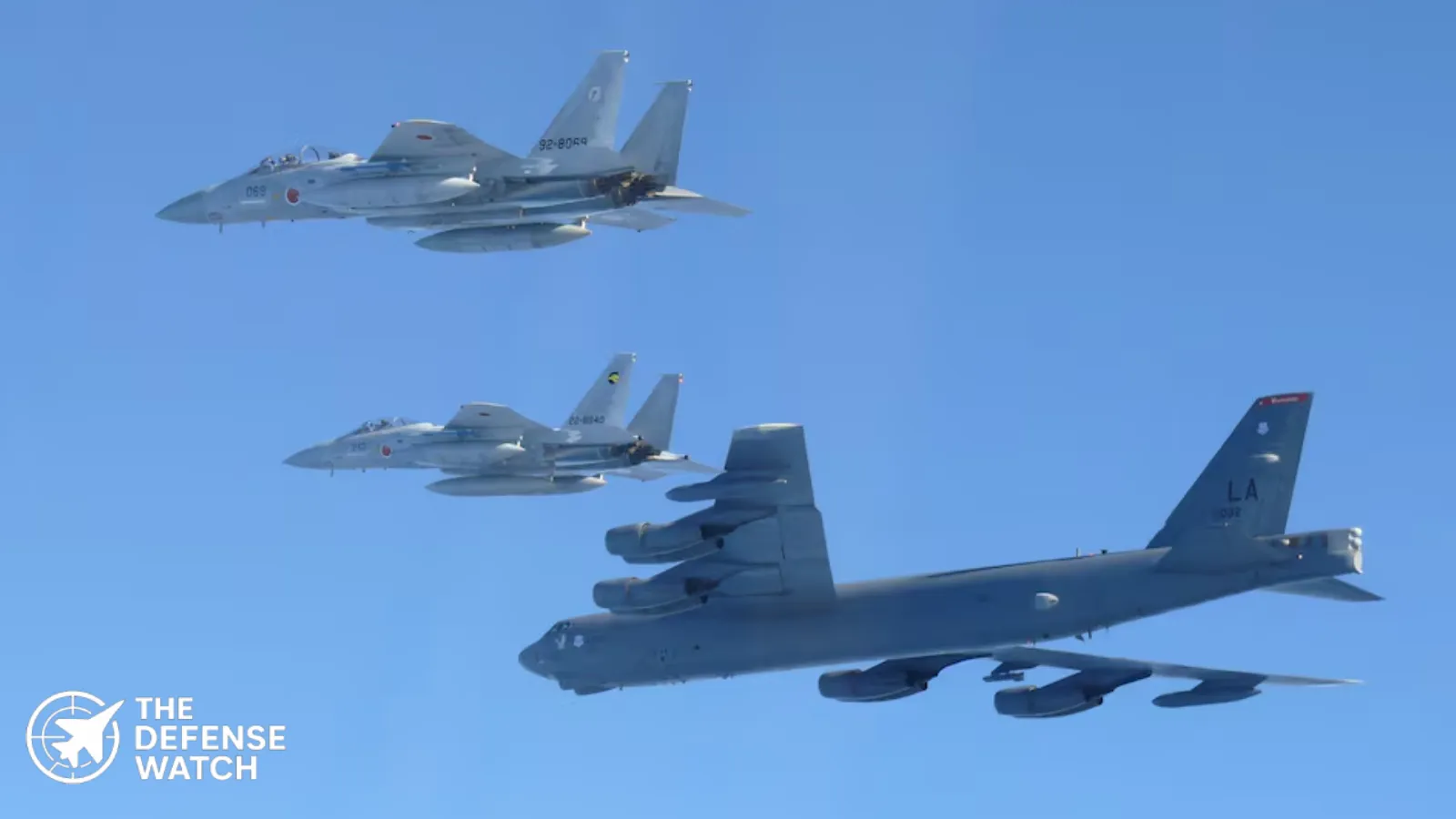
Japan and the United States held coordinated military drills over the Sea of Japan on Wednesday, with U.S. B-52 strategic bombers flying alongside Japanese fighter jets in a high-visibility demonstration of allied air power and readiness, Tokyo’s defense ministry said on Thursday.

Contents
What Happened and WhereContext of Rising Regional ActivityOfficial Statements on the DrillsStrategic and Policy ImplicationsWhat Could Come Next

The exercise came amid heightened regional military activity, including recent joint bomber flights by China and Russia near Japanese airspace, and serves as a clear signal of continued U.S. and Japanese cooperation in the face of shifting security challenges in the Indo-Pacific.

What Happened and Where

On December 10, two U.S. nuclear-capable B-52 strategic bombers flew over the waters of the Sea of Japan in formation with units of the Japan Air Self-Defense Force. Participating Japanese aircraft included three F-35 stealth fighters and three F-15 air-superiority jets, according to official statements.

The drills involved coordinated flight operations over international waters, with no reported violations of Japanese sovereign airspace. Japanese and U.S. officials described the flights as routine joint readiness exercises.

- Advertisement -

Context of Rising Regional Activity

The announcement followed separate military activity by China and Russia. On Tuesday, strategic bombers from both countries conducted a joint flight from the East China Sea into the western Pacific, prompting Japan to scramble fighter jets to monitor the patrol.

Tokyo has also reported other Chinese military maneuvers in recent days, including carrier drills and incidents of Chinese aircraft locking radar on Japanese fighters — incidents Japan regards as risky but which Beijing has denied were aimed at escalation.

These developments unfold against a backdrop of increasing Chinese air and naval activity near Taiwan and around Japan’s southwestern island chain, adding to strategic concerns in Tokyo and among U.S. defense planners.

Official Statements on the Drills

Japan’s defense ministry said the joint drills with U.S. forces reaffirmed both countries’ resolve to prevent any unilateral attempts to change the regional status quo by force, and confirmed the readiness posture of the Japan Self-Defense Forces and U.S. military.

In a statement, Tokyo highlighted that these exercises were designed to enhance interoperability between U.S. and Japanese units deployed in the region.

A U.S. official, speaking on condition of anonymity, noted that the missions were planned well before the recent China-Russia flights and that similar joint sorties with strategic bombers had taken place in previous months.

Strategic and Policy Implications

The use of B-52 strategic bombers in joint exercises underscores the depth of U.S. military engagement in the Indo-Pacific, particularly at a time of heightened tensions with China. The aircraft’s global reach and nuclear-capable designation add strategic weight to these drills, which Tokyo and Washington frame as routine but meaningful demonstrations of alliance cohesion.

U.S. officials in Washington reaffirmed the strength of the bilateral alliance with Japan, while also seeking to balance broader diplomatic ties with Beijing. At a press briefing, a White House spokeswoman said maintaining a strong alliance with Tokyo did not preclude constructive relations with China.

- Advertisement -

From Tokyo’s perspective, these joint exercises serve dual purposes. They signal deterrence against potential coercion in the region and reassure U.S. allies and partners of continued defense cooperation under shifting geopolitical conditions.

What Could Come Next

Allied observers are watching whether Japan and the United States will expand such joint air operations or integrate additional domains such as naval or missile defense drills in response to persistent military movements by China and Russia.

Japan, which hosts significant U.S. military assets including forward-deployed Marine units and carrier strike group support, may further calibrate its defense posture in future exercises to address emerging threats in the East China Sea and wider Indo-Pacific.

Down the line, Tokyo and Washington are likely to continue blending routine readiness drills with broader alliance signaling as tensions evolve, especially around Taiwan and contested maritime zones.


TAGGED:B-52 strategic bombersChina Russia tensionsIndo Pacific securityJapan US militaryJoint drills Sea of Japan
Share This Article
Facebook Copy Link Print
ByTeamDefenseWatch
TeamDefenseWatch is the official editorial byline of TheDefenseWatch.com. Working under one umbrella, TheDefenseWatch.com, the team delivers verified, factual reporting on global defense, military technology, aerospace systems, and security developments. Articles are sourced from official statements, defense industry releases, and trusted media, with editorial review to ensure accuracy and clarity.Contact: info@TheDefenseWtach.com
3 Comments
  • Pingback: Two U.S. Soldiers, Civilian Interpreter Killed in Syria Ambush | TheDefenseWatch.com
  • Pingback: UK Royal Navy Unveils Proteus: First Full-Size Crewless Helicopter to Counter North Atlantic Threats | TheDefenseWatch.com
  • Pingback: RAF and US Air Force Strengthen NATO Airpower in Exercise Point Blank 26 Across England | TheDefenseWatch.com

Leave a Reply Cancel reply

Your email address will not be published. Required fields are marked *

Search Defense Systems

Latest Defense Systems

  • B61 Nuclear Bomb B61 Nuclear Bomb
  • Japan E-767 Airborne Japan E-767 Airborne
  • Remington 870 Shotgun Remington 870 Shotgun
  • RUTA B1 Cruise Missile RUTA B1 Cruise Missile
  • XQ-67A Drone XQ-67A Drone
  • B-25 Mitchell Bomber B-25 Mitchell Bomber
  • F-100 Super Sabre F-100 Super Sabre
  • North American F-86 Sabre North American F-86 Sabre
  • North American XB-70 Valkyrie North American XB-70 Valkyrie

Recent Compares

  • J-10C vs JF-17 Thunder: Which Fighter Is More Capable? J-10C vs JF-17 Thunder: Which Fighter Is More Capable? View Comparison →
  • Tejas vs Gripen: Key Differences and Capabilities Tejas vs Gripen: Key Differences and Capabilities View Comparison →
  • Tejas vs MiG-21 Bison: How India Replaced Its Iconic Supersonic Fighter Tejas vs MiG-21 Bison: How India Replaced Its Iconic Supersonic Fighter View Comparison →
  • F-35 vs F-16: Stealth, Sensors and Combat Roles F-35 vs F-16: Stealth, Sensors and Combat Roles View Comparison →
  • Tejas Fighter Jet vs F-16 Fighting Falcon: Capability Compared Tejas Fighter Jet vs F-16 Fighting Falcon: Capability Compared View Comparison →
  • Rafale Fighter Jet vs F-16 Fighting Falcon : Which Fighter Has the Edge? Rafale Fighter Jet vs F-16 Fighting Falcon : Which Fighter Has the Edge? View Comparison →
  • Su-57 Fighter Jet vs J-20 Fighter Jet: Stealth and Air Combat Compared Su-57 Fighter Jet vs J-20 Fighter Jet: Stealth and Air Combat Compared View Comparison →
  • Mirage 2000 vs Tejas Mk1A: Legacy Combat Power vs Indigenous Modernization Mirage 2000 vs Tejas Mk1A: Legacy Combat Power vs Indigenous Modernization View Comparison →
  • Rafale Fighter Jet vs F-22 Raptor: Which Air Dominance Fighter Has the Edge? Rafale Fighter Jet vs F-22 Raptor: Which Air Dominance Fighter Has the Edge? View Comparison →
  • Tejas Fighter Jet vs. Rafale Fighter Jet: India’s Indigenous Fighter Meets France’s Proven Multirole Combat Aircraft Tejas Fighter Jet vs. Rafale Fighter Jet: India’s Indigenous Fighter Meets France’s Proven Multirole Combat Aircraft View Comparison →

Recent Posts

  • General Atomics to Supply Components for U.S. Army and Navy Hypersonic Weapons
  • Lockheed Martin Tests Mk21A Reentry Vehicle for Sentinel ICBM
  • Lockheed Martin Wins $122.4 Million Trident II Navigation Contract
  • Pentagon Prepares Review of Military Legal System and JAG Corps
  • U.S. and Colombia Launch Southern Vanguard 2027 Exercise

You Might Also Like

Helsing HX-2 drone Japan
Asian Defense & Security

Helsing Moves To Enter Japan’s Drone Market With Rakuten As Military Deal Advances

August 17, 2026
Image: Computer-generated
Asian Defense & Security

Pakistan Coast Guards Hit In First Direct Sea Attack Near Iran Border

April 13, 2026
India border infrastructure BRO
Asian Defense & Security

India Emphasizes Border Infrastructure Vital to Technology-Driven Warfare: Rajnath Singh at BRO Conclave

September 7, 2026
TAI Malaysia defense cooperation
Asian Defense & Security

TAI Moves To Expand Defense Cooperation With Malaysia As Southeast Asia Modernization Accelerates

September 12, 2026

Logo

Copyright © 2026 TheDefenseWatch.com

Helpful Links

  • Home
  • About Us
  • Privacy Policy
  • Terms of Use / Disclaimer
  • U.S. Privacy Notice – CCPA Compliance

Defense Systems

  • Defense Systems
  • Comparisons 
  • Manufacturer
  • Tactical Calculators

Popuplar

Which 5 Air Forces Possess the Costliest Fighter Jet Fleets in the World
Evolving Strategic Value: Carrier Strike Groups in the Indo-Pacific’s Future Security Architecture
Autonomous Weapon Systems Spark U.S. Ethics Debate Amid Rapid Military AI Integration

We report on developments involving military forces, governments, defense companies, research organizations, and security institutions around the world. 

Welcome Back!

Sign in to your account

Username or Email Address
Password

Lost your password?