Executive Summary:
The JF-17 Thunder, co-produced by Pakistan and China, has grown from a Cold-War-era stopgap into a genuine export success story, with Azerbaijan alone signing a $4.6 billion deal for 40 Block 3 jets. Priced at roughly a tenth of a Rafale, the JF-17 is proving that “good enough, cheap, and unrestricted” can out-compete Western jets in the arms bazaar that actually matters — the developing world’s.
A Rafale costs roughly ten times what Pakistan charges for a combat-ready JF-17 Thunder Block 3. That single fact explains why Azerbaijan just signed a $4.6 billion order for 40 of them.

No Western manufacturer can touch that price point on a fourth-generation multirole airframe. The JF-17 was never meant to be the best fighter in the sky — it was built to be the fighter a cash-strapped air force could actually afford, buy without political strings, and keep flying for decades.
That formula is now working better than anyone in Islamabad or Chengdu predicted.
Technical Analysis: The Deep Dive Into The Thunder’s Design
The JF-17 traces back to 1998-99 agreements between Pakistan and China, drawn up after the US Pressler Amendment blocked delivery of 28 already-paid-for F-16s. The first prototype flew in August 2003, and the jet entered Pakistan Air Force service in 2007, becoming fully operational with No. 26 Squadron in 2010.
Three production blocks tell the story of steady, deliberate escalation. Block I was the initial 2007 variant with basic avionics and no aerial refueling; Block II arrived in 2013 with refueling capability, improved avionics, and greater payload; Block III added an AESA radar and a modernized cockpit.

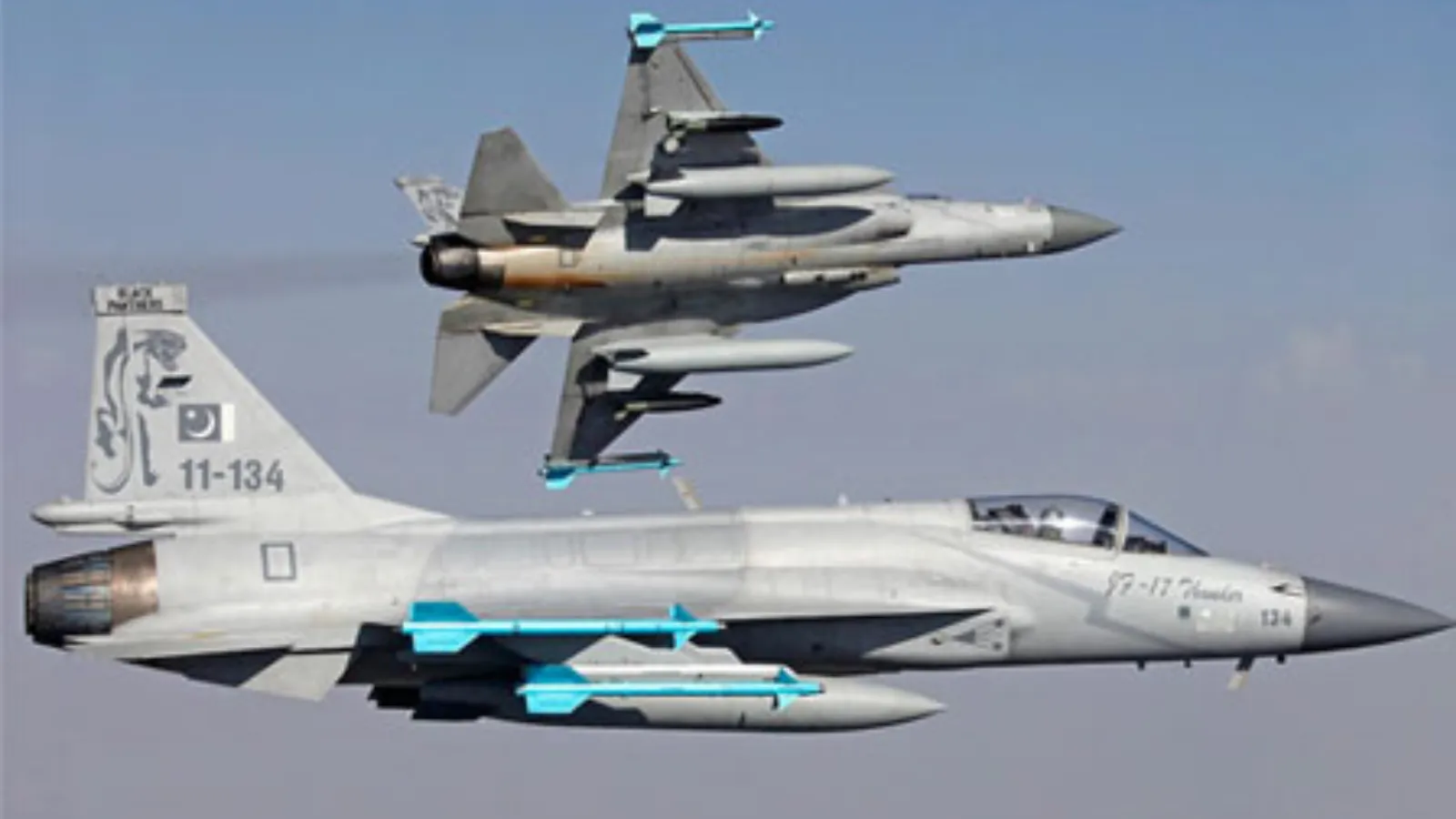
Image : PAC Block III specifically brings the KLJ-7A active electronically scanned array radar, a helmet-mounted display and sight, three-axis fly-by-wire controls, upgraded electronic warfare gear, and infrared search-and-track compatibility. That’s a genuine sensor-fusion cockpit, not a patched-up 1990s jet.
Power comes from a Russian-origin turbofan. The Block III variant runs on the RD-93MA afterburning turbofan, producing about 91 kilonewtons (19,000 lbs) of thrust under full authority digital engine control. That gets the airframe to Mach 1.6, roughly 1,960 km/h.
Airframe numbers stay lean by design. The jet measures about 14.3 meters long with a 9.5-meter wingspan, an empty weight near 7,965 kg, and a maximum takeoff weight around 13,500 kg, with a listed service life of roughly 4,000 flight hours or 25 years. Lightweight airframe, single engine, minimal parts inventory — every design choice traces back to keeping the sustainment bill low for the buyer.

Image : PAC Pricing is where the jet actually wins wars — the budget kind. Early Block I units cost around $15 million, Block II pushed closer to $25 million with its added capability, and Block III — now the primary export configuration — is being quoted between $25 million and $50 million depending on package. Pakistan’s Kamra production facility currently runs an annual output of 20-25 aircraft, enough to cover both PAF needs and the growing export backlog.
JF-17 Thunder: Variant-By-Variant Snapshot
Variant Service Entry Key Upgrade Approx. Unit Cost Block I 2007 Baseline avionics, no A2A refueling ~$15M Block II 2013 A2A refueling, composite structure, EW suite ~$25M JF-17B 2017 Twin-seat trainer/combat variant Comparable to Block II Block III 2019 onward KLJ-7A AESA radar, HMD/S, fly-by-wire $25M–$50M The Export Boom: From Baku To Mogadishu
Numbers tell the adoption story better than any press release. By October 2025, 177 JF-17s had rolled off the line, a meaningful share of them Block 3 units built for export customers rather than the PAF.
Azerbaijan is the headline deal. Baku’s acquisition is Pakistan’s largest-ever defense export contract, valued at $4.6 billion for 40 aircraft, building on an earlier 2024 agreement worth $1.6 billion and bundling training, munitions, and full logistics support. The first three jets landed in Baku in October 2025, a geopolitical marker as Azerbaijan modernizes its fleet amid persistent tension with Armenia.

Image : PAC Somalia is the newest name on the list. In February 2026, reports emerged that Somalia is negotiating for up to 24 Block III jets in a package worth roughly $900 million — a deal that would mark the country’s largest defense investment since 1991 and rebuild an air force that currently has no fighter aircraft at all, only light utility planes and helicopters.
Islamabad isn’t stopping at the airframe sale. Pakistan is now pitching the JF-17 in active talks with 13 countries at once, and industrial plans on the table include additional assembly lines, a faster production tempo, and deeper Chinese involvement in component manufacturing. This isn’t a one-off sale — it’s Pakistan building an aerospace export industry around a single airframe family, the same way Sweden built one around the Gripen.
The Insight: Why JF-17 Doctrine Looks Like A Rush-Strategy In Competitive Shooters
Strip away the hardware and the JF-17 program is executing a strategy competitive gamers would recognize instantly: win on tempo and economy, not on raw individual power.
In games like Counter-Strike or Call of Duty, a team with a cheaper loadout that buys more often, contests more angles, and never lets the round economy stall will consistently out-tempo an opponent sitting on a handful of maxed-out weapons. The JF-17 is that strategy in airframe form — Pakistan isn’t trying to out-spec the F-35 one-for-one, it’s trying to field three or four jets, sensors, and pilots for the sustainment cost of one exquisite Western platform.

Image : PAC That’s also the logic behind “econ rounds” in esports: sometimes the correct play isn’t the best gun, it’s the gun you can afford to lose without losing the game. Somalia and Azerbaijan aren’t buying the most capable jet on the market — they’re buying the jet whose loss, in combat or in the balance sheet, doesn’t end their air force.
The JF-17 doesn’t have to beat an F-16 in a dogfight. It has to be affordable enough that a country can field a real squadron instead of a symbolic one — and networked well enough that numbers start doing the work individual capability used to do.”
Conclusion: The Real Threat Isn’t The Jet, It’s The Price Tag
The JF-17 Thunder was born out of an arms embargo and grew into Pakistan’s most consequential defense export product. Its technology is respectable, not revolutionary — the real disruption is economic.

Image : PAC Every Azerbaijan-style deal signed at a tenth of a Rafale’s price puts pressure on Dassault, Lockheed, and Saab to justify their margins to budget-constrained air forces from Africa to the Caucasus. In a market where most buyers are counting dollars per airframe rather than chasing absolute stealth or range, “cheap, capable, and unrestricted” is turning out to be a formula the West doesn’t have a ready answer for.
Frequently Asked Questions
How much does a JF-17 Thunder cost?Early Block I units ran about $15 million, Block II rose to roughly $25 million, and the current Block III export configuration is quoted between $25 million and $50 million depending on the support package.
Who makes the JF-17 Thunder?It’s a joint program between Pakistan Aeronautical Complex (PAC) and China’s Chengdu Aircraft Corporation (CAC), assembled at PAC’s Kamra facility.
Which countries operate or have ordered the JF-17?Pakistan is the primary operator. Azerbaijan has ordered 40 Block 3 jets in a $4.6 billion deal, Myanmar ordered 16 Block 2 aircraft for $560 million in 2015, and Somalia is in negotiations for up to 24 Block III jets worth roughly $900 million. Nigeria has also acquired the type.
What radar does the JF-17 Block III use?The Block III carries the KLJ-7A active electronically scanned array (AESA) radar, giving it a genuine sensor-fusion edge over earlier mechanically-scanned Block I/II variants.
Pakistan’s $1.5 Billion Sudan Arms Deal Collapses Under Saudi Pressure
Pakistan’s ambitious Sudan arms deal has been suspended after Saudi Arabia withdrew financial backing and urged Islamabad to terminate the agreement, dealing a significant blow to Pakistan’s expanding defense export program and revealing the degree to which Gulf financing shapes Islamabad’s arms diplomacy.
- Pakistan has placed a $1.5 billion weapons and aircraft deal with Sudan on hold following direct pressure from Saudi Arabia.
- The proposed package included 10 K-8 Karakoram light attack aircraft, over 200 drones, advanced air defense systems, and potentially JF-17 Thunder fighter jets.
- Saudi Arabia withdrew financing for the deal and urged Islamabad to terminate the agreement entirely, citing concerns about involvement in African proxy conflicts.
- The suspension follows Pakistan’s separate $4 billion-plus arms deal with Libya’s eastern-based Libyan National Army, finalized in December 2025.
- The halt underscores how Gulf financial leverage shapes Pakistani defense export strategy and the limits of Islamabad’s arms diplomacy independence.
The Big Picture
Pakistan has emerged as one of the most aggressive new entrants in the global defense export market over the past two years. Defense exports reportedly reached all-time highs in 2025, with officials attributing the surge to the perceived battle-tested performance of platforms like the JF-17, following Pakistan’s deployment of the aircraft in its conflict with India.
Islamabad has leveraged those combat credentials to pursue large-scale arms agreements across the Middle East and Africa—markets where Western suppliers face sanctions constraints or political complications. In December 2025, Pakistan signed a deal worth more than $4 billion with Libya’s eastern-based Libyan National Army, one of its largest-ever arms deals, covering 16 JF-17 fighter jets, 12 Super Mushshak trainer aircraft, and additional equipment for land, sea, and air operations.
The Sudan deal was intended to be the next major milestone in that trajectory. Its collapse—driven not by Pakistani hesitation but by Gulf financial pressure—exposes the structural dependency at the heart of Islamabad’s defense export model.
What’s Happening
Pakistan has put a $1.5 billion deal to supply weapons and jets to Sudan on hold after Saudi Arabia asked for the agreement to be terminated and said it would not finance the purchase, two Pakistani security sources and a diplomatic source told Reuters.
The proposed package included over 200 drones for reconnaissance and loitering attacks, 10 K-8 Karakoram light attack aircraft, advanced air defense systems, PAC MFI-395 Super Mushshak training aircraft, and potentially JF-17 Thunder fighter jets jointly developed with China.
Reuters first reported the deal was in its final stages in January 2026, noting it had been brokered by Saudi Arabia, though no Saudi financing was disclosed at that time. The April 20 report confirms that Riyadh’s role extended well beyond brokerage—it was the deal’s financial backbone.
One meeting in March between Sudanese military officials and Saudi representatives reportedly contributed to the withdrawal of financing, following a broader Saudi reassessment of its involvement in regional conflicts.
Neither Pakistan’s military nor Sudan’s armed forces responded to requests for comment. The Saudi government media office also did not immediately respond.
Why It Matters
The suspension is significant for three reasons. First, it stalls a deal that Sudan’s military badly needs. Assistance from Pakistan, especially drones and jets, could help Sudan’s army regain the air supremacy it had toward the start of its war with the RSF, which has increasingly used drones to gain territory, eroding the army’s position.
Second, it signals the outer boundary of Pakistan’s defense export autonomy. Islamabad can negotiate and structure deals, but without Gulf financing—particularly Saudi liquidity—it cannot always close them. Pakistan is currently operating under a $7 billion IMF program, following a short-term deal to avert a sovereign default in 2023, and won IMF support after Saudi Arabia and other Gulf allies provided financial and deposit rollovers. That financial dependency translates directly into leverage over Pakistan’s foreign policy decisions, including arms sales.
Third, the collapse demonstrates how Saudi Arabia uses economic relationships as instruments of foreign policy restraint—a form of soft-power veto that rarely requires public statements.
Strategic Implications
Saudi objectives in Sudan appear centered on preventing the collapse of the national army as the backbone of the state, achieved through political acceptance and regional facilitation rather than direct intervention. Riyadh’s decision to pull financing is therefore not a withdrawal of support for Sudan’s military per se—it reflects a recalibration of how Saudi Arabia wants to be seen externally.
Some Western countries had advised Riyadh to stay away from proxy wars in Africa, a factor that sources say influenced Saudi Arabia’s decision to signal that Pakistan should terminate the deal. This advisory pressure, likely from Washington or European capitals, illustrates how diplomatic signaling cascades through financial relationships: Western governments pressure Riyadh, Riyadh pressures Islamabad, and Islamabad suspends the deal.
This cascade model matters for assessing Pakistan’s future export ambitions. Every deal Pakistan structures through Gulf financing channels carries an embedded political risk—the financier can pull out if it faces external pressure. For Pakistan to truly operate as an independent defense exporter, it will need either sovereign financing mechanisms, deferred payment arrangements with buyers, or access to alternative credit structures that bypass Gulf intermediaries.
The Libya deal, by contrast, appears to have proceeded without similar complications—possibly because Libya’s eastern forces secured their own financing, or because the Gulf political environment around that transaction was cleaner. The divergence between the two deals is instructive.
Competitor View
From an Indian perspective, the suspension is a minor strategic relief. New Delhi has watched Pakistan’s defense export surge with concern, particularly JF-17 proliferation into regions where India has strategic interests. A Sudan deal falling apart reduces one potential theater of expanded Pakistani air power projection, even if temporarily.
For the UAE, the outcome is more complex. The UAE has been accused of providing logistical support to the RSF in Sudan, a charge it officially denies. A Pakistan-supplied weapons package to Sudan’s army would have directly countered UAE-aligned interests in the conflict. Riyadh’s intervention—whether coordinated with Abu Dhabi or not—effectively preserved that battlefield balance.
China will monitor the outcome closely. The JF-17 is a joint Pakistan-China platform, and expanded export sales benefit both Chinese defense industry revenues and Beijing’s influence in target markets. A stalled Sudan deal is a missed commercial and strategic opening for Beijing’s broader Africa engagement strategy.
What To Watch Next
The immediate question is whether the deal remains suspended or formally collapses. Pakistani security sources described the deal as placed “on hold” rather than terminated—suggesting Islamabad is leaving the door open if Saudi Arabia reverses course or alternative financing emerges.
Sudan’s military will continue to seek external suppliers. Analysts note the pause may also affect other potential arms agreements under discussion, including a separate multibillion-dollar deal involving Libya, which is reportedly under review amid shifting Saudi strategic priorities.
For Pakistan, the priority will be insulating future defense export pipelines from single-point financial dependency. Developing deferred payment options for cash-constrained buyers, or structuring deals through bilateral government-to-government credit rather than Gulf-brokered financing, would reduce exposure to this kind of pressure.
The JF-17’s export calendar—including active discussions with Iraq, Bangladesh, Azerbaijan, Nigeria, and Myanmar—will also bear watching. Iraq has expressed keen interest in the JF-17 and Super Mushshak trainers, with advanced talks underway. Unlike the Sudan deal, many of those potential buyers have direct procurement budgets that do not require Saudi intermediation.
Capability Gap
The suspended deal would have addressed a critical deficit in Sudan’s military toolkit. The RSF has increasingly relied on drones to capture territory, crippling the army’s formations and dominance—a capability gap the Pakistan package, with its 200-plus drone component and light attack aircraft, was specifically designed to close. The Defense Post
Without this deal, Sudan’s army remains at an aerial disadvantage against RSF drone operations. Alternative suppliers are limited: Western governments face humanitarian and legal constraints on arms transfers to Sudan; Russia and China have their own political and commercial calculations. Pakistan was, effectively, the most accessible and cost-competitive option available.
The suspension therefore has direct battlefield consequences. Sudan’s military will likely continue to press for the deal’s revival or seek alternative procurement pathways—potentially at higher cost and longer lead times.
The Bottom Line
Saudi Arabia’s financial veto over Pakistan’s Sudan arms deal confirms that Islamabad’s defense export ambitions, however commercially impressive, remain structurally constrained by the Gulf financial dependencies that underwrite Pakistan’s broader economic stability.
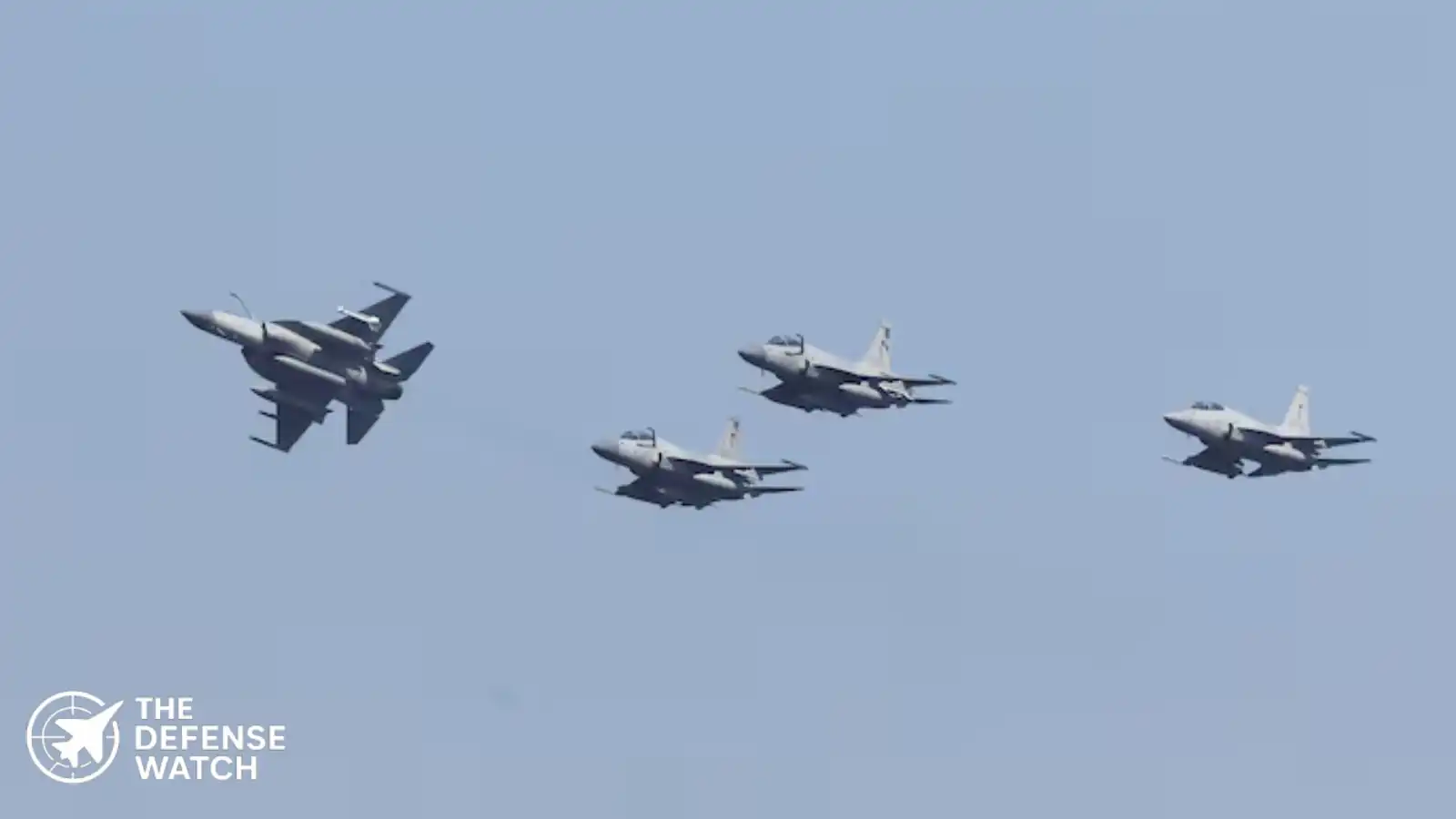
the Azerbaijan Air Force officially inducted its first batch of the JF‑17 Block III multirole fighters, acquired from Pakistan Aeronautical Complex (PAC) in partnership with Chengdu Aircraft Corporation. The induction occurred during Azerbaijan’s Victory Day parade in Baku, where several of the jets performed a fly-over, symbolizing their entry into service.
Background
The JF-17 Thunder program is a collaborative effort between Pakistan and China to develop a lightweight, cost-effective, multirole fighter. The Block III variant represents a significant upgrade over earlier versions, featuring an active electronically scanned array (AESA) radar, enhanced avionics, improved maneuverability and extended mission range. Azerbaijan’s interest in modernizing its air-force has been well documented, as the country seeks to replace older Soviet-era platforms with more capable systems.
Details of the Induction
According to publicly available reports, Azerbaijan’s deal with Pakistan was initially announced in February 2024 for around US $1.6 billion, covering an unspecified number of JF-17 Block III aircraft plus training and support. That agreement has reportedly been expanded significantly, with some sources citing a contract covering up to 40 aircraft at a value of around US $4.6 billion. Deliveries of the first jets to Azerbaijan began in September 2024, and the formal induction in November 2025 marks their entry into operational service.
Azerbaijan displayed at least five of the newly acquired fighters during the parade. International defense observers note that this represents a direct shift in Baku’s procurement strategy — moving away from legacy Russian and Soviet platforms and towards a lighter, more flexible fighter which can integrate with drone-enabled warfare and networked combat scenarios.
The JF-17 Block III is understood to deliver a combat radius of over 900 km (internal fuel) and extendable to beyond 1 700 km with drop tanks, powered by a Klimov RD-93MA engine and equipped with the KLJ-7A AESA radar among other enhancements. According to one defense-industry commentary, the unit cost is estimated at US $25-30 million, which positions it favourably against other modern fighters in terms of affordability.
Commenting on the move, defense analysts highlight that the induction fulfils both operational and strategic objectives: upgrading capability and signaling greater procurement independence from traditional suppliers. For Azerbaijan, the decision to adopt a Pakistan-China co-developed platform may reflect a growing strategic alignment and a desire to diversify supply chains.
JF-17 Thunder Fighter Jet- Full Specifications
- Generation: 4.5th
- Maximum Speed: Mach 1.8
- No. of Engines: 1
- Radar Range: ~170 km (~105 miles) (AESA)
Strategic Implications
From a policy perspective, the induction of the JF-17 Block III impacts several domains:
- Regional balance of air-power – Azerbaijan’s acquisition may prompt neighbouring states to revisit their own air-force modernisation and procurement strategies.
- Defence procurement diversification – By sourcing fighters from Pakistan/China, Azerbaijan signals a departure from sole reliance on Western or Russian systems.
- Industrial cooperation and export signaling – For Pakistan and its aviation-industry partner, the deal demonstrates export viability for the JF-17 program.
- Operational shift in doctrine – The capability to integrate modern missiles, networked sensors and manned-unmanned teaming suggests that Azerbaijan is preparing for future high-tempo air operations.
While official details about exact numbers and delivery schedules remain limited, the public parade and statements confirm operational entry into service. Analysts will monitor how quickly Azerbaijan transitions these jets into frontline squadrons, the nature of munitions integration, and the training pipeline for aircrews.
What’s Next?
Looking ahead, key questions include:
- How rapidly will Azerbaijan field the full complement of JF-17 Block III fighters and transition them into operational squadrons?
- What armaments and sensor packages will accompany the jets in Azerbaijani service?
- How will this procurement affect Azerbaijan’s existing fleet of Soviet-era MiG and Su aircraft, and what decisions will be taken regarding those legacy platforms?
- Will this move stimulate further defence-industrial cooperation among Pakistan, China and Azerbaijan (or even Turkey) in the South-Caucasus theatre?
- How will regional actors respond—particularly neighbouring Armenia and its air-force partnerships?
In summary, the induction of the JF-17 Block III into the Azerbaijan Air Force marks a significant milestone in the country’s air-power modernization. It delivers a cost-effective, modern multirole fighter and signals a strategic recalibration of procurement partnerships — with implications for regional military balance and defense-industrial dynamics.