- Home
- Catalog
- Fighter Jets
- MIG-31 Fighter Jet
MIG-31 Fighter Jet
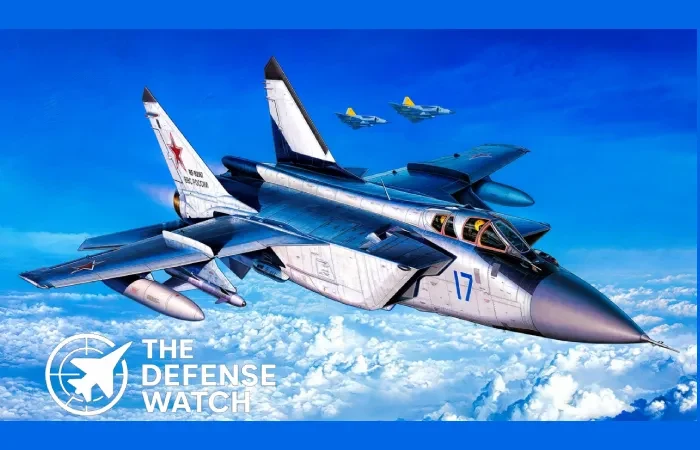
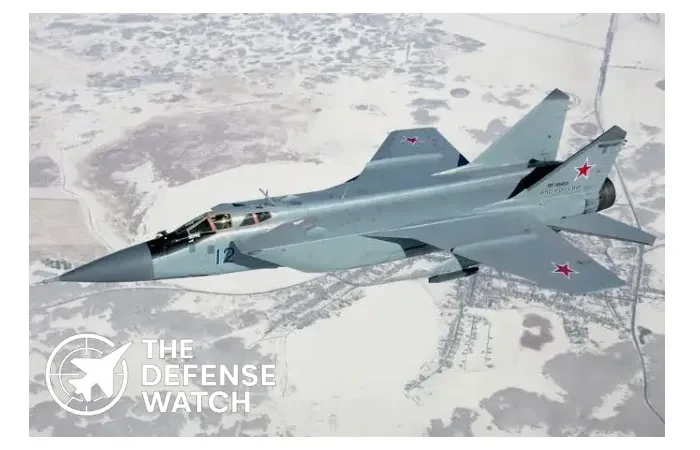
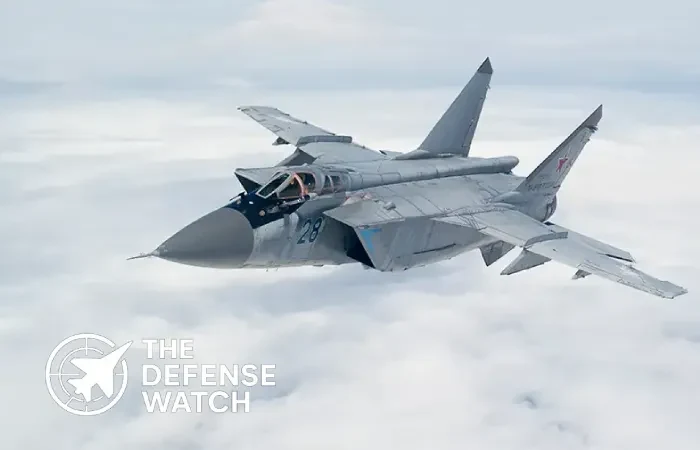
Full Specifications
General Information
| Name | MiG‑31 Foxhound |
| Manufacturer | Mikoyan Design Bureau |
| Country of Origin | Soviet Union (Russia) |
| Type / Role | Supersonic long-range interceptor |
| Generation | 4th / 4++ interceptor |
| Status | In service (Russia) |
| First Flight | 1975 (prototype) |
| Introduction / In Service Since | 1981 |
| Number Built | ~500+ airframes |
| Operators | Russia, Kazakhstan (limited) |
Dimensions & Structure
| Length | 22.67 m |
| Wingspan | 13.46 m |
| Height | 6.15 m |
| Wing Area | 6.15 m |
| Empty Weight | 21,820 kg |
| Maximum Takeoff Weight (MTOW) | 46,200 kg |
| Internal Weapons Bay | None |
| External Hardpoints | Up to 8 |
Performance
| Maximum Speed | ~Mach 2.83 |
| Range | ~3,000 km |
| Combat Radius | 720–1,450 km |
| Service Ceiling | ~25,000 m |
| Rate of Climb | ~288 m/s |
| Thrust-to-Weight Ratio | ~0.85 |
| G Limits | Up to 5 g |
Powerplant
| Engine Type | Soloviev D-30F6 turbofan |
| No. of Engines | 2 |
| Thrust (each) | ~152 kN (with afterburner) |
| Thrust Vectoring | None |
| Fuel Capacity | ~16,130 kg internal |
Armament
| Gun | 1 × GSh‑6‑23 23 mm rotary cannon (800 rounds) |
| Missiles (Air-to-Air) | 4 × R‑33 (AA‑9 “Amos”), upgraded variants carry R‑37M |
| Missiles (Air-to-Ground) | Limited / optional (MiG‑31K variant can carry Kinzhal) |
| Bombs | Rare / not primary role |
| Hardpoints | Up to 8 external pylons |
| Payload Capacity | ~3,000 kg external |
Avionics & Systems
| Radar | Zaslon‑A / M / AM PESA |
| Radar Range | ~200–400 km (upgraded versions) |
| Electronic Warfare (EW) System | RWR, IRST, datalinks |
| Targeting System | Track-while-scan, multi-target |
| Helmet Display | Standard instrumentation |
| Navigation | Inertial, radio navigation |
| Autopilot / AI Assistance | Basic autopilot |
| Communication | Secure datalink networked flights |
Stealth & Technology
| Radar Cross Section (RCS) | Large / non-stealth |
| Stealth Features | None |
| Infrared Signature Reduction | Minimal |
| Sensor Fusion | Basic, modernized variants improved |
| Networking Capabilities | Yes, via datalink |
Variants
| Special Export Versions | - |
Operational History
| Major Conflicts / Deployments | Cold War air‑defence patrols in Arctic & Far East; more recently deployed in Ukraine theatre and border incursions (Zona Militar) |
| Notable Operators | Russian Aerospace Forces (VKS) primarily; smaller numbers with Kazakhstan |
| Combat Proven? | Not widely reported in air‑to‑air combat, but remains a strategic asset and involved in high‑alert missions |
| Mission Types | High‑altitude interception, cruise missile defense, long‑range patrol, “mini‑AWACS” support |
Cost & Program
| Unit Cost | Not publicly disclosed for recent blocks (US$ terms) |
| Development Cost | Soviet era, undisclosed |
| Program Name | MiG‑31 Foxhound interceptor program |
| Funding Countries | Soviet Union / Russia |
Additional Information
| Upgrades Planned | Continued modernization of remaining airframes; upgrade to BM/BSM standard; potential replacement programme → MiG‑41 (future) (Armijai) |
| Future Replacement | MiG‑41 (in planning) as next‑generation high‑altitude interceptor |
| Export Restrictions | Very limited export; export version MiG‑31E offered but minimal foreign uptake (Defense Magazine) |
| Notable Achievements | First fighter to incorporate a PESA radar; ability to patrol remote air‑space and serve as network node |
| Competitors | Western interceptors/air‑defense fighters – e.g., F‑14 Tomcat (retired), future high‑altitude intercept designs |
PROS
- Exceptional high‑altitude speed and climb performance for area interception.
- Long‑range radar (Zaslon series) enabling beyond‑visual‑range detection.
- Two‑seat crew architecture with dedicated weapons systems operator.
- Integrated datalink/networking capability for coordinated patrols.
- Adaptable to carry new missiles/hypersonic weapons in newer variants.
CONS
- Limited manoeuvrability (design emphasises speed over dog‑fight agility).
- High fuel consumption and operational cost relative to more modern fighters.
- Aging airframes and finite production numbers constrain long‑term replaceability.
- Reliant on older-generation avionics in many units, with upgrade backlog.
- Export restrictions and ecosystem limited outside Russia (reducing interoperability).
MiG-31 Foxhound Interceptor Jet
The MiG‑31 Foxhound commands attention as one of the few supersonic interceptors still in frontline use, designed during the Cold War to seize control of vast air‑spaces and deny strategic bombers and cruise missiles at distance. Developed by the Mikoyan Design Bureau in the Soviet Union, this two‑seat, twin‑engine platform entered service in the early 1980s and remains relevant for U.S. defense‑watchers analyzing high‑end Russian aviation capabilities.
Manufacturer & Origin
Manufactured by Mikoyan in the Soviet Union (now Russia), the MiG‑31 was conceived as the evolution of the MiG‑25 “Foxbat” but with greater endurance, avionics sophistication and a true area‑defense interceptor role.
Purpose & Major Capabilities
Its primary mission: high‑speed interception of strategic bombers, cruise missiles and other intruders in remote air‑spaces where ground‑radar coverage is thin. The MIG-31 Fighter Jet uses its PESA radar — the Zaslon series — to detect targets at very long range, share data with other aircraft via secure datalinks and guide long‑range air‑to‑air missiles. With a top speed around Mach 2.83 at high altitude and Mach 1.23 at low levels, the platform prioritizes speed and reach over agile dog‑fighting.
Range, Speed, Armament & Technology
Powered by two Soloviev D‑30F6 afterburning turbofans, the MiG‑31 can undertake long‑patrol missions across hundreds of kilometres. Its radar enables tracking up to 24 targets and engaging up to eight simultaneously in modernized variants. Armament includes the long‑range R‑33 (AA‑9 “Amos”) missiles designed for defending against large, fast targets at ranges up to 120‑160 km. The aircraft also carries a 23 mm GSh‑6‑23 cannon and multiple external hardpoints for additional missiles or fuel.
Operational Use
For a U.S.‑focused audience, the MIG-31 Fighter Jet represents a strategic wake‑up call: an interceptor capable of patrolling across Russia’s vast territory, launching beyond‑visual‑range engagements, network‑linking with other aircraft and serving as a “mini‑AWACS” within its formation. Its sustained in‑service life and upgrade programs (MiG‑31BM/BSM) underline Russia’s emphasis on area‑denial and high‑altitude interception.
(FAQs) – MIG-31 Fighter Jet
The MiG‑31 and F‑22 serve different roles. The MiG‑31 is a high-speed, long-range interceptor designed to patrol vast territories and engage multiple high-altitude targets, while the F‑22 Raptor is a stealth air superiority fighter optimized for agility, dogfighting, and low-observable penetration. In terms of speed and radar range, MiG‑31 excels; for stealth, maneuverability, and multi-role combat, F‑22 outperforms.
Russia operates approximately 115–120 MiG‑31s in various configurations, including modernized MiG‑31BM and MiG‑31K variants. Older models continue to be upgraded under modernization programs.
Yes. The MiG‑31 is highly effective in its interceptor role. Its strengths include extremely high speed (Mach 2.83+), long-range radar (Zaslon series), ability to engage multiple targets simultaneously, and long operational range. However, it is less maneuverable in close-range dogfights compared to modern air superiority fighters.
The MiG‑31 and F‑15 are comparable in some aspects but serve slightly different purposes. The F‑15 is versatile with excellent maneuverability and multi-role capability, while the MiG‑31 focuses on long-range interception and high-altitude patrol. Against strategic bombers or cruise missiles at extreme ranges, MiG‑31 holds an advantage.
The MiG‑31 can reach a top speed of approximately Mach 2.83 at high altitudes. At lower altitudes, speed decreases to around Mach 1.23 due to aerodynamic and engine limitations.
Get real time update about this post category directly on your device, subscribe now.
Reviews
Disclaimer Note
The information provided on TheDefenseWatch.com is for general informational purposes only. While we strive to ensure the accuracy, completeness, and timeliness of our content regarding defense and aerospace products, technologies, and specifications, we cannot guarantee that all information is 100% accurate or up-to-date due to the evolving nature of military technology and classified data.TheDefenseWatch.com does not warrant the reliability, suitability, or availability of the information for any specific purpose. Users are advised to consult official sources, such as manufacturers, government publications, or defense agencies, for precise and verified data before making decisions based on our content.We are not affiliated with any defense manufacturers, governments, or military organizations mentioned. Opinions, reviews, and ratings reflect expert analysis but are subjective and should not be considered endorsements. TheDefenseWatch.com is not responsible for any errors, omissions, or consequences arising from the use of this website’s content.External links are provided for convenience and do not imply endorsement. TheDefenseWatch.com reserves the right to update or modify content without prior notice. By using this website, you agree to our Privacy & Cookies Policy.



New Arrivals


Popular Comparisons
-
 SIG XM7 Rifle vs M4: Key Differences and Performance Comparison
View Comparison →
SIG XM7 Rifle vs M4: Key Differences and Performance Comparison
View Comparison → -
Eurofighter Typhoon vs Rafale vs F-35: Fighter Jet Comparison
View Comparison →
-
J-20 vs F-22: Stealth Fighter Showdown Explained
View Comparison →
-
F-14 Tomcat vs Su-57: Can a Legend Challenge Russia’s Stealth Fighter?
View Comparison →
-
Su-35 vs Su-57: Russia’s Top Fighter Jets Compared
View Comparison →
-
Eurofighter Typhoon vs Su-57: Ultimate Fighter Jet Comparison
View Comparison →
-
Rafale vs Su-57: 4.5 Gen vs 5th Gen Fighter Jet Comparison
View Comparison →
-
Su-57 vs F-16 Fighting Falcon: Stealth vs Speed
View Comparison →
-
China vs Russia: J-20 Mighty Dragon vs Su-57 Felon Comparison
View Comparison →
-
Su-57 Felon vs F-22 Raptor: Stealth Air Superiority Face-Off
View Comparison →


- Pentagon Considers Second B-21 Raider Production Line To Accelerate U.S. Stealth Bomber Expansion

- France Unveils 78,000-Ton Nuclear Aircraft Carrier France Libre With 40-Aircraft Capacity
- L3Harris Wins $77.8M U.S. Navy Contract for Kineto Tracking Mount Sustainment
- US Navy Awards $15.38B Columbia-Class Submarine Contract To Strengthen Nuclear Deterrent
- China Surges Production Capacity For J-20 And J-35 Stealth Fighters As Beijing Expands Fifth-Generation Fleet
- Netanyahu Announces Elimination Of Senior Iranian Figures In Air Campaign
- US Bombers Avoid European Airspace On Iran Bombing Runs In Strategic Route Shift
- Japan’s EC-2 Electronic Warfare Jet Completes First Flight, Expanding Standoff Jamming Capabilities
- NASA’s X-59 Quiet Supersonic Jet Gears Up for Second Flight — A Giant Leap Toward Silent Boom AviationNASA X-59 Second Flight: Supersonic Aviation Reborn
- US Weapons Shipments to Taiwan Unaffected by Iran War, Officials Confirm