- Home
- Catalog
- Bombers & Strategic Aircraft
- EC-130H Compass Call
EC-130H Compass Call
Full Specifications
1. General Information
| Name | EC-130H Compass Call |
| Manufacturer | Lockheed Martin, L3Harris |
| Country of Origin | United States |
| Introduction / In Service Since | Early 1980s |
| Status | Limited service |
| Category | Electronic Warfare Aircraft |
| Crew | 9 to 13 |
| Unit Cost | Not publicly disclosed |
2. Dimensions & Structure
| Length | 97 ft |
| Wingspan | 132 ft |
| Height | 38 ft |
| Wing Area | 1,745 sq ft |
| Empty Weight | ~70,000 lb |
| Maximum Takeoff Weight (MTOW) | ~155,000 lb |
3. Performance
| Maximum Speed | ~300 knots |
| Range | 2,000+ miles |
| Combat Radius | Classified |
| Service Ceiling | ~33,000 ft |
| Rate of Climb | ~1,400 ft per minute |
4. Powerplant
| Engine Type | 4 turboprop engines |
| Thrust (per engine) | ~4,600 shp |
| Total Thrust | ~18,400 shp |
5. Payload & Armament
| Internal Payload Capacity | Classified |
| Weapons Bay | None |
| Compatible Weapons | None |
| Hardpoints | None |
6. Avionics & Systems
| Radar System | Navigation radar |
| Navigation | INS, GPS |
| Electronic Warfare (EW) | Communications and radar jamming suite |
| Stealth Features | None |
7. Operational History
| Primary Operator | United States Air Force |
| Conflict Usage | Gulf War, Iraq, Afghanistan |
| Notable Missions | Enemy communications disruption |
8. Additional Information
| Variants | EC-130H Block upgrades |
| Successor / Future Replacement | EC-37B Compass Call |
| Notable Features | Wide spectrum electronic attack |
| Estimated Operational Life | Mid 2020s |
PROS
- Powerful airborne electronic attack capability
- Proven combat record in multiple conflicts
- Long endurance and mission persistence
- Integrates well with joint and allied forces
- Based on reliable C-130 airframe
CONS
- Aging platform with high maintenance demands
- Limited survivability in contested airspace
- No kinetic self-defense weapons
- Large crew requirement
- Being phased out for newer systems
EC-130H Compass Call Electronic Attack Aircraft
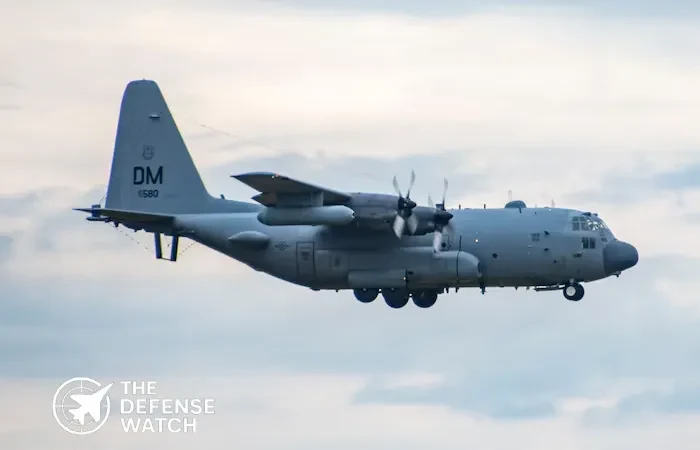
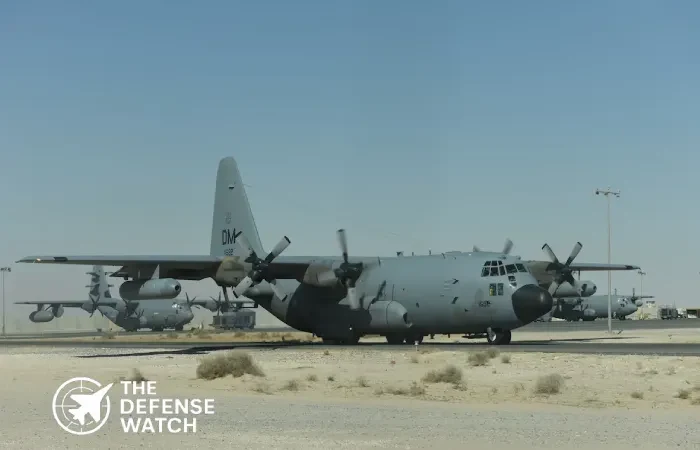
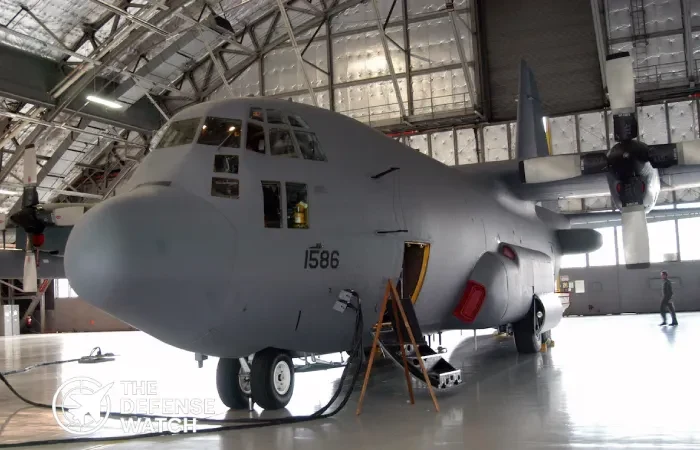
The EC-130H Compass Call is one of the U.S. Air Force’s most specialized electronic warfare aircraft, designed to disrupt and disable enemy command, control, and communications systems. Based on the proven C-130 Hercules airframe, this aircraft plays a critical role in modern joint and coalition operations by targeting adversary electronic networks rather than physical targets.
Developed by Lockheed Martin and modified with advanced electronic attack systems by L3Harris, the EC-130H entered service in the early 1980s. Its primary mission is to conduct airborne electronic attack against enemy communications, radar, navigation, and data links. By degrading an opponent’s ability to coordinate forces, the Compass Call provides a major advantage to U.S. and allied air, ground, and naval units.
The aircraft operates at subsonic speeds and relies on endurance rather than speed. It carries a large mission crew that manages complex jamming and signal disruption systems during long-duration sorties. The EC-130H does not carry traditional weapons. Instead, its payload consists of powerful transmitters, antennas, and signal processors capable of targeting a wide range of frequencies.
Compass Call aircraft have been used extensively in conflicts including the Gulf War, operations in Iraq and Afghanistan, and missions against violent extremist networks. Its ability to interrupt enemy communications in real time has made it a key enabler for strike aircraft, special operations forces, and ground commanders.
Although highly effective, the EC-130H is reaching the end of its service life. The U.S. Air Force is transitioning its mission to the EC-37B Compass Call, which offers improved range, survivability, and modern systems. Until full replacement, the EC-130H remains a vital asset in U.S. electronic warfare operations.
EC-130H Compass Call Price
The EC-130H Compass Call does not have a standard unit sale price due to its highly classified systems and mission-specific modifications. Estimates place the aircraft’s conversion and system cost in the range of several hundred million US dollars per platform, including long-term support and upgrades.
Get real time update about this post category directly on your device, subscribe now.
Reviews
Disclaimer Note
The information provided on TheDefenseWatch.com is for general informational purposes only. While we strive to ensure the accuracy, completeness, and timeliness of our content regarding defense and aerospace products, technologies, and specifications, we cannot guarantee that all information is 100% accurate or up-to-date due to the evolving nature of military technology and classified data.TheDefenseWatch.com does not warrant the reliability, suitability, or availability of the information for any specific purpose. Users are advised to consult official sources, such as manufacturers, government publications, or defense agencies, for precise and verified data before making decisions based on our content.We are not affiliated with any defense manufacturers, governments, or military organizations mentioned. Opinions, reviews, and ratings reflect expert analysis but are subjective and should not be considered endorsements. TheDefenseWatch.com is not responsible for any errors, omissions, or consequences arising from the use of this website’s content.External links are provided for convenience and do not imply endorsement. TheDefenseWatch.com reserves the right to update or modify content without prior notice. By using this website, you agree to our Privacy & Cookies Policy.

New Arrivals



Popular Comparisons
-
 SIG XM7 Rifle vs M4: Key Differences and Performance Comparison
View Comparison →
SIG XM7 Rifle vs M4: Key Differences and Performance Comparison
View Comparison → -
Eurofighter Typhoon vs Rafale vs F-35: Fighter Jet Comparison
View Comparison →
-
J-20 vs F-22: Stealth Fighter Showdown Explained
View Comparison →
-
F-14 Tomcat vs Su-57: Can a Legend Challenge Russia’s Stealth Fighter?
View Comparison →
-
Su-35 vs Su-57: Russia’s Top Fighter Jets Compared
View Comparison →
-
Eurofighter Typhoon vs Su-57: Ultimate Fighter Jet Comparison
View Comparison →
-
Rafale vs Su-57: 4.5 Gen vs 5th Gen Fighter Jet Comparison
View Comparison →
-
Su-57 vs F-16 Fighting Falcon: Stealth vs Speed
View Comparison →
-
China vs Russia: J-20 Mighty Dragon vs Su-57 Felon Comparison
View Comparison →
-
Su-57 Felon vs F-22 Raptor: Stealth Air Superiority Face-Off
View Comparison →


- UK Nightfall Procurement Plans Face Government Silence Amid Air Defense Debate

- NASA Completes First Flight Of Laminar Flow Scaled Wing Design In Aerodynamic Breakthrough
- Singapore Orders Three G550 Maritime Surveillance Aircraft To Boost Early Warning Network
- Polish Defense Industry Backs EU SAFE Mechanism To Boost National Production And Exports
- How StormBreaker Integration Expands Super Hornet Precision Strike Options for The U.S. Navy
- Former US F-35 Pilot Arrested for Allegedly Training Chinese Air Force
- NATO Intelligence From Germany: SWARM Biotactics Cybernetic Insect Swarms Enter Operational Use
- UK And Norway Sign Naval Helicopter Pact To Deepen Maritime Defense Cooperation
- Israel MOD Signs $42 Million Merkava Tank Transmission Deal With Ashot Ashkelon
- China’s New Aircraft Carrier Faces Persistent Design Flaw, Raising Questions About PLAN Power Projection