
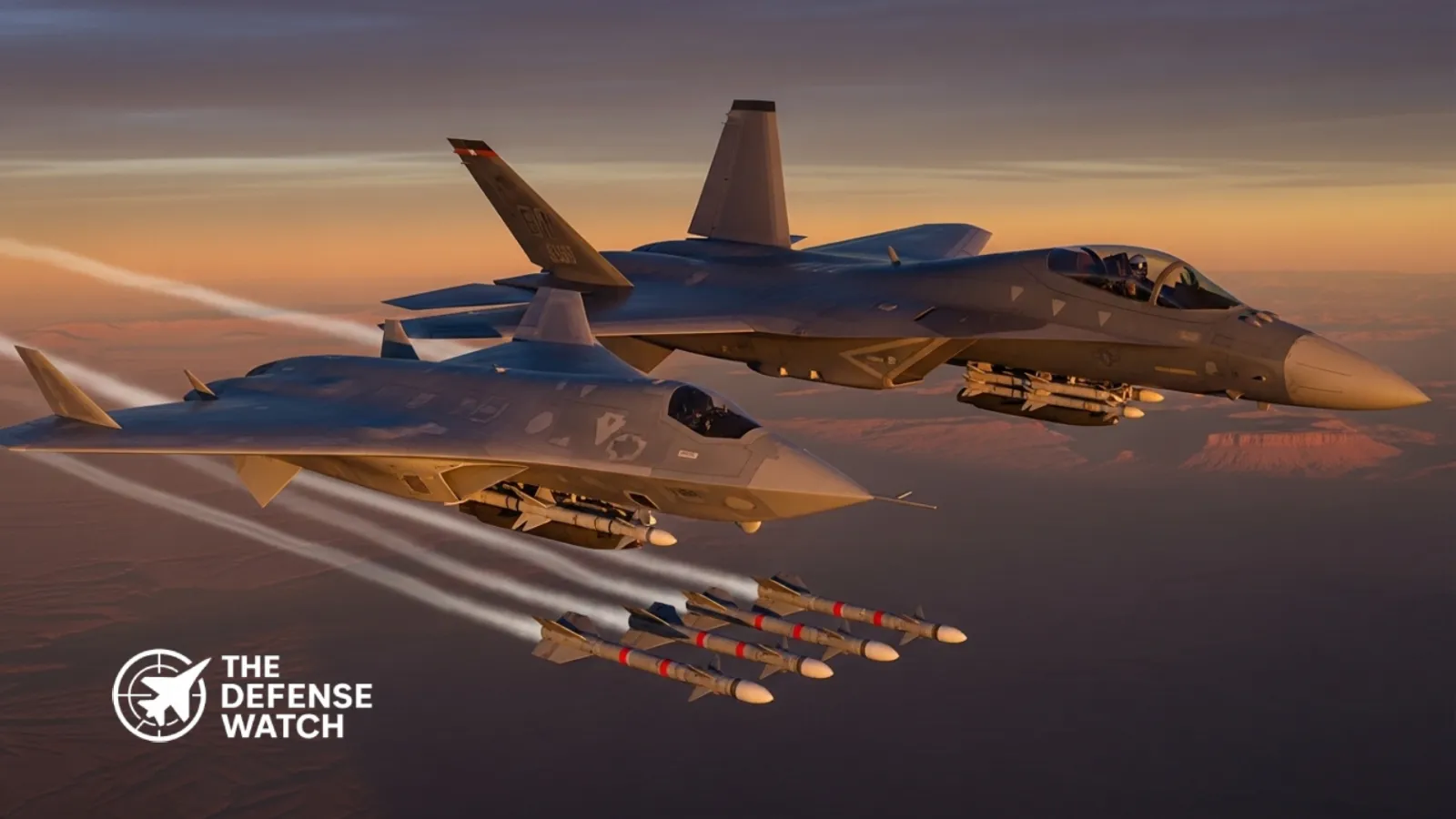
- ► The U.S. Air Force is advancing the Collaborative Combat Aircraft program through a phased weapons integration strategy.
- ► CCA platforms are designed to operate alongside crewed fighters under the Next Generation Air Dominance framework.
- ► Initial integration focuses on existing U.S. munitions to reduce risk and accelerate operational capability.
- ► The effort supports broader Air Force modernization and distributed combat operations.
- ► Officials emphasize deliberate testing and integration to ensure safety, reliability, and combat effectiveness.
USAF Collaborative Combat Aircraft Program Moves Into Weapons Integration Phase
The Collaborative Combat Aircraft program is progressing through a deliberate weapons integration process as the U.S. Air Force refines how autonomous platforms will operate in future high-end conflicts.
According to the United States Air Force, the effort focuses on carefully integrating proven munitions onto emerging uncrewed aircraft designed to fly alongside crewed fighters. The goal is to reduce technical risk while accelerating operational capability.
The Collaborative Combat Aircraft program forms a central pillar of the Next Generation Air Dominance architecture. Under this concept, autonomous aircraft will support crewed platforms by carrying additional weapons, conducting sensing missions, and extending operational reach.
A Phased and Risk-Managed Approach
Air Force officials describe the weapons integration strategy as deliberate and incremental. Instead of developing entirely new weapons in parallel with new aircraft, the service is prioritizing compatibility with existing, combat-proven munitions already in the inventory.
This approach serves several purposes.
First, it reduces development timelines. Integrating established weapons avoids the long certification cycles associated with new munitions. Second, it supports logistical continuity across the force. Third, it strengthens interoperability within joint and allied operations.
From a force design perspective, the Collaborative Combat Aircraft program is intended to create mass at a lower cost than traditional fighters. By distributing weapons across multiple autonomous platforms, commanders can complicate enemy targeting and increase survivability in contested airspace.
Supporting NGAD and Future Air Dominance
The Collaborative Combat Aircraft program is closely aligned with NGAD objectives. While NGAD centers on a sixth-generation crewed fighter, CCA platforms provide scalable combat power around that core aircraft.
In practical terms, autonomous aircraft could carry additional air-to-air missiles, electronic warfare payloads, or intelligence, surveillance, and reconnaissance systems. This reduces the burden on crewed aircraft and enables greater tactical flexibility.
The Air Force has consistently emphasized that CCAs are not simply drones in the traditional sense. Instead, they are designed as collaborative systems that integrate into a broader combat network. That network includes advanced data links, distributed sensors, and secure communications that allow real-time coordination.
The deliberate weapons integration effort reflects lessons learned from past acquisition programs. Rushing integration can create cascading delays and cost overruns. A phased plan, by contrast, allows the service to validate software, hardware interfaces, and safety protocols step by step.
Operational Implications and Strategic Context
The Collaborative Combat Aircraft program arrives at a time when the United States faces pacing challenges in the Indo-Pacific and other theaters. Potential adversaries continue to expand integrated air defense systems, long-range missiles, and counter-air capabilities.
In that environment, survivability and distributed operations become critical.
Autonomous aircraft operating in coordination with crewed fighters can increase tactical options. They can absorb risk in high-threat areas, extend sensor coverage, and expand weapons capacity without placing additional pilots in harm’s way.
From an operational standpoint, integrating weapons early and methodically ensures these platforms are not limited to sensing roles alone. Arming CCAs provides credible combat utility from the outset.
The Air Force has underscored that testing remains central to the effort. Weapons separation trials, flight envelope validation, and software verification are essential before operational deployment. Safety, reliability, and predictable performance remain non-negotiable requirements.
Industrial and Modernization Impact
The Collaborative Combat Aircraft program also signals a shift in how the Air Force approaches acquisition. Modular architectures and open systems design are intended to allow faster upgrades over time.
By aligning weapons integration with existing inventories, the service reduces supply chain friction and enhances sustainment efficiency. This matters as the Air Force balances modernization priorities across fighters, bombers, tankers, and space-based assets.
As development continues, the deliberate weapons integration strategy positions the Collaborative Combat Aircraft program as a credible component of future U.S. airpower.
Rather than pursuing rapid but risky fielding, the Air Force is prioritizing structured integration, operational validation, and scalable growth. That methodical path may prove decisive as the service works to maintain air superiority in increasingly contested environments.
Get real time update about this post category directly on your device, subscribe now.
