- Home
- Catalog
- Radar Systems
- SPY-7 AESA Radar System
SPY-7 AESA Radar System
Full Specifications
1. General Information
| Name / Designation | SPY-7 |
| Manufacturer | Lockheed Martin |
| Country of Origin | United States |
| Type / Role | Long range air and missile defense radar |
| Operational Domain | Land and Sea |
| Status | In production and deployment |
2. Technical Specifications
| Frequency Band | S band |
| Antenna Type | AESA |
| Antenna Aperture / Size | Scalable modular array panels |
| Power Output | High power GaN transmit modules |
| Detection Range | 1,000 to 2,000+ km depending on target |
| Tracking Range | Long range, missile defense class |
| Target Tracking Capacity | 100+ simultaneous tracks |
| Elevation Coverage | High angle ballistic tracking |
| Azimuth Coverage | 360 degrees |
| Beam Steering | Electronic beam steering |
| Pulse Repetition Frequency (PRF) | Classified |
| Resolution | High discrimination capability |
| Update Rate | Rapid multi target refresh |
| Clutter Rejection / ECCM | Advanced ECCM and interference rejection |
3. Functional Capabilities
| Primary Functions | Search, track, discrimination, missile guidance |
| Target Types | Ballistic missiles, cruise missiles, aircraft, UAVs |
| Integration / Networking | Aegis Combat System compatible |
| IFF Capability | Integrated IFF support |
| Data Link / Networking | Secure military data networks |
| Weather & Terrain Resistance | All weather operation |
| Mobility / Mounting | Fixed site or ship mounted |
4. Physical & Operational Characteristics
| Dimensions | Modular array dependent on configuration |
| Weight | Multi ton installation |
| Power Requirement | High power infrastructure |
| Cooling System | Advanced liquid and air cooling |
| Operating Temperature Range | Military standard |
| Deployment Platform | Aegis Ashore, naval vessels |
| Crew Requirement | Operated via integrated combat system |
5. Software & Processing
| Signal Processor Type | Digital beamforming processor |
| Processing Speed | High performance real time processing |
| AI / Automation Features | Automated threat discrimination |
| Data Output / Interface | Integrated combat system interface |
| Software Upgradeability | Modular and upgradeable |
6. Operational History
| Year Introduced | 2020s |
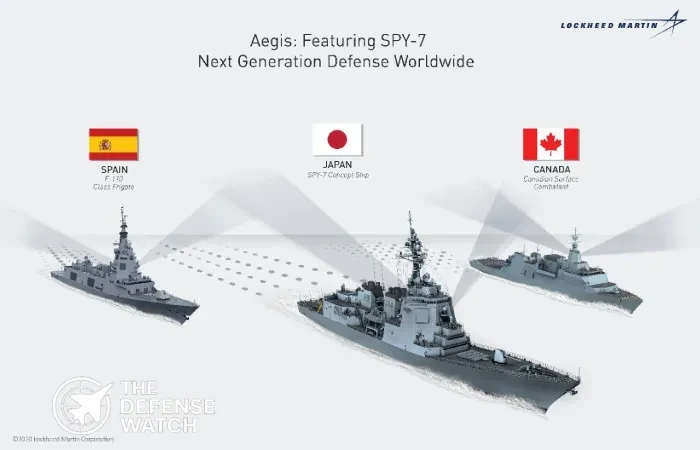
| Users / Operators | United States, Japan, Spain, Canada |
| Notable Deployments | Aegis Ashore installations |
| Successor / Predecessor | Successor to earlier SPY-1 variants |
7. Export / Compliance Data
| Export Availability | Available to allied nations |
| ITAR / MTCR Status | ITAR controlled |
| Cost Estimate | Hundreds of millions USD per site |
PROS
- Long range ballistic missile detection
- AESA with Gallium Nitride modules
- High target tracking capacity
- Strong electronic counter countermeasures
- Compatible with Aegis systems
CONS
- High procurement cost
- Large fixed installation footprint
- Complex integration requirements
- Significant power demand
- Export controlled technology
AN/SPY-7(V)1 AESA Radar System
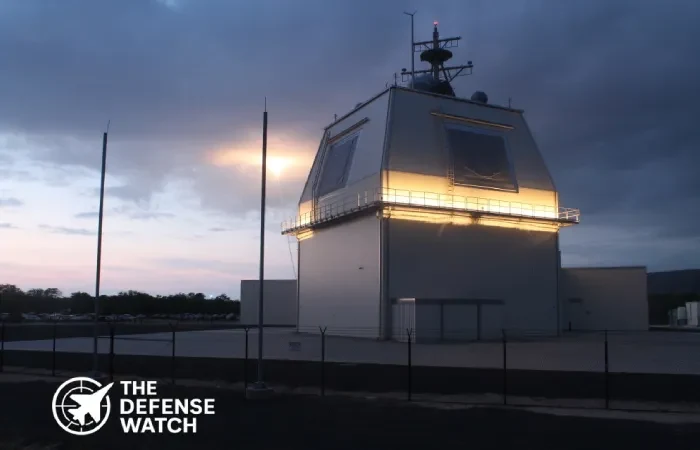
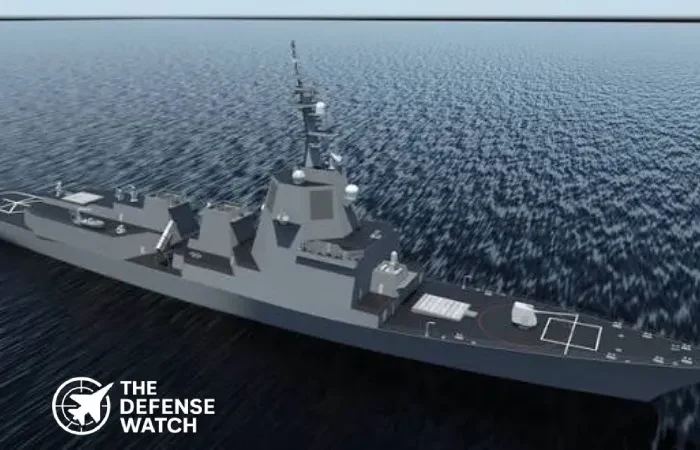
The SPY-7 radar is a next generation long range air and missile defense system designed to detect, track, and discriminate advanced aerial threats. Built to counter ballistic missiles, cruise missiles, hypersonic weapons, and aircraft, SPY-7 brings scalable active electronically scanned array technology to land and sea based platforms.
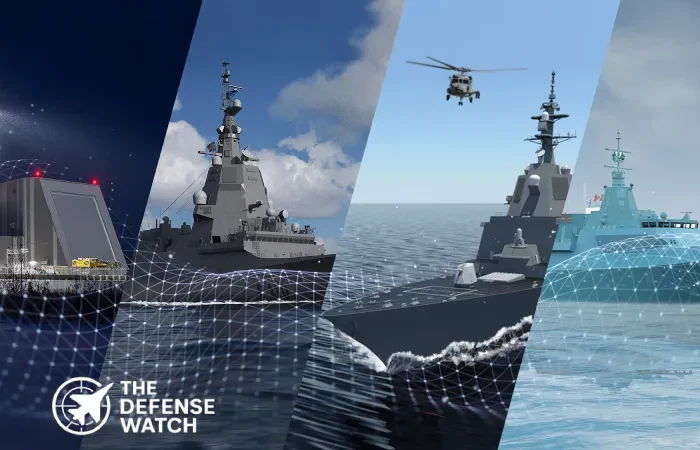
Developed by Lockheed Martin, SPY-7 is derived from the company advanced solid state radar family and supports the Aegis Combat System architecture. It is selected by the United States and allied nations for ballistic missile defense and integrated air and missile defense missions.
Manufacturer and Origin
SPY-7 is manufactured by Lockheed Martin in the United States. It is part of the company radar portfolio supporting Aegis Ashore installations and future naval combatants.
Speed and Range
As a radar system, SPY-7 does not have speed in the traditional sense. Instead, it delivers high power S band detection with a range exceeding 2,000 kilometers for certain ballistic missile threats. It can simultaneously track hundreds of targets, offering persistent surveillance across 360 degrees in azimuth and high elevation coverage.
Technology and Capabilities
AN/SPY-7 uses Gallium Nitride based transmit receive modules. This improves sensitivity, power efficiency, and resistance to electronic warfare. The radar supports simultaneous search, track, and missile guidance functions. It integrates with Standard Missile interceptors and advanced command networks.
Cost
Exact unit cost is not publicly disclosed. Estimates for full SPY-7 installations within missile defense programs range in the hundreds of millions of dollars depending on configuration and infrastructure.
FAQs
It operates primarily in the S band.
Yes, it is designed for ballistic missile detection and tracking.
The United States, Japan, Spain, and Canada have selected variants of SPY-7.
Yes, it uses active electronically scanned array technology.
It is designed to detect and track advanced high speed threats, including hypersonic weapons.
Get real time update about this post category directly on your device, subscribe now.
Reviews
Disclaimer Note
The information provided on TheDefenseWatch.com is for general informational purposes only. While we strive to ensure the accuracy, completeness, and timeliness of our content regarding defense and aerospace products, technologies, and specifications, we cannot guarantee that all information is 100% accurate or up-to-date due to the evolving nature of military technology and classified data.TheDefenseWatch.com does not warrant the reliability, suitability, or availability of the information for any specific purpose. Users are advised to consult official sources, such as manufacturers, government publications, or defense agencies, for precise and verified data before making decisions based on our content.We are not affiliated with any defense manufacturers, governments, or military organizations mentioned. Opinions, reviews, and ratings reflect expert analysis but are subjective and should not be considered endorsements. TheDefenseWatch.com is not responsible for any errors, omissions, or consequences arising from the use of this website’s content.External links are provided for convenience and do not imply endorsement. TheDefenseWatch.com reserves the right to update or modify content without prior notice. By using this website, you agree to our Privacy & Cookies Policy.
New Arrivals



Popular Comparisons
-
 SIG XM7 Rifle vs M4: Key Differences and Performance Comparison
View Comparison →
SIG XM7 Rifle vs M4: Key Differences and Performance Comparison
View Comparison → -
Eurofighter Typhoon vs Rafale vs F-35: Fighter Jet Comparison
View Comparison →
-
J-20 vs F-22: Stealth Fighter Showdown Explained
View Comparison →
-
F-14 Tomcat vs Su-57: Can a Legend Challenge Russia’s Stealth Fighter?
View Comparison →
-
Su-35 vs Su-57: Russia’s Top Fighter Jets Compared
View Comparison →
-
Eurofighter Typhoon vs Su-57: Ultimate Fighter Jet Comparison
View Comparison →
-
Rafale vs Su-57: 4.5 Gen vs 5th Gen Fighter Jet Comparison
View Comparison →
-
Su-57 vs F-16 Fighting Falcon: Stealth vs Speed
View Comparison →
-
China vs Russia: J-20 Mighty Dragon vs Su-57 Felon Comparison
View Comparison →
-
Su-57 Felon vs F-22 Raptor: Stealth Air Superiority Face-Off
View Comparison →


- War Energy Departments Test Transportable Nuclear Power Reactor For Military Base Energy Security

- Patria NEMO 120mm Mortar System: Finland’s Fire-on-the-Move Solution Reshaping Global Indirect Fire Support
- India Approves 1.1 Billion Dollar S-400 Missile Procurement After 2025 Conflict
- Romania Demands 230 Million Lei From Otokar Over Armored Vehicle Project Delays
- Saudi Arabia Picks Leonardo C-27J For Maritime Patrol Fleet, Deliveries Start 2029
- Northrop Grumman Unveils VALEN AESA Radar, A Generational Leap In Sensing Technology
- German Air Force Receives First IRIS-T SLM Air Defense System In National Configuration
- US Navy Operates F-35C And EA-18G Aircraft From USS Abraham Lincoln In Red Sea
- Northrop Grumman And Thales In Belgium Expand Partnership To Support NATO And European Defense Programs
- US And Japan Activate SPY 7 Radar Manufacturing For Aegis System Equipped Vessels