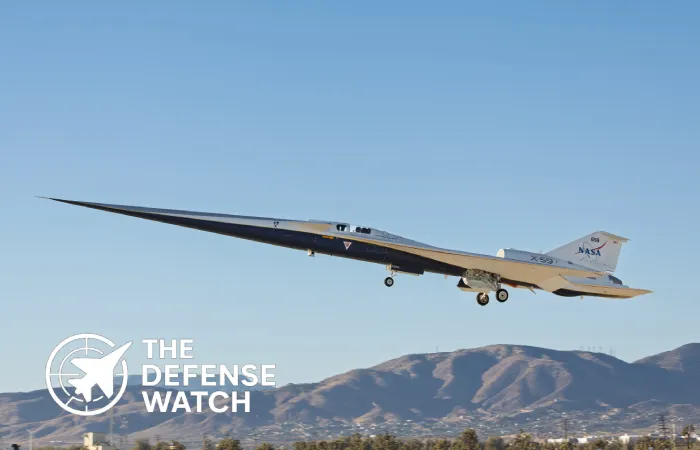
NASA X-59 Quiet Supersonic Demonstrator
The NASA X-59 Quiet Supersonic Demonstrator represents a major step forward in next-generation aviation technology. Developed under NASA’s Low-Boom Flight Demonstrator (LBFD) program and built by Lockheed Martin’s Skunk Works, the X-59 is designed to fly faster than sound—without the disruptive sonic booms that have long restricted supersonic travel over land.
Unveiled as part of NASA’s Quesst Mission, the X-59’s primary objective is to gather data on how communities respond to its uniquely quiet sonic signature, a sound closer to a gentle thump than a boom. This data will help regulators like the FAA and ICAO reconsider bans on supersonic flights over populated areas—paving the way for commercial supersonic travel.
Powered by a General Electric F414-GE-100 turbofan engine, the X-59 can cruise at approximately Mach 1.4 (1,490 km/h) at 55,000 feet. Its sleek 99.7-foot frame and narrow fuselage are optimized for acoustic shaping, ensuring pressure waves do not coalesce into loud booms. Instead, the sound is diffused, significantly lowering ground-level noise impact.
Unlike combat aircraft, the X-59 carries no weapons or payload; its mission is purely experimental. It uses advanced avionics and an external vision system that replaces a traditional cockpit window, giving pilots high-resolution forward visibility through cameras and displays.
NASA X-59 Quiet Supersonic Demonstrator Price in US
While the X-59 is not a commercial product, the total program cost is estimated at $247 million, including design, construction, and testing. If successful, it could spark a new era of quiet supersonic airliners and influence future U.S. aerospace design and commercial regulations.