DF-41 Dongfeng-41 — China’s Long-Range Nuclear ICBM
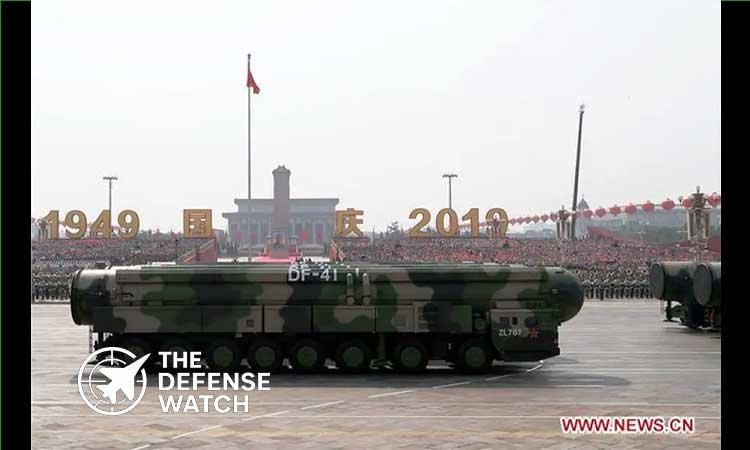
The DF-41 (Dongfeng-41) is China’s most powerful and advanced intercontinental ballistic missile (ICBM), designed to strengthen Beijing’s nuclear deterrence and second-strike capability. Developed by the China Academy of Launch Vehicle Technology (CALT) under the China Aerospace Science and Technology Corporation (CASC), it represents the peak of Chinese strategic missile engineering.
Design and Capabilities
The DF-41 is a solid-fueled, road-mobile ICBM, capable of delivering multiple independently targetable reentry vehicles (MIRVs). With a reported range exceeding 12,000–15,000 km, it can reach virtually any target across the globe, including the continental United States. This mobility and range combination provides China with a rapid-response, survivable deterrent against nuclear threats.
The missile employs an advanced inertial navigation system (INS) augmented by BeiDou satellite guidance, offering improved accuracy with a circular error probable (CEP) estimated under 100 meters. The DF-41 can carry up to 10 MIRVed nuclear warheads, each capable of striking separate targets, increasing both penetration capability and strategic flexibility.
Operationally, the DF-41 can be launched from road-mobile transport erector launchers (TELs), rail platforms, or silo-based systems, allowing for unpredictable deployment and enhanced survivability. The use of solid-fuel propulsion drastically reduces launch preparation time compared to older liquid-fueled systems like the DF-5.
With its combination of range, speed, and payload, the DF-41 forms a critical component of China’s nuclear triad, complementing submarine-launched and air-delivered systems under the People’s Liberation Army Rocket Force (PLARF).
DF-41 Dongfeng-41 Price in United States
While not commercially available, defense analysts estimate that the DF-41 program’s per-unit cost could exceed $20–25 million when factoring in production, mobility platforms, and command infrastructure.