- Home
- Catalog
- Military Satellites & Space Systems
- GPS III Navigation Satellite
GPS III Navigation Satellite

Full Specifications
1. General Information
| System Name | GPS III Navigation Satellite |
| Manufacturer | Lockheed Martin |
| Country of Origin | United States |
| Type / Role | Military and Civil Navigation Satellite |
| In Service | Yes |
| Year Introduced | 2018 |
| Unit Cost | USD 550–600 Million (Estimated) |
2. Performance & Capabilities
| Orbit Type | Medium Earth Orbit (MEO) |
| Operational Altitude | ~20,200 km |
| Operational Inclination | 55 degrees |
| Imaging / Sensor Type | L1, L2, L5, M Code |
| Resolution / Accuracy | Sub meter military accuracy |
| Revisit Time / Coverage | Global |
| Mission Duration | 15 years |
3. Payload & Sensor Specifications
| Primary Sensor | Navigation Signal Generator |
| Data Transmission | Encrypted navigation broadcast |
| Payload Weight | ~1,600 kg |
| Onboard Power | Solar arrays, approx 4 kW |
4. Guidance, Control & Communication
| Attitude Control System | Reaction wheels and thrusters |
| Orbit Control | Chemical propulsion |
| Communication Link | S Band and secure uplinks |
| Data Encryption | Military grade encryption |
| Telemetry & Command System | Secure Space Force ground network |
5. Launch & Deployment
| Launch Vehicle | Falcon 9 |
| Launch Site | Cape Canaveral Space Force Station |
| Deployment Orbit | Medium Earth Orbit |
| Launch Mass | ~3,880 kg |
| Deployment Method | Direct orbital insertion |
6. Operational & Command Use
| Primary Operators | United States Space Force |
| Global Coverage | Yes |
| Combat Proven | Yes |
| Typical Missions | Navigation, timing, weapon guidance |
| Notable Feature | M Code anti jamming signal |
7. Future & Experimental Use
| Planned Upgrades | GPS IIIF enhancements |
| Replacement / Next Gen | GPS IIIF |
| Experimental Variants | Enhanced cyber resilience |
| International Collaboration | Limited allied access |
PROS
- Highly accurate military grade positioning
- Strong anti jamming and anti spoofing protection
- Global coverage with fewer satellites
- Improved cybersecurity features
- Long operational lifespan
CONS
- High unit and launch cost
- Vulnerable to anti satellite weapons
- Complex ground infrastructure required
- Long production timelines
- Limited maneuverability once deployed
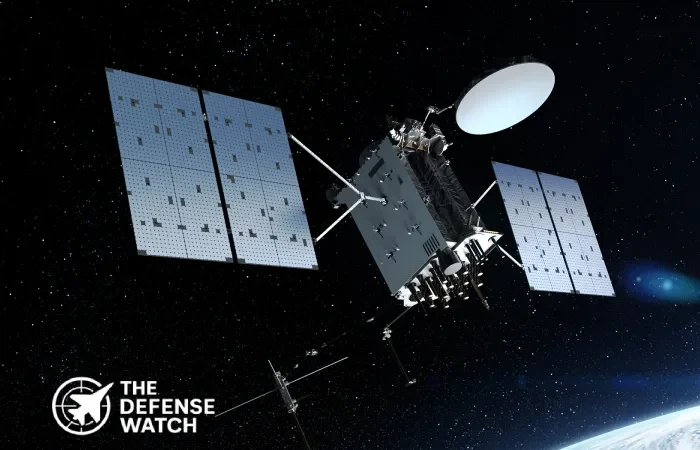
The GPS III navigation satellite is the latest evolution of the Global Positioning System operated by the United States Space Force. Designed to replace aging GPS II satellites, GPS III strengthens the backbone of modern navigation, timing, and precision warfare used daily by U.S. forces and allies.
Developed by Lockheed Martin, GPS III provides more accurate positioning data, greater signal strength, and better resistance to jamming and spoofing. These improvements support everything from smart weapons and aircraft navigation to encrypted military timing and civilian infrastructure synchronization.
Mission and Core Capabilities
GPS III satellites broadcast enhanced signals for both military and civilian users. The new M Code military signal is up to three times more accurate and eight times more resistant to interference than previous versions. This ensures reliable navigation in contested environments, including electronic warfare scenarios.
GPS III operates in Medium Earth Orbit, allowing global coverage with fewer satellites. Each spacecraft features improved atomic clocks, advanced digital payloads, and secure command and control links.
Operational Use
GPS III supports precision guided munitions, aircraft navigation, naval operations, missile guidance, and joint force coordination. Civilian users benefit from improved accuracy for aviation, emergency services, and financial networks. The system is fully interoperable with allied navigation systems such as Galileo.
GPS III Navigation Satellite Price
The estimated unit cost of a GPS III satellite for the United States ranges between USD 550 to 600 million, including advanced payloads, cybersecurity upgrades, and long term operational support. Costs vary based on launch vehicle and ground system integration.
FAQs
It provides navigation, timing, and positioning for U.S. military and civilian users worldwide.
Lockheed Martin builds GPS III for the U.S. Space Force.
Military accuracy is significantly higher than older GPS systems, especially with M Code.
Yes, it offers strong resistance to jamming and spoofing.
Each satellite is designed for about 15 years of service.
Get real time update about this post category directly on your device, subscribe now.
Reviews
Disclaimer Note
The information provided on TheDefenseWatch.com is for general informational purposes only. While we strive to ensure the accuracy, completeness, and timeliness of our content regarding defense and aerospace products, technologies, and specifications, we cannot guarantee that all information is 100% accurate or up-to-date due to the evolving nature of military technology and classified data.TheDefenseWatch.com does not warrant the reliability, suitability, or availability of the information for any specific purpose. Users are advised to consult official sources, such as manufacturers, government publications, or defense agencies, for precise and verified data before making decisions based on our content.We are not affiliated with any defense manufacturers, governments, or military organizations mentioned. Opinions, reviews, and ratings reflect expert analysis but are subjective and should not be considered endorsements. TheDefenseWatch.com is not responsible for any errors, omissions, or consequences arising from the use of this website’s content.External links are provided for convenience and do not imply endorsement. TheDefenseWatch.com reserves the right to update or modify content without prior notice. By using this website, you agree to our Privacy & Cookies Policy.


New Arrivals





Popular Comparisons
-
 SIG XM7 Rifle vs M4: Key Differences and Performance Comparison
View Comparison →
SIG XM7 Rifle vs M4: Key Differences and Performance Comparison
View Comparison → -
Eurofighter Typhoon vs Rafale vs F-35: Fighter Jet Comparison
View Comparison →
-
J-20 vs F-22: Stealth Fighter Showdown Explained
View Comparison →
-
F-14 Tomcat vs Su-57: Can a Legend Challenge Russia’s Stealth Fighter?
View Comparison →
-
Su-35 vs Su-57: Russia’s Top Fighter Jets Compared
View Comparison →
-
Eurofighter Typhoon vs Su-57: Ultimate Fighter Jet Comparison
View Comparison →
-
Rafale vs Su-57: 4.5 Gen vs 5th Gen Fighter Jet Comparison
View Comparison →
-
Su-57 vs F-16 Fighting Falcon: Stealth vs Speed
View Comparison →
-
China vs Russia: J-20 Mighty Dragon vs Su-57 Felon Comparison
View Comparison →
-
Su-57 Felon vs F-22 Raptor: Stealth Air Superiority Face-Off
View Comparison →


- UK Nightfall Procurement Plans Face Government Silence Amid Air Defense Debate

- NASA Completes First Flight Of Laminar Flow Scaled Wing Design In Aerodynamic Breakthrough
- Singapore Orders Three G550 Maritime Surveillance Aircraft To Boost Early Warning Network
- Polish Defense Industry Backs EU SAFE Mechanism To Boost National Production And Exports
- How StormBreaker Integration Expands Super Hornet Precision Strike Options for The U.S. Navy
- Former US F-35 Pilot Arrested for Allegedly Training Chinese Air Force
- NATO Intelligence From Germany: SWARM Biotactics Cybernetic Insect Swarms Enter Operational Use
- UK And Norway Sign Naval Helicopter Pact To Deepen Maritime Defense Cooperation
- Israel MOD Signs $42 Million Merkava Tank Transmission Deal With Ashot Ashkelon
- China’s New Aircraft Carrier Faces Persistent Design Flaw, Raising Questions About PLAN Power Projection