- Home
- Catalog
- Bombers & Strategic Aircraft
- E-130J Aircraft
E-130J Aircraft
Full Specifications
1. General Information
| Name | E-130J |
| Manufacturer | Northrop Grumman / Lockheed Martin |
| Country of Origin | United States |
| Introduction / In Service Since | Under development, mid 2020s |
| Status | In development |
| Category | Airborne Command and Control |
| Crew | 10 to 15 |
| Unit Cost | Estimated 150M+ USD |
2. Dimensions & Structure
| Length | 97 ft 9 in |
| Wingspan | 132 ft 7 in |
| Height | 38 ft 10 in |
| Wing Area | 1,745 sq ft |
| Empty Weight | Approx. 75,000 lbs |
| Maximum Takeoff Weight (MTOW) | 164,000 lbs |
3. Performance
| Maximum Speed | 410 mph |
| Range | 2,000+ nm |
| Combat Radius | Mission dependent |
| Service Ceiling | 28,000 ft |
| Rate of Climb | Approx. 1,800 ft/min |
4. Powerplant
| Engine Type | 4 × Rolls Royce AE 2100D3 turboprops |
| Thrust (per engine) | 4,700 shp |
| Total Thrust | 18,800 shp combined |
5. Payload & Armament
| Internal Payload Capacity | Approx. 44,000 lbs |
| Weapons Bay | None |
| Compatible Weapons | Not weaponized |
| Hardpoints | None |
6. Avionics & Systems
| Radar System | Advanced maritime surveillance radar |
| Navigation | Integrated GPS / INS |
| Electronic Warfare (EW) | Defensive countermeasures suite |
| Stealth Features | Limited signature reduction |
7. Operational History
| Primary Operator | U.S. Navy |
| Conflict Usage | Not yet operational |
| Notable Missions | Strategic nuclear command support |
8. Additional Information
| Variants | E-130J baseline |
| Successor / Future Replacement | Replaces E-6B Mercur |
| Notable Features | Survivable nuclear communications platform |
| Estimated Operational Life | 30+ years projected |
PROS
- Modern replacement for aging airborne command fleet
- Based on reliable C-130J airframe
- Long endurance with aerial refueling capability
- Hardened communications for nuclear missions
- Lower operating cost than jet based alternatives
CONS
- Slower than jet powered command aircraft
- Limited stealth characteristics
- High integration and mission system cost
- Large radar signature
- Dependent on secure satellite infrastructure
E-130J Strategic Nuclear Command Aircraft
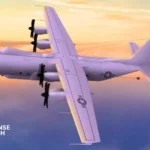
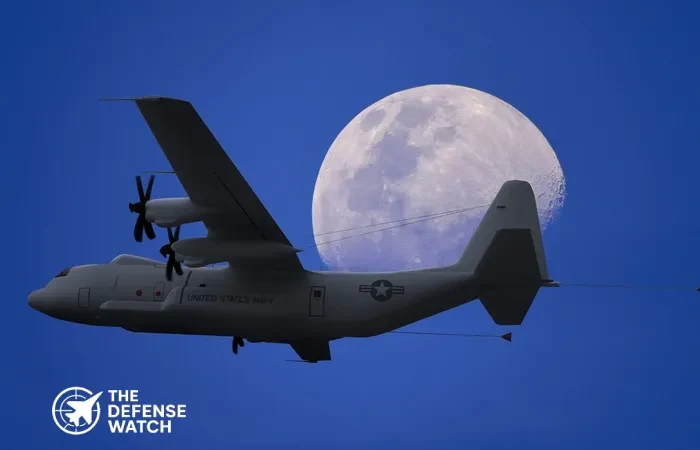
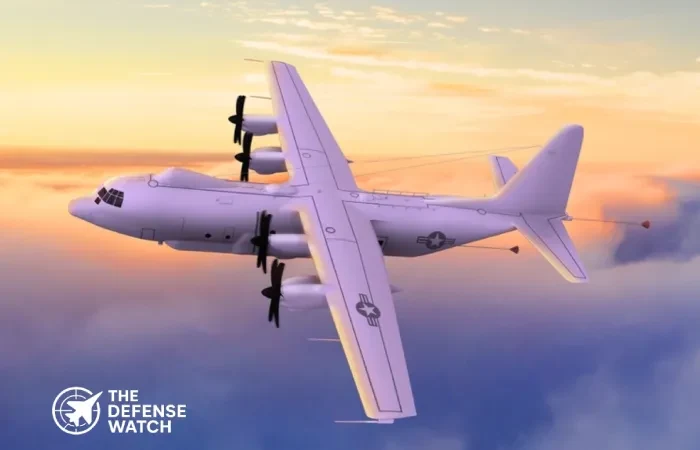
The E-130J aircraft is the U.S. Navy’s next generation airborne nuclear command and control platform, developed to replace the aging E-6B fleet. Built on the proven C-130J Super Hercules airframe, the E-130J supports the Take Charge and Move Out mission, ensuring secure and survivable communication between national command authorities and U.S. nuclear forces.
Designed for operations in contested environments, the aircraft provides resilient, beyond line of sight communications to ballistic missile submarines, strategic bombers, and ground based nuclear units. It is expected to serve as a key airborne node in the United States nuclear command, control, and communications architecture.
Manufacturer
The E-130J is being developed by Northrop Grumman Systems Corp., working in partnership with Lockheed Martin, the manufacturer of the C-130J platform. Northrop Grumman integrates the mission systems, communications suite, and specialized command equipment required for strategic operations. The program reflects a modernization effort by the U.S. Navy to ensure long term survivability and operational continuity.
Speed and Range
Based on the C-130J airframe, the E-130J has a maximum speed of about 410 mph, roughly Mach 0.6. It offers a ferry range exceeding 2,000 nautical miles without refueling, with extended endurance supported by aerial refueling capability. Its turboprop configuration allows efficient long duration flights at medium altitudes.
Cost and Price
The E-130J is acquired under a cost plus incentive contract structure. While exact unit costs are not fully disclosed, estimates suggest a per aircraft program cost exceeding 150 million dollars, depending on mission system integration and support packages.
Get real time update about this post category directly on your device, subscribe now.
Reviews
Disclaimer Note
The information provided on TheDefenseWatch.com is for general informational purposes only. While we strive to ensure the accuracy, completeness, and timeliness of our content regarding defense and aerospace products, technologies, and specifications, we cannot guarantee that all information is 100% accurate or up-to-date due to the evolving nature of military technology and classified data.TheDefenseWatch.com does not warrant the reliability, suitability, or availability of the information for any specific purpose. Users are advised to consult official sources, such as manufacturers, government publications, or defense agencies, for precise and verified data before making decisions based on our content.We are not affiliated with any defense manufacturers, governments, or military organizations mentioned. Opinions, reviews, and ratings reflect expert analysis but are subjective and should not be considered endorsements. TheDefenseWatch.com is not responsible for any errors, omissions, or consequences arising from the use of this website’s content.External links are provided for convenience and do not imply endorsement. TheDefenseWatch.com reserves the right to update or modify content without prior notice. By using this website, you agree to our Privacy & Cookies Policy.


New Arrivals



Popular Comparisons
-
 SIG XM7 Rifle vs M4: Key Differences and Performance Comparison
View Comparison →
SIG XM7 Rifle vs M4: Key Differences and Performance Comparison
View Comparison → -
Eurofighter Typhoon vs Rafale vs F-35: Fighter Jet Comparison
View Comparison →
-
J-20 vs F-22: Stealth Fighter Showdown Explained
View Comparison →
-
F-14 Tomcat vs Su-57: Can a Legend Challenge Russia’s Stealth Fighter?
View Comparison →
-
Su-35 vs Su-57: Russia’s Top Fighter Jets Compared
View Comparison →
-
Eurofighter Typhoon vs Su-57: Ultimate Fighter Jet Comparison
View Comparison →
-
Rafale vs Su-57: 4.5 Gen vs 5th Gen Fighter Jet Comparison
View Comparison →
-
Su-57 vs F-16 Fighting Falcon: Stealth vs Speed
View Comparison →
-
China vs Russia: J-20 Mighty Dragon vs Su-57 Felon Comparison
View Comparison →
-
Su-57 Felon vs F-22 Raptor: Stealth Air Superiority Face-Off
View Comparison →


- How Hermeus Quarterhorse Mk 2.1’s First Flight Advances America’s Race to Field Reusable Supersonic Drones

- TKMS Signs Pan Canadian Indigenous Agreements For Canadian Patrol Submarine Project
- GE9X Becomes Most Powerful Commercial Jet Engine After 27,000 Test Cycles
- General Atomics Wins $35.3M MQ-9A Support Contract For Netherlands
- Northrop Grumman Secures $225M E-130J Training Systems Contract For Navy Take Charge And Move Out Program
- U.S. Precision Strike Destroys Iranian Tor-M1 Air Defense System in Major Operation
- Denmark Orders French SAMP/T NG Air Defense Systems to Counter Ballistic Missile Threats
- IDF Conducts Broad Strikes On Hezbollah Infrastructure In Southern Lebanon After Cross‑Border Attacks
- Operation Roaring Lion: Israel MOD Launches Major Aerial And Maritime Airlift To Resupply IDF
- UK Hosts NATO Nuclear Talks To Reinforce Alliance Deterrence Role