- Home
- Catalog
- Missiles & Precision Weapons
- DF-17 Hypersonic Missile
DF-17 Hypersonic Missile


Full Specifications
1. General Information
| Name / Designation | DF-17 (Dong Feng-17) |
| Type / Role | Medium-Range Ballistic Missile with Hypersonic Glide Vehicle |
| Country of Origin | China |
| Manufacturer | China Aerospace Science and Technology Corporation (CASC) |
| Service Entry / Year Introduced | 2019 |
| Operational Status | Active |
2. Performance & Range
| Range | 1,800–2,500 km |
| Speed | Mach 5–10 |
| Ceiling / Altitude Limit | 60–100 km (Glide Phase) |
| Accuracy (CEP) | <10 m (estimated) |
| Warhead Type | Conventional / Nuclear-capable |
3. Guidance & Targeting
| Guidance System | Inertial + Satellite (Beidou) |
| Targeting Mode | Autonomous Glide Guidance |
| Launch Platform Compatibility | Road-Mobile TEL |
| Seeker Type | Hypersonic Glide Vehicle (Non-Radar Seeker) |
4. Physical Characteristics
| Length | ~11 m |
| Diameter | 1.2 m |
| Wingspan | N/A (Glide Body) |
| Launch Weight | ~15,000 kg |
| Propulsion | Two-stage Solid Rocket Booster |
5. Warhead & Payload
| Warhead Weight | 500–1,000 kg |
| Explosive Type | High-Explosive / Nuclear |
| Detonation Mechanism | Impact or Proximity Fuse |
| Payload Options | Hypersonic Glide Vehicle |
6. Operational Use & Capabilities
| Operational Range Type | Medium |
| Deployment Platform | Ground-based TEL |
| Target Types | Strategic Infrastructure, Ships, Airbases |
| Combat Proven | No (Tested, Not Combat-used) |
| Users / Operators | China |
PROS
- Hypersonic speed (Mach 5+) enables rapid strike capability
- High maneuverability reduces interception risk
- Precision targeting for both nuclear and conventional missions
- Solid-fuel system allows quick launch and mobility
- Strengthens regional deterrence and strategic depth
CONS
- Extremely high production and maintenance costs
- Limited global operational experience
- Dependence on advanced satellite guidance
- Potential arms race escalation in the Indo-Pacific
- Vulnerability during launch phase to pre-emptive strikes
DF-17 Hypersonic Glide Missile: A New Era of Precision Strike
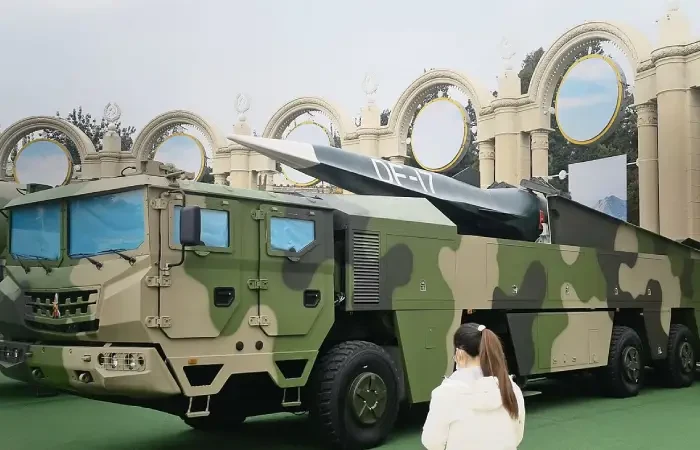
The DF-17 (Dong Feng-17) represents one of China’s most significant advancements in next-generation missile technology. Designed and developed by the China Aerospace Science and Technology Corporation (CASC), this medium-range hypersonic glide vehicle (HGV) system combines speed, accuracy, and survivability to enhance the People’s Liberation Army Rocket Force’s (PLARF) strategic strike capabilities.
First unveiled during the 2019 National Day Parade in Beijing, the DF-17’s primary mission is to penetrate advanced missile defense systems and deliver conventional or nuclear payloads with high precision. Unlike traditional ballistic missiles, it carries a hypersonic glide vehicle that detaches from its booster after launch, flying at speeds exceeding Mach 5 while performing unpredictable maneuvers that make interception extremely difficult.
The DF-17 reportedly has an effective range of 1,800–2,500 kilometers, allowing it to target key regional assets, including aircraft carriers, airbases, and radar installations. Its glide vehicle employs aerodynamic lift and controlled re-entry flight, maintaining a lower and less predictable trajectory compared to conventional ballistic systems.
The missile uses solid-fuel propulsion and advanced inertial and satellite guidance systems, ensuring fast launch readiness and improved accuracy, with an estimated circular error probable (CEP) of under 10 meters. While China has not disclosed the DF-17’s operational deployment in detail, analysts suggest it is now fully operational within multiple PLARF brigades, strengthening China’s anti-access/area denial (A2/AD) strategy across the Indo-Pacific region.
DF-17 Hypersonic Missile Price in United States
While the DF-17 is not available for export, defense analysts estimate its development and unit cost would likely range between $10–15 million per missile based on comparable hypersonic systems. For context, U.S. hypersonic programs such as ARRW and CPS share similar cost brackets due to advanced materials, guidance, and propulsion systems.
Get real time update about this post category directly on your device, subscribe now.
Reviews
Disclaimer Note
The information provided on TheDefenseWatch.com is for general informational purposes only. While we strive to ensure the accuracy, completeness, and timeliness of our content regarding defense and aerospace products, technologies, and specifications, we cannot guarantee that all information is 100% accurate or up-to-date due to the evolving nature of military technology and classified data.TheDefenseWatch.com does not warrant the reliability, suitability, or availability of the information for any specific purpose. Users are advised to consult official sources, such as manufacturers, government publications, or defense agencies, for precise and verified data before making decisions based on our content.We are not affiliated with any defense manufacturers, governments, or military organizations mentioned. Opinions, reviews, and ratings reflect expert analysis but are subjective and should not be considered endorsements. TheDefenseWatch.com is not responsible for any errors, omissions, or consequences arising from the use of this website’s content.External links are provided for convenience and do not imply endorsement. TheDefenseWatch.com reserves the right to update or modify content without prior notice. By using this website, you agree to our Privacy & Cookies Policy.

New Arrivals


Popular Comparisons
-
 SIG XM7 Rifle vs M4: Key Differences and Performance Comparison
View Comparison →
SIG XM7 Rifle vs M4: Key Differences and Performance Comparison
View Comparison → -
Eurofighter Typhoon vs Rafale vs F-35: Fighter Jet Comparison
View Comparison →
-
J-20 vs F-22: Stealth Fighter Showdown Explained
View Comparison →
-
F-14 Tomcat vs Su-57: Can a Legend Challenge Russia’s Stealth Fighter?
View Comparison →
-
Su-35 vs Su-57: Russia’s Top Fighter Jets Compared
View Comparison →
-
Eurofighter Typhoon vs Su-57: Ultimate Fighter Jet Comparison
View Comparison →
-
Rafale vs Su-57: 4.5 Gen vs 5th Gen Fighter Jet Comparison
View Comparison →
-
Su-57 vs F-16 Fighting Falcon: Stealth vs Speed
View Comparison →
-
China vs Russia: J-20 Mighty Dragon vs Su-57 Felon Comparison
View Comparison →
-
Su-57 Felon vs F-22 Raptor: Stealth Air Superiority Face-Off
View Comparison →


- Pentagon Considers Second B-21 Raider Production Line To Accelerate U.S. Stealth Bomber Expansion

- France Unveils 78,000-Ton Nuclear Aircraft Carrier France Libre With 40-Aircraft Capacity
- L3Harris Wins $77.8M U.S. Navy Contract for Kineto Tracking Mount Sustainment
- US Navy Awards $15.38B Columbia-Class Submarine Contract To Strengthen Nuclear Deterrent
- China Surges Production Capacity For J-20 And J-35 Stealth Fighters As Beijing Expands Fifth-Generation Fleet
- Netanyahu Announces Elimination Of Senior Iranian Figures In Air Campaign
- US Bombers Avoid European Airspace On Iran Bombing Runs In Strategic Route Shift
- Japan’s EC-2 Electronic Warfare Jet Completes First Flight, Expanding Standoff Jamming Capabilities
- NASA’s X-59 Quiet Supersonic Jet Gears Up for Second Flight — A Giant Leap Toward Silent Boom AviationNASA X-59 Second Flight: Supersonic Aviation Reborn
- US Weapons Shipments to Taiwan Unaffected by Iran War, Officials Confirm