F-16 Fighting Falcon vs F-35 Lightning II — Can the Classic Still Compete?
Old Warhorse Meets Stealth Future
Few comparisons in modern airpower spark as much debate as F-16 vs F-35. The F-16 Fighting Falcon, introduced in the late 1970s, became a Cold War icon and one of the most widely exported fighters in history. The F-35 Lightning II, by contrast, represents the pinnacle of fifth-generation stealth technology and digital warfare.
As the U.S. Air Force continues to operate both aircraft, questions persist: can the battle-proven F-16 still hold its own against its stealthier, more expensive successor? The answer reflects not just a tale of two jets, but the evolution of U.S. air dominance and shifting geopolitical realities — from NATO deterrence to Pacific airpower competition with China.
F-16 vs F-35: Key Specifications
| Specification | F-16 Fighting Falcon | F-35 Lightning II |
|---|---|---|
| Manufacturer | Lockheed Martin | Lockheed Martin |
| Role | Multirole Fighter | Stealth Multirole Fighter |
| Crew | 1 | 1 |
| Max Speed | Mach 2.0 (1,500 mph) | Mach 1.6 (1,200 mph) |
| Combat Range | 340 miles | 670 miles |
| Service Ceiling | 50,000 ft | 50,000 ft |
| Thrust | 29,000 lbf | 43,000 lbf |
| Internal Weapons Bay | None (external hardpoints only) | Yes (stealth internal bay) |
| Unit Cost (approx.) | $30–40 million | $80–120 million |
| Service Entry | 1978 | 2015 |
| Stealth Capability | Low (minimal radar reduction) | High (stealth airframe + coatings) |
| Primary Users | U.S., NATO, 25+ countries | U.S., NATO, allies (15+ countries) |
F-16 Fighting Falcon Fighter Jet Vs F-35 Lightning II Fighter Jet
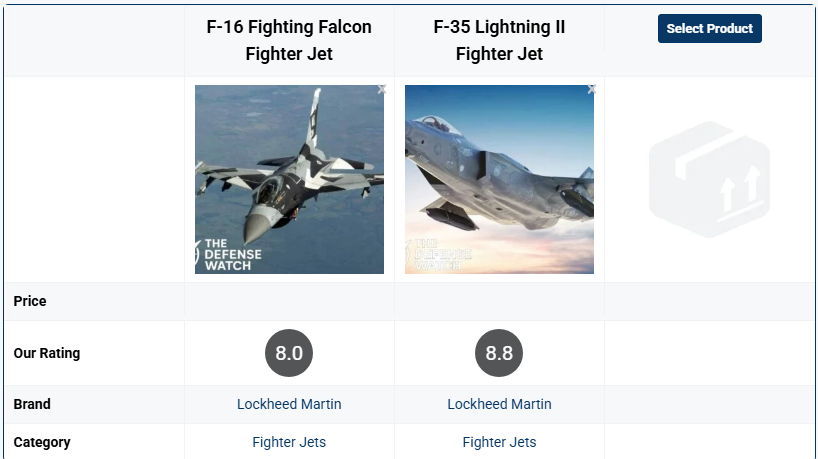
Design & Technology
The F-16 was built for agility — lightweight, highly maneuverable, and cost-effective. Its bubble canopy gives unmatched visibility in dogfights, and the fly-by-wire control system revolutionized fighter handling in the 1970s.
The F-35, however, is built for the digital age. Its stealth profile, radar-absorbing coatings, and AN/APG-81 AESA radar give it unmatched situational awareness. Its Distributed Aperture System (DAS) and Electro-Optical Targeting System (EOTS) allow 360-degree targeting and threat detection. The F-35 also features sensor fusion, combining multiple data sources into a single pilot display — a capability the F-16 lacks.
Firepower & Performance
The F-16 carries a diverse external weapons loadout — up to 17,000 pounds of bombs, missiles, and fuel tanks. It’s compatible with AIM-120 AMRAAM, AIM-9X Sidewinder, and JDAM precision bombs, making it a versatile strike platform. However, its external stores increase radar visibility.
The F-35 has a smaller loadout — around 18,000 pounds combined internal and external — but gains stealth advantage when weapons are stored internally. It employs the same air-to-air missiles as the F-16 but integrates them with a stealth-first philosophy, striking before detection. In beyond-visual-range (BVR) engagements, the F-35 has the upper hand due to its superior sensors and low radar cross-section.
In a dogfight, the F-16 remains nimble and agile, often turning tighter than the F-35. Yet, modern air warfare rarely relies on close-range engagements, making the F-35’s information dominance the real advantage.
Operational Range & Mobility
The F-16 has a shorter combat range but can be equipped with drop tanks or aerial refueling for extended missions. It’s lighter, faster, and capable of operating from shorter runways.
The F-35, with its larger internal fuel capacity, has roughly double the range on internal fuel alone. Its F-35B variant can perform vertical takeoffs and landings for Marine Corps operations, while the F-35C serves carrier missions.
In global deployments — from Europe’s NATO air policing to Pacific deterrence missions — the F-35’s longer range and networking capabilities provide greater strategic flexibility.
Combat Effectiveness & Real-World Use
The F-16 has proven itself in over 25 conflicts, from the Gulf War to counterterrorism operations in Syria. Its reliability, ease of maintenance, and affordability keep it in service across 25 nations. Modernized versions like the F-16V (Viper) add AESA radar and advanced cockpit systems to keep the platform relevant.
The F-35, while newer, has already seen combat with the U.S., Israel, and the UK, performing precision strikes in contested environments. Its ability to integrate with ground, naval, and airborne assets through data linking makes it the centerpiece of next-generation warfare.
Cost, Export, and Geopolitical Impact
The F-16’s low cost and high availability make it a favorite for allies like Taiwan, Greece, and Poland. Its export success strengthens U.S. influence globally.
Meanwhile, the F-35’s higher cost is offset by its interoperability benefits — NATO allies operating the same stealth platform create a unified intelligence and strike network. Over 17 countries have ordered the F-35, ensuring its dominance through the 2060s.
Analysis: F-16 vs F-35 — Different Eras, Same Flag
The F-16 symbolizes reliability and affordability — a fighter built for large-scale, flexible use. The F-35 represents information warfare, stealth, and data superiority.
While the F-16 wins in dogfight maneuverability, cost, and maintainability, the F-35 dominates in situational awareness, survivability, and networked warfare.
The U.S. Air Force now uses both — F-35s for high-threat environments and F-16s for homeland defense, training, and allied operations. In essence, the F-16 still fights — but the F-35 decides the outcome before the fight begins.
Conclusion: Can the F-16 Still Compete?
The F-16 vs F-35 debate isn’t about replacement — it’s about evolution. The F-16 remains a capable, cost-effective fighter for decades to come, while the F-35 leads the U.S. and its allies into the next generation of air dominance.
In a stealth-first future, the F-35 clearly holds the technological edge. Yet, for nations balancing cost, reliability, and proven performance, the F-16 Fighting Falcon remains an enduring symbol of American aerospace mastery.
FAQs: F-16 vs F-35 Comparison
The F-16 is faster at Mach 2.0, while the F-35 tops out at Mach 1.6 due to its stealth-oriented design.
In close-range combat, the F-16’s agility gives it an edge. But the F-35 rarely needs to dogfight, thanks to its superior sensors and long-range missile targeting.
The F-35 ranges from $80–120 million per unit, while modern F-16V variants cost around $35–40 million.
Yes. The F-16 remains in active service, while the F-35 is the Air Force’s primary next-generation fighter.
With upgrades like the F-16V and advanced radar, it remains highly competitive for mid-level missions and allied air forces.
Get real time update about this post category directly on your device, subscribe now.

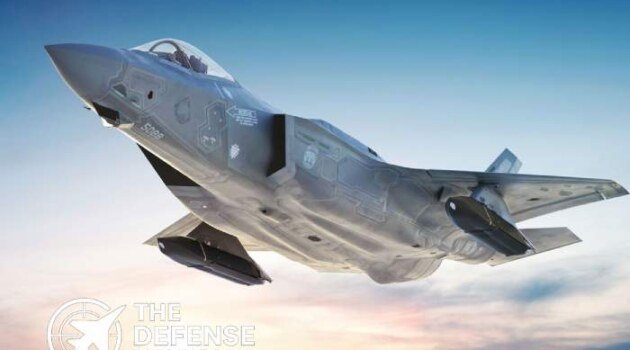
| |
| Price | |
| Our Rating | |
| Manufacturer | Lockheed Martin Lockheed Martin |
| Category | Fighter Jets Fighter Jets |
General Information
| Name | F-16 Fighting Falcon F-35 Lightning II |
| Manufacturer | General Dynamics / Lockheed Martin Lockheed Martin |
| Country of Origin | United States United States |
| Type / Role | Multirole Fighter Multirole Stealth Fighter |
| Generation | 4th 5th |
| Status | Active / In Service In Service |
| First Flight | January 20, 1974 December 15, 2006 |
| Introduction / In Service Since | 1978 2015 |
| Number Built | Over 4,600 1,200+ (as of 2025) |
| Operators | USA, Israel, Turkey, Greece, South Korea, etc. USA, UK, Japan, Israel, Italy, Australia, and others |
Dimensions & Structure
| Length | 49 ft 5 in (15.06 m) 51.2 ft (15.6 m) |
| Wingspan | 32 ft 8 in (9.96 m) 35 ft (10.7 m) |
| Height | 16 ft 8 in (5.09 m) 14.4 ft (4.38 m) |
| Wing Area | 300 sq ft (27.87 m²) 460 sq ft (42.7 m²) |
| Empty Weight | 18,900 lb (8,573 kg) 29,300 lb (13,300 kg) |
| Maximum Takeoff Weight (MTOW) | 42,300 lb (19,187 kg) 70,000 lb (31,800 kg) |
| Internal Weapons Bay | None 2 (up to 5,700 lb payload) |
| External Hardpoints | 9 6–10 (up to 18,000 lb total) |
Performance
| Maximum Speed | Mach 2.0 Mach 1.6 |
| Range | 2,620 mi (4,220 km) with drop tanks 1,380 mi (2,220 km) |
| Combat Radius | ~500 mi (800 km) ~670 mi (1,080 km) |
| Service Ceiling | 50,000 ft (15,240 m) 50,000 ft (15,240 m) |
| Rate of Climb | 50,000 ft/min 45,000 ft/min |
| Thrust-to-Weight Ratio | 1.095 0.87 |
| G Limits | +9 / -3 +9 |
Powerplant
| Engine Type | Pratt & Whitney F100-PW-229 / GE F110-GE-129 Pratt & Whitney F135-PW-100 |
| No. of Engines | 1 1 |
| Thrust (each) | 29,000 lbf (afterburner) 43,000 lbf |
| Thrust Vectoring | No Yes (on F-35B variant) |
| Fuel Capacity | 7,000 lb internal ~18,500 lb internal |
Armament
| Gun | 1× M61A1 20mm Vulcan GAU-22/A 25mm cannon (F-35A) |
| Missiles (Air-to-Air) | AIM-9, AIM-120 AIM-120 AMRAAM, AIM-9X |
| Missiles (Air-to-Ground) | AGM-65, AGM-88 AGM-154 JSOW, AGM-158 JASSM |
| Bombs | JDAM, Paveway, Cluster bombs JDAM, Paveway II/III, SDB I/II |
| Hardpoints | 9 6 external + 2 internal |
| Payload Capacity | 17,000 lb (7,700 kg) ~18,000 lb |
Avionics & Systems
| Radar | AN/APG-68 / AN/APG-83 AESA AN/APG-81 AESA |
| Radar Range | ~160 km ~150+ km |
| Electronic Warfare (EW) System | AN/ALQ-213, ALQ-131 AN/ASQ-239 suite |
| Targeting System | Sniper XR / LANTIRN EOTS (Electro-Optical Targeting System) |
| Helmet Display | JHMCS HMDS Gen III |
| Navigation | GPS/INS GPS/INS with terrain-following |
| Autopilot / AI Assistance | Digital Fly-by-Wire Advanced flight management |
| Communication | Link 16, Secure UHF/VHF MADL & Link 16 secure data links |
Stealth & Technology
| Radar Cross Section (RCS) | ~1.2 m² ~0.001 m² |
| Stealth Features | Limited shaping, radar-absorbent coatings RAM coating, internal weapons bay, edge alignment |
| Infrared Signature Reduction | Moderate Yes |
| Sensor Fusion | Partial (F-16V upgrade) Full 360° data integration |
| Networking Capabilities | Link 16, Joint operations compatible Distributed data-sharing with allied units |
Variants
| Special Export Versions | F-16I (Israel), KF-16 (South Korea) F-35I (Israel), F-35A (Japan), etc. |
Operational History
| Major Conflicts / Deployments | Gulf War, Kosovo, Iraq, Afghanistan Middle East operations (Iraq, Syria) |
| Notable Operators | USAF, Israel, Turkey, Taiwan, UAE USAF, USN, USMC, RAF, IDF |
| Combat Proven? | Yes Yes |
| Mission Types | Air superiority, strike, SEAD, CAS Air superiority, strike, SEAD, ISR |
Cost & Program
| Unit Cost | ~$35 million (Block 70) $80–100 million (variant-dependent) |
| Development Cost | ~$8 billion (program total) ~$400 billion (program total) |
| Program Name | Lightweight Fighter (LWF) Joint Strike Fighter (JSF) |
| Funding Countries | United States, NATO partners USA, UK, Italy, Netherlands, Canada, Australia, etc. |
Additional Information
| Upgrades Planned | AESA radar, datalink, EW suite Block 4, Tech Refresh 3 |
| Future Replacement | F-35A Lightning II NGAD (2035+) |
| Export Restrictions | Controlled under ITAR U.S. FMS approval required |
| Notable Achievements | Most exported Western fighter Widest global fighter program in history |
| Competitors | JAS 39 Gripen, MiG-29, Mirage 2000 Su-57, J-20, Tempest, KF-21 |

|
Disclaimer Note
The information provided on TheDefenseWatch.com is for general informational purposes only. While we strive to ensure the accuracy, completeness, and timeliness of our content regarding defense and aerospace products, technologies, and specifications, we cannot guarantee that all information is 100% accurate or up-to-date due to the evolving nature of military technology and classified data.TheDefenseWatch.com does not warrant the reliability, suitability, or availability of the information for any specific purpose. Users are advised to consult official sources, such as manufacturers, government publications, or defense agencies, for precise and verified data before making decisions based on our content.We are not affiliated with any defense manufacturers, governments, or military organizations mentioned. Opinions, reviews, and ratings reflect expert analysis but are subjective and should not be considered endorsements. TheDefenseWatch.com is not responsible for any errors, omissions, or consequences arising from the use of this website’s content.External links are provided for convenience and do not imply endorsement. TheDefenseWatch.com reserves the right to update or modify content without prior notice. By using this website, you agree to our Privacy & Cookies Policy.
New Arrivals


Popular Comparisons
-
 SIG XM7 Rifle vs M4: Key Differences and Performance Comparison
View Comparison →
SIG XM7 Rifle vs M4: Key Differences and Performance Comparison
View Comparison → -
Eurofighter Typhoon vs Rafale vs F-35: Fighter Jet Comparison
View Comparison →
-
J-20 vs F-22: Stealth Fighter Showdown Explained
View Comparison →
-
F-14 Tomcat vs Su-57: Can a Legend Challenge Russia’s Stealth Fighter?
View Comparison →
-
Su-35 vs Su-57: Russia’s Top Fighter Jets Compared
View Comparison →
-
Eurofighter Typhoon vs Su-57: Ultimate Fighter Jet Comparison
View Comparison →
-
Rafale vs Su-57: 4.5 Gen vs 5th Gen Fighter Jet Comparison
View Comparison →
-
Su-57 vs F-16 Fighting Falcon: Stealth vs Speed
View Comparison →
-
China vs Russia: J-20 Mighty Dragon vs Su-57 Felon Comparison
View Comparison →
-
Su-57 Felon vs F-22 Raptor: Stealth Air Superiority Face-Off
View Comparison →


- Pentagon Considers Second B-21 Raider Production Line To Accelerate U.S. Stealth Bomber Expansion

- France Unveils 78,000-Ton Nuclear Aircraft Carrier France Libre With 40-Aircraft Capacity
- L3Harris Wins $77.8M U.S. Navy Contract for Kineto Tracking Mount Sustainment
- US Navy Awards $15.38B Columbia-Class Submarine Contract To Strengthen Nuclear Deterrent
- China Surges Production Capacity For J-20 And J-35 Stealth Fighters As Beijing Expands Fifth-Generation Fleet
- Netanyahu Announces Elimination Of Senior Iranian Figures In Air Campaign
- US Bombers Avoid European Airspace On Iran Bombing Runs In Strategic Route Shift
- Japan’s EC-2 Electronic Warfare Jet Completes First Flight, Expanding Standoff Jamming Capabilities
- NASA’s X-59 Quiet Supersonic Jet Gears Up for Second Flight — A Giant Leap Toward Silent Boom AviationNASA X-59 Second Flight: Supersonic Aviation Reborn
- US Weapons Shipments to Taiwan Unaffected by Iran War, Officials Confirm