Executive Summary:
Dassault Aviation has confirmed a renewed disagreement with Airbus over the multinational Eurodrone program, exposing continuing industrial tensions within one of Europe’s largest collaborative defense projects. The latest dispute comes as European governments continue investing heavily in sovereign defense capabilities and unmanned aircraft intended to reduce dependence on non-European systems.
Dassault Confirms Fresh Eurodrone Rift With Airbus
Dassault Aviation has acknowledged a new disagreement with Airbus over the Eurodrone program, adding another layer of uncertainty to Europe’s flagship Medium Altitude Long Endurance (MALE) unmanned aircraft project.
The confirmation came during remarks by Dassault Chief Executive Eric Trappier, who said longstanding industrial issues remain unresolved despite previous efforts to stabilize cooperation between the program’s principal partners. Reuters first reported the renewed disagreement on July 1, 2026.
The Eurodrone is being developed under the management of Airbus Defence and Space on behalf of the European procurement agency OCCAR, with major industrial contributions from Dassault Aviation in France and Leonardo in Italy.
While officials have not indicated that the program itself is at immediate risk, the renewed friction underscores the persistent governance challenges facing Europe’s largest multinational defense development efforts.
A Long History Of Industrial Disagreements
The Eurodrone program has experienced several disputes since its inception, many centered on industrial workshare, technical responsibilities, decision-making authority, and program management.
Dassault has previously criticized aspects of the project’s governance, arguing that engineering decisions and leadership responsibilities should better reflect each partner’s expertise.
Eric Trappier indicated that disagreements remain despite years of negotiations, suggesting that underlying structural issues have yet to be fully resolved.
Neither Airbus nor Dassault has announced any immediate changes to the production schedule following the latest comments.
What Is The Eurodrone?
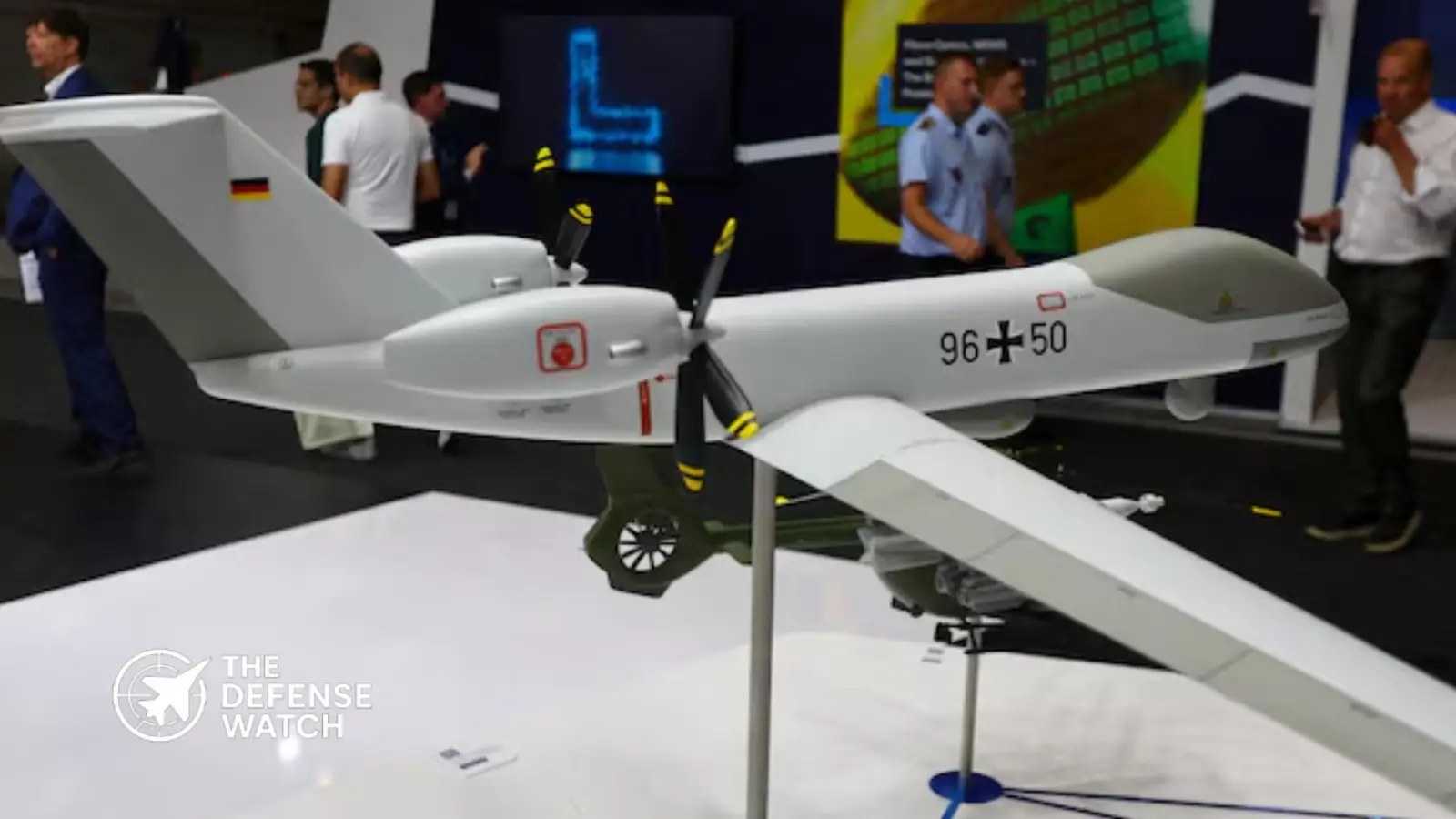
The Eurodrone is Europe’s first jointly developed MALE remotely piloted aircraft system designed to provide intelligence, surveillance, reconnaissance (ISR), target acquisition, and precision strike capabilities.
The aircraft is intended to replace reliance on imported platforms while giving European armed forces greater operational autonomy.
Participating nations include:
| Participating Country | Planned Role |
|---|---|
| Germany | Lead customer |
| France | Operational user |
| Italy | Operational user |
| Spain | Operational user |
The aircraft is managed through OCCAR and developed by Airbus Defence and Space as the prime contractor, with Leonardo and Dassault serving as major industrial partners.
Key Eurodrone Characteristics
Although development continues, publicly released program information identifies several planned capabilities.
| Capability | Details |
|---|---|
| Class | MALE UAV |
| Mission | ISR and precision strike |
| Engines | Twin turboprop |
| Endurance | Approximately 40 hours |
| Operations | All-weather missions |
| Payload | Multi-mission sensor suite with optional weapons integration |
| Customers | Germany, France, Italy, Spain |
The twin-engine configuration distinguishes Eurodrone from several competing MALE UAVs and reflects European certification and safety requirements for operations in civilian-controlled airspace.
Why The Industrial Relationship Matters
Unlike many national procurement programs, Eurodrone relies on multiple governments and several major aerospace companies sharing technical authority.
This collaborative structure distributes costs and preserves national aerospace industries but also makes decision-making significantly more complex.
Differences over engineering leadership, software integration, production responsibilities, or certification can affect development timelines even when governments remain committed to funding the program.
Such challenges are common across multinational European defense initiatives, particularly those involving advanced aerospace technologies.
Strategic Importance For Europe
Eurodrone forms part of Europe’s broader effort to strengthen defense-industrial independence amid heightened security concerns following Russia’s invasion of Ukraine and increasing emphasis on NATO readiness.
For years, European militaries have depended heavily on foreign-built unmanned aircraft, particularly the MQ-9 Reaper supplied by the United States.
Developing a domestically controlled MALE UAV offers several strategic advantages:
- Greater sovereignty over mission software and upgrades.
- Reduced dependence on non-European suppliers.
- Improved protection of sensitive operational data.
- Long-term support for Europe’s aerospace industrial base.
- Common capability across participating European armed forces.
These objectives remain politically important despite periodic industrial disagreements.
Implications Beyond Eurodrone
The renewed dispute may attract particular attention because Airbus and Dassault are also central partners in Europe’s much larger Future Combat Air System (FCAS), alongside Spain.
Although the two programs are managed separately, recurring disagreements between the companies have periodically raised concerns about the effectiveness of Europe’s collaborative defense acquisition model.
Governments supporting FCAS and Eurodrone have consistently emphasized that industrial partners must resolve differences without undermining long-term capability development.
For defense planners, maintaining stable industrial cooperation is increasingly important as Europe accelerates investment in next-generation combat aircraft, autonomous systems, missile defense, and space capabilities.
Analysis: Collaboration Remains Europe’s Greatest Strength And Challenge
The latest disagreement illustrates a recurring dilemma within European defense procurement.
Collaborative programs allow participating nations to spread development costs, retain domestic industrial expertise, and produce capabilities that might otherwise be unaffordable for individual countries. However, they also require competing companies, each backed by national governments, to align commercial interests with collective military objectives.
Eurodrone demonstrates this balancing act. Technically, the aircraft addresses a genuine operational requirement by providing Europe with a sovereign ISR and strike platform. Politically, it represents a commitment to reducing dependence on external suppliers. Industrially, however, success depends as much on effective governance as engineering excellence.
For the United States and NATO allies, the program remains strategically relevant because a successful Eurodrone fleet could strengthen Europe’s contribution to alliance intelligence, surveillance, and reconnaissance missions while easing demand on U.S. unmanned assets during future operations.
The renewed Airbus-Dassault dispute does not necessarily threaten the aircraft’s eventual delivery, but it highlights how industrial coordination remains one of the most significant risks facing large multinational defense programs. Maintaining schedule discipline while balancing national industrial interests will continue to shape the project’s trajectory over the remainder of the decade.