














@2026 – All Right Reserved. TheDefenseWatch.com
- Home
- Defense Systems
- Missiles & Precision Weapons
- R-60 Missile
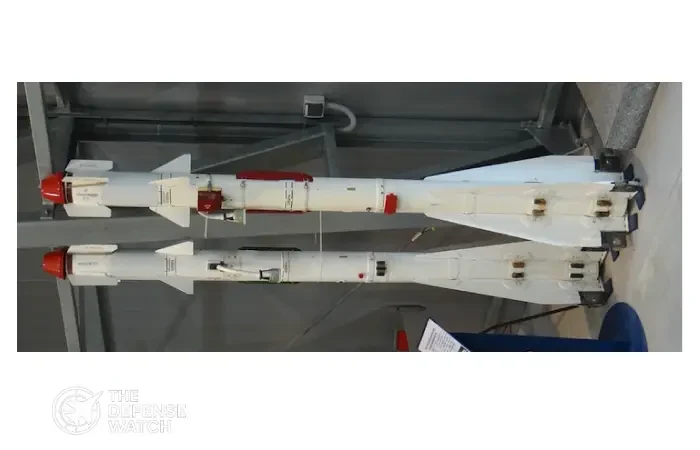
R-60 Missile
Defense Systems Full Specifications
1. General Information
| Name / Designation | R-60 (AA-8 Aphid) |
| Type / Role | Short-Range Air-to-Air Missile |
| Country of Origin | Soviet Union |
| Manufacturer | Molniya Design Bureau |
| Service Entry / Year Introduced | 1974 |
| Operational Status | Active in Multiple Countries |
2. Performance & Range
| Range | Up to 8 km (Short Range) |
| Speed | Approx. Mach 2.5 |
| Ceiling / Altitude Limit | Typically 0–20,000 m (Platform Dependent) |
| Accuracy (CEP) | N/A (Proximity-fused AAM) |
| Warhead Type | HE-Fragmentation |
3. Guidance & Targeting
| Guidance System | Infrared Homing |
| Targeting Mode | Fire-and-Forget |
| Launch Platform Compatibility | Fighter Jets (MiG/Su Series) |
| Seeker Type | IR Seeker / Improved IR (R-60M) |
4. Physical Characteristics
| Length | ~2.1 m |
| Diameter | ~0.12 m |
| Wingspan | ~0.39 m |
| Launch Weight | 43–45 kg |
| Propulsion | Solid-Fuel Rocket |
5. Warhead & Payload
| Warhead Weight | ~3.5 kg |
| Explosive Type | HE-Fragmentation |
| Detonation Mechanism | Proximity / Impact Fuse |
| Payload Options | Single HE Payload |
6. Operational Use & Capabilities
| Operational Range Type | Short Range |
| Deployment Platform | Air-Launched |
| Target Types | Fighters, UAVs, Helicopters |
| Combat Proven | Yes |
| Users / Operators | Russia, India, Syria, Ukraine, Several Export Nations |
PROS
- Highly maneuverable for close-range engagements
- Lightweight, allowing multiple hardpoint configurations
- Proven infrared fire-and-forget guidance
- Widely compatible with Soviet and export aircraft
- Cost-effective and abundant on the global market
CONS
- Limited range compared to modern dogfight missiles
- Older seeker technology is vulnerable to flares
- Not suitable for beyond-visual-range combat
- Reduced performance against modern stealth aircraft
- Minimal modernization potential due to dated architecture
R-60 Short-Range Infrared Air-to-Air Missile
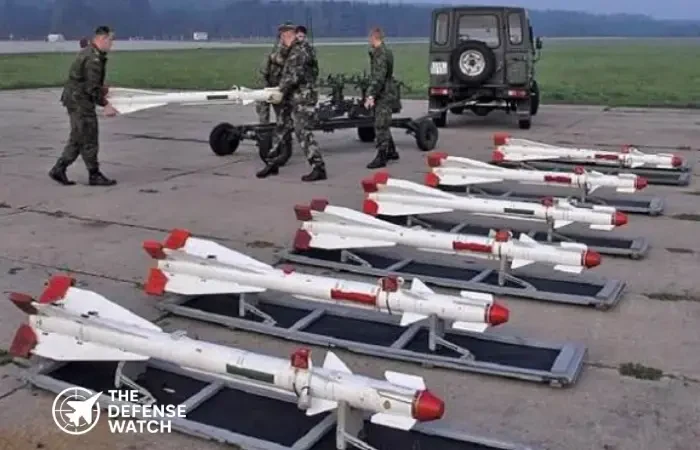
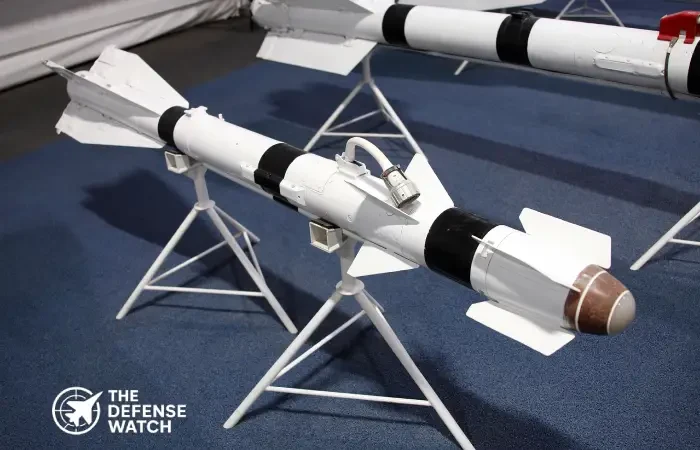
The R-60 is one of the most recognizable short-range air-to-air missiles developed during the Cold War, designed to give Soviet fighter aircraft a compact, agile, and rapid-reaction weapon for close-range engagements. Known by NATO as the AA-8 “Aphid,” the missile remains in service with several air forces and has seen extensive operational use across multiple conflicts.
Overview and Development
Developed by the Soviet Union’s Molniya Design Bureau, the R-60 was introduced in the mid-1970s to equip fighters such as the MiG-21, MiG-23, MiG-29, and Su-27. Its purpose was clear: provide a highly maneuverable heat-seeking missile capable of striking fast-moving airborne targets at short distances.
Capabilities and Technology
The standard R-60 features an infrared homing seeker, enabling true fire-and-forget performance. Its compact airframe—under 45 kg—allows aircraft to carry multiple missiles without compromising agility. With a typical engagement range of up to 8 km, the R-60 excels in dogfight scenarios where rapid lock-on and high maneuverability are essential.
The missile’s fragmentation warhead is designed to maximize effectiveness against fighters, UAVs, and low-altitude airborne threats. Upgraded versions, including the R-60M, offer improved seekers, better countermeasure resistance, and an expanded engagement envelope.
Operational Use
Throughout its service life, the R-60 has been used in numerous regional conflicts, proving reliable in harsh environments. It remains compatible with many legacy and modernized aircraft in Asia, Eastern Europe, Africa, and the Middle East.
Applications for U.S. Defense Analysis
For U.S. defense observers, the R-60 remains relevant due to its widespread presence in global inventories and its role in shaping close-range air-combat doctrine among non-NATO operators.
R-60 Missile Price
While pricing varies due to age, export history, and refurbishment status, R-60 missiles typically fall into the low-cost short-range missile category, making them inexpensive compared to modern Western equivalents. Exact U.S. market values depend on availability through allied inventories or decommissioned stock.
Disclaimer Note
The information provided on TheDefenseWatch.com is for general informational purposes only. While we strive to ensure the accuracy, completeness, and timeliness of our content regarding defense and aerospace products, technologies, and specifications, we cannot guarantee that all information is 100% accurate or up-to-date due to the evolving nature of military technology and classified data.TheDefenseWatch.com does not warrant the reliability, suitability, or availability of the information for any specific purpose. Users are advised to consult official sources, such as manufacturers, government publications, or defense agencies, for precise and verified data before making decisions based on our content.We are not affiliated with any defense manufacturers, governments, or military organizations mentioned. Opinions, reviews, and ratings reflect expert analysis but are subjective and should not be considered endorsements. TheDefenseWatch.com is not responsible for any errors, omissions, or consequences arising from the use of this website’s content.External links are provided for convenience and do not imply endorsement. TheDefenseWatch.com reserves the right to update or modify content without prior notice. By using this website, you agree to our Privacy & Cookies Policy.
New Arrivals
Popular Comparisons
-
 Tejas Fighter Jet vs F-16 Fighting Falcon: Capability Compared
View Comparison →
Tejas Fighter Jet vs F-16 Fighting Falcon: Capability Compared
View Comparison → -
Rafale Fighter Jet vs F-16 Fighting Falcon : Which Fighter Has the Edge?
View Comparison →
-
Su-57 Fighter Jet vs J-20 Fighter Jet: Stealth and Air Combat Compared
View Comparison →
-
Mirage 2000 vs Tejas Mk1A: Legacy Combat Power vs Indigenous Modernization
View Comparison →
-
Rafale Fighter Jet vs F-22 Raptor: Which Air Dominance Fighter Has the Edge?
View Comparison →
-
Tejas Fighter Jet vs. Rafale Fighter Jet: India’s Indigenous Fighter Meets France’s Proven Multirole Combat Aircraft
View Comparison →
-
F-22 Raptor vs. F-35 Joint Strike Fighter: Which Fifth Generation Fighter Has the Edge?
View Comparison →
-
F-35A vs. F-22 Raptor: Which U.S. Stealth Fighter Dominates Modern Air Combat?
View Comparison →
-
AGM-114 Hellfire vs. AGM-179 JAGM: Which U.S. Precision Missile Is Better?
View Comparison →
-
Patriot (PAC-3) vs. THAAD: Complete Missile Defense System Comparison, Capabilities, Range, and Strategic Roles
View Comparison →
- Greek-Operated Patriot Intercepts Ballistic Missile and Drone Over Saudi Arabia

- Raytheon Wins $50.1 Million Navy Order for EA-18G Next Generation Jammer Repairs
- Stark Aerospace Wins $114 Million MK 41 VLS Canister Contract
- Northrop Grumman Wins $123.8M F-35 APG-85 Lot 7 Radar Contract
- Leonardo, Fincantieri Win €3.7B Contract for Two Italian Navy DDX Destroyers
- Finnish President Urges Musk to Expand Starlink Access for Ukraine to Target Russian Missile Launchers
- MV-22B Osprey Completes First Navy Sonobuoy Acceptance Test
- Saab expands Swedish space role through new partnerships with SSC Space, OHB Sweden and Ericsson
- Russian Mi-8 Briefly Enters Polish Airspace, Prompting Fighter Scramble
- Last A-10 Warthog Departs Nellis, Closing a 49-Year Close Air Support Era