
- Home
- Defense Systems
- Tanks & Armored Vehicles
- Leopard 1 Tank
Leopard 1 Tank
Defense Systems Full Specifications
1. General Information
| Vehicle Name | Leopard 1 MBT |
| Type / Role | Main Battle Tank |
| Manufacturer | Krauss-Maffei, Germany |
| Country of Origin | West Germany |
| In Service | Yes |
| Year Introduced | 1965 |
| Unit Cost | Approx. USD 1.2 million |
| Crew | 4 (Commander, Gunner, Loader, Driver) |
2. Dimensions & Weight
| Length (Gun Forward) | 9.54 m |
| Width | 3.37 m |
| Height | 2.38 m |
| Weight | 42.2 tons |
| Ground Clearance | 0.40 m |
| Chassis Material | Rolled Steel |
3. Performance
| Engine Type | MTU MB 838 CaM Diesel |
| Engine Power | 600 hp |
| Power-to-Weight Ratio | 14.2 hp/ton |
| Maximum Speed (Road) | 65 km/h |
| Maximum Speed (Off-Road) | 45 km/h |
| Operational Range | 600 km |
| Suspension Type | Torsion Bar |
4. Armament
| Main Gun | 105 mm L7 Rifled |
| Ammunition Capacity | 50 rounds |
| Secondary Armament | 1 × 7.62mm MG, optional roof MG |
| Gun Elevation/Depression | +20° / -10° |
| Fire Control System | Optical with basic ballistic computer |
5. Protection & Armor
| Armor Type | Rolled Homogeneous Steel |
| Reactive Armor | Optional |
| NBC Protection | Yes |
| Smoke Grenade Launchers | 2 × 6-barrel |
6. Mobility & Capability
| Maximum Gradient | 60% |
| Side Slope | 30% |
| Trench Crossing | 2.5 m |
| Vertical Obstacle | 1.0 m |
| Fording Depth | 1.2 m |
7. Sensors & Electronics
| Fire Control Computer | Basic Infrared |
| Night Vision | Basic Infrared |
| Communication System | Radio VHF/UHF |
8. Operational Info
| Service Branch | U.S. Army (limited use), Allies |
| Primary Operator | Germany, Netherlands, Belgium, Turkey |
| Combat Experience | Gulf War, Peacekeeping Ops |
| Upgrade Packages | Leopard 1A5, Leopard 1A6 |
| Production Status | Retired in Germany, export active |
PROS
- Highly mobile and fast for an MBT
- Reliable 105mm main gun with long-range accuracy
- Modular upgrades for modern battlefield relevance
- Proven combat record in multiple conflicts
- Diesel engine with excellent operational range
CONS
- Light armor compared to modern MBTs
- Vulnerable to advanced anti-tank guided missiles
- Limited survivability in high-intensity conflicts
- Outdated electronics without upgrades
- Smaller ammunition capacity than newer tanks
Leopard 1 Main Battle Tank
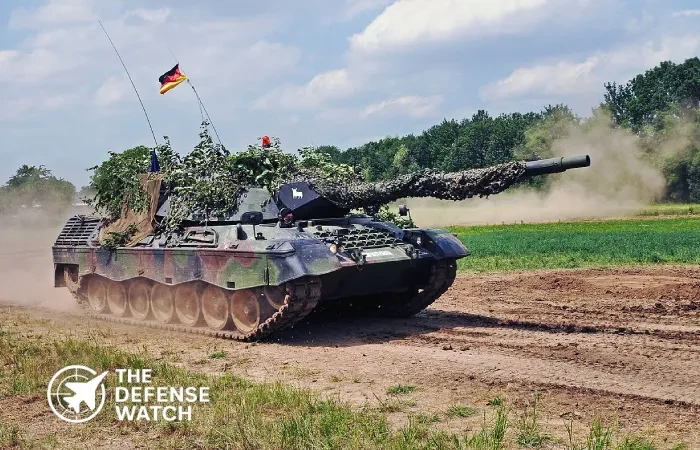
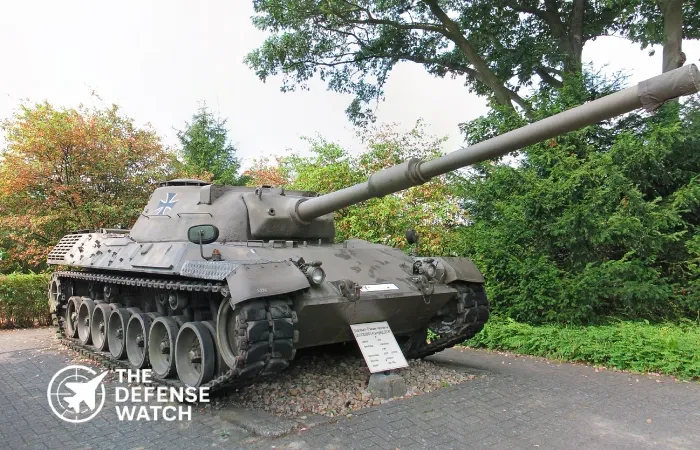
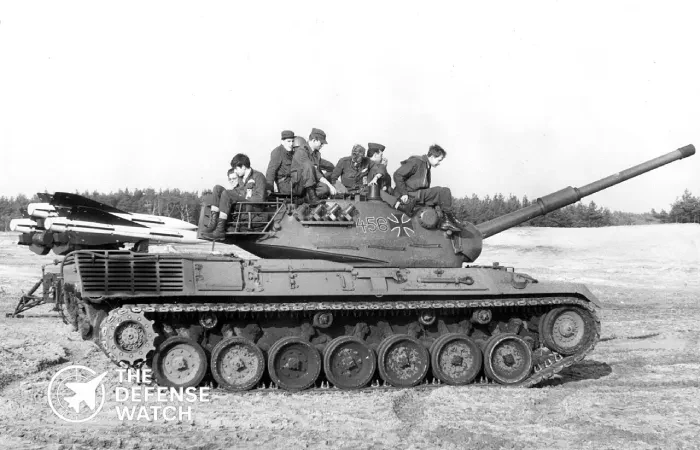
Manufactured in West Germany, the Leopard 1 was designed for both defensive and offensive operations, featuring a highly mobile chassis and a powerful 105mm Royal Ordnance L7 rifled main gun capable of engaging enemy armor at long distances. The tank’s diesel-powered engine provides up to 600 hp, giving it a top road speed of 65 km/h and an operational range of approximately 600 km, ideal for rapid maneuvers across varied terrain.
The Leopard 1’s modular design allows for multiple upgrade packages, including enhanced fire control systems, stabilized guns, and improved night-fighting capabilities. Secondary armament includes a coaxial 7.62mm MG and a roof-mounted machine gun, offering balanced protection against infantry and light vehicles.
This tank’s lightweight armor emphasizes mobility while still providing protection against small arms and artillery fragments. Its combat record spans decades, with deployment in Europe, the Middle East, and beyond, proving its reliability and adaptability.
Today, the Leopard 1 continues to serve in nations requiring a cost-effective, high-performance MBT for training and operational readiness. Its enduring design demonstrates how strategic engineering can deliver an effective balance of speed, firepower, and tactical flexibility.
Leopard 1 Tank Price
The Leopard 1 is a classic German main battle tank (MBT) that revolutionized armored warfare during the Cold War era. Developed by Krauss-Maffei in the 1960s, it was designed to prioritize speed, mobility, and firepower over heavy armor, making it a versatile platform for modern mechanized forces. The tank quickly became a standard in NATO armies and remains operational in several countries today.
Disclaimer Note
The information provided on TheDefenseWatch.com is for general informational purposes only. While we strive to ensure the accuracy, completeness, and timeliness of our content regarding defense and aerospace products, technologies, and specifications, we cannot guarantee that all information is 100% accurate or up-to-date due to the evolving nature of military technology and classified data.TheDefenseWatch.com does not warrant the reliability, suitability, or availability of the information for any specific purpose. Users are advised to consult official sources, such as manufacturers, government publications, or defense agencies, for precise and verified data before making decisions based on our content.We are not affiliated with any defense manufacturers, governments, or military organizations mentioned. Opinions, reviews, and ratings reflect expert analysis but are subjective and should not be considered endorsements. TheDefenseWatch.com is not responsible for any errors, omissions, or consequences arising from the use of this website’s content.External links are provided for convenience and do not imply endorsement. TheDefenseWatch.com reserves the right to update or modify content without prior notice. By using this website, you agree to our Privacy & Cookies Policy.
New Arrivals



Popular Comparisons
-
 Tejas vs Gripen: Key Differences and Capabilities
View Comparison →
Tejas vs Gripen: Key Differences and Capabilities
View Comparison → -
Tejas vs MiG-21 Bison: How India Replaced Its Iconic Supersonic Fighter
View Comparison →
-
F-35 vs F-16: Stealth, Sensors and Combat Roles
View Comparison →
-
Tejas Fighter Jet vs F-16 Fighting Falcon: Capability Compared
View Comparison →
-
Rafale Fighter Jet vs F-16 Fighting Falcon : Which Fighter Has the Edge?
View Comparison →
-
Su-57 Fighter Jet vs J-20 Fighter Jet: Stealth and Air Combat Compared
View Comparison →
-
Mirage 2000 vs Tejas Mk1A: Legacy Combat Power vs Indigenous Modernization
View Comparison →
-
Rafale Fighter Jet vs F-22 Raptor: Which Air Dominance Fighter Has the Edge?
View Comparison →
-
Tejas Fighter Jet vs. Rafale Fighter Jet: India’s Indigenous Fighter Meets France’s Proven Multirole Combat Aircraft
View Comparison →
-
F-22 Raptor vs. F-35 Joint Strike Fighter: Which Fifth Generation Fighter Has the Edge?
View Comparison →


- USS Oregon Visits Norway as U.S. Navy Maintains High North Presence

- Lockheed Martin Unveils PAC-3 Edge Interceptor for U.S. Army
- Northrop Grumman Completes B-2 Spirit of Kitty Hawk Overhaul
- Army Report Finds Systemic Failures Behind Fatal 2025 Midair Collision
- Lockheed Martin to Supply Black Hawk Training Systems to Philippine Air Force
- US Air Force Expands B-21 Raider Production Capacity by 25%
- Boeing Wins $10.9 Million VC-25B Test Maintenance Contract Modification
- Raytheon Wins $6.34 Billion Contract for SM-3 Block IB Missile Production
- USS Abraham Lincoln CO Addresses Crew Welfare Concerns After 322-Day Deployment
- General Dynamics, Primordial Labs to Add Voice Control to Abrams and XM30




Fighter Jets
-
 MIG-31 Fighter Jet
-
J-10CE Fighter Jet
-
Chengdu J-10 Fighter Jet
-
Chengdu J-10C Fighter Jet
-
Gripen E Fighter Jet
-
Tejas Mk1A Fighter Jet
-
Tejas Mk‑2 Fighter Jet
-
F-16V Viper Block 70 Fighter Jet
-
F-15EX Eagle II Fighter
-
Boeing F/A-XX Fighter
-
F-15E Strike Eagle Fighter
-
F/A-18E/F Super Hornet Fighter Jet
-
Saab Gripen F Fighter Jet
-
JAS 39E/F Gripen Fighter Jet
-
JAS 39 Gripen Fighter Jet
-
F-35A Lightning II Fighter Jet
-
F/A-18F Super Hornet
-
J-50 Fighter Jet
-
Spanish EF-18 Hornet Fighter
-
F-47 Fighter Jet
-
F-35i Adir Fighter Jet
-
F-16 Fighting Falcon
-
AIDC T-5 Brave Eagle
-
F-CK-1 Ching-Kuo Fighter







Recent Compares
-
Tejas vs Gripen: Key Differences and Capabilities
View Comparison →
-
Tejas vs MiG-21 Bison: How India Replaced Its Iconic Supersonic Fighter
View Comparison →
-
F-35 vs F-16: Stealth, Sensors and Combat Roles
View Comparison →
-
Tejas Fighter Jet vs F-16 Fighting Falcon: Capability Compared
View Comparison →
-
Rafale Fighter Jet vs F-16 Fighting Falcon : Which Fighter Has the Edge?
View Comparison →
Latest Defense Systems
10 Compares Defense Systems
-
Tejas vs Gripen: Key Differences and Capabilities
View Comparison →
-
Tejas vs MiG-21 Bison: How India Replaced Its Iconic Supersonic Fighter
View Comparison →
-
F-35 vs F-16: Stealth, Sensors and Combat Roles
View Comparison →
-
Tejas Fighter Jet vs F-16 Fighting Falcon: Capability Compared
View Comparison →
-
Rafale Fighter Jet vs F-16 Fighting Falcon : Which Fighter Has the Edge?
View Comparison →
-
Su-57 Fighter Jet vs J-20 Fighter Jet: Stealth and Air Combat Compared
View Comparison →
-
Mirage 2000 vs Tejas Mk1A: Legacy Combat Power vs Indigenous Modernization
View Comparison →
-
Rafale Fighter Jet vs F-22 Raptor: Which Air Dominance Fighter Has the Edge?
View Comparison →
-
Tejas Fighter Jet vs. Rafale Fighter Jet: India’s Indigenous Fighter Meets France’s Proven Multirole Combat Aircraft
View Comparison →
-
F-22 Raptor vs. F-35 Joint Strike Fighter: Which Fifth Generation Fighter Has the Edge?
View Comparison →
- USS Oregon Visits Norway as U.S. Navy Maintains High North Presence
- Lockheed Martin Unveils PAC-3 Edge Interceptor for U.S. Army
- Northrop Grumman Completes B-2 Spirit of Kitty Hawk Overhaul
- Army Report Finds Systemic Failures Behind Fatal 2025 Midair Collision
- Lockheed Martin to Supply Black Hawk Training Systems to Philippine Air Force