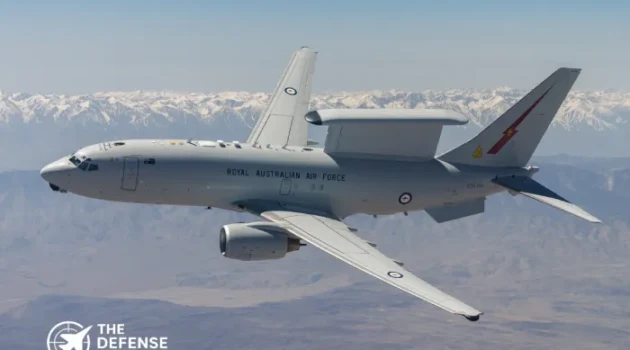
The E-7 is based on the Boeing 737-700 and uses a Northrop Grumman Multi-Role Electronically Scanned Array, or MESA, mounted above the fuselage. Australia’s E-7A fleet is officially listed at six aircraft, with a published range of 7,040 km and a maximum speed of 955 km/h. Boeing lists the E-7’s unrefueled range at 3,500 nautical miles, or about 6,482 km.
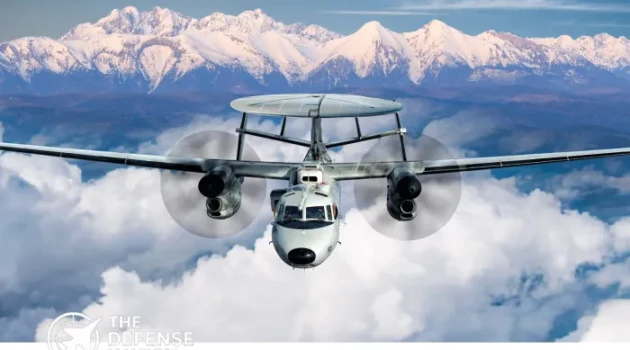
The E-2D Advanced Hawkeye is a very different design. It is a carrier-based aircraft built around the E-2 family and equipped with the AN/APY-9 radar. NAVAIR lists a speed above 300 knots, a ceiling of 37,000 feet and two T56-A-427A turboprops producing 5,100 shaft horsepower each.
KEY FACTS AT A GLANCE
| Specification | E-7 Wedgetail | E-2D Advanced Hawkeye | A-50/A-50U Mainstay |
|---|---|---|---|
| Manufacturer | Boeing | Northrop Grumman | Beriev, with Vega/Rostec mission systems |
| Basic platform | Boeing 737-700 | Carrier-based E-2 airframe | Ilyushin Il-76 transport derivative |
| Generation | Modern AEW&C | Modern carrier AEW&C | A-50U modernized legacy AEW&C |
| Maximum speed | 955 km/h | 300+ knots, about 556 km/h | About 800 km/h |
| Published range | 6,482 km unrefueled | Public sources emphasize endurance and aerial refueling rather than a single combat-radius figure | About 5,000 km for A-50 |
| Ceiling | 41,000 ft | 37,000 ft in NAVAIR specification | About 10,000 m |
| Primary sensor | Northrop Grumman MESA radar | AN/APY-9 radar | Shmel-M radar system |
| Radar architecture | Electronically scanned array | Electronically scanned array within rotodome | Large rotating radar system |
| Crew | 2 pilots plus mission crew | 5 | About 15 for A-50 |
| Armament | None | None | None |
| Air-to-air refueling | Yes | Yes on equipped aircraft | Not treated as a standard published capability |
| Main role | Long-range AEW&C and battle management | Carrier AEW&C and fleet command and control | Long-range airborne radar surveillance and control |
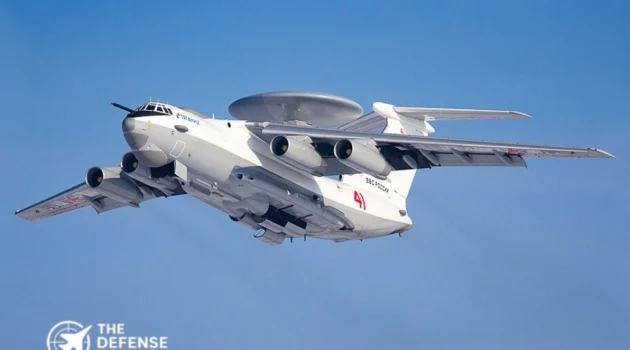
The Russian A-50 is derived from the Il-76 transport aircraft. The A-50U modernization replaces or upgrades significant elements of the mission system, including radar electronics and operator displays. Russian sources state that the A-50U can track more targets and direct more fighters than the earlier A-50.
Executive Summary
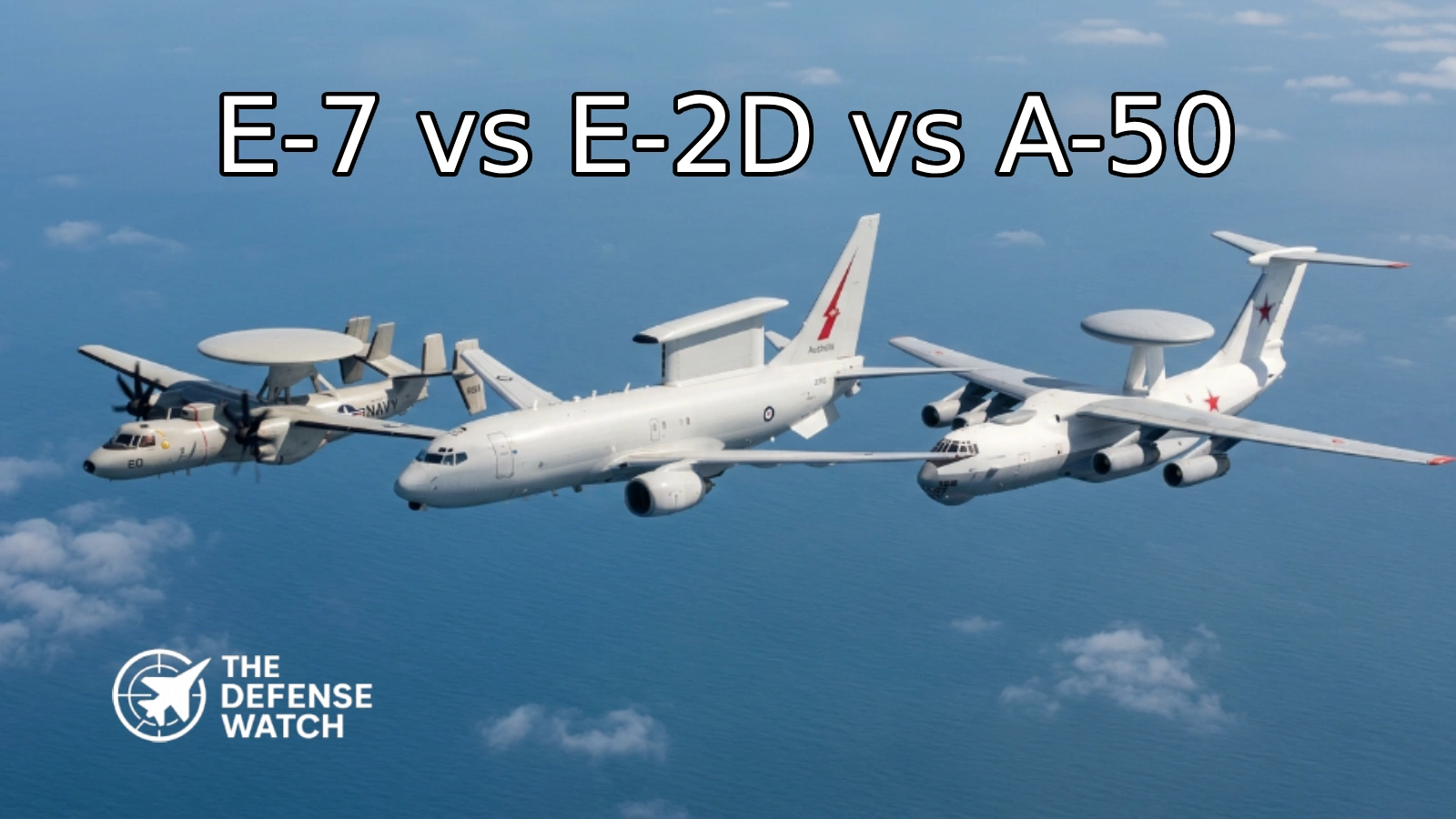
The E-7 Wedgetail, E-2D Advanced Hawkeye and A-50 Mainstay represent three different approaches to airborne early warning and control. The E-7 uses a large 737-based airframe to combine long endurance, a sizable mission crew, electronically scanned radar and extensive communications. The E-2D is smaller and carrier compatible, making it central to U.S. Navy carrier strike group air defense and battle management. The A-50, meanwhile, is a heavy Il-76-derived platform designed to provide long-range radar surveillance and fighter control.
Recent milestones show continued investment in the Western systems. In May 2026, the first RAF E-7 Wedgetail arrived at RAF Lossiemouth for continued test and evaluation. The E-2D program is also receiving new capabilities, including a $33 million Precision Approach Landing Capability integration contract announced in April 2026. Russia continues to modernize its A-50 fleet through the A-50U program, although detailed current performance data remain limited in public sources.
E-7 Wedgetail: Large-Area Surveillance and Battle Management
The E-7 Wedgetail is designed around the idea that an AEW&C aircraft is more than a flying radar. It functions as an airborne command node connecting aircraft, ships, ground forces and other sensors.
Its most distinctive feature is the MESA radar, mounted in a fixed structure above the fuselage. Unlike the large rotating radar dish used on older AWACS aircraft, the MESA architecture provides electronically scanned coverage while avoiding the need for a mechanically rotating antenna.
Australia states that the E-7 can simultaneously track airborne and maritime targets and cover more than four million square kilometers during a standard mission. The aircraft also carries 10 mission consoles and supports HF, VHF, UHF, Link 11, Link 16 and satellite communications.
The 737-based airframe gives the E-7 considerable internal volume for mission equipment, operators, fuel and communications equipment. Its published maximum ceiling is 41,000 feet, while the Australian aircraft can receive aerial refueling.
A major recent milestone came in May 2026, when the first British E-7 arrived at RAF Lossiemouth. The aircraft, designated WT001, entered continued test and evaluation rather than operational service.
The E-7 has also demonstrated its role in future networked warfare. In 2025, Boeing and the Royal Australian Air Force demonstrated control of multiple MQ-28 Ghost Bat aircraft from an E-7, followed later that year by an air-to-air missile engagement involving the MQ-28, E-7A and F/A-18F.
E-2D Advanced Hawkeye: Carrier-Based Airborne Command Node
The E-2D Advanced Hawkeye is optimized for a different operating environment. Its defining advantage is carrier compatibility.
The aircraft uses the AN/APY-9 radar, which NAVAIR describes as providing a major increase in radar capability over earlier E-2 variants. The system is designed for airborne surveillance, early warning, target tracking and battle management across maritime and land environments.
The E-2D uses a five-person crew and a glass cockpit with a tactical fourth operator display. Its mission system can integrate radar, IFF, electronic support measures and off-board sensors, allowing the aircraft to distribute tactical information to other forces.
Aerial refueling has significantly expanded the operational flexibility of the E-2D. The Navy states that refueling allows the aircraft to remain airborne longer and operate farther from its carrier.
In April 2026, NAVAIR announced a $33 million contract to integrate Precision Approach Landing Capability into the E-2D. The system is intended to improve carrier landing precision in adverse weather, low visibility and nighttime conditions.
The E-2D therefore combines airborne early warning with the specific requirements of carrier aviation. Its smaller airframe and lower speed compared with the E-7 are not necessarily disadvantages because its design priorities include carrier launch and recovery, fleet air defense and integration with naval combat systems.
A-50 Mainstay: Russia’s Heavy AEW&C Platform
The A-50 Mainstay is the oldest basic design in this comparison. It is derived from the Il-76 transport aircraft and uses a large radar system mounted above the fuselage.
The aircraft is designed to detect, identify and track airborne targets while also monitoring large surface and ground targets. It can transmit information to command centers and guide fighter aircraft.
The A-50U modernization program introduces newer electronics, larger LCD displays and an updated navigation system. Russian industry sources say the modernization reduces equipment weight while improving radar and mission-system performance.
Public technical sources list the original A-50 at approximately 800 km/h maximum speed, around 5,000 km range and a ceiling of about 10,000 meters. Published figures for the A-50U’s actual operational performance are less complete, so those numbers should not automatically be applied to every modernized aircraft.
The A-50’s large airframe offers substantial space for mission personnel and equipment. However, the platform’s public modernization record is less transparent than that of the U.S. and allied aircraft.
Sensor Fusion and Electronic Warfare
The three aircraft are not stealth platforms. Their survivability comes primarily from standoff distance, altitude, electronic protection, networking, fighter escorts and situational awareness, rather than low radar cross section.
Consequently, assigning a specific RCS figure to any of the three would be misleading because authoritative public figures are not available.
The E-7 emphasizes networked battle management. Boeing describes its system as integrating airborne surveillance with multidomain data and communications.
The E-2D similarly operates as a networked command-and-control aircraft. Its radar, IFF, electronic support measures and data links allow it to create and distribute a broader tactical picture.
The A-50U performs a comparable mission using the Russian Vega-developed radar and command system. Russian sources state that the modernized aircraft can detect newer aircraft types and track more targets than the original configuration.
None of these aircraft carries a conventional primary armament. Their combat value comes from detecting threats, managing the air battle and passing targeting information to fighters, ships and other weapons platforms.
Propulsion and Performance
The propulsion philosophies reflect their airframe designs.
The E-7 uses two CFM International CFM56-7 turbofans, each producing 27,300 pounds of thrust according to Australia’s published specifications.
The E-2D uses two Rolls-Royce T56-A-427A turboprops, each rated at 5,100 shaft horsepower. Its lower speed is offset by its ability to operate from aircraft carriers and remain integrated with the carrier air wing.
The A-50 uses four engines because it is based on the much larger Il-76 transport architecture. Public specifications identify four turbofan engines on the A-50 family.
Comparative Assessment
Area E-7 Wedgetail E-2D Advanced Hawkeye A-50/A-50U Long-range AEW&C Very strong Strong Strong Carrier operations No Yes No Mission crew capacity Large Smaller Large Networking Extensive Extensive Extensive, with less public detail Radar technology MESA electronically scanned array AN/APY-9 electronically scanned radar Shmel-M family Aerial refueling Yes Yes Public data limited Maritime operations Strong Strong Strong Modernization transparency High High Limited Primary design emphasis Joint battle management Carrier fleet defense Long-range air surveillance Strategic and Export Outlook
The E-7 has developed into an international AEW&C platform rather than an Australian-only system. Australia operates six aircraft, while the United Kingdom is introducing the E-7AEW Mk1. Boeing also lists Türkiye and South Korea among E-7 customers.
The RAF’s first aircraft reached Lossiemouth in May 2026, marking an important step toward British operational service.
The E-2D follows a different export model centered on naval aviation. France became an international E-2D customer, while Japan is also part of the wider E-2D user community. Its carrier compatibility makes it particularly relevant to navies operating large-deck aircraft carriers.
Russia’s A-50U remains an important component of its long-range airborne surveillance architecture, but its modernization pace and fleet availability are harder to evaluate from public information. Russian defense sources continue to report A-50U upgrades and deliveries.
Conclusion
The E-7 Wedgetail, E-2D Advanced Hawkeye and A-50 are built around the same basic military requirement: extend the commander’s view of the battlespace beyond the limits of ground-based radar and individual fighters.
The E-7 combines a large commercial-derived airframe, electronically scanned radar and extensive networking for long-duration joint operations. The E-2D places similar sensor and command functions aboard a carrier-capable platform optimized for fleet air defense. The A-50 provides Russia with a heavy airborne radar and command platform based on the Il-76 architecture, with the A-50U modernization adding newer electronics and mission equipment.
The most important distinction is therefore not maximum speed or airframe size. It is how each aircraft fits into its wider combat network. Modern AEW&C aircraft increasingly serve as airborne data and command nodes, connecting sensors, aircraft, ships and weapons into a common operational picture. Recent E-7 demonstrations with the MQ-28 and continuing E-2D software and landing-system upgrades show how this role is expanding beyond traditional early warning toward distributed, networked air combat.