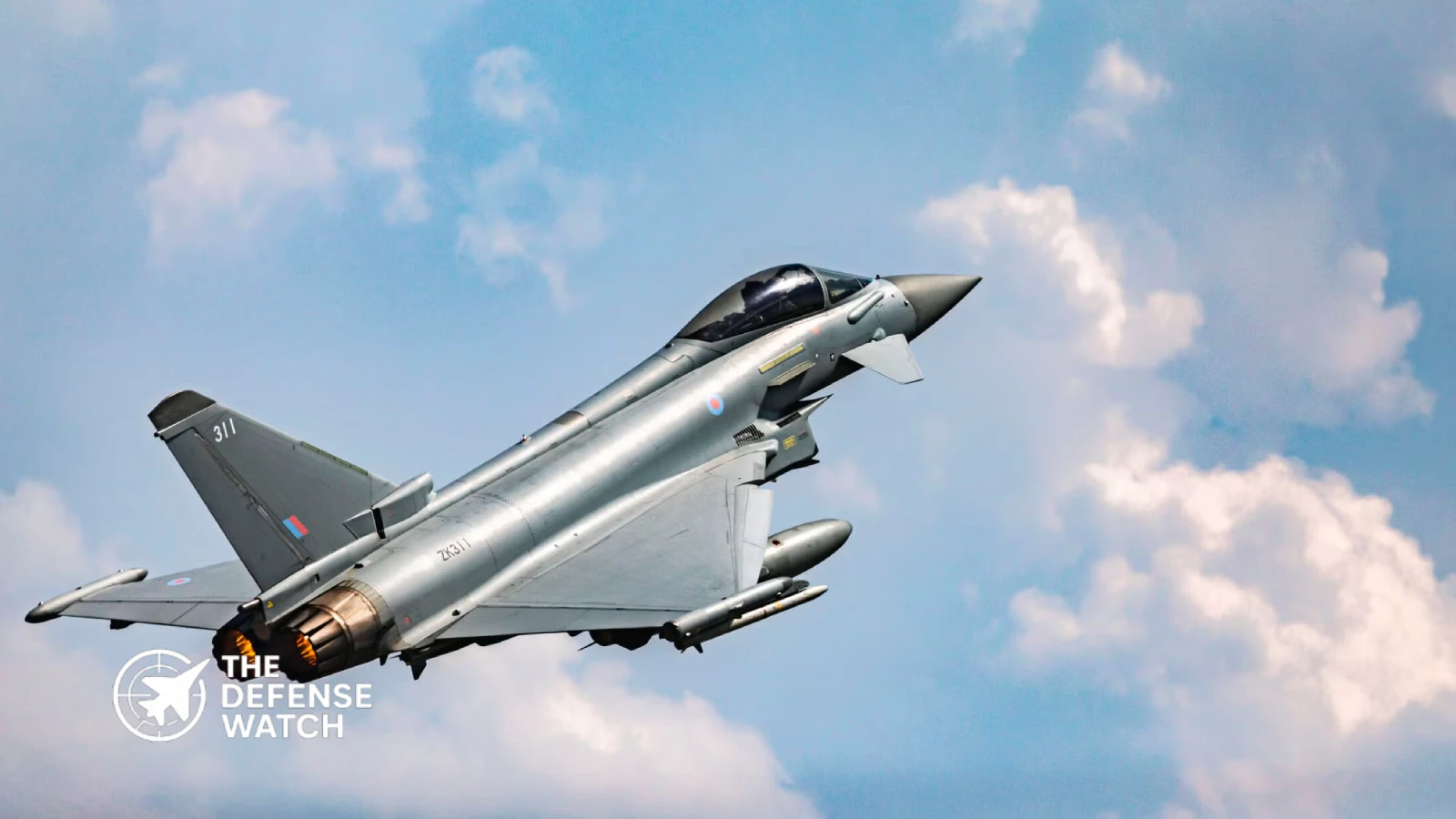
Executive Summary: RAF Typhoon fighters launched from RAF Lossiemouth on Friday night after an unidentified aircraft approached UK airspace. An RAF Voyager tanker supported the Quick Reaction Alert mission, but the aircraft remained far enough away that no interception was required.
RAF Typhoons Scrambled North of Scotland
RAF Typhoons scrambled north of Scotland on Friday night after an unidentified aircraft approached UK airspace, according to the UK Defence Journal. The fighters launched from RAF Lossiemouth in Moray as part of the Royal Air Force’s Quick Reaction Alert, or QRA, system. An RAF Voyager tanker also took part in the sortie.
The aircraft that triggered the response remained sufficiently distant from the UK that the Typhoons did not conduct an interception. The RAF aircraft were subsequently observed returning to base.
The incident demonstrates the purpose of the QRA system, which keeps fighter aircraft and crews at high readiness to respond rapidly when an unidentified or potentially concerning aircraft is detected near UK airspace.
How The Quick Reaction Alert System Works
The UK maintains QRA forces at RAF Lossiemouth and RAF Coningsby. Lossiemouth is responsible for the northern approaches to the United Kingdom, including Scotland, while Coningsby provides coverage for the south.
The RAF says its QRA Typhoons remain on standby around the clock. When an aircraft is detected that cannot immediately be identified or whose behavior requires investigation, information from military and civilian surveillance systems can be assessed before a decision is made to launch fighters.
The RAF’s published QRA process involves surveillance and command elements including the Control and Reporting Centre at RAF Boulmer and the National Air and Space Operations Centre. Once authorization is given, pilots at the appropriate QRA station can be ordered to launch.
Importantly, a QRA launch does not automatically mean that an aircraft has violated sovereign UK airspace.
The RAF explains that fighters can be dispatched to identify an aircraft, establish communications, monitor its movements, or escort it if required. An interception may ultimately be unnecessary if the aircraft changes course or remains outside the area where direct engagement is required.
That distinction is important in the latest incident. The available reporting does not identify the aircraft involved or establish that it entered UK sovereign airspace. The UK Defence Journal reported only that the aircraft was approaching UK airspace and remained sufficiently distant for an interception not to take place.
RAF Lossiemouth Remains Key To Northern Air Defense
RAF Lossiemouth has a central role in Britain’s northern air defense posture.
The station, located in Moray in northeastern Scotland, is one of two RAF QRA bases protecting UK airspace. It is home to four Typhoon squadrons alongside the RAF’s P-8A Poseidon maritime patrol aircraft capability.
The RAF specifically notes that normal Typhoon flying from Lossiemouth generally takes place during daytime and evening hours, but QRA aircraft remain on standby 24 hours a day and can launch without notice.
That helps explain why unusual aircraft activity can occur outside normal scheduled flying periods.
The station’s geographic position is also significant. Lossiemouth provides a northern base from which RAF fighters can respond to activity around Scotland, the North Atlantic and approaches to the United Kingdom.
The UK government has previously described Lossiemouth as the northern QRA station and highlighted its role in responding to unidentified aircraft and potential threats.
Voyager Tanker Adds Endurance
The involvement of an RAF Voyager tanker provides an additional indication of how the QRA force can be supported during longer-range sorties.
Voyager is the RAF’s air-to-air refueling and strategic air transport aircraft. Its tanker capability allows compatible aircraft such as the Typhoon to receive fuel while airborne, extending their endurance and operational reach.
For northern air-defense missions, this capability can be particularly useful because aircraft detected well away from the UK may require fighters to remain airborne for an extended period while the situation is assessed.
In the latest incident, the Voyager was airborne in support of the Typhoons, according to open-source flight tracking information cited by the UK Defence Journal. The publication reported that the Typhoon departed Lossiemouth on a north-easterly heading while the tanker was also airborne.
Typhoon Remains Central To RAF Air Defense
The Eurofighter Typhoon FGR4 is the RAF’s primary fighter for QRA duties in the United Kingdom.
The aircraft was developed as an air-superiority fighter but has evolved into a multirole platform capable of performing air defense, strike and other missions. The RAF says Typhoon continues to play a major role in UK QRA operations as well as NATO air-policing missions.
For air-defense missions, RAF Typhoons can employ weapons including the Advanced Short Range Air-to-Air Missile and Meteor beyond-visual-range air-to-air missile. The aircraft is also equipped with sensors and radar designed to support detection, tracking and identification of airborne targets.
The latest RAF Typhoons scrambled north of Scotland incident therefore fits into an established UK air-defense framework rather than representing a new type of mission.
What The Incident Shows
The key point is that the QRA system is designed to respond before an unidentified aircraft necessarily becomes a direct threat to UK territory.
The fighters were launched, supported by a tanker, and prepared to investigate the aircraft. Because the target remained sufficiently distant, an interception was ultimately not required. That outcome illustrates one of the principal functions of QRA: maintaining the ability to investigate potential concerns quickly while avoiding unnecessary escalation.
It also demonstrates the importance of maintaining fighters at readiness in Scotland. RAF Lossiemouth’s location gives the UK a standing fighter presence positioned close to the country’s northern approaches.
There is no evidence in the available reporting that the unidentified aircraft entered British sovereign airspace, nor has the UK Defence Journal publicly identified it. Those details should not be inferred beyond the information currently available.
For readers tracking UK and NATO air activity, the episode is another example of how fighter aircraft, surveillance networks and tanker support work together to maintain continuous air-defense coverage.