Executive Summary:
Northrop Grumman has delivered the 70th E-2D Advanced Hawkeye to the United States Navy, marking a key milestone in modernizing carrier-based airborne early warning capabilities. The platform enhances situational awareness and battle management across contested environments. The delivery reflects continued investment in network-centric warfare and integrated air and missile defense.
E-2D Hawkeye Delivery Milestone Strengthens U.S. Naval Aviation
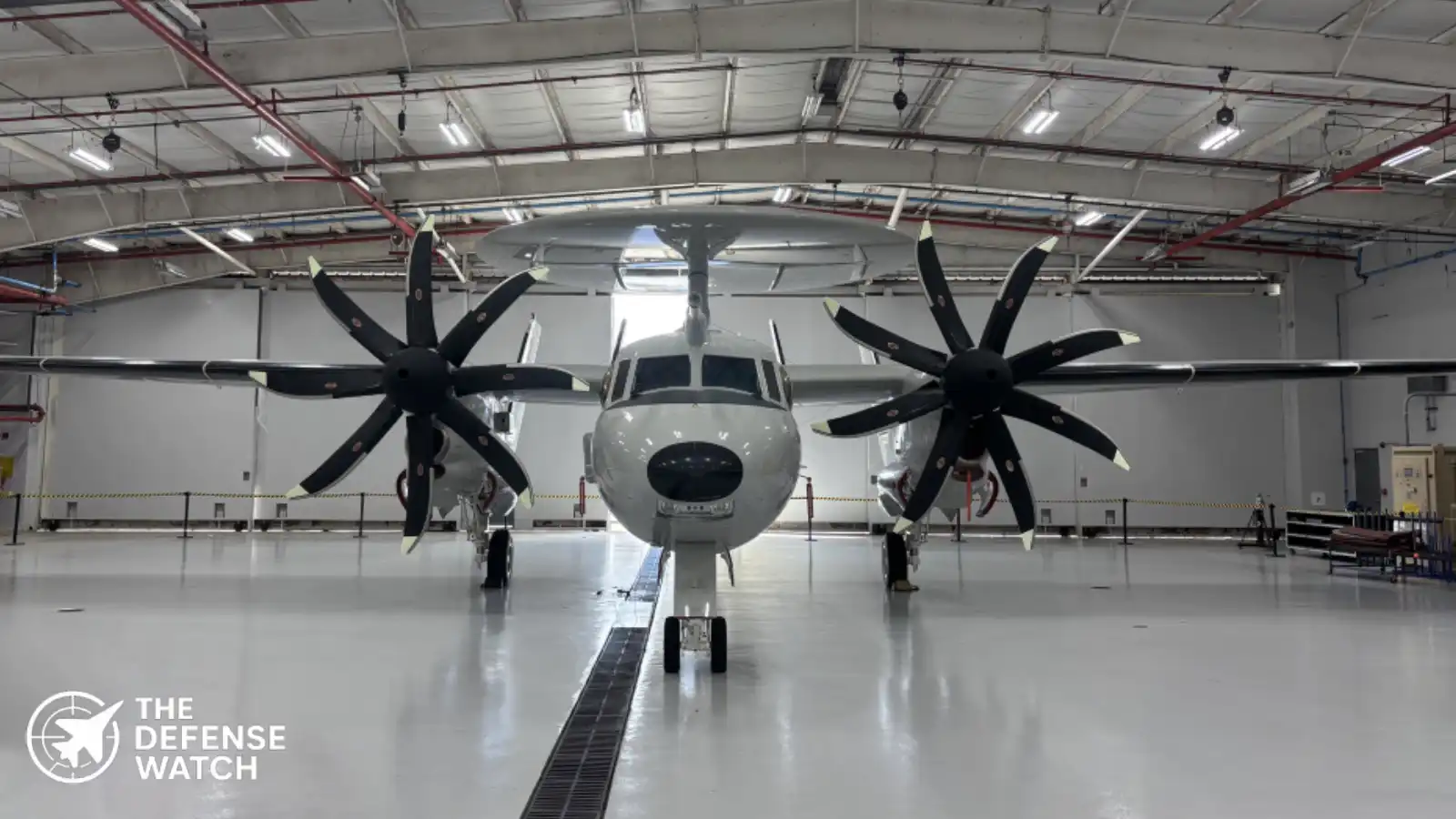
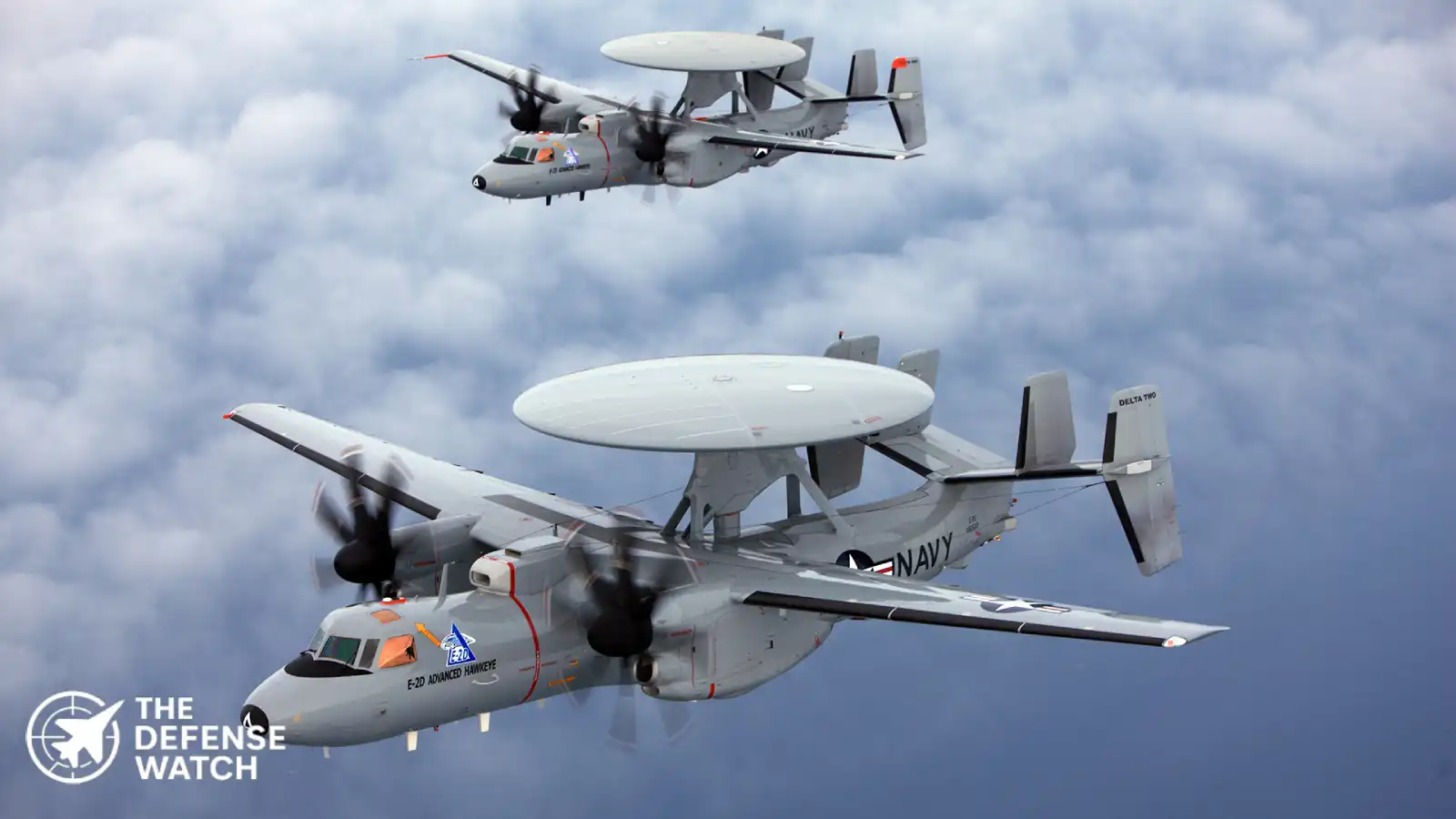
The delivery of the 70th E-2D Advanced Hawkeye underscores the U.S. Navy’s sustained effort to modernize its airborne early warning and command-and-control fleet. The aircraft, manufactured by Northrop Grumman, represents the latest evolution of the long-serving Hawkeye family.
The E-2D replaces older variants with a platform designed for operations in highly contested electromagnetic environments. It provides enhanced detection, tracking, and coordination capabilities for carrier strike groups operating across global theaters.
This milestone reflects steady production progress under a multi-year procurement framework aimed at delivering a fully modernized fleet.
Advanced Radar and Network-Centric Warfare Capabilities
At the core of the E-2D’s capability is its AN/APY-9 radar, which enables simultaneous air and surface surveillance over extended ranges. The aircraft is optimized for detecting low-observable and cruise missile threats.
Key Technical Advantages
- 360-degree radar coverage with advanced electronic scanning
- Enhanced detection of low-signature targets, including cruise missiles and UAVs
- Integrated battle management systems for real-time command and control
- Cooperative Engagement Capability (CEC) enabling sensor data sharing across platforms
- Improved data fusion, supporting joint and coalition operations
The aircraft serves as a critical node in the Navy’s broader Naval Integrated Fire Control-Counter Air (NIFC-CA) architecture.
Comparison: E-2D Advanced Hawkeye vs E-2C Hawkeye
Feature E-2D Advanced Hawkeye E-2C Hawkeye Range Extended (>550 km detection) ~400 km detection Payload Advanced radar + upgraded avionics Legacy radar systems Status Active production and deployment Being phased out Key Technology AN/APY-9 AESA radar, CEC, NIFC-CA integration Mechanically scanned radar Operational Role in Carrier Strike Groups
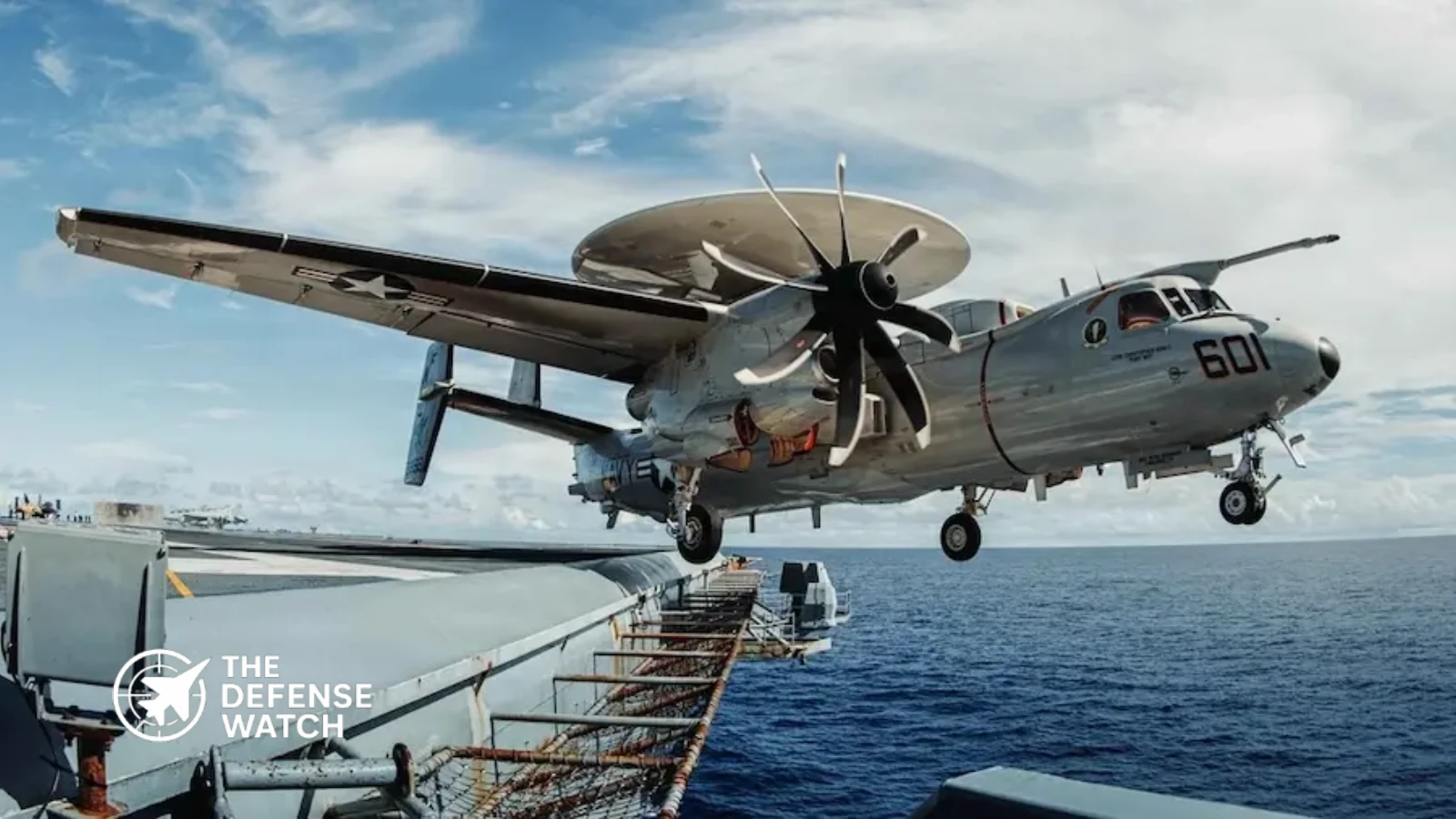
The E-2D operates from U.S. Navy aircraft carriers, providing:
- Early warning of airborne threats
- Battle management for air defense missions
- Coordination of fighter aircraft and interceptors
- Integration with surface and air assets
Its ability to act as an airborne command post makes it indispensable in high-end naval warfare scenarios.
Strategic Context: Countering Modern Threat Environments
The continued fielding of the E-2D comes amid evolving global threats, including:
- Proliferation of long-range anti-ship missiles
- Increased use of low-observable aircraft and drones
- Expansion of peer adversary anti-access/area denial (A2/AD) networks
In this context, the E-2D enhances the U.S. Navy’s ability to:
- Maintain persistent maritime domain awareness
- Coordinate multi-domain operations
- Enable long-range engagement capabilities
The aircraft plays a central role in ensuring carrier strike groups remain viable in contested regions such as the Indo-Pacific and beyond.
Production Outlook and Fleet Expansion
Northrop Grumman continues production under existing contracts, with additional aircraft expected to be delivered in the coming years. The U.S. Navy plans to expand its E-2D fleet to fully replace legacy E-2C variants.
The program also includes international interest, with allied nations evaluating or operating the platform to enhance their own airborne early warning capabilities.
Conclusion
The delivery of the 70th E-2D Advanced Hawkeye marks a significant milestone in U.S. naval aviation. As threats become more complex and contested environments more challenging, the platform provides a critical edge in airborne surveillance, battle management, and networked warfare.
Lockheed Martin DREXR Upgrade Advances E-2D Hawkeye Capability
The Lockheed Martin DREXR upgrade has successfully completed flight testing on the U.S. Navy’s E-2D Advanced Hawkeye, marking an important step in keeping one of America’s most critical airborne early warning aircraft ready for future threats. The company announced the milestone on April 21, saying the program was completed in cooperation with Northrop Grumman.
The E-2D Advanced Hawkeye is the Navy’s carrier-based airborne surveillance and battle management aircraft. It provides long-range radar coverage, tracks hostile aircraft and missiles, and helps connect naval and joint forces across the battlespace.
- Lockheed Martin and Northrop Grumman completed flight testing of the DREXR upgrade for the U.S. Navy E-2D Advanced Hawkeye.
- DREXR stands for Digital Receiver Exciter Recorder and replaces legacy exciter and receiver subsystems.
- Tested capabilities included wideband transmit and receive, software-defined waveforms, and independent radar element transmission.
- Upgrade is designed to improve detection, tracking, and decision speed in contested environments.
- E-2D remains a key airborne command-and-control asset for U.S. Navy carrier strike groups.
The latest DREXR modernization effort focuses on upgrading core radar electronics rather than replacing the aircraft itself. That matters because the Hawkeye fleet remains central to U.S. carrier strike group operations, especially as potential adversaries field longer-range missiles, stealth aircraft, electronic warfare systems, and drone swarms.
What The DREXR Upgrade Changes
According to Lockheed Martin, DREXR, short for Digital Receiver Exciter Recorder, is a compact single-box system that replaces the current exciter and receiver subsystems aboard the aircraft.
During flight testing, the team validated:
- Wideband transmit and receive functions
- Independent transmit control for each radar element
- Software-defined waveform capability
- Integrated recording for mission analysis
- Data collection to support future AI-enabled capabilities
In practical terms, these upgrades should allow faster software changes, better signal processing, and improved adaptability against emerging threats.
That is increasingly important because modern radar competition is no longer only about range. It is also about how quickly a sensor can classify targets, reject jamming, and share data across multiple platforms.
Why The E-2D Hawkeye Still Matters
The E-2D Advanced Hawkeye is often overshadowed by fighter jets, but it is one of the most valuable aircraft on any carrier deck.
Its AN/APY-9 radar is designed to detect aircraft and cruise missiles at long range while supporting command-and-control functions. The platform also acts as a communications node linking ships, aircraft, and joint forces.
From an operational standpoint, fighters such as the F-35 can strike targets, but platforms like the Hawkeye help the fleet see first and react first.
That makes modernization programs like DREXR strategically significant. Improving sensing and battle management can increase the effectiveness of every other platform operating nearby.
Broader U.S. Navy Modernization Context
The DREXR milestone comes as the U.S. Navy and industry are also pursuing broader Block II modernization for the E-2D fleet, including cockpit, computing, and mission system upgrades.
This layered approach suggests the Navy intends to keep the Hawkeye relevant well into the next decade rather than rushing toward an entirely new replacement platform.
For Pentagon planners, that is a practical path. Incremental upgrades can deliver better performance faster and at lower risk than launching a clean-sheet aircraft program.
Analysis
The Lockheed Martin DREXR upgrade is more than a routine electronics refresh. It reflects a larger shift in military aviation where software speed, modular hardware, and sensor networking are becoming as important as airframe performance.
As maritime threats expand in the Indo-Pacific and other theaters, the side that detects first and coordinates faster gains a decisive edge. In that environment, the E-2D Hawkeye remains a high-value asset, and upgrades like DREXR help preserve that advantage.