

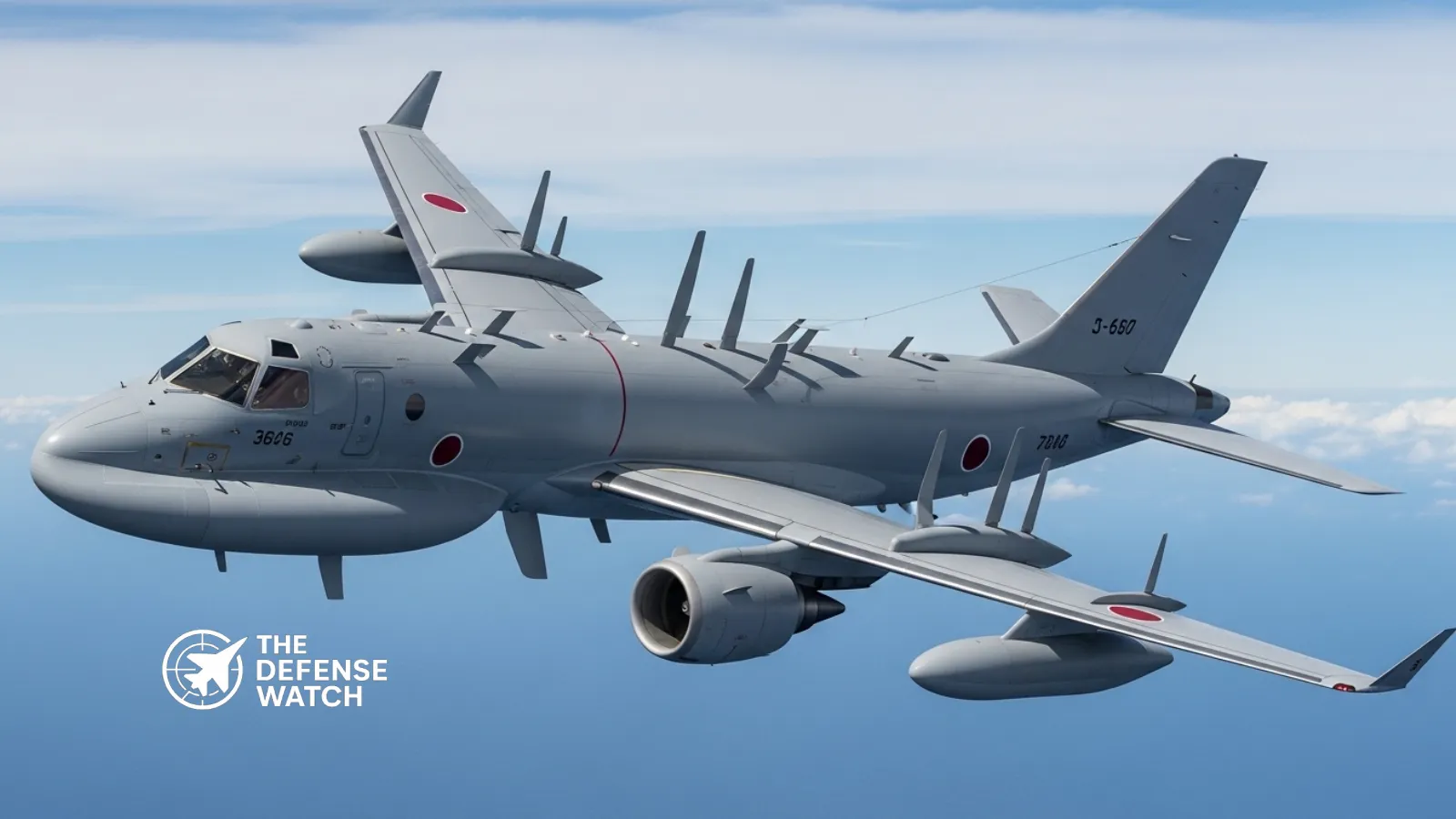
- Japan is preparing a new airborne electronic warfare aircraft derived from the Kawasaki P-1 maritime patrol platform.
- The aircraft will conduct signals intelligence, radar detection, and electronic jamming missions.
- The system is intended to replace aging EP-3 Orion electronic intelligence aircraft used by the Japan Maritime Self-Defense Force.
- Development funding includes roughly 41.4 billion yen requested in Japan’s FY2025 defense budget.
- The platform will support Japan’s growing focus on electromagnetic warfare and cross-domain military operations.
Japan Electronic Warfare Aircraft Program Moves Toward Testing
Japan’s new electronic warfare aircraft is moving toward testing as Tokyo accelerates efforts to strengthen its electromagnetic warfare capabilities. The aircraft, derived from the Kawasaki P-1 maritime patrol aircraft, is designed to conduct signals intelligence collection, radar detection, and electronic attack missions for the Japan Maritime Self-Defense Force (JMSDF).
The platform forms part of a broader Japanese defense modernization initiative aimed at improving the country’s ability to detect, disrupt, and exploit adversary communications and radar systems. Once operational, the aircraft will replace the JMSDF’s aging EP-3 Orion electronic intelligence aircraft, which have been in service since the early 1990s.
Japan’s Ministry of Defense has requested approximately 41.4 billion yen (about $288 million) in its fiscal year 2025 defense budget to continue development of the program.
The Big Picture
Electronic warfare has become a central domain in modern military operations. Control of the electromagnetic spectrum determines how effectively forces can detect threats, communicate, guide weapons, and disrupt enemy systems.
Japan’s defense strategy increasingly emphasizes this domain as regional security conditions grow more complex. Chinese and Russian military activity in the East China Sea and Western Pacific has increased significantly over the past decade, placing greater pressure on Japan’s surveillance and electronic intelligence capabilities.
Modern conflicts rely heavily on networked sensors, digital command systems, and advanced radar. Electronic warfare platforms can degrade these systems without firing a shot. They can jam communications, deceive radar networks, or collect intelligence on adversary capabilities.
For Tokyo, developing a modern Japan electronic warfare aircraft allows the Self-Defense Forces to operate more effectively in a highly contested electromagnetic environment.
What’s Happening
Japan’s Ministry of Defense is developing a specialized electronic warfare aircraft based on the domestically produced Kawasaki P-1 maritime patrol aircraft. The P-1 already serves as Japan’s primary anti-submarine and maritime surveillance aircraft.
The electronic warfare variant will incorporate a wide range of sensors and systems designed to monitor and manipulate the electromagnetic spectrum.
According to Japanese defense planning documents, the aircraft will support missions including:
- Signals intelligence (SIGINT)
- Electronic intelligence (ELINT)
- Communications intelligence (COMINT)
- Radar detection and classification
- Electronic jamming and deception
The aircraft is expected to carry multiple antennas, sensor arrays, and specialized radomes positioned around the fuselage. These features enable the platform to collect electronic emissions from radar and communication systems over long distances.
Japanese defense officials describe the platform as a multi-sensor electronic intelligence aircraft designed to support joint operations across multiple domains.
Prototype development began in fiscal year 2024, with production and testing expected to continue through the early 2030s.
Why It Matters
Electronic warfare capability is essential for modern military operations.
Advanced air defense systems rely on radar networks that track aircraft, guide missiles, and coordinate defenses. Electronic warfare platforms can interfere with those networks by jamming signals or feeding false information into radar systems.
The new Japan electronic warfare aircraft will give Tokyo a stronger ability to monitor foreign military activity and disrupt hostile sensors if necessary.
This capability is particularly important for maritime security. Japan sits along major sea lanes that connect the Pacific and Indian Oceans. Monitoring electromagnetic emissions from ships, aircraft, and military installations helps the Self-Defense Forces maintain situational awareness across vast areas.
Electronic intelligence aircraft also support targeting, early warning, and battle management during joint operations.
Strategic Implications
The development of a modern electronic warfare aircraft reflects Japan’s broader shift toward advanced defense technologies.
Tokyo’s latest national defense strategies emphasize:
- Cross-domain operations
- Integrated command and control networks
- Long range strike capabilities
- Advanced intelligence and surveillance systems
Electronic warfare sits at the center of all these capabilities.
If deployed effectively, the platform could support operations involving fighter aircraft, naval forces, and missile defense systems. It could also help protect friendly aircraft by degrading enemy radar and missile guidance systems.
For allied operations, the aircraft could contribute to intelligence sharing and joint situational awareness across the Indo Pacific.
Competitor View
China will likely view the new Japan electronic warfare aircraft as part of a broader regional trend toward advanced electromagnetic warfare capabilities.
The People’s Liberation Army has invested heavily in electronic warfare platforms, including specialized aircraft designed to jam radar systems and support suppression of enemy air defenses.
From Beijing’s perspective, Japan’s development of a modern airborne electronic warfare capability strengthens the technological edge of U.S. allied forces operating in the Western Pacific.
Russia may also monitor the program closely, particularly given its growing military presence in the Sea of Japan and surrounding areas.
However, Japan has framed the program as a defensive measure intended to improve surveillance, intelligence collection, and operational resilience.
Capability Gap
The program addresses a clear capability gap in Japan’s current electronic intelligence fleet.
The JMSDF currently operates a small number of EP-3 Orion aircraft that perform signals intelligence missions. These aircraft have served for decades and are becoming increasingly difficult to maintain.
Older platforms also struggle to keep pace with modern digital radar systems, encrypted communications networks, and advanced electronic warfare techniques.
By replacing these aircraft with a new system derived from the P-1, Japan aims to deploy a platform with:
- Greater sensor sensitivity
- Expanded data processing capacity
- Improved survivability
- Longer operational endurance
Despite these advantages, electronic warfare aircraft often operate close to contested airspace, which exposes them to potential interception or missile threats.
For that reason, these platforms typically operate with escort aircraft or maintain stand-off distances from hostile defenses.
What To Watch Next
Several milestones will shape the future of the program.
Key developments include:
- Prototype production and ground testing
- Initial flight testing of the electronic warfare configuration
- Integration of advanced signal processing systems
- Operational evaluation with the JMSDF
Full operational capability is expected later in the next decade once testing and system integration are completed.
Japan’s defense planners may also expand the program depending on operational requirements and budget priorities.
The Bottom Line
Japan’s new electronic warfare aircraft program marks a significant step toward strengthening electromagnetic dominance and intelligence collection capabilities in the Indo Pacific.
