
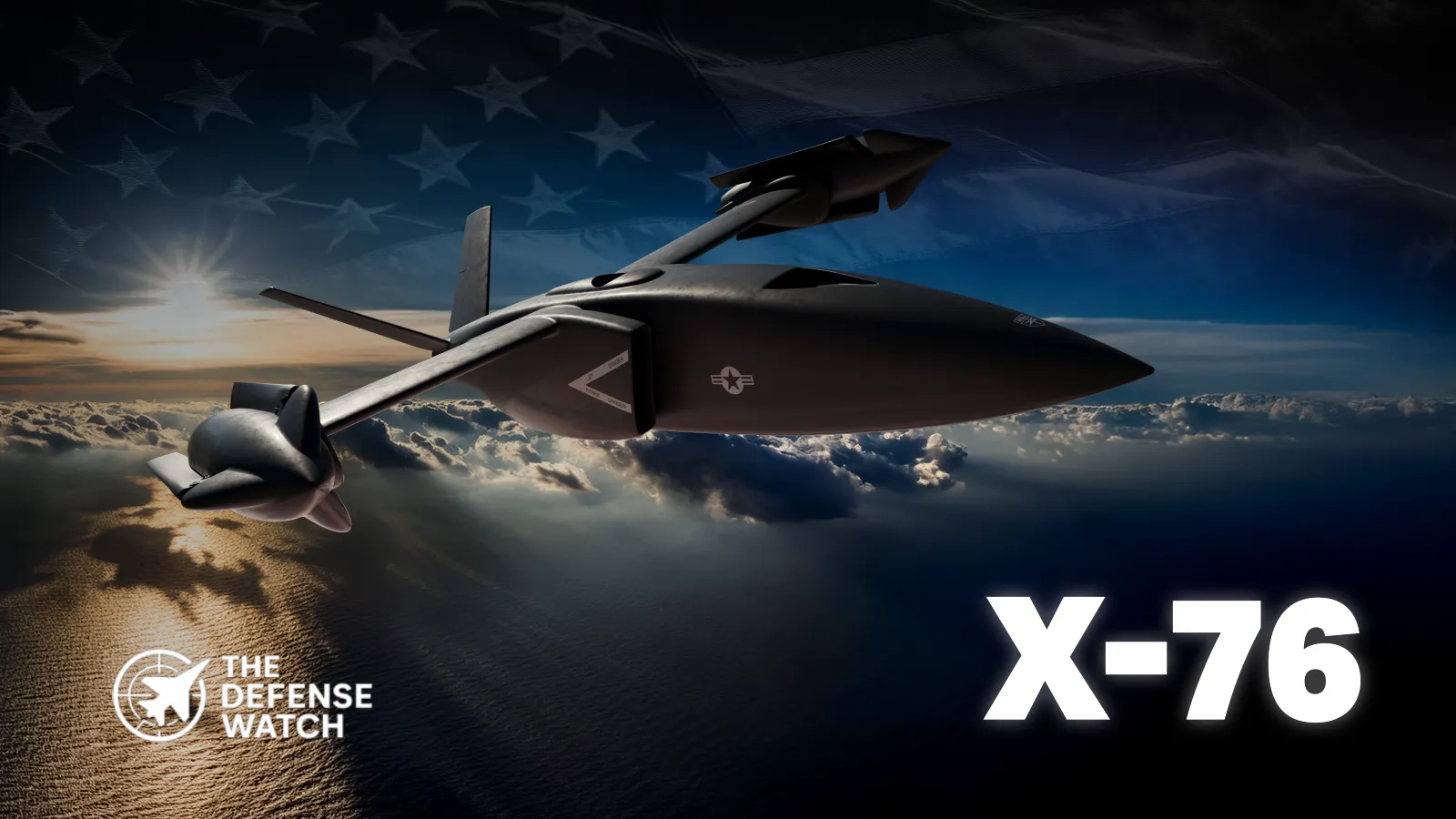
- Bell completed the Critical Design Review for DARPA’s SPRINT X-Plane program and received the official X-76 designation.
- The experimental aircraft aims to combine helicopter-like vertical lift with jet-like cruise speeds exceeding 400 knots.
- The program is jointly funded by DARPA and U.S. Special Operations Command to enable runway independent military aviation.
- Phase 2 now moves into aircraft construction and ground testing before a planned flight test phase later in the program.
- The X-76 demonstrator could shape future U.S. military vertical lift aircraft capable of rapid deployment without traditional airfields.
DARPA SPRINT X-76 X-Plane Advances Toward Flight Testing
The DARPA SPRINT X-76 X-Plane program has reached a major milestone after Bell Textron completed the aircraft’s Critical Design Review (CDR), clearing the project to move into the manufacturing phase. The aircraft demonstrator, officially designated X-76, is part of DARPA’s Speed and Runway Independent Technologies (SPRINT) initiative aimed at developing a new class of high speed vertical lift aircraft.
Bell will now begin constructing the experimental aircraft as part of Phase 2 of the program, which includes detailed design, manufacturing, integration, and ground testing ahead of a planned flight test campaign.
The program is jointly funded by DARPA and U.S. Special Operations Command and seeks to combine the vertical takeoff capability of helicopters with the speed and range typically associated with fixed wing aircraft.
The Big Picture
The DARPA SPRINT X-76 X-Plane reflects a broader U.S. effort to transform military air mobility through advanced vertical lift technologies. For decades, military planners have faced a fundamental trade off between aircraft that can take off vertically and those capable of high speed cruise.
Helicopters offer flexibility and can operate from small landing zones, but they typically cruise at speeds well below 200 knots. Fixed wing aircraft provide far greater speed and range but depend on runways, which can become vulnerable targets during high intensity conflict.
SPRINT aims to overcome that long standing limitation by developing aircraft that can operate without runways while cruising at speeds exceeding 400 knots.
Such capabilities align closely with emerging U.S. operational concepts such as distributed operations, rapid force projection, and expeditionary logistics in contested environments.
What’s Happening
Bell Textron announced on March 9, 2026, that it had successfully completed the Critical Design Review for the DARPA SPRINT program, enabling the company to begin building the aircraft demonstrator designated X-76.
The milestone follows Bell’s selection for Phase 2 of the program in 2025 after completing earlier conceptual and preliminary design phases.
The SPRINT program seeks to demonstrate an aircraft capable of:
- Cruising between 400 and 450 knots
- Hovering and landing in austere environments
- Operating from unprepared surfaces without traditional runways
Bell’s design uses an innovative stop and fold rotor system, allowing rotor blades to operate during vertical takeoff and landing but fold away during high speed forward flight to reduce aerodynamic drag.
Once the aircraft transitions to cruise mode, a separate propulsion system provides forward thrust, enabling speeds closer to jet powered aircraft.
Why It Matters
The DARPA SPRINT X-76 X-Plane directly addresses one of the most persistent operational constraints in military aviation, reliance on fixed runways.
Runways offer speed and payload advantages but represent a critical vulnerability during modern conflicts. Long range precision weapons and drone attacks have made airfields increasingly easy targets.
A high speed aircraft that can take off vertically and operate from small landing zones could allow U.S. forces to disperse aviation assets across many locations rather than concentrating them at a handful of major bases.
For special operations forces, the ability to insert or extract personnel rapidly without established infrastructure could significantly expand operational flexibility.
Strategic Implications
The technologies demonstrated by the X-76 could influence future U.S. military aircraft across multiple mission sets.
High speed VTOL aircraft could support:
- Special operations infiltration missions
- Rapid logistics and medical evacuation
- Forward resupply for distributed units
- Expeditionary basing in contested environments
In large scale conflict scenarios, these capabilities could improve survivability by reducing dependence on large fixed airfields.
The SPRINT concept also supports the Pentagon’s broader push toward distributed and resilient force structures, particularly in the Indo Pacific where dispersed island chains complicate traditional aviation operations.
Competitor View
Strategic competitors closely track U.S. experimental aviation programs, especially those related to vertical lift and operational mobility.
China has invested heavily in advanced rotorcraft and hybrid aircraft concepts aimed at extending operational reach across the Western Pacific. Russia has also explored high speed helicopter designs intended to increase battlefield mobility.
A successful demonstration of the DARPA SPRINT X-76 X-Plane would reinforce U.S. leadership in advanced vertical lift technology and may accelerate similar research efforts among competing powers.
Experimental X-plane programs have historically influenced global aviation trends. Technologies first demonstrated through such programs often appear later in operational aircraft.
What To Watch Next
With the design phase complete, the program now enters the aircraft construction stage.
Bell will focus on:
- Manufacturing the X-76 demonstrator
- Integrating propulsion and rotor systems
- Conducting ground testing and validation
Flight testing is expected during Phase 3 of the SPRINT program, which DARPA plans to begin around 2028.
Those tests will evaluate how effectively the aircraft can transition between vertical lift and high speed cruise while maintaining stability and efficiency.
Capability Gap
The DARPA SPRINT X-76 X-Plane targets a specific operational gap in military aviation.
Current tiltrotor aircraft such as the V-22 Osprey provide improved speed over helicopters but remain limited in top speed due to aerodynamic drag from their rotor systems.
The stop and fold rotor concept attempts to overcome that limitation by eliminating rotor drag once the aircraft transitions into forward flight.
However, the approach introduces technical challenges, particularly in flight transition, propulsion integration, and structural complexity. Demonstrating reliable transitions between rotor and cruise modes will be critical for the program’s success.
The Bottom Line
The DARPA SPRINT X-76 X-Plane represents a major step toward aircraft that combine helicopter flexibility with jet level speed, potentially redefining future military air mobility.