- Home
- Catalog
- Missiles & Precision Weapons
- YJ-19 Missile
YJ-19 Missile
Full Specifications
1. General Information
| Name / Designation | YJ-19 |
| Type / Role | Hypersonic Anti-Ship Cruise Missile |
| Country of Origin | China |
| Manufacturer | (Not officially confirmed — developed for PLA Navy) |
| Service Entry / Year Introduced | 2025 (publicly unveiled) |
| Operational Status | Likely prototype / early deployment |
2. Performance & Range
| Range | Not publicly confirmed — scramjet design suggests medium to long‑range strike potential |
| Speed | Cruise: hypersonic (> Mach 5), Terminal: up to Mach 10+ claimed |
| Ceiling / Altitude Limit | Sea-skimming or atmospheric cruise — designed for maritime strike |
| Accuracy (CEP) | Not publicly disclosed |
| Warhead Type | Not officially disclosed — likely high-explosive fragmentation or anti-ship penetrator |
3. Guidance & Targeting
| Guidance System | INS / mid-course updates (unconfirmed) |
| Targeting Mode | Likely fire-and-forget + terminal guidance |
| Launch Platform Compatibility | Submarine (torpedo tube), surface vessel |
| Seeker Type | Not publicly confirmed |
4. Physical Characteristics
| Length | Not publicly disclosed |
| Diameter | Fits 533 mm torpedo tubes |
| Wingspan | Not publicly disclosed |
| Launch Weight | Not publicly disclosed |
| Propulsion | Air-breathing scramjet with booster for ignition |
5. Warhead & Payload
| Warhead Weight | Not publicly disclosed |
| Explosive Type | Likely HE fragmentation / penetrator |
| Detonation Mechanism | Not publicly disclosed |
| Payload Options | Conventional anti-ship (nuclear capability unconfirmed) |
6. Operational Use & Capabilities
| Operational Range Type | Medium / Long-range (unconfirmed) |
| Deployment Platform | Submarine, surface vessel |
| Target Types | Surface combatants, high-value maritime targets |
| Combat Proven | No verified public combat use |
| Users / Operators | PLA Navy (China) |
PROS
- Hypersonic speed (Mach 6–10) drastically reduces enemy reaction time.
- Air‑breathing scramjet propulsion allows sustained high-speed flight with improved range and flexibility.
- Submarine‑launch capable (533 mm torpedo-tube compatible), enhancing stealth and survivability of launch platform.
- In-flight maneuverability complicates interception by missile defense systems.
- Versatile platform options — sea, submarine or potentially land-based — increase strategic deployment flexibility.
CONS
- Very limited public data — actual range, warhead size, and guidance reliability remain unverified.
- Air-breathing hypersonic missiles face severe thermal and engineering stress, possibly reducing reliability or raising maintenance burden.
- Uncertainty about operational readiness — may remain in prototype or early deployment phase for years.
- Without confirmed production or export standard, unlikely to enter allied arsenals, limiting its broader strategic impact.
- Defense systems may eventually adapt — future countermeasures or improvements in radar/ASW may blunt its advantage.
YJ-19 Hypersonic Anti‑Ship Missile
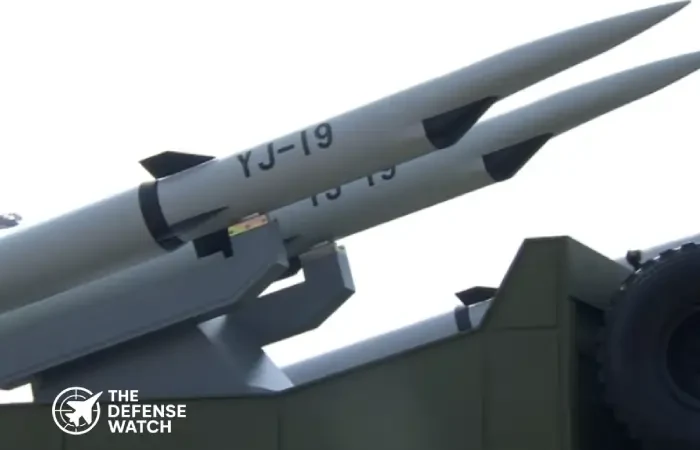
The YJ-19 marks a cutting‑edge leap in naval strike capability: an air-breathing hypersonic cruise missile presented publicly for the first time by the People’s Liberation Army Navy (PLAN) during China’s 2025 Victory Day Parade. Unlike traditional anti-ship weapons, YJ-19 leverages a scramjet engine, enabling sustained hypersonic flight that dramatically compresses reaction windows for adversary defenses.
Advanced Design & Purpose
Developed in China, the YJ-19 is purpose-built to engage high-value naval targets — such as surface combatants and aircraft carriers — as well as potential fixed land targets in contested maritime zones. Its status as an air‑breathing hypersonic cruise missile differentiates it from ballistic or boost‑glide missiles: once its onboard booster accelerates it to scramjet ignition speed, the missile transitions to sustained atmospheric cruise, offering both speed and maneuverability.
The missile’s slender fuselage and small diameter point to compatibility with standard 533 mm submarine torpedo tubes, suggesting submarine-launched deployment in addition to ship or land-based launch options — a design choice that enhances stealth and survivability of its launch platforms.
Capabilities & Threat Profile
While official performance metrics remain unconfirmed, open-source analysis indicates a cruise speed above Mach 5, with terminal acceleration potentially reaching Mach 10 — placing it firmly in the hypersonic regime. This speed, combined with in-flight maneuverability, makes interception by modern missile defense systems extremely challenging. The air-breathing propulsion reduces propellant burden, increasing potential range and flexibility for mid-course guidance adjustments.
Because the missile can be launched from submarines — including diesel-electric or nuclear-powered designs — YJ-19 offers the PLAN a deep‑sea standoff strike capability. This dual stealth-plus-speed profile could significantly complicate naval defense planning for any adversary operating in contested waters.
YJ-19 Hypersonic Missile Price
At present there is no publicly available credible price for the YJ-19 as it remains a military asset under national service only. Open‑source cost estimations do not exist; thus any price in U.S. dollars would be speculative and not meaningful for public reporting or procurement analysis.
Get real time update about this post category directly on your device, subscribe now.
Reviews
Disclaimer Note
The information provided on TheDefenseWatch.com is for general informational purposes only. While we strive to ensure the accuracy, completeness, and timeliness of our content regarding defense and aerospace products, technologies, and specifications, we cannot guarantee that all information is 100% accurate or up-to-date due to the evolving nature of military technology and classified data.TheDefenseWatch.com does not warrant the reliability, suitability, or availability of the information for any specific purpose. Users are advised to consult official sources, such as manufacturers, government publications, or defense agencies, for precise and verified data before making decisions based on our content.We are not affiliated with any defense manufacturers, governments, or military organizations mentioned. Opinions, reviews, and ratings reflect expert analysis but are subjective and should not be considered endorsements. TheDefenseWatch.com is not responsible for any errors, omissions, or consequences arising from the use of this website’s content.External links are provided for convenience and do not imply endorsement. TheDefenseWatch.com reserves the right to update or modify content without prior notice. By using this website, you agree to our Privacy & Cookies Policy.


New Arrivals



Popular Comparisons
-
 SIG XM7 Rifle vs M4: Key Differences and Performance Comparison
View Comparison →
SIG XM7 Rifle vs M4: Key Differences and Performance Comparison
View Comparison → -
Eurofighter Typhoon vs Rafale vs F-35: Fighter Jet Comparison
View Comparison →
-
J-20 vs F-22: Stealth Fighter Showdown Explained
View Comparison →
-
F-14 Tomcat vs Su-57: Can a Legend Challenge Russia’s Stealth Fighter?
View Comparison →
-
Su-35 vs Su-57: Russia’s Top Fighter Jets Compared
View Comparison →
-
Eurofighter Typhoon vs Su-57: Ultimate Fighter Jet Comparison
View Comparison →
-
Rafale vs Su-57: 4.5 Gen vs 5th Gen Fighter Jet Comparison
View Comparison →
-
Su-57 vs F-16 Fighting Falcon: Stealth vs Speed
View Comparison →
-
China vs Russia: J-20 Mighty Dragon vs Su-57 Felon Comparison
View Comparison →
-
Su-57 Felon vs F-22 Raptor: Stealth Air Superiority Face-Off
View Comparison →


- Iran-US Ceasefire Negotiations Stall as Strait of Hormuz Standoff Deepens

- US Deploys Uncrewed Drone Boats In Conflict With Iran As Maritime Tensions Escalate
- Raytheon Expands Alabama Missile Integration Facility To Boost U.S. Defense Production Capacity
- Australian-Built Boxer Combat Reconnaissance Vehicles Roll Off Production Line, Boosting Land 400 Program
- U.S. Army To Begin M1E3 Abrams Prototype Operational Testing In Summer 2026
- Raytheon Secures $773.5M Contract Boost For AN/TPY-2 Radar Development Through 2030
- Javelin Missile Production Ramp Accelerates as Lockheed Martin Overhauls Supply Chain for High-Volume Output
- Indian Army To Buy 800 Km Plus Range BrahMos Supersonic Cruise Missiles
- US Navy Iwo Jima Amphibious Ready Group Expands Caribbean Anti-Trafficking Push
- Chinas Laser Air Defense Systems Light Arrow 21A And Light Arrow 11E Form Layered Counter Drone Shield