- Home
- Catalog
- Aircraft Carriers
- USS Nimitz Aircraft Carrier
USS Nimitz Aircraft Carrier
Full Specifications
1. Physical Characteristics
| Ship Type | Aircraft Carrier |
| Class | Nimitz-class |
| Length | 333 m |
| Beam (Width) | 41 m |
| Flight Deck Width | 76 m |
| Draft | 11.3 m |
| Displacement (Full Load) | 100,000+ tons |
2. Propulsion & Performance
| Propulsion Type | Nuclear |
| Powerplant | 2 × A4W nuclear reactors |
| Shafts | 4 shafts |
| Maximum Speed | 30+ knots |
| Range | Unlimited |
| Endurance | 70–90 days at sea |
3. Flight Operations
| Aircraft Launch System | CATOBAR |
| Catapult Type | Steam |
| Recovery System | Arresting gear |
| Total Aircraft Capacity | 60–75 aircraft |
| Hangar Capacity | Full-length hangar |
| Aircraft Types Supported | Fighters, AEW, EW, ASW helos |
4. Sensors & Electronics
| Primary Radar | 3D air-surveillance radar |
| Navigation Radar | Standard naval navigation radar |
| Fire Control Radar | Supports Sea Sparrow & CIWS |
| Electronic Warfare Suite | ESM/ECM jammers and countermeasures |
| Communication Systems | SATCOM, Link-16 |
5. Weapons & Defense Systems
| CIWS | Phalanx CIWS |
| Short-Range SAMs | RAM, NATO Sea Sparrow |
| Missile Launchers | Limited surface-defense |
| Decoy Systems | Chaff, flares, EW decoys |
6. Command & Control
| Combat Management System | Integrated U.S. Navy CMS |
| Combat Information Center (CIC) | Central shipboard operations hub |
| Air Operations Center | Oversees flight operations |
| Data Links | Tactical & satellite systems |
7. Crew & Capacity
| Ship Crew | ~3,000 |
| Air Wing Personnel | ~1,500 |
| Total Complement | ~5,000+ |
8. Construction & Cost
| Shipbuilder/Manufacturer | Newport News Shipbuilding (USA) |
| Construction Started | 1968 |
| Commissioned | 1975 |
| Estimated Cost | ~$5B (original era cost) |
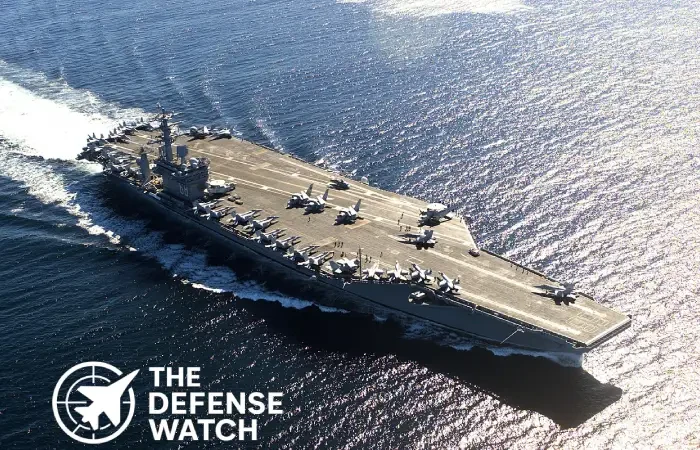
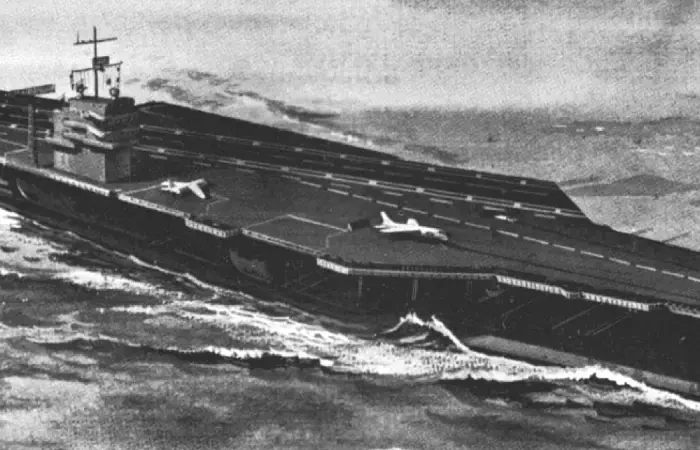
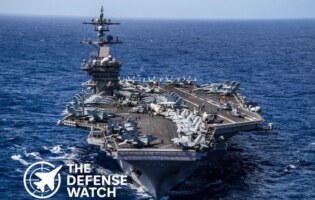
The USS Nimitz (CVN-68) stands as one of the most recognizable symbols of American naval power, serving as the lead ship of the U.S. Navy’s legendary Nimitz-class carriers. Commissioned in 1975 and built by Newport News Shipbuilding, the Nimitz pioneered the modern era of nuclear-powered supercarriers—combining massive air wing capacity, long-endurance operations, and advanced command-and-control systems suitable for sustained high-intensity missions.
Designed for power projection, sea control, and rapid global response, the USS Nimitz leverages a pair of A4W nuclear reactors that provide virtually unlimited range, enabling continuous deployments without refueling for over two decades. Her immense deck layout supports CATOBAR (catapult-assisted takeoff but arrested recovery) operations using steam catapults and arresting gear, launching aircraft such as the F/A-18E/F Super Hornet, E-2D Hawkeye, EA-18G Growler, and MH-60 helicopters.
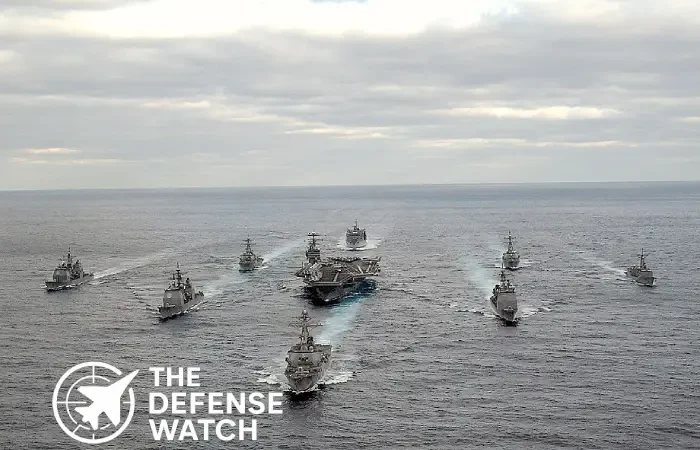
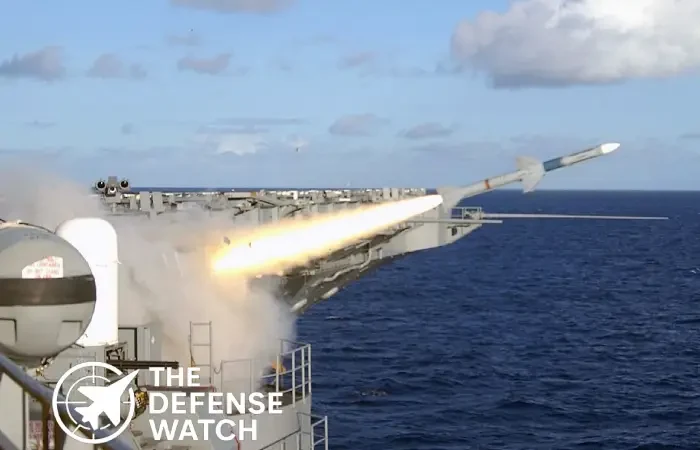
With a full-load displacement exceeding 100,000 tons, the carrier accommodates more than 5,000 personnel, including ship crew, air wing, and command staff. The Nimitz integrates layered self-defense systems—such as Phalanx CIWS, Rolling Airframe Missile (RAM), and NATO Sea Sparrow—to counter airborne and surface threats. A suite of long-range air-surveillance radars, electronic warfare systems, and secure communication networks enhances situational awareness across complex maritime environments.
Throughout her decades of service, the USS Nimitz Aircraft Carrier has supported major U.S. operations worldwide, from the Indian Ocean during the Iran Hostage Crisis to carrier air strikes in Iraq, Afghanistan, and the Pacific. Though newer Ford-class carriers are replacing earlier designs, the Nimitz remains a fully capable frontline asset, demonstrating the durability and adaptability of U.S. carrier technology.
FAQs
The USS Nimitz is one of the most powerful warships ever built. As a nuclear-powered supercarrier, it can operate for over 20 years without refueling, carry 60–75 aircraft, and sustain high-tempo flight operations. Its defensive suite—including Phalanx CIWS, RAM, and Sea Sparrow missiles—combined with advanced radar and electronic warfare systems, ensures formidable air and surface defense, making it a key instrument of U.S. global power projection.
The carrier is named after Fleet Admiral Chester W. Nimitz, who served as Commander in Chief of the U.S. Pacific Fleet during World War II. Admiral Nimitz played a pivotal role in the Pacific theater, overseeing major naval operations against Japan, including the decisive Battle of Midway. Naming the carrier after him honors his legacy and leadership in naval history.
Yes. The USS Nimitz is scheduled for eventual decommissioning as newer Ford-class aircraft carriers enter service. However, as of now, it remains fully operational and continues to conduct deployments and training missions worldwide. Decommissioning is a long-term process, and the Nimitz is expected to serve the U.S. Navy for several more years before being retired.
Get real time update about this post category directly on your device, subscribe now.
Reviews
Disclaimer Note
The information provided on TheDefenseWatch.com is for general informational purposes only. While we strive to ensure the accuracy, completeness, and timeliness of our content regarding defense and aerospace products, technologies, and specifications, we cannot guarantee that all information is 100% accurate or up-to-date due to the evolving nature of military technology and classified data.TheDefenseWatch.com does not warrant the reliability, suitability, or availability of the information for any specific purpose. Users are advised to consult official sources, such as manufacturers, government publications, or defense agencies, for precise and verified data before making decisions based on our content.We are not affiliated with any defense manufacturers, governments, or military organizations mentioned. Opinions, reviews, and ratings reflect expert analysis but are subjective and should not be considered endorsements. TheDefenseWatch.com is not responsible for any errors, omissions, or consequences arising from the use of this website’s content.External links are provided for convenience and do not imply endorsement. TheDefenseWatch.com reserves the right to update or modify content without prior notice. By using this website, you agree to our Privacy & Cookies Policy.
New Arrivals

Popular Comparisons
-
 SIG XM7 Rifle vs M4: Key Differences and Performance Comparison
View Comparison →
SIG XM7 Rifle vs M4: Key Differences and Performance Comparison
View Comparison → -
Eurofighter Typhoon vs Rafale vs F-35: Fighter Jet Comparison
View Comparison →
-
J-20 vs F-22: Stealth Fighter Showdown Explained
View Comparison →
-
F-14 Tomcat vs Su-57: Can a Legend Challenge Russia’s Stealth Fighter?
View Comparison →
-
Su-35 vs Su-57: Russia’s Top Fighter Jets Compared
View Comparison →
-
Eurofighter Typhoon vs Su-57: Ultimate Fighter Jet Comparison
View Comparison →
-
Rafale vs Su-57: 4.5 Gen vs 5th Gen Fighter Jet Comparison
View Comparison →
-
Su-57 vs F-16 Fighting Falcon: Stealth vs Speed
View Comparison →
-
China vs Russia: J-20 Mighty Dragon vs Su-57 Felon Comparison
View Comparison →
-
Su-57 Felon vs F-22 Raptor: Stealth Air Superiority Face-Off
View Comparison →


- Pentagon Considers Second B-21 Raider Production Line To Accelerate U.S. Stealth Bomber Expansion

- France Unveils 78,000-Ton Nuclear Aircraft Carrier France Libre With 40-Aircraft Capacity
- L3Harris Wins $77.8M U.S. Navy Contract for Kineto Tracking Mount Sustainment
- US Navy Awards $15.38B Columbia-Class Submarine Contract To Strengthen Nuclear Deterrent
- China Surges Production Capacity For J-20 And J-35 Stealth Fighters As Beijing Expands Fifth-Generation Fleet
- Netanyahu Announces Elimination Of Senior Iranian Figures In Air Campaign
- US Bombers Avoid European Airspace On Iran Bombing Runs In Strategic Route Shift
- Japan’s EC-2 Electronic Warfare Jet Completes First Flight, Expanding Standoff Jamming Capabilities
- NASA’s X-59 Quiet Supersonic Jet Gears Up for Second Flight — A Giant Leap Toward Silent Boom AviationNASA X-59 Second Flight: Supersonic Aviation Reborn
- US Weapons Shipments to Taiwan Unaffected by Iran War, Officials Confirm