- Home
- Catalog
- Tanks & Armored Vehicles
- T 72 Battle Tank
T 72 Battle Tank
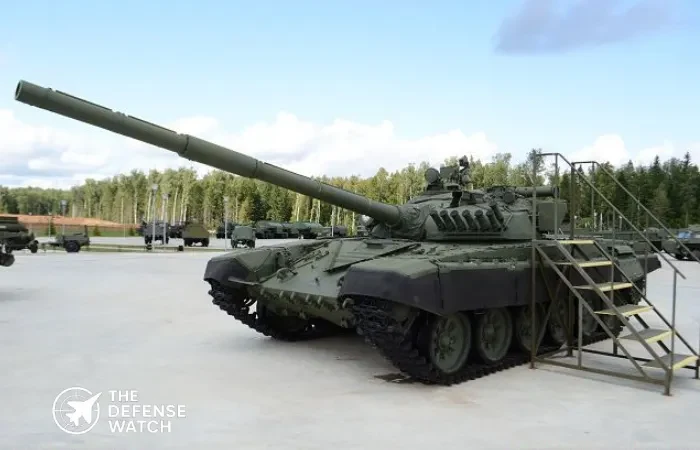
Full Specifications
1. General Information
| Vehicle Name | T 72 |
| Type / Role | Main Battle Tank |
| Manufacturer | Uralvagonzavod |
| Country of Origin | Soviet Union Russia |
| In Service | Yes |
| Year Introduced | 1973 |
| Unit Cost | USD 0.5 to 2 mil |
| Crew | 3 |
2. Dimensions & Weight
| Length (Gun Forward) | 9.53 m |
| Width | 3.59 m |
| Height | 2.23 m |
| Weight | 41 tons |
| Ground Clearance | 0.49 m |
| Chassis Material | Steel armor base |
3. Performance
| Engine Type | Diesel |
| Engine Power | 780 hp |
| Power-to-Weight Ratio | 19 hp per ton |
| Transmission | Manual |
| Maximum Speed (Road) | 60 km per hour |
| Maximum Speed (Off-Road) | 460 km |
| Operational Range | Torsion bar |
4. Armament
| Main Gun | 125 mm 2A46 smoothbore |
| Ammunition Capacity | 39 to 45 rounds (variant dependent) |
| Secondary Armament | 7.62 mm PKT coaxial MG, 12.7 mm NSVT or Kord HMG |
| Gun Elevation/Depression | plus 14 degrees, minus 6 degrees |
| Fire Control System | Optical FCS with laser rangefinder, digital FCS on upgraded variants |
| Stabilization | Dual axis gun stabilizer |
| Rate of Fire | 6 to 8 rounds per minute (autoloaded) |
5. Protection & Armor
| Armor Type | Steel composite |
| Reactive Armor | Optional ERA |
| NBC Protection | Yes |
| Smoke Grenade Launchers | Yes |
| Fire Suppression System | Automatic |
6. Mobility & Capability
| Maximum Gradient | 60 percent |
| Trench Crossing | 2.8 m |
| Fording Depth | 1.2 m |
| Amphibious Capability | No |
7. Sensors & Electronics
| Thermal Imaging | Optional upgrades |
| Night Vision | Infrared |
| Laser Rangefinder | Yes |
| Communication System | Tactical radio |
8. Operational Info
| Service Branch | Army |
| Primary Operator | Russia, Ukraine, India, Iraq |
| Combat Experience | Middle East, Eastern Europe |
| Upgrade Packages | T 72B3 and export variants |
| Production Status | Modernization ongoing |
PROS
- Proven combat history across multiple regions
- Simple mechanical design supports easy maintenance
- Autoloader reduces crew size
- Large global supply of spare parts
- Adaptable to modern upgrade packages
CONS
- Limited crew protection in older variants
- Autoloader ammunition placement increases risk
- Weaker situational awareness than modern NATO tanks
- Aging armor design without upgrades
- Less effective against advanced active protection systems
T 72 Main Battle Tank
The T 72 main battle tank remains one of the most recognized armored vehicles of the Cold War era and beyond. First introduced in the early 1970s, it was built to give Soviet armored units a reliable, mass producible tank that balanced firepower, protection, and mobility. Over time, the T 72 gained a long combat record across the Middle East, Europe, Asia, and Africa, shaping how armored warfare evolved in lower and mid intensity conflicts.
Development, Origin, and Purpose
Developed by Uralvagonzavod in the Soviet Union, the T 72 was designed as a simpler and cheaper alternative to the T 64. Its purpose was clear, equip large armored formations with a tank that could be produced quickly, maintained in harsh conditions, and operated by conscript crews. This philosophy helped make the T 72 one of the most widely exported tanks in history, with Russia and dozens of allied nations fielding local variants.
Firepower and Battlefield Capability
The T 72 is armed with a 125 mm smoothbore main gun supported by an autoloader, allowing a smaller crew of three. It can fire armor piercing, high explosive, and guided anti tank rounds. Secondary weapons include a coaxial machine gun and a roof mounted heavy machine gun. With a top road speed of about 60 km per hour and a range near 460 km, the tank is built for rapid armored thrusts and defensive holding actions.
Protection, Upgrades, and Modern Use
Early models relied on steel armor, while later versions added composite layers and explosive reactive armor. Modern upgrades include thermal sights, digital fire control systems, and improved engines. Despite losses in recent conflicts, upgraded T 72 variants continue to serve due to low cost, large inventories, and steady modernization programs.
T 72 Battle Tank Price
The T 72 Main Battle Tank does not have an official U.S. market price, as it is not sold to U.S. forces. Export and refurbished units typically range from USD 0.5 to 2 million, depending on condition and upgrade level.
Get real time update about this post category directly on your device, subscribe now.
Reviews
Disclaimer Note
The information provided on TheDefenseWatch.com is for general informational purposes only. While we strive to ensure the accuracy, completeness, and timeliness of our content regarding defense and aerospace products, technologies, and specifications, we cannot guarantee that all information is 100% accurate or up-to-date due to the evolving nature of military technology and classified data.TheDefenseWatch.com does not warrant the reliability, suitability, or availability of the information for any specific purpose. Users are advised to consult official sources, such as manufacturers, government publications, or defense agencies, for precise and verified data before making decisions based on our content.We are not affiliated with any defense manufacturers, governments, or military organizations mentioned. Opinions, reviews, and ratings reflect expert analysis but are subjective and should not be considered endorsements. TheDefenseWatch.com is not responsible for any errors, omissions, or consequences arising from the use of this website’s content.External links are provided for convenience and do not imply endorsement. TheDefenseWatch.com reserves the right to update or modify content without prior notice. By using this website, you agree to our Privacy & Cookies Policy.
More Products from UralVagonZavod (UVZ)
New Arrivals
Popular Comparisons
-
 SIG XM7 Rifle vs M4: Key Differences and Performance Comparison
View Comparison →
SIG XM7 Rifle vs M4: Key Differences and Performance Comparison
View Comparison → -
Eurofighter Typhoon vs Rafale vs F-35: Fighter Jet Comparison
View Comparison →
-
J-20 vs F-22: Stealth Fighter Showdown Explained
View Comparison →
-
F-14 Tomcat vs Su-57: Can a Legend Challenge Russia’s Stealth Fighter?
View Comparison →
-
Su-35 vs Su-57: Russia’s Top Fighter Jets Compared
View Comparison →
-
Eurofighter Typhoon vs Su-57: Ultimate Fighter Jet Comparison
View Comparison →
-
Rafale vs Su-57: 4.5 Gen vs 5th Gen Fighter Jet Comparison
View Comparison →
-
Su-57 vs F-16 Fighting Falcon: Stealth vs Speed
View Comparison →
-
China vs Russia: J-20 Mighty Dragon vs Su-57 Felon Comparison
View Comparison →
-
Su-57 Felon vs F-22 Raptor: Stealth Air Superiority Face-Off
View Comparison →


- Pentagon Considers Second B-21 Raider Production Line To Accelerate U.S. Stealth Bomber Expansion

- France Unveils 78,000-Ton Nuclear Aircraft Carrier France Libre With 40-Aircraft Capacity
- L3Harris Wins $77.8M U.S. Navy Contract for Kineto Tracking Mount Sustainment
- US Navy Awards $15.38B Columbia-Class Submarine Contract To Strengthen Nuclear Deterrent
- China Surges Production Capacity For J-20 And J-35 Stealth Fighters As Beijing Expands Fifth-Generation Fleet
- Netanyahu Announces Elimination Of Senior Iranian Figures In Air Campaign
- US Bombers Avoid European Airspace On Iran Bombing Runs In Strategic Route Shift
- Japan’s EC-2 Electronic Warfare Jet Completes First Flight, Expanding Standoff Jamming Capabilities
- NASA’s X-59 Quiet Supersonic Jet Gears Up for Second Flight — A Giant Leap Toward Silent Boom AviationNASA X-59 Second Flight: Supersonic Aviation Reborn
- US Weapons Shipments to Taiwan Unaffected by Iran War, Officials Confirm