- Home
- Catalog
- Missiles & Precision Weapons
- Standard Missile-3
Standard Missile-3
Full Specifications
1. General Information
| Name / Designation | RIM-161 Standard Missile-3 (SM-3) |
| Type / Role | Ballistic Missile Defense Interceptor |
| Country of Origin | United States |
| Manufacturer | Raytheon Missiles and Defense (RTX) |
| Service Entry / Year Introduced | 2004 |
| Operational Status | Active |
2. Performance & Range
| Range | 700+ km engagement range |
| Speed | Mach 10+ |
| Ceiling / Altitude Limit | 1,000+ km exo-atmospheric intercept capability |
| Accuracy (CEP) | Direct hit kinetic interception |
| Warhead Type | Kinetic Energy Warhead (Non-Explosive) |
3. Guidance & Targeting
| Guidance System | INS, GPS, Infrared Seeker |
| Targeting Mode | Fire-and-Forget |
| Launch Platform Compatibility | Naval Vessels, Aegis Ashore |
| Seeker Type | Infrared Homing |
4. Physical Characteristics
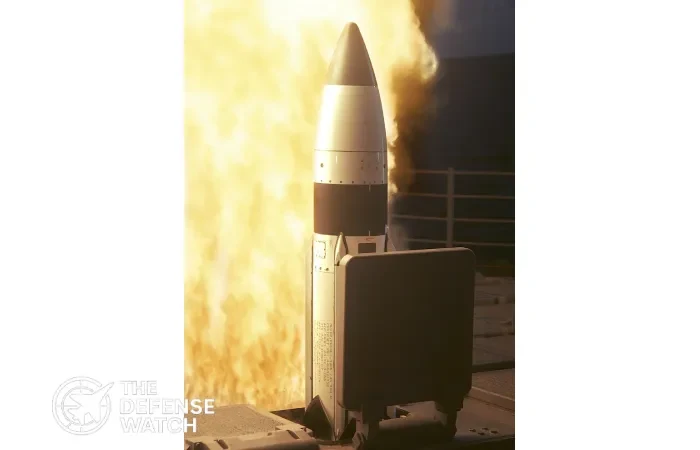
| Length | 6.55 m (varies by variant) |
| Diameter | 0.34 m booster section |
| Wingspan | Not applicable |
| Launch Weight | Approx. 1,500 kg |
| Propulsion | Three-stage Solid-fuel Rocket |
5. Warhead & Payload
| Warhead Weight | Approx. 23 kg kinetic vehicle |
| Explosive Type | None (Kinetic Impact) |
| Detonation Mechanism | Direct Impact |
| Payload Options | Kinetic Kill Vehicle |
6. Operational Use & Capabilities
| Operational Range Type | Long |
| Deployment Platform | Sea, Land |
| Target Types | Short to Intermediate Range Ballistic Missiles |
| Combat Proven | Yes |
| Users / Operators | United States, Japan, NATO Allies |
PROS
- Proven hit to kill interception capability
- Integrated with Aegis BMD combat system
- Capable of exo-atmospheric intercepts
- Deployed on mobile naval platforms
- Strengthens allied missile defense networks
CONS
- High unit procurement cost
- Limited effectiveness against advanced hypersonic threats
- Requires sophisticated radar and tracking support
- Dependent on Aegis system compatibility
- Inventory numbers constrained by production cost
Standard Missile-3 SM-3 Ballistic Missile Interceptor
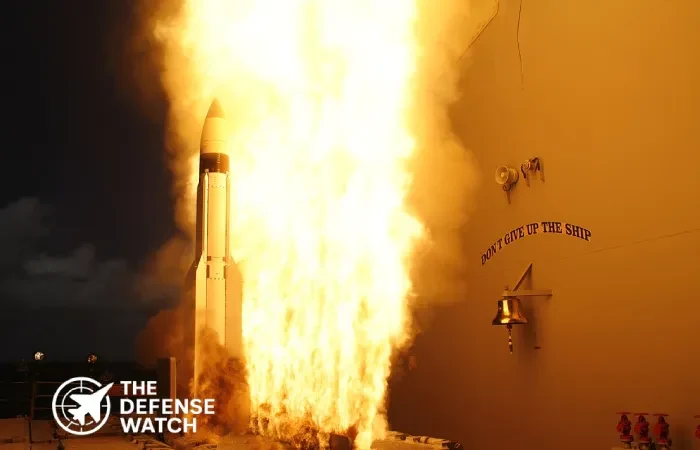
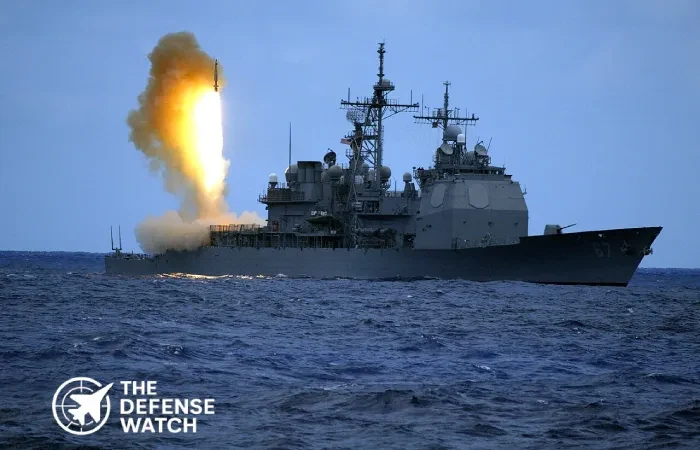
The Standard Missile-3, commonly known as SM-3, is a ship based ballistic missile interceptor developed to counter short to intermediate range ballistic missile threats. Designed for exo-atmospheric engagements, the SM-3 forms a core element of the U.S. Navy Aegis Ballistic Missile Defense system. It uses hit to kill technology, destroying incoming missiles through kinetic energy rather than an explosive warhead.
SM-3 interceptors are deployed aboard Aegis equipped cruisers and destroyers, as well as at Aegis Ashore sites in Europe. The missile plays a central role in layered missile defense strategies, protecting U.S. forces, allied territories, and critical infrastructure.
Manufacturer
The SM-3 is produced by Raytheon Missiles and Defense, now part of RTX Corporation, in partnership with Aerojet Rocketdyne for propulsion systems. The program is managed under the U.S. Missile Defense Agency. Multiple variants exist, including the Block IA, IB, IIA, and IIB concepts, with the Block IIA co developed with Japan.
Speed
The SM-3 travels at speeds exceeding Mach 10, depending on the variant. Its high velocity enables rapid response against fast moving ballistic missile targets in midcourse flight.
Range
The interceptor has an operational engagement range exceeding 700 kilometers, with advanced variants capable of intercepting targets at altitudes above 1,000 kilometers in space.
Cost / Price
Unit cost varies by variant. The SM-3 Block IA and IB are estimated at roughly 9 to 12 million dollars per missile, while the larger Block IIA variant can exceed 20 million dollars per unit.
Get real time update about this post category directly on your device, subscribe now.
Reviews
Disclaimer Note
The information provided on TheDefenseWatch.com is for general informational purposes only. While we strive to ensure the accuracy, completeness, and timeliness of our content regarding defense and aerospace products, technologies, and specifications, we cannot guarantee that all information is 100% accurate or up-to-date due to the evolving nature of military technology and classified data.TheDefenseWatch.com does not warrant the reliability, suitability, or availability of the information for any specific purpose. Users are advised to consult official sources, such as manufacturers, government publications, or defense agencies, for precise and verified data before making decisions based on our content.We are not affiliated with any defense manufacturers, governments, or military organizations mentioned. Opinions, reviews, and ratings reflect expert analysis but are subjective and should not be considered endorsements. TheDefenseWatch.com is not responsible for any errors, omissions, or consequences arising from the use of this website’s content.External links are provided for convenience and do not imply endorsement. TheDefenseWatch.com reserves the right to update or modify content without prior notice. By using this website, you agree to our Privacy & Cookies Policy.
New Arrivals


Popular Comparisons
-
 SIG XM7 Rifle vs M4: Key Differences and Performance Comparison
View Comparison →
SIG XM7 Rifle vs M4: Key Differences and Performance Comparison
View Comparison → -
Eurofighter Typhoon vs Rafale vs F-35: Fighter Jet Comparison
View Comparison →
-
J-20 vs F-22: Stealth Fighter Showdown Explained
View Comparison →
-
F-14 Tomcat vs Su-57: Can a Legend Challenge Russia’s Stealth Fighter?
View Comparison →
-
Su-35 vs Su-57: Russia’s Top Fighter Jets Compared
View Comparison →
-
Eurofighter Typhoon vs Su-57: Ultimate Fighter Jet Comparison
View Comparison →
-
Rafale vs Su-57: 4.5 Gen vs 5th Gen Fighter Jet Comparison
View Comparison →
-
Su-57 vs F-16 Fighting Falcon: Stealth vs Speed
View Comparison →
-
China vs Russia: J-20 Mighty Dragon vs Su-57 Felon Comparison
View Comparison →
-
Su-57 Felon vs F-22 Raptor: Stealth Air Superiority Face-Off
View Comparison →


- French Nuclear-Armed Rafale Fighters Could Operate From Belgium Under New Deterrence Plan

- Iranian Ballistic Missile Intercepted By NATO SM-3 In Eastern Mediterranean, Turkish Defense Ministry Confirms
- U.S. Air Force Tests Minuteman III ICBM With Multiple Reentry Vehicles In Routine Launch From Vandenberg
- European Investment Fund Commits €50 Million To InvestEU Defence Equity Facility, Backs Deeptech And Dual Use Capital Fund III
- US Submarine Sinks Iranian Warship In Indian Ocean, First Torpedo Kill Since World War II
- France Redeploys Charles De Gaulle Carrier Strike Group To Middle East As US Iran War Expands
- British F-35B Shoots Down Drone In First Operational Kill Over Jordan
- US Operation Epic Fury Strikes 2,000 Iranian Targets In First 100 Hours, CENTCOM Says
- Allen Control Systems Joins Red Cat Futures Initiative To Advance Autonomous Counter-Drone And Precision Defense Capabilities
- EU Defense Commissioner Calls FCAS Fighter Jet Project A Failure Amid Mounting Delays