- Home
- Catalog
- Attack & Multirole Drones (UAVs)
- Shahed-136 Drone
Shahed-136 Drone
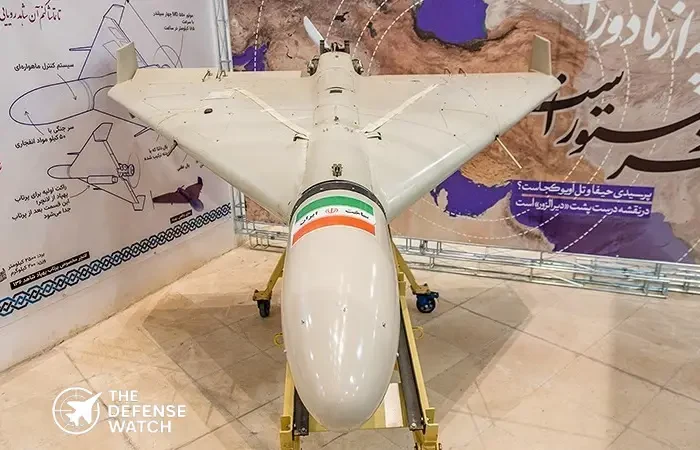
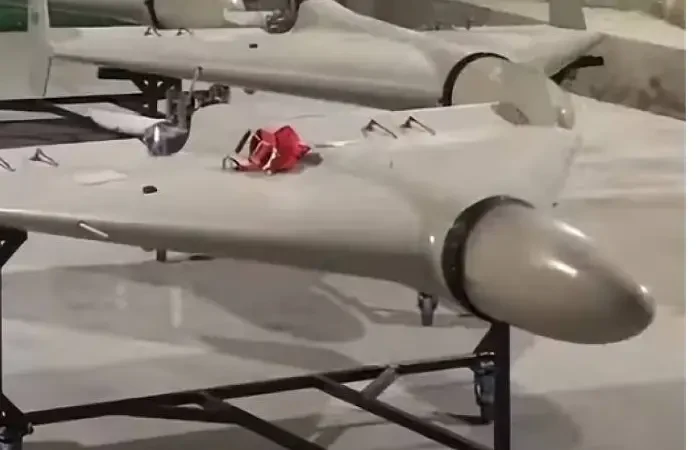
Full Specifications
1. General Information
| Name | Shahed-136 |
| Manufacturer | HESA (Iran) |
| Country of Origin | Iran/Russian |
| Type / Role | Loitering Munition / Kamikaze UAV |
| First Flight / Introduced | 2020 (approx.) |
| Status | In Service (Russia/Iran) |
| Unit Cost | USD $20,000–40,000 (Estimated) |
2. Performance
| Maximum Speed | ~185 km/h |
| Cruise Speed | ~150 km/h |
| Operational Range | 1,000–2,000 km |
| Endurance | 6–8 hours |
| Service Ceiling | Low-altitude flight |
| Rate of Climb | Not publicly disclosed |
3. Dimensions
| Length | ~3.5 m |
| Wingspan | ~2.5 m |
| Height | ~0.5 m |
| Maximum Takeoff Weight (MTOW) | ~200 kg |
4. Payload & Armament
| Payload Capacity | ~30–50 kg explosive warhead |
| Hardpoints | None (integrated warhead) |
| Weapons | High-explosive fragmentation |
| Sensors | Basic navigation sensors |
| Avionics | GPS/INS Guidance |
5. Propulsion
| Engine Type | MD550/MD560 Piston Engine (variant) |
| Engine Power | Small piston output (est.) |
| Propeller Type | Two-Blade Pusher Propeller |
6. Communication & Control
| Control Type | Pre-programmed flight path |
| Data Link Range | Limited / One-way strike |
| Navigation | GPS / INS |
| Ground Control Station | Mobile launcher racks |
7. Operational Use
| Primary Users | Iran, Russia |
| Combat Proven | Yes |
| Notable Operations | Ukraine Conflict (Russia) |
PROS
- Long operational range for strategic strikes
- Low unit cost enabling mass deployment
- Simple design allows rapid manufacturing
- Effective in swarm attacks to saturate defenses
- Difficult to detect at long distances due to small RCS
CONS
- Limited accuracy compared to advanced Western systems
- Vulnerable to strong electronic jamming
- Single-use design limits versatility
- Prop-driven flight makes it relatively slow
- Ineffective against mobile or hardened targets
Shahed-136 Loitering Munition System
The Shahed-136 loitering munition has emerged as one of the most widely recognized kamikaze drones used in modern warfare. Originally developed by Iran and later supplied to Russian forces, the platform is designed for long-range precision strikes against fixed infrastructure, logistics hubs, and high-value targets. Its low cost, simplicity, and long-endurance flight profile have made it a significant component of Russia’s asymmetric strike capability.
Manufactured by Iran Aircraft Manufacturing Industrial Company (HESA), the Shahed-136 features a delta-wing layout with a rear-mounted pusher propeller and a small warhead integrated into the fuselage. While unsophisticated compared to Western loitering munitions, its mass-production design and swarm-deployment tactics have proven tactically challenging for defending forces. The drone typically cruises at relatively low speeds and altitudes, helping it evade radar and overwhelm air defenses when launched in large numbers.
Operational use by Russia has demonstrated its range—often estimated at 1,000–2,000 km depending on payload and launch method—allowing stand-off strikes from deep within Russian territory. Its warhead, roughly 30–50 kg, is optimized for damaging infrastructure such as power stations, ammunition depots, fuel facilities, and command posts. Navigation relies on commercial-grade satellite guidance blended with inertial systems, making it resistant to limited GPS disruption but still vulnerable to stronger jamming.
Shahed-136 Drone Price
In the U.S. defense analysis community, the Shahed-136 is often highlighted for its low production cost—reportedly tens of thousands of dollars per unit—significantly cheaper than most interceptors used to defeat it. This cost asymmetry has driven renewed focus on counter-UAS technologies, including electronic warfare, short-range air defense, and directed-energy systems.
Get real time update about this post category directly on your device, subscribe now.
Reviews
Disclaimer Note
The information provided on TheDefenseWatch.com is for general informational purposes only. While we strive to ensure the accuracy, completeness, and timeliness of our content regarding defense and aerospace products, technologies, and specifications, we cannot guarantee that all information is 100% accurate or up-to-date due to the evolving nature of military technology and classified data.TheDefenseWatch.com does not warrant the reliability, suitability, or availability of the information for any specific purpose. Users are advised to consult official sources, such as manufacturers, government publications, or defense agencies, for precise and verified data before making decisions based on our content.We are not affiliated with any defense manufacturers, governments, or military organizations mentioned. Opinions, reviews, and ratings reflect expert analysis but are subjective and should not be considered endorsements. TheDefenseWatch.com is not responsible for any errors, omissions, or consequences arising from the use of this website’s content.External links are provided for convenience and do not imply endorsement. TheDefenseWatch.com reserves the right to update or modify content without prior notice. By using this website, you agree to our Privacy & Cookies Policy.
New Arrivals


Popular Comparisons
-
 SIG XM7 Rifle vs M4: Key Differences and Performance Comparison
View Comparison →
SIG XM7 Rifle vs M4: Key Differences and Performance Comparison
View Comparison → -
Eurofighter Typhoon vs Rafale vs F-35: Fighter Jet Comparison
View Comparison →
-
J-20 vs F-22: Stealth Fighter Showdown Explained
View Comparison →
-
F-14 Tomcat vs Su-57: Can a Legend Challenge Russia’s Stealth Fighter?
View Comparison →
-
Su-35 vs Su-57: Russia’s Top Fighter Jets Compared
View Comparison →
-
Eurofighter Typhoon vs Su-57: Ultimate Fighter Jet Comparison
View Comparison →
-
Rafale vs Su-57: 4.5 Gen vs 5th Gen Fighter Jet Comparison
View Comparison →
-
Su-57 vs F-16 Fighting Falcon: Stealth vs Speed
View Comparison →
-
China vs Russia: J-20 Mighty Dragon vs Su-57 Felon Comparison
View Comparison →
-
Su-57 Felon vs F-22 Raptor: Stealth Air Superiority Face-Off
View Comparison →


- Russian KOMETA-M Found In Iranian Shahed-136 Drone After Attack On UK Akrotiri Base

- TP400-D6 Programme Reaches 1 Million Engine Flying Hours, Marking Major Milestone For Europrop International
- Qatar International Media Office Responds To Bloomberg Article, Rejects Allegations
- US Central Command Says Iranian Navy Eliminated In Gulf Of Oman Strikes
- How Hermeus Quarterhorse Mk 2.1’s First Flight Advances America’s Race to Field Reusable Supersonic Drones
- TKMS Signs Pan Canadian Indigenous Agreements For Canadian Patrol Submarine Project
- GE9X Becomes Most Powerful Commercial Jet Engine After 27,000 Test Cycles
- General Atomics Wins $35.3M MQ-9A Support Contract For Netherlands
- Northrop Grumman Secures $225M E-130J Training Systems Contract For Navy Take Charge And Move Out Program
- U.S. Precision Strike Destroys Iranian Tor-M1 Air Defense System in Major Operation